

#On the Seventh Ward
"Stamped mercy still burns." — saying of the Cinder Markets, San Vesta
The Scorch-Cure Infirmary of the Ember-Priory of San Vesta keeps seven wards, two quarantine blocks and a surgery cut into the basalt undercroft. It lies one terrace below the Great Ovens. The volcanic heat reaches it second-hand and still arrives too warm. Six of those wards cure what the Church expects cured, at the pace the Church expects. The seventh is the experimental wing. Its keeper is Sister-Physic Marra Vell. Every ledger that has troubled to count its output records that output as recovery.
Readers who have served in the north should put a different room out of mind. Bastion-Irongate keeps a Ward Seven of its own among its Breatheries, a lung clinic of bleach, mint and plague panic. The two share a numeral and nothing else worth filing. Irongate's ward fills with men who cannot breathe. San Vesta's discharges men who breathe perfectly well and who differ, in particulars the forms cannot name, from the men it admitted.
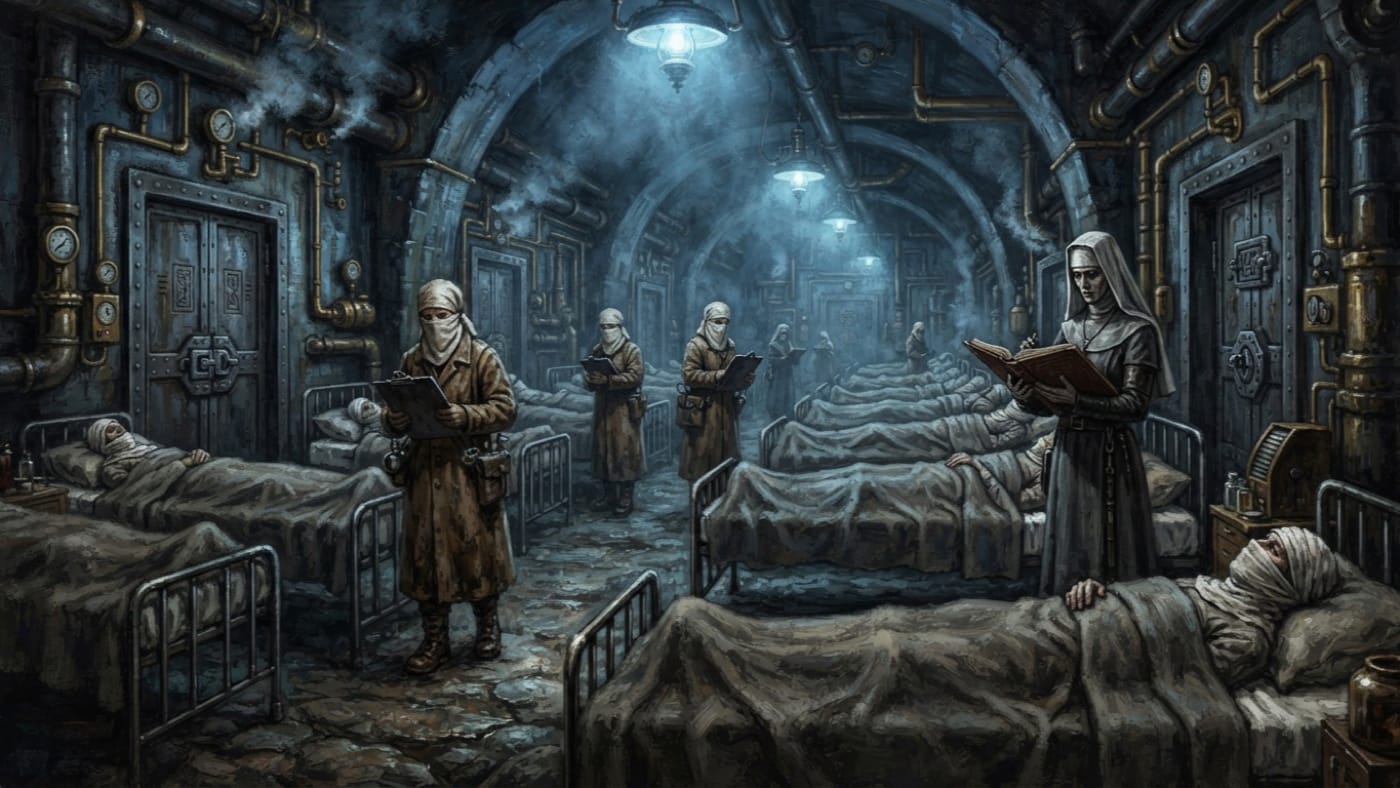
By night the ward burns blue-white, as the whole infirmary does. The antiseptic smoke is held at the density the Sister-Physics prescribe. There are iron cots. The basalt sweats heat into the linen, and white-ash veils move between the beds at the hour of ward confession. Chaplain and physician share a pen. Symptoms go down in a notation halfway between clinical charting and confession transcript, so a fever and a fault are written in one hand and kept in one drawer. Nobody has asked the Bureau of Records to separate them. It would decline.
#On Vell and the Permission to Treat
Sister-Physic Vell speaks in dosages. Greetings, refusals and remarks on the weather all come out of her as quantities. Her eyes do not blink near open flame. Her orderlies say this is the habit of a woman who has worked for years in rooms where the air itself can ignite once the ash-content passes a threshold. They say she has memorised that threshold and refuses to write it down. The explanation is theirs. The Sister-Physic has offered none, and I have learned not to ask a woman who measures her silences in grains to account for them.
Her power is practical, and so it is real. She holds cures and she holds triage lists. In a priory where a man's place on the list decides whether he is treated this week or buried next, the list is the sharper instrument. Those who believe a Sister-Physic is merely a nurse with a better veil have never needed a bed at San Vesta.
She does not govern the priory. San Vesta is ruled by its tri-compact of Priorate Council, Infirmary Tribunal and Oven Quartermastery. The Quartermastery holds the flour and has no seal over a single dose. Experiment answers to a different trinity. Under the dispensation Innovation Permitted Under Stamp, a procedure begins as a written proposal. The Infirmary Tribunal reviews it and the Priorate Council approves it. Both stamp it. The regional office of the Bureau of Alchemical Standards counter-stamps it, and the Ledger Cloisters file it in triplicate. Only then may a flame be lit or a patient touched. A physician who reverses that order is reclassified as a heretical operative. The Bureau of Doctrine has never been known to reverse a reclassification out of sympathy.
The proposals record what Ward Seven administers under those seals, and I do not. No protocol, compound or schedule particular to the ward has reached my desk. I know what the infirmary practises at large: conventional medicine; graduated volcanic heat in sealed chambers; antiseptic smoke; and the theory, held with liturgical confidence, that heat suppresses infection. I know the theory is held. I have not watched it proved.
#On Variant Convalescence
The Bureau of Alchemical Standards calls Ward Seven's recovery rates "statistically notable." It has not published the statistics. I have seen no rate, no comparison with the six lesser wards, no count of the dead and no number of patients. "Notable" is the Bureau's highest praise. It is also the word the Bureau uses for an anomaly it intends to watch. That the two meanings share one word is the Bureau's design.
Most of the ward's patients recover. Some of them recover wrong. The reports describe three manifestations, and I enter them separately because they are separate.
First, the walk. Patients leave Ward Seven walking differently. The step that crosses the infirmary threshold is not the step recorded beside the intake slip, and men who knew the patient before admission notice it first.
Second, the speech. These patients pause in unfamiliar places. A sentence breaks where the man never used to break it, like a reader stumbling at the line-end of a borrowed breviary.
Third, and least convenient, the memory. Some patients remember things that happened to other people. The orderlies say only that the memories are wrong. Whose they are, how they came, and whether any one of them could be traced to its owner have not been established by any office I have consulted. I do not intend to establish it here by eloquence.
Each office has its own name for the condition. The Tribunal's term is variant convalescence. In Vell's notation it is atypical recovery patterns. The orderlies, who have to change the linen, speak of patients waking up with the wrong memories. None of the three phrases states a cause. Each tells you what its author can afford to say. The ward's own lore, as repeated on the lower terraces, holds that what Sister-Physic Vell fears is no death on her lists but a patient who improves wrong.
The forms do not share her fear. The fever has broken, the wound has closed and the chest is clear. Every column of the discharge form is satisfied, and the patient is entered as recovered. That is what recovery means at San Vesta: a body fit to be returned to the ledger.
#On Discharge and Quarantine
The Tribunal decides when a patient is well. That decision begins the debt. Every patient cured at San Vesta owes recovery service: labour shifts in the ovens, the canalworks, the kilns or the dormitories, kept up until the ledger says the body is paid. The infirmary's published tariffs are illustrative and apply to the whole house. A broken arm costs three weeks and a lung infection six. A full scorch-cure for advanced trench-fever costs a year. The year begins when the Tribunal says the patient is well, which need not be when the patient feels well. I have found no separate tariff for Ward Seven in the record. Ordinary recovery service ends when its term is paid. The lifelong oath belongs to the resurrection-bread and its debtors, and it should not be imported onto Vell's beds.
The priory calls medical discharge into labour conscription friendly severance. The friendliness belongs to the ledger.
Around this machinery the usual commerce gathers. Cure priority can be bought, and counterfeit triage slips pass hand to hand in the Cinder Markets. One instrument is never offered for sale, and that is the relapse exemption. The Tribunal alone may grant it. A patient counted as recovered owes his shifts, however differently he walks to them.
When a ward shows atypical recovery patterns, the Tribunal locks it down. Quarantine writs are issued, ward bracelets are checked against the lists, and the doors close under a seal the infirmary staff cannot break. At that point the Cool Mask Brotherhood becomes relevant. It calls itself a respiratory charity. Through the Ash Canalworks and the lava-tube underpaths beneath them, it moves medicine and people out of the quarantine zones. My papers record no extraction from Ward Seven by name, no route from its doors, no arrangement with its Sister-Physic and no count of patients missing from its cots. They record only that the tunnels exist and that the Tribunal's locks invite people to use them.
The Bureau of Mercy described San Vesta's infirmary as "a model of compassionate efficiency."
The Bureau of Mercy has revised its assessment of the infirmary as a whole. The current classification is "efficient." The adjective was removed after an internal audit in A.S. 199, and the audit's findings remain sealed. I do not know whether they mention Ward Seven. I have been told that asking is itself an entry.
#On the Present Condition
As the survey of A.S. 201 records, San Vesta is a priory at the edge of its own dispensation. Pilgrim intake has tripled in four years. The dormitories overflow into the cloisters and the markets. Demand for treatment outruns the beds, and the Tribunal's restrictions on resurrection-bread push more of the desperate toward the infirmary doors. All of the priory's labour runs on bodies that owe: the ovens, the canalworks, the kilns, and the dormitories, which need tending as badly as the rest.
In that arithmetic, Ward Seven is the most productive room on the lower terraces. It returns workers to the schedule at a rate the Bureau of Alchemical Standards calls notable. Its patients stoke, rake, sift and haul. Some of them stoke with a stride their mothers would not know. Some break their sentences at strange places, and some remember a kitchen, a harbour or a funeral that belonged to somebody else. The Tribunal enters all of them as recovered, because by every column it keeps they are.
Sister-Physic Vell continues to speak in dosages. Her lists continue to decide the order of the sick. Her eyes do not leave the flame.