

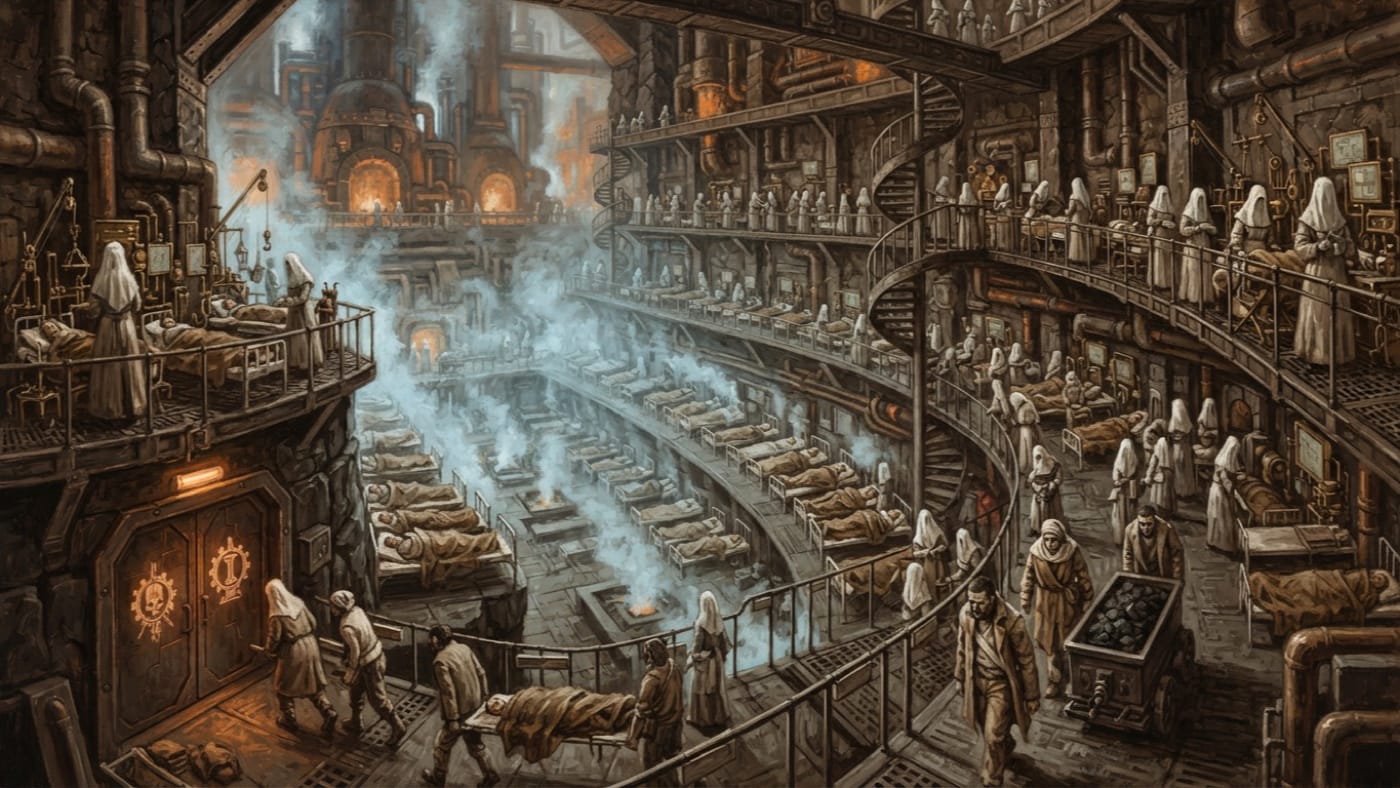
#On the Wards and Their Heat
The iron cots of the Scorch-Cure Infirmary are never cold. A convalescent who takes hold of the frame will find the rail as warm as a censer chain after Vespers. The linen under him is faintly singed wherever it has lain too long against the basalt. This is by design. Everything at San Vesta is by design, including the parts that went wrong.
The infirmary occupies the lower terraces of the Ember-Priory of San Vesta, one terrace below the Great Ovens. The registry places it on the basalt rise of the Iberian Ember-Priories, in Zone 1/7. Its heat arrives second. The sealed vent beneath the priory gives its primary flow to the ovens, because bread is the priory's covenant with the Synod. Whatever is left goes down by channel to the wards and is spent on the sick. The order of allocation is a sermon in its own right. I recommend it to any novice who still imagines that the Church ranks souls above loaves.
There are seven wards, two quarantine blocks, and a surgery in the basalt undercroft, where the stone keeps the instruments warm. The priory's published survey calls the establishment the largest medical facility in the Iberian theater. I will not supply the figures a Rationalist would need to check the boast. Catwalks run above the cots so that the Sister-Physics, in their white-ash veils, can pass over the patients without going among them. A blue-white light comes off the antiseptic smoke. Soldiers, pilgrims, oven-hands with blistered forearms and canal-rakers with slag in their lungs lie in rows and sweat without pause. The sweat is also recorded.
#On the Scorch-Cure
The treatment that gives the house its name is easy to describe and impossible to audit. Patients are shut into sealed chambers and exposed to graduated volcanic warmth. The Sister-Physics watch them through the haze and write down whatever the heat draws out of them: fever, tremor, cough and sin. Their notation is half physician's chart and half confessor's transcript. A single column may hold a quickened pulse and an admitted theft, and nobody troubles to tell the two apart. Guilt is entered as dosage. Confession is entered as a treatment plan. The chaplain and the physician sign the same sheet.
The institution holds that warmth suppresses infection. It may be right. The priory's own published account says the surgery's heat suppresses infection "theoretically", and that word has never been withdrawn.
Ordinary medicine goes on underneath the ceremony. Orderlies set bones, drain wounds, change linen that has browned at the hem, and carry litters up and down the catwalk stairs at every watch. In the undercroft the surgeons cut with smoke at their shoulders and litany in their ears. The experimental work sits beside this ordinary labour under a separate stamp. It is conducted under the Doctrine of Acceptable Innovation, and in the Iberian theater San Vesta alone holds the dispensation for it.
Sister-Physic Marra Vell runs Ward Seven, the experimental wing. Her office ends at its door. She has never needed it to reach further, because she holds the cures and the triage lists, and the rest of the infirmary comes to her. She speaks in dosages and does not blink near flame. Her orderlies give a reason for this. They say she has memorised the ash-content at which the air of her ward will ignite and refuses to write the figure down. I record their explanation because nobody has offered another.
#On Recovery Service
The Infirmary Tribunal governs admission. It decides who is treated, in what order, on what terms and at what price. The price is labour. Every cure incurs recovery service, owed to the priory in shifts at the ovens, the canalworks, the kilns or the dormitories. The Tribunal sets the length according to the illness and the expense of treating it.
The published tariffs are short. A broken arm costs three weeks. A lung infection costs six. A full scorch-cure for advanced trench-fever costs a year, and the year begins when the Tribunal declares the patient well.
The local name for discharge is "friendly severance." One stroke of the pen severs the patient from the ward and fixes him to a labour roster. The friendliness lies in the absence of shackles. The Bureau of Records receives one line, transferred, and the ward has a cot free by Compline.
A patient may feel well and still be sick in the Ledger. Another may cough blood on the canal rail and be recovered in the Ledger. The two conditions need not meet, and the Tribunal has never pretended they must.
Priority can be bought. Everyone at San Vesta knows the cost of a better place on a triage list. Counterfeit triage slips are sold in the dormitories, small squares of paper that buy life by the inch. One thing cannot be bought, and that is a relapse exemption, which only the Tribunal may grant. Its terms are the Tribunal's business. I have not seen them in print.
The Tribunal sits in the priory's tri-compact alongside the Priorate Council and the Oven Quartermastery. Experimental permission takes a longer road. A proposal for Ward Seven must first pass Tribunal review. It then needs Priorate approval and the stamps of both bodies, and after that the counter-stamp of the regional office of the Bureau of Alchemical Standards. Finally it is filed in triplicate in the Ledger Cloisters, and only then may a patient be touched. Over all of it hangs Dispensation 77-V of the Bureau of Doctrine, most recently renewed in A.S. 194 (1904 CE). The physicians' review committee rotates every six months, so that no physician sits long enough to become either brilliant or dangerous. The Vent-Wardens below rotate every eight months. Neither schedule takes any account of the other.
#On Ward Seven and the Quarantine Blocks
"If the smoke writes you, don't read it." (Saying of the San Vesta terraces)
The Bureau of Alchemical Standards describes Vell's patients as recovering at "statistically notable" rates.
Some of them recover wrong. Patients discharged from Ward Seven have been seen walking with an altered gait. They pause mid-sentence in places their families do not recognise, and they recall, apparently sincerely, events from lives that were never theirs. The Tribunal calls this "variant convalescence." Vell's term is "atypical recovery patterns." The orderlies say that the patients wake up with the wrong memories. I set down all three accounts and certify none of them. The Bureau has assigned no cause, and the Warden of the Sacred Ledger does not freelance in the matter of souls.
When a ward shows these signs, the Tribunal locks it down. The heat produces its own disturbances as well. Fevered patients see doctrine, or names, moving in the shimmer above their cots, and some of them try to follow the text. The established remedies are incense dampeners, silence masks and mirror-prayers. They are applied with great ceremony and inconsistent results.
Below the wards, cut deep into the basalt where the vent's heat cannot reach, are the Cool Rooms. These damp stone chambers hold the vision-struck until the writing in the air fades, and they also serve for questioning. Damp stone loosens a tongue as reliably as warm stone loosens a cough. The priory forbids unsanctioned cold and keeps cold rooms of its own, and it sees no contradiction in this. The rooms are sanctioned.
The Innovation Annex stands at the summit, above the shimmer-line, a separate house with separate keys. Ward Seven lies below, among the sick. Pilgrims confuse the two. Clerks do not.
The Bureau of Mercy described the Scorch-Cure Infirmary as "a model of compassionate efficiency."
The Bureau of Mercy's current published assessment is "efficient." The adjective was withdrawn after an internal audit in A.S. 199 (1909 CE). The audit's findings remain sealed.
#On the Present Condition
At the time of this survey, A.S. 201 (1911 CE), the intake desks are never empty.
The wounded come from Las Cadenas, the Iberian trench position that San Vesta supplies under standing order of the Bureau of War. Ash-bread goes out to them and broken soldiers come back. The infirmary treats them, the Tribunal assesses them, and the ovens receive them in due course. Each transaction is recorded twice, once as mercy and once as stock.
Pilgrims bring their dying up the stamped road, and the Third-Day Debtors keep vigil in the dormitories and press for wider access to Resurrection-bread. The bread gives a dying recipient three more days. It cures nothing. Its oath binds the recipient to recovery service for life, and some recipients outlive the interval and so discover what "life" means in a Tribunal contract. Whether a debtor recovers or dies, the infirmary keeps the chart.
Prior Celestín of the Third Ember holds the doctrine and the production decisions, and Quartermaster Odran Ashweight holds the stores. At the time of this survey a flour convoy from Vall de Sal is three days late, and Ashweight has begun the count. Linen, flour, lamp-oil and smoke-resin all come out of the same arithmetic, and the wards share the reckoning with the ovens.
The Cool Mask Brotherhood supplies the respirators the kiln-workers breathe through. The Bureau of Purity tolerates the masks because the incense depends on the workers. The Brotherhood also moves medicine and people through the lava-tube underpaths beneath the canalworks, and some of those people walk out of locked quarantine. The Bureau has extended no tolerance to that traffic. The Tribunal enters these patients as absent, assesses their service in absentia, and leaves the debt standing.