

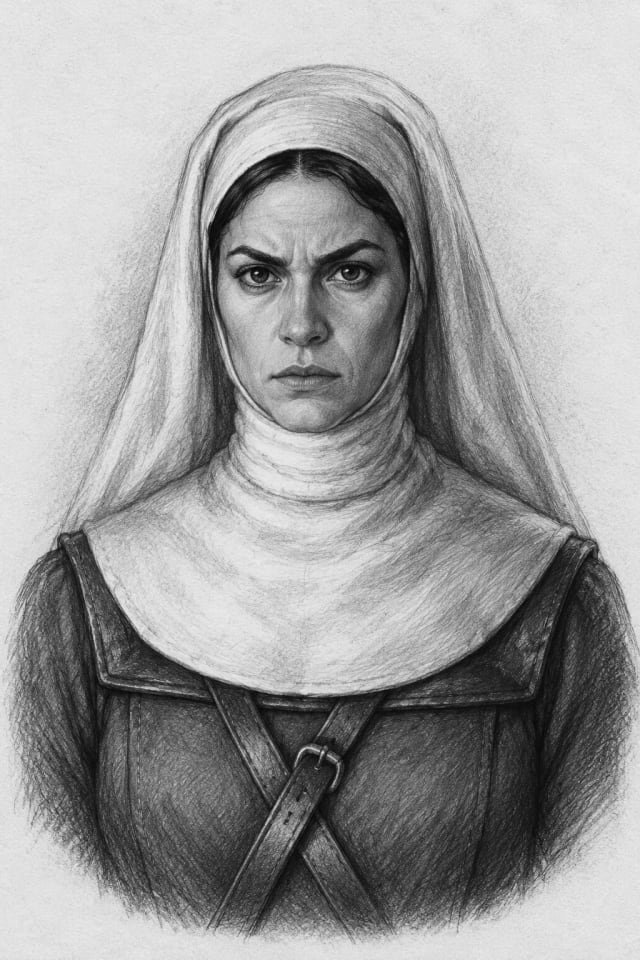
#On Her Station
Sister-Physic Marra Vell runs Ward Seven of the Scorch-Cure Infirmary at the Ember-Priory of San Vesta. Ward Seven is the experimental wing. It is the one ward in the Iberian Ember-Priories where the Church permits medicine to go beyond what medicine already knows. The other six wards set bones, drain lungs and bury the patients who would not cooperate. Vell wears the same white-ash veil as every other Sister-Physic on the terrace, and that is where the resemblance ends.
In every register I have consulted, her office is the ward. Her power is the list. Vell controls the cures, and she controls the triage lists that decide the order in which San Vesta's sick receive them. In a priory where the order of treatment is effectively the treatment, the woman who writes the order holds more than her title admits. On paper the Infirmary Tribunal sits above her. At San Vesta, paper settles less than it should.
She speaks in dosages. Ask her about a patient and the answer comes back as quantity, interval and sequence. The patient's name is attached at the end, for the convenience of the clerk.
She also does not blink near flame. Her orderlies explain this. They say she knows the ash-content at which the air of the ward will ignite, has memorised the figure, and refuses to write it down. I have no better explanation. I am not sure I want one.
#On the Cure and Its Permission
"Innovation is mercy when stamped." — Priorate formula, San Vesta
The volcanic heat below the Great Ovens is divided by schedule. The infirmary gets the secondary channel. In the sealed chambers of the scorch-cure, patients are given graduated warmth, enough to keep them in a sweat that some call therapeutic and others call penitential. A Sister-Physic records every symptom in a notation that is half medical chart and half confession transcript. A fever and a fault go into the same column. The Tribunal maintains that the heat suppresses infection in the basalt surgery below. The priory's own account calls this suppression theoretical, and I am content to leave it there.
Vell's competence does not depend on theory. Ward Seven's reputation rests on the experiments, but the ward still sets fractures, still breaks fevers, and still keeps the trench-fevered alive through the weeks when the ordinary wards would have handed them to the chaplain. Every Mercy Ward-Sister in the theater does the same unglamorous work. Vell does it under heavier supervision.
Under the dispensation of the Bureau of Doctrine, before a single patient is touched, every experimental proposal must pass review by the Tribunal and approval by the Priorate Council. It must carry the stamps of both, receive a counter-stamp from the regional office of the Bureau of Alchemical Standards, and be filed in triplicate in the Ledger Cloisters. If any seal is missing, the practitioner is no longer a physician. She is a heretical operative. Doctrine gives her permission to innovate, and Doctrine can take it back in one reclassification.
The committee that reviews her proposals rotates every six months, so that no physician gathers enough authority to become either brilliant or dangerous. That rule governs the committee. What it governs inside Ward Seven, the rule does not say.
#On the Lists
"Stamped mercy still burns." — Dormitory saying, San Vesta
A triage list looks like a schedule. In practice it is a sentence handed down in instalments. The patient at the top of Vell's list sees the heat that morning. The patient at the bottom waits, and at San Vesta, where ward infection kills as reliably as the ovens burn, the wait is part of the diagnosis.
Everyone in the priory knows this, which is why the lists have a black market. In the Cinder Markets, counterfeit triage slips change hands next to bread shards and unstamped sedatives, and the priory's dedicated record confirms that priority can be bought. No document I have seen puts a coin in Vell's hand. The market exists because her list exists. Whoever sets the price for a place on it is beyond my evidence.
Each cure produces a debt. The Tribunal sets the terms of recovery service, and the cured patient works it off in the ovens, the canalworks, the kilns or the dormitories. A broken arm costs three weeks. A full scorch-cure for advanced trench-fever costs a year. The year starts when the Tribunal declares the patient well, which is not always when the patient feels well. Only the Tribunal can grant an exemption for relapse. Its terms are not published.
This puts Vell at a junction of the priory's three powers. Prior Celestín of the Third Ember controls doctrinal sanction and authorises production. Quartermaster Odran Ashweight controls the flour and the coal. Vell decides which bodies come back to them able to work. If the Prior stamps more, the Quartermaster needs more hands. If the Quartermaster is short of hands, the pressure falls on the ward. None of the three can run San Vesta alone. I have found no record that any of them has tried.
#On Variant Convalescence
The Bureau of Alchemical Standards calls Ward Seven's recovery rates "statistically notable." The Bureau has published no percentage, no sample and no death total, and it has given no cause. "Notable" is the Bureau's word for a result it has noticed and does not intend to explain.
Some of the recovered do not come back as they went in.
I separate what has been observed from what has been reported. Some patients leave Ward Seven walking with a different gait, which anyone at the infirmary door can see. They pause in their speech at places where they never used to pause. Their families notice this first, and the clerks notice it second. Some of them remember events that happened to other people. That claim comes from the patients themselves and from the orderlies who listen to them. I record it as a report.
The priory has three names for the same patient. The Tribunal calls the condition variant convalescence, which files it as a kind of recovery and therefore as a kind of success. Vell calls it atypical recovery patterns. That is a clinician's phrase. It describes a deviation from the expected course, and it does not concede that the patient is cured. The orderlies call it patients waking up with the wrong memories. They carry the bedpans and so are allowed to say what they mean.
The priory's record of what Vell fears contains one entry: patients who improve wrong. I offer no confession for it, because none has been made. I give her no motive, because none has been filed. Her fear can be read in her lists and her quarantine notices. She does not fear patients who decline, because decline is a quantity she can measure. She fears the patient whose numbers all improve and who then walks out of the ward like a stranger.
The Tribunal counts that patient as a cure. The Bureau counts him toward the notable figure. Ashweight counts him as a pair of hands. Vell is the only one who counts him as a problem.
Earlier reports from the Bureau of Mercy described San Vesta's infirmary as "a model of compassionate efficiency."
The Bureau of Mercy has revised its assessment. The current classification is "efficient." The adjective was removed after an internal audit in A.S. 199. The audit's findings remain sealed.
#On the Present Pressure
As of A.S. 201, Ward Seven works inside a priory that is filling faster than it can heal.
The pilgrim intake has tripled in four years. The dormitories are overflowing, and many of the people in them arrived carrying a dying relative and a willingness to sign anything. The Tribunal has restricted access to resurrection-bread on the grounds of theological stability. Whatever the theology, the arithmetic is simple: the dying who cannot get bread end up in a triage queue. Every name that cannot get into the bread line goes on to Vell's list.
Whenever a ward shows atypical recovery patterns, the Tribunal locks it down under quarantine writ. The Cool Mask Brotherhood, working from the canalworks and the lava-tube underpaths, smuggles medicine and people out of those zones. The Bureau of Purity has mapped the tunnels. It has not shut the Brotherhood down. Patients taken out through the underpaths leave the triage list, the recovery-service ledger and Vell's observation all at once. No register follows them. Whether any of the patients removed this way were improving wrong, I cannot say. The Brotherhood keeps no charts, and if Vell keeps one, she has not shared it.
Meanwhile the flour convoy is late. Ashweight has sealed the gates and started the count. A count of mouths against loaves soon becomes a count of beds against bodies. When that happens, the list in Ward Seven matters more than any seal in the Ledger Cloisters.
My assessment is a clinical one, in the only grammar Vell would accept. Her recovery rate is notable and unexplained. Her intake is rising and her outflow is leaking. And the one measure of success the priory has not adopted belongs to the woman who controls its lists.