

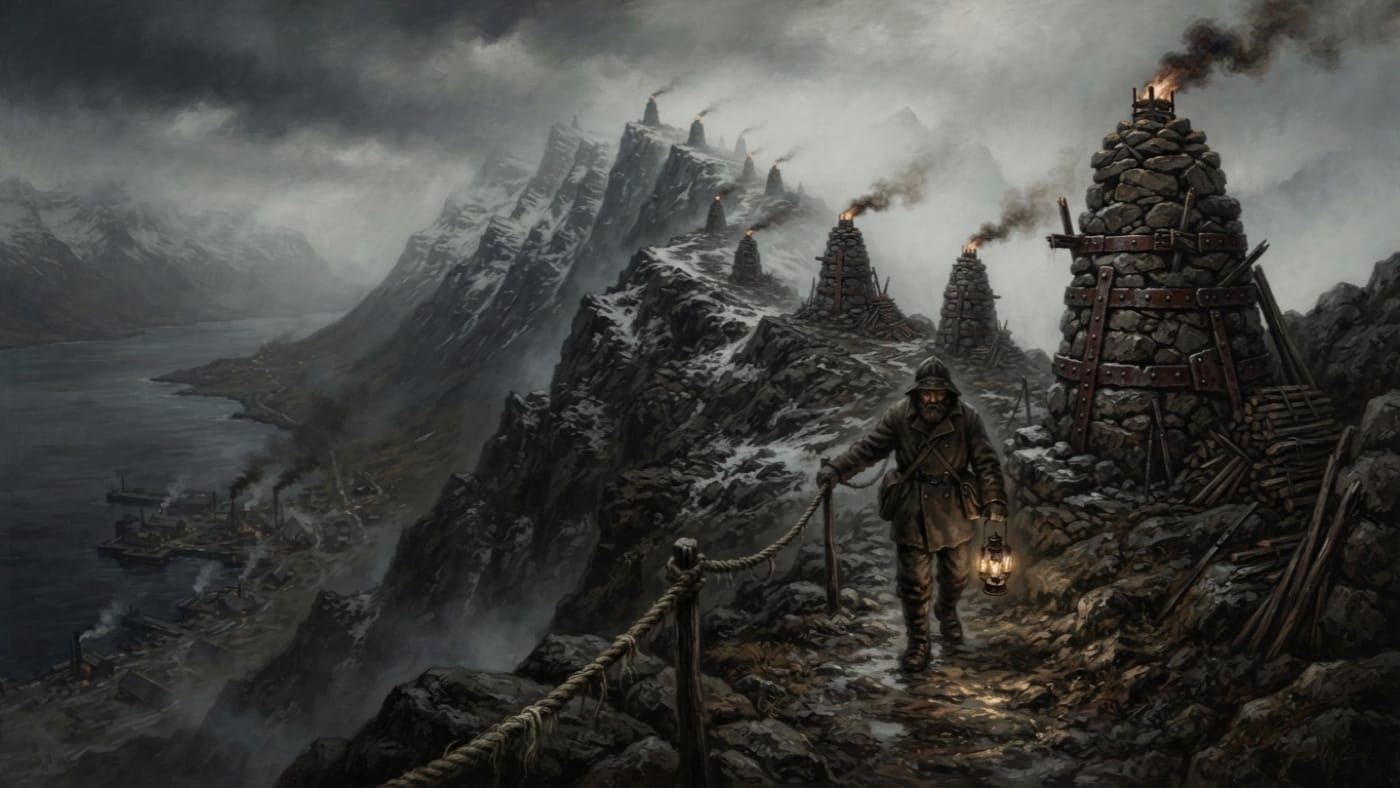
#On the Ridge Above Hrafnvik
Compiled A.S. 201 / 1911 CE from the standing record. The cairns are older than this file, and the file does not know by how much.
A line of stone cairns runs along the ridge above the hamlets of Hrafnvik, over the smoking Render Yards and over the Longhouse Rows, which breathe stew through their roof-holes. Each cairn carries a signal fire. The record says the fires can be seen from three passes and one sea-lane. I give that sentence as the record gives it. It describes the network. It does not describe each stone, because no Bureau officer has stood at every cairn with a sighting-glass, and I do not intend to be the first. This entry names neither the passes nor the sea-lane. A reader who wants the lines of sight drawn may apply to the Winter Watch. It will feed him, house him, and tell him nothing.
The cairns also mark the upper edge of a claim. The Clan Moot holds its territory from the Longhouse Rows to the ridge, and on the cairn stones the ancestral claim and the signal fire share the same masonry. The Bureau of Doctrine has never sent a clerk up there to dispute the boundary. He would have had to walk.
I could not establish who built the cairns, when they were built, or how many stand today. I asked the Moot for years and was given winters. This entry therefore has no section on the founding. An empty heading is more honest than a furnished one.
#On Ash, Iron and Distance
The cairns smell of ash and iron. The ash comes from the fires. Nobody I asked would tell me where the iron comes from, and I have not supplied an answer.
The ridge is weather's ground, and the people who climb it are guests. Knife-wind changes direction in the middle of a gust. Whiteouts come down without warning. On clear nights the aurora distorts distance, so a cairn that seems a hundred yards off may be a mile away, or may be directly overhead, which is worse. The Watch stacks cairn-wood ahead of a storm in the way a sacristan lays in candles before Lent, without discussion and before anyone asks for them. A fire that cannot be lit when it is needed is only a pile of stones.
The men who tend the fires listen to the fog the way a physician listens to a chest. Captain Rauk One-Eye reads lamp-flame lean, gull absence, rope slack and the dullness of a snow surface, and he hears weather before it arrives. I do not claim that every watcher on the ridge has his ear. I do claim that the cairns are posts for listening as much as for burning, and that a watcher is judged on both.
On the inland slopes the Watch also uses cairns as route marks against den stilla hungern. Its patrols report that cairns there sometimes appear doubled. Its doctrine on the point runs to one line: if the cairn says descend, descend. I file that instruction beside the signal fires without claiming they are the same stones.
#On Duty, Passage and the Three Hands
The fires are fed by obligation. Every household owes the Moot watch-hours, as it owes oil-tithes and wick dues. A young man may serve the cliff. An old woman may tend a signal cairn. A child may carry lamp-codes from the shrine to the narrows, provided the child can keep silent on paths where speech gives the fog a handle. A household that cannot pay its oil arrears may pay in nights on the ridge instead. A household that refuses goes into the Moot's memory, and a household that keeps refusing goes dark.
Three authorities stand over the ridge, and none of them owns it outright.
Elder Sigrun Half-Wick speaks first in the Moot and knows which households can spare a body for duty. She does not own the cairns, and Rauk is not her deputy. Watch Captains are elected by the clan moots and answer to the elders as a body.
Rauk keeps the routes. No grain sledge crosses the high pass without his route mark, and no seal-oil convoy leaves in bad weather without his watchers. No southern inspector reaches Watch Cairn Nine without being fed, housed, watched and kept from useful information. His board of notches, bone tags and black cord says more about the ridge than any survey of it ever filed, and he will not explain it.
Prior Malthus keeps the papers. He has no seat on the ridge. He can still issue an exemption that stops a household from giving its last able watcher to an impossible fast, or leave a name off a roster in ink that nobody checks. His instrument is the pen, and the pen governs the cairns' manpower at one remove.
#On Light, Silence and the Low Lantern
A signal cairn exists to be seen, and Hrafnvik has also learned what being seen costs. A lamp carried on a cliff path at night announces itself to every cairn on the ridge. The Dark-House Circle moves its oil along unlit routes for that reason, walking by touch. I name neither its carriers nor its paths, and this entry does not begin now. I note only that the same ridge which watches the passes for the Moot also watches the settlement, and that some households in Hrafnvik plan their nights around its sight.
On certain paths, and only on those, the people of Hrafnvik keep three precautions. They walk in silence. They carry triple-wick lanterns low. They renew the salt circles at the edge of safe ground after every tide. Sigrun knows the cairn approaches where the lanterns are held low, and she knows them from memory, not as an expert. The rules belong to particular paths, set by particular people. The Watch has given no general order covering every cairn, and this entry does not invent one.
The reason for the rules is the fog. On windless nights over flat water it returns speech altered. Prayers come back with the wrong saint in them, and names come back in the cadence of the dead. The Bureau of Rites files this as Category Two Localized Acoustic Distortion (Responsive), a label that states nothing about origin. The locals say three flames confuse whatever is listening. That is their explanation. No office has certified that it works.
"Cliff Path Nine, Watch Cairn approach. The triple wick confuses what is listening. The lean is the warning." (Image caption, Hrafnvik entry.)
Corrected. The body of that entry gives the explanation to the locals, and the caption stated it as fact. The lanterns are lit and maintained. Whether they confuse anything is unconfirmed, and so is the meaning of a flame that leans seaward. The local saying, if the flame leans seaward, don't follow your own thoughts, is advice and not a diagnosis.
#On Watch Cairn Nine
One cairn on the ridge has acquired a name in southern files, and that is a misfortune for any cairn. Watch Cairn Nine is one member of the line. Some clerks have used its name for the whole network, and they are wrong.
The site has two recorded hazards. The first is lightning, which the record lists as a danger of the place. I know of no strike, casualty or date tied to it, and I connect it to nothing. The second is the fog, which speaks names at Cairn Nine. The cliff path below the cairn runs over black water, and in still fog the next turn of the path cannot be seen. The Watch holds that anyone who speaks on that path lets the fog learn his name, and that anyone who walks it in silence cannot be found. A watcher bound for Cairn Nine climbs the whole way without a word, with wet rope in one hand and the lantern in the other. If he slips, he does not call out. I record the rule as a belief kept at high cost. Belief kept at that price is evidence of conviction. It is not evidence of mechanism.
I spoke once on that path. Rauk did not rebuke me. He walked faster.
Rauk's published dossier gives the account of A.S. 197. Three watchers went up to relight the cairn, and two came back. For six nights afterward a voice in the fog, attributed to the third man, asked for the correction of a prayer. Rauk ordered silence on the outer path and triple-wick lanterns at both turns. Prior Malthus filed an exposure incident. I filed something else in the same season and sealed the page myself. The page stays sealed.
This entry gives no name for the missing watcher and no finding on what became of him. It also makes no finding on whose voice was heard or what produced it. The record holds a report, an order, a Chapter filing and a sealed page.
#On the Present Compilation
As of this A.S. 201 compilation, the fires on the ridge are still fed. Hrafnvik's conditional compliance has been renewed and stays under review. The Watch has fewer men than it had, because young northerners go south to Königsberg and further, where officers praise their quiet competence without knowing what it cost. Watch-hours are still owed and still paid. Sigrun still allocates, Rauk still marks the routes, and Malthus still signs. The ridge does not care which of them is right, provided someone climbs.
This compilation adds no inspection and resolves no anomaly. It draws no map, and it does not certify that any local precaution is a law of the Creator's world rather than the habit of the people who survived it.