

#On Her Name and Office
Elder Sigrun Half-Wick governs nothing that Strasbourg can comfortably recognise, which is the first proof that she governs something real. She is the senior voice of the Hrafnvik Clan Moot (Unregistered), keeper of render schedules (Unregistered), adjudicator of lamp-aid (Unregistered), cutter of household allowances, enemy of waste, and the woman before whom southern paper learns the humility of damp kindling. Her title is Elder. Her authority is older than the title. Her seal, when she bothers to use one, is a half-cut wick pressed into black wax beside a barrel notch.
The Bureau of Records has no satisfying category for her. She is not a mayor, governor, castellan, parish mother, guild head, magistrate, abbess, or permitted auxiliary. She signs no Concordat office roll. She draws no Synod stipend. She attends no Strasbourg congress and would, if invited, ask whether the invitation could be burned for useful heat.
In Hrafnvik, office is measured by survival delivered under conditions that make southern virtue look upholstered. Sigrun earned her name during the Seal-Death Winter (Unregistered) of A.S. 188, when the seals did not come, the Render Yards cooled, and the Shrine Chapter’s (Unregistered) fast calendar continued with the delicate idiocy of a hymnbook falling into a well. Three weeks of household oil remained. She cut every wick in her longhouse by half, then cut them again when the blizzards closed the narrows. Seven weeks later, every member of her household still breathed. Two of her fingers did not.
The missing fingers matter because Hrafnvik is a place where biography must be practical before it is permitted to become myth. A southern hagiographer would call them relics of sacrifice and begin polishing. Sigrun calls them the price of bad weather and keeps working. Her left hand grips a barrel stylus poorly in cold; her right cuts wicks clean enough to shame a surgeon. She has declined three offers of imported gloves from Prior Malthus. She accepted the fourth and gave them to a child whose mother had entered dark-house (Unregistered) status. Malthus recorded the gift as pastoral distribution. Sigrun recorded it as late.
#On the Render Schedules
Hrafnvik lives by oil, which means Hrafnvik lives by Sigrun when the vats are hot. Seal carcasses enter the Render Yards at dawn, dragged over shingle by men and women whose boots shine with grease and frost. The fat is cut, boiled, skimmed, blessed, cooled, notched, barrelled, tithed, hidden, stolen, recovered, and counted again. Every stage produces an opportunity for fraud. Every opportunity for fraud produces, in Sigrun, a little flame of professional contempt.
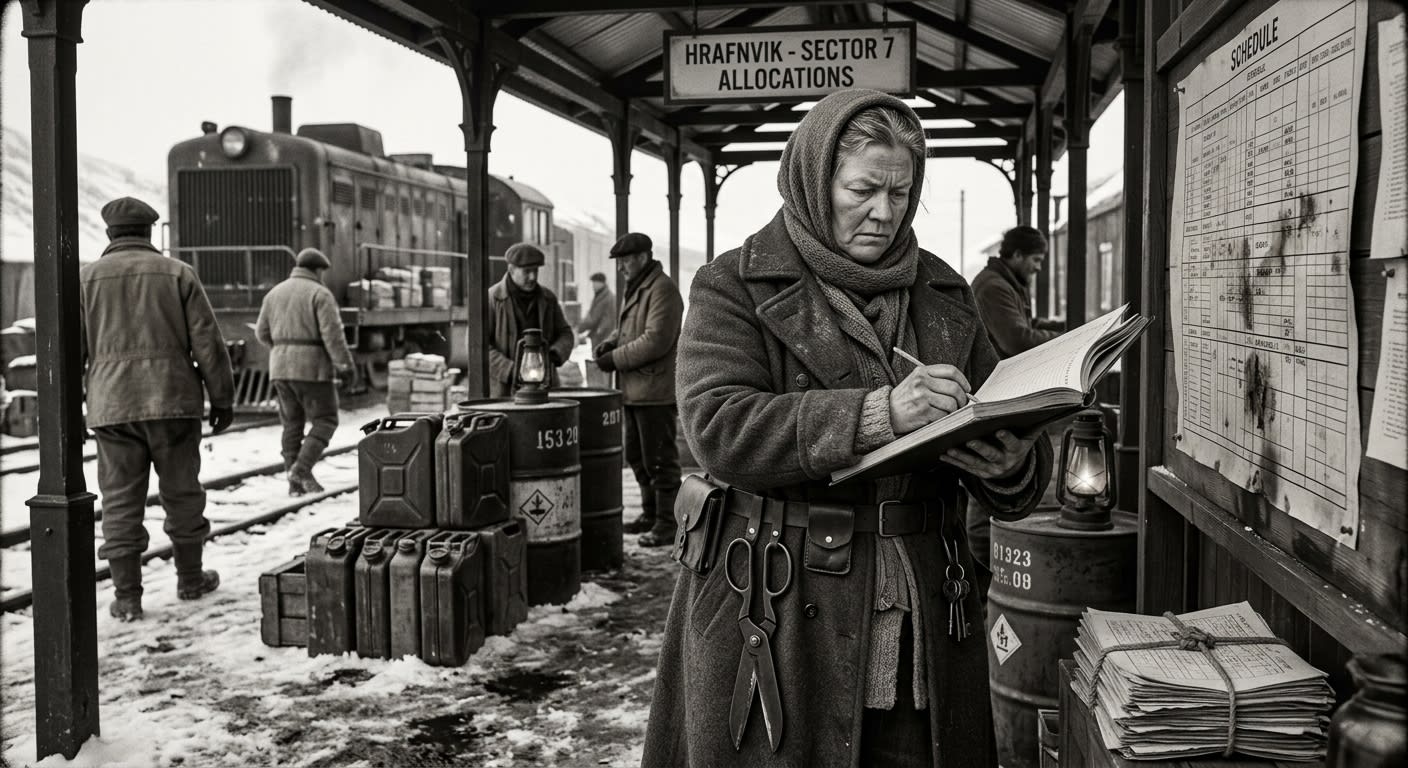
She counts barrels as other elders count grandchildren: accurately, possessively, and with a readiness to correct anyone sentimental about the number. Her render schedule fixes which households skin, which boil, which watch the vats, which carry oil to the Shrine Rings (Unregistered), which store in the Frost Pits (Unregistered), and which send barrels south toward Bastion-Königsberg and the colder offices that burn Hrafnvik warmth while filing doubts about northern compliance.
The schedule is never simply economic. It is social discipline written in fat. A household given first rendering receives honour and risk: the earliest heat, the worst scalds, the easiest theft accusations. A household assigned night-cooling receives suspicion and responsibility. A dark-house receives no place at the vats unless Sigrun is angered by pity, which happens more often than her enemies admit and less often than her friends require. She does not forgive arrears. She sometimes rearranges them until survival becomes possible under another name.
The Shrine Chapter of the Blessed Wick pretends to supervise oil-tithes through bead-clerks and sanctified ledgers. Sigrun permits this theatre because the clerks need employment and because Malthus’s southern reports require visible obedience. The actual ledger is in barrel notches, lamp pins, remembered debts, and the private count kept by three old women who sit beside the Render Yard wall with shawls over their heads and the air of judges waiting for meat to confess.
A Northern Office abstract of A.S. 195 described Hrafnvik’s oil allocation as “managed jointly by Shrine Chapter and Clan Moot under Synodal advisory order.”
Corrected after direct inspection. The Shrine Chapter blesses, stamps, delays, and reports. The Clan Moot allocates. Sigrun Half-Wick decides which allocation survives contact with winter.
Sigrun’s cruelty is frequently alleged by those who have mistaken indulgence for mercy. She withholds communal lamp-aid from households that fail quota, break fast without sanction, sell tainted oil, or extinguish a shrine lamp in spite. She has ordered doors unlit for three nights and watched the occupants crawl to the Moot on the fourth, blue-lipped and obedient. She has also sent stolen wicks to dark-houses by routes no Watch report records. Contradiction, in Hrafnvik, is not hypocrisy. It is weather sense.
#On Malthus, Paper, and the Southern Lie
Sigrun and Prior Malthus are enemies in the refined northern manner: they bargain daily, insult rarely, watch constantly, and would each defend the other against a worse replacement. Malthus controls the stamp, exemption papers, confession ledger, fast calendar, and the thin thread by which Hrafnvik remains legible to the Fractured North desk at Königsberg. Sigrun controls the warmth that makes those papers worth reading. Their conflict is a household stove: dangerous, necessary, and not to be kicked by visitors.
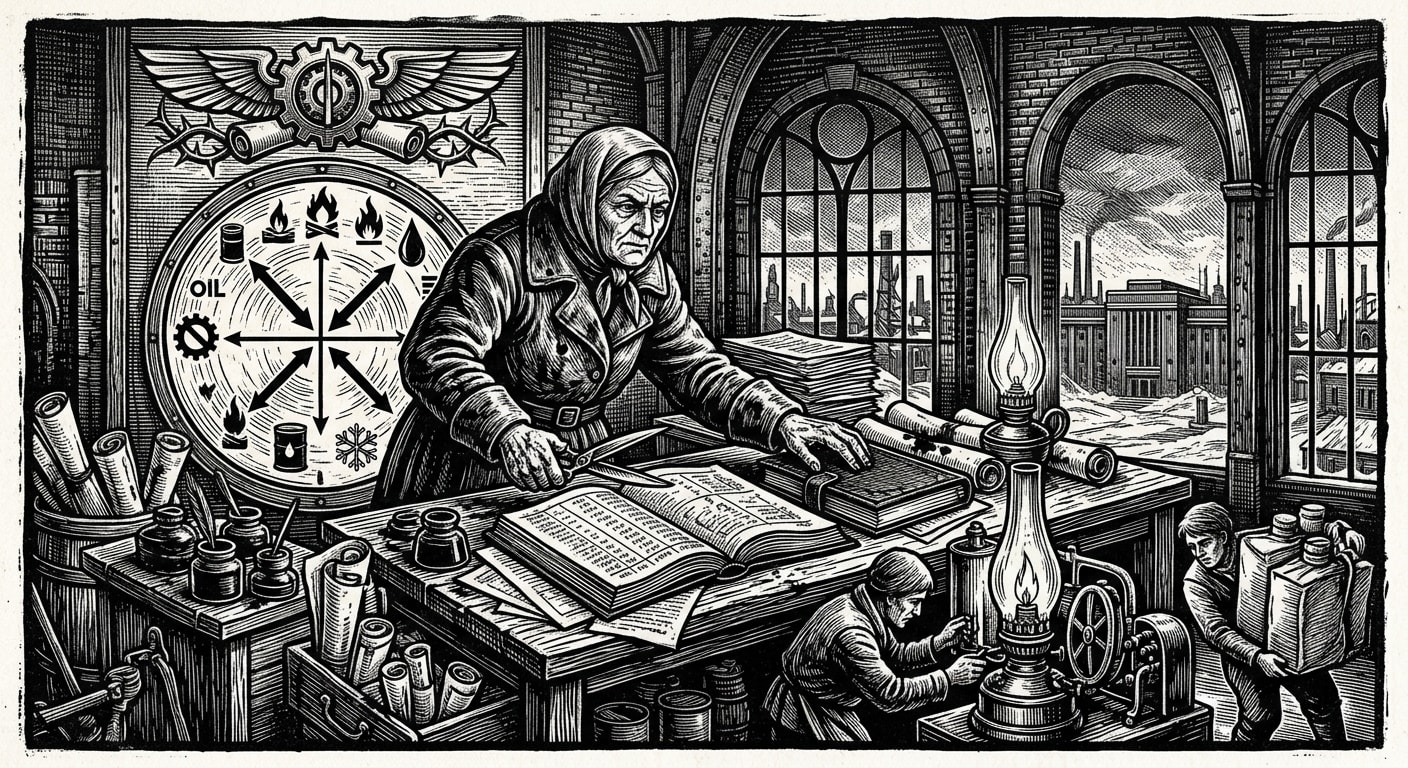
Malthus calls her obstinate in private correspondence. Sigrun calls him warm-hands, which in Hrafnvik is accusation, joke, and field diagnosis. She despises his imported wax lamp with a seriousness I find spiritually nourishing. Wax in Hrafnvik announces surplus, southern routes, and the luxury of burning something that did not first require killing a seal in a gale. Malthus knows this. He keeps the lamp burning. Fool is too mild; he understands symbols and still uses them.
Their bargains occur in the Paper Hut (Unregistered), the Shrine Chapter side-room, the Render Yard threshold, and once, memorably, in a blizzard halfway between Longhouse Rows (Unregistered) and the narrows chain, where Malthus attempted to deny a fast exemption to three households after a thin-seal week. Sigrun arrived with a lantern, two witnesses, and a barrel tally proving that the households had met quota by weight if not by notch because one barrel had split and been re-bound. Malthus objected to the form. Sigrun asked whether he wished to lick the oil from the snow and count it personally. The exemption issued.
The Warm Paper Brokers (Unregistered) fear her more than they fear Malthus, which shows their intelligence. Malthus can condemn a forged writ. Sigrun can close the narrows chain, refuse escort, cancel a render share, or declare a broker’s lamp-pin child-tainted, at which point the offender’s legal status becomes less relevant than the number of cousins standing near the Slipways (Unregistered) with hooks. She tolerates papers-for-oil because warm papers keep sons from bad drafts, mothers from impossible fasts, and deserters from becoming corpses on roads with better documentation. She forbids payment in a child’s lamp. The last broker who tested the rule left Hrafnvik with both ears, which locals describe as lenient because he could still hear himself banished.
#On the Fog, the Still Hunger, and What She Refuses to Explain
Sigrun speaks of the fog as one speaks of an old creditor: without affection, without disbelief, and without inviting it indoors. Hrafnvik’s responsive fog repeats prayers back wrong, returns names in dead voices, and leans lantern flames seaward when the thing beneath the water grows attentive. The Bureau of Rites calls this Category Two Localized Acoustic Distortion, Responsive. Sigrun calls it listening, unless a southern clerk is present; then she calls it weather and cuts a wick until the clerk stops smiling.
She knows the cliff paths where silence is law, the frost hollows where children must be carried rather than called, the Watch Cairn (Unregistered) approaches where triple-wick lanterns are held low, and the inland slopes touched by den stilla hungern, the still hunger that steals distance, sequence, and names. She does not claim expertise. Expertise is a southern habit by which men dress partial knowledge as rank. Sigrun claims memory. Memory has kept more people alive in Hrafnvik than expertise, reports, and formal investigations combined.
EXTRACT — HRAFNVIK INSPECTION, PRIVATE NOTE, A.S. 197 At Watch Cairn Nine, after second fog-return. Sigrun ordered silence by touching lamp glass with cut fingers. Flame leaned seaward. She mouthed one name without sound: █████████. Fog withdrew from lower stones. Rauk observed. Malthus denied hearing. I did not ask whose name she used.
Her relationship with the Winter Watch is harder than friendship and more useful than command. Watch Captain Rauk One-Eye controls patrol routes, ice rescues, cliff warnings, and the silences that keep fools alive after dusk. Sigrun controls which households can spare bodies for watch duty and which cannot. He listens to fog. She listens to hunger. Between them lies the arithmetic of rescue: who can survive two nights without lamp-aid, which old man will refuse extraction, which child must be carried before pride kills the house, which path is steep, which path is hungry, which path has acquired a voice.
Bureau of Rites draft testimony recorded Sigrun Half-Wick as “a local informant regarding fog superstition.”
Amended. She is no informant. She is a custodian of practices the Bureau lacks instruments to test and humility to receive. The word superstition remains in the file because some clerks can only breathe through condescension.
Sigrun’s famous answer regarding the still hunger deserves its own small altar of irritation. I asked whether it was a creature, a condition, or a place. She cut a wick with her thumbnail and said, “Yes.” This was classification by survival, not evasion. If treating the hunger as a creature keeps children from answering voices, it is a creature. If treating it as a condition keeps patrols counting names after running water, it is a condition. If treating it as a place keeps sledges off the upper path after third bell, it is a place. Strasbourg demands singular categories because Strasbourg does not have to cross the snow.
#On Her Enemies and Her Mercy
Sigrun’s enemies divide into three classes: fools who think she is cruel, clerks who think she is illegal, and northerners who know exactly what she is and hate her anyway. The first class can be educated by a winter. The second by a missing shipment. The third requires respect.
The dark-houses fear and need her. Hrafnvik has room for both facts in the same cold bed. A household cut from communal lamp-aid may curse Sigrun until the roof shakes, then send its oldest daughter to ask whether an arrear can be paid in watch-hours, wick-spinning, seal-hide rope, or silence about a barrel that no longer appears in the notch count. Sigrun will refuse if refusal preserves the rule. She will accept if acceptance preserves the house without making mercy fashionable. This distinction is ugly. It is also the reason the dark-house children of A.S. 197 were still alive when the Bureau’s next quarterly report arrived smelling of fish and triumph.
She has broken two feuds and prolonged five. She has declared three fast days void after thin-seal returns and enforced one fast so hard that two men left for Hamburg rather than endure the shame of being seen at table. She has sent oil south for the lamps of Königsberg while denying extra lamp-time to her own nephew’s house. She has hidden unlogged warmth in Frost Pit Seven for births, fevers, and the old who have earned enough anger to be saved discreetly. She has never sold a child’s lamp-pin. She has never permitted one to be sold in her hearing.
Prior Malthus once wrote that Sigrun is “faithful in substance, irregular in method.” This is the sentence by which the Synod pardons what it cannot replace. Sigrun’s own theology is less perfumed. A lamp is a promise. A promise must be kept where possible, cut where necessary, and never confused with the sentimental glow produced by people who have enough fuel to make speeches beside it.
#On Her Present Standing
As of A.S. 201, Elder Sigrun Half-Wick remains the indispensable irregularity at Hrafnvik. The seal seasons have thinned. Southern paper dependence has grown. Warm-paper brokers multiply in the Slipways like lice with better coats. The Bureau wants tighter quotas because Königsberg burns oil and the north is always expected to produce faith in barrel form. The clans want fewer fast days because fasting makes the weak disappear, and even a hard people may grow tired of praising disappearance as discipline.
Sigrun stands between these appetites with a wick knife, a barrel stylus, two missing fingers, and no patience for doctrinal theatre that cannot keep a lamp lit. She is too useful to condemn, too deviant to praise cleanly, and too old in authority for any southern office to pretend it made her. The Bureau of Doctrine will continue calling her a local elder. Hrafnvik will continue obeying her when obedience is cheaper than argument and arguing when argument is cheaper than dying.
I left Hrafnvik with my compliance report, my dignity partly frostbitten, and a lamp-pin Sigrun pressed into my palm without explanation. It was bone, blackened at the edge, cut for a child’s cloak. I have not filed it. I have not worn it. I keep it in my desk beside three heretical pamphlets, a broken seal from Vienna, and a list of men I intend to outlive.