

#On What the Fog Returns
Speak into it and it answers. The answer is always a little wrong.
The anomaly belongs to a single fjord in the Fractured North, and it does not travel. It is the property of Hrafnvik in the same way the stink of the Render Yards is the property of Hrafnvik. It stays put, it does not go away, and every southern office it has been offered to has declined it. It only appears under certain conditions. On some windless nights the fjord goes as flat as poured lead, and the fog comes down thick enough to wring out like a cloak. Words spoken into it on those nights come back.
They come back altered. That is the whole of the phenomenon, and the whole of the trouble.
The Bureau of Rites has designated it Category Two — Localized Acoustic Distortion (Responsive). I commend the order for its economy. Localized means it has stayed in Hrafnvik. Acoustic means it is heard. Responsive means it waits for someone to speak first. The designation says nothing about origin, intent or allegiance. A reader who finds any of those in a Category Two filing has mistaken a cabinet label for a confession. And not every fog on that coast answers. Most of it simply drowns people, in the honest Norwegian manner, and asks nothing in return.
#On the Danger of Correction
The prayer returns damaged. The speaker repairs it. The repair returns damaged.
The cruelty is that what comes back is still recognizably what was sent. A prayer comes back calling on the wrong saint. A confession comes back carrying a sin the confessor did not commit. A name comes back in the cadence of someone dead. The Watch also reports names that come back without ever having been spoken, which is a separate and worse kind of impertinence. None of this proves the added sin was committed, or that the dead are present, or that anyone in the fog knows the name it has just recited. The fog is a poor witness. It is merely a persistent one.
The danger lies in the reflex, and the reflex is a pious one. A man who hears his prayer come back garbled wants to set it right. He says it again, carefully, and it comes back wrong somewhere new. He amends the amendment. A confession that returns with a stranger's sin attached invites a denial. The denial is also speech, and it goes into the fog along with everything else. The people of Hrafnvik need two words for where this ends: madness, and self-incrimination. I have no clinical vocabulary to add and will not invent one. A man correcting himself against a voice that never stops correcting him is keeping a ledger that has no final entry.
On my seventh night in Hrafnvik I heard the Creed recited in my own voice. Every I believe had been replaced with I remember. I set this down as I set it down then, as my own testimony. The Bureau has accepted my testimony on worse subjects. It proves I heard something. It does not prove the fog knows anything about me that I do not. I did not answer it. That is the only part of the episode I claim credit for, and I claim all of it.
#On the Lanterns, the Salt, and the Path
If the flame leans seaward, don't follow your own thoughts.
Hrafnvik's measures against the fog are older than the Synod, and they are obeyed more reliably than anything the Synod has sent north since. There are three: lanterns, salt and silence. None of them was issued by Strasbourg, and none of them is going to be withdrawn.
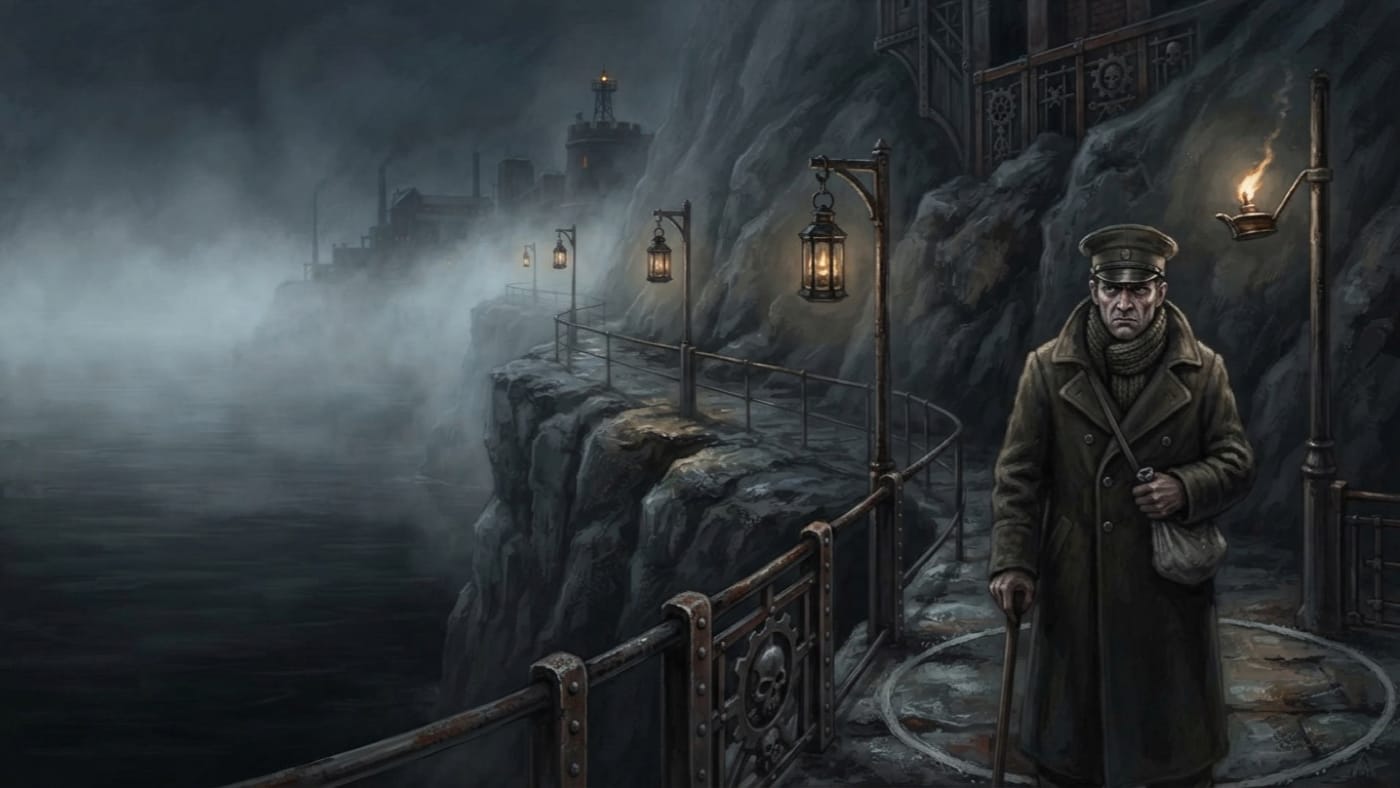
Triple-wick lanterns burn on the paths where the fog lies thickest. The lanterns are greasy, squat and hot to the hand, and they smell of the Render Yards from fifty paces. The Watch hangs them from iron crooks driven into the cliff and trims them with fingers that have stopped feeling the cold. The locals say three flames confuse whatever is listening. That is their explanation. What I can attest is that the lanterns are lit and maintained, and that nobody in Hrafnvik will walk those paths in still fog without one.
Salt circles mark the edge of safe ground. They are laid as thin grey lines on wet rock, and they are renewed after every tide. That last detail tells the reader more about the place than any census. Every tide washes the salt from the stone, every tide someone climbs down with a pouch and lays it again, and nobody has yet proposed skipping a tide to see what happens.
Silence governs certain routes. The strictest is the cliff path to Watch Cairn Nine, where the signal fire stands over black water and the next turn of the path is hidden in fog. The rule is simple. Speak on that path and the fog will learn your name. Walk it silent and it cannot find you. So the Watch insists. A Watchman bound for Cairn Nine goes the whole way up without a word, with wet rope under one hand and the lantern in the other. If he slips, he does not call out. I offer no opinion on whether the rule works. I note only that it is kept, and in Hrafnvik a rule kept at that price amounts to a statement of belief.
Then there is the flame. Lamps in Hrafnvik gutter in still air, which no lamp has any business doing. When the flame leans, the direction matters. A flame leaning seaward is the local warning, and the saying that goes with it is the one at the head of this section. It is advice. It is not a diagnostic. No instrument in any Bureau has confirmed what the lean means, and the people of Hrafnvik do not wait for an instrument before they stop talking.
#On the Three Explanations and the Survey
Three authorities, three answers, one flame.
Hrafnvik is governed by three bodies, and each of them has an opinion about the fog. Each opinion suits the job its holder already does.
Captain Rauk One-Eye of the Winter Watch treats the fog as information. He listens to it the way a pilot reads a chart, and his patrols lose fewer men than any other Watch post on the northern periphery. Elder Sigrun Half-Wick of the Clan Moot sets the render schedules and decides which households get communal warmth. She treats the fog as one more thing a household has to survive, alongside the dark and the fast. Prior Malthus and the Shrine Chapter of the Blessed Wick keep the papers, the exemptions and the confession ledger. Their job is to make the fog sound reasonable to Strasbourg.
During my inspection I asked each of them why the flame leans seaward. Elder Sigrun said it leans when the fog is listening. Captain Rauk said it leans when something beneath the water is hungry. Prior Malthus said it leans because of barometric pressure differentials in the fjord's microclimate. I have written before that all three were lying and that only one of them knew it. I stand by that sentence, and I decline to say which one.
The Bureau of Rites sent a survey team in A.S. 199. The team stayed four days and filed a report three sentences long. The first sentence described the phenomenon. The second recommended further study. The third requested reassignment. I have read longer reports on the condition of a single bell-rope. I have rarely read a more honest one.
The fog's file sits next to an older quarrel, the bell-schedule. The Office of Bells was constituted in A.S. 52, and the Bell Codex it now administers was ratified in A.S. 115. Hrafnvik's shrine-bells ring something older than either. The garrison at Bastion-Königsberg has documented what happens when the Strasbourg standard and the northern patterns sound at once. The Bureau of Bells calls the result acoustically non-canonical. Nothing in the record shows that either pattern disperses the fog, and I make no such claim.
ERRATUM — BUREAU OF BELLS, NORTHERN OFFICE Previous notation (A.S. 195) described the Hrafnvik bell-schedule as "non-compliant but harmless." This assessment is revised. The bell-schedule is non-compliant. Whether it is harmless depends on one's definition of harm, one's tolerance for dissonance, and one's willingness to entertain the possibility that the fjord-bells were tuned against something the Bell Codex has not catalogued.
Stamped: Bureau of Bells — A.S. 199
The south tolerates all of this because the oil comes south. The Bureau of Doctrine sends a Prior and a census-taker, and once in a long while a Hieromnemon. It has never sent anyone with orders to make the fog stop. Its tolerance is explained by the ledgers, and the ledgers explain nothing about the fog.
#On the Present Disposition
Monitor. Do not answer.
The official record of the Responsive Acoustic Fog can be stated completely in a few lines, and I will not pad it out. The fog occurs on still nights over flat water in one fjord. It returns speech altered. People who try to correct what it returns come to harm by correcting it. The Watch keeps lanterns, salt and silence, and keeps them faithfully. Three local authorities give three incompatible explanations for the warning flame. One survey team spent four days in Hrafnvik and asked to be sent somewhere else.
The cause is not stated in any order I have seen, and I will not supply one here. Readers bound for Hrafnvik need only one instruction. It is the only instruction in the order that every authority in Hrafnvik, southern or northern, would sign without amendment.
If your own prayer comes back to you wrong, let it stay wrong. The Creator heard it correctly the first time. The fog can keep its copy.
Nihil obstat.