
#On the Office Without an Office
The Winter Watch is a militia in the same sense that a famine is a diet: the category satisfies a clerk and insults the thing itself.
The Winter Watch is the northern system of armed obligation by which the Fractured North keeps its passes open, its coasts observed, its trade routes guarded, and its children alive through the long dark. The Bureau of War calls it “Irregular Auxiliary, Category Three, Non-Integrated.” The Bureau of Records calls it “seasonal local defence.” The Bureau of Doctrine, having spent forty years receiving reports from Priors who understood their position better than their superiors, calls it “a tolerated necessity.”
The northerners call it the Watch.
One should attend to that brevity. A thing named with one word has either existed too long to require explanation or kills those who ask for one. In this case, as in so many of the North's better arrangements, both propositions apply.
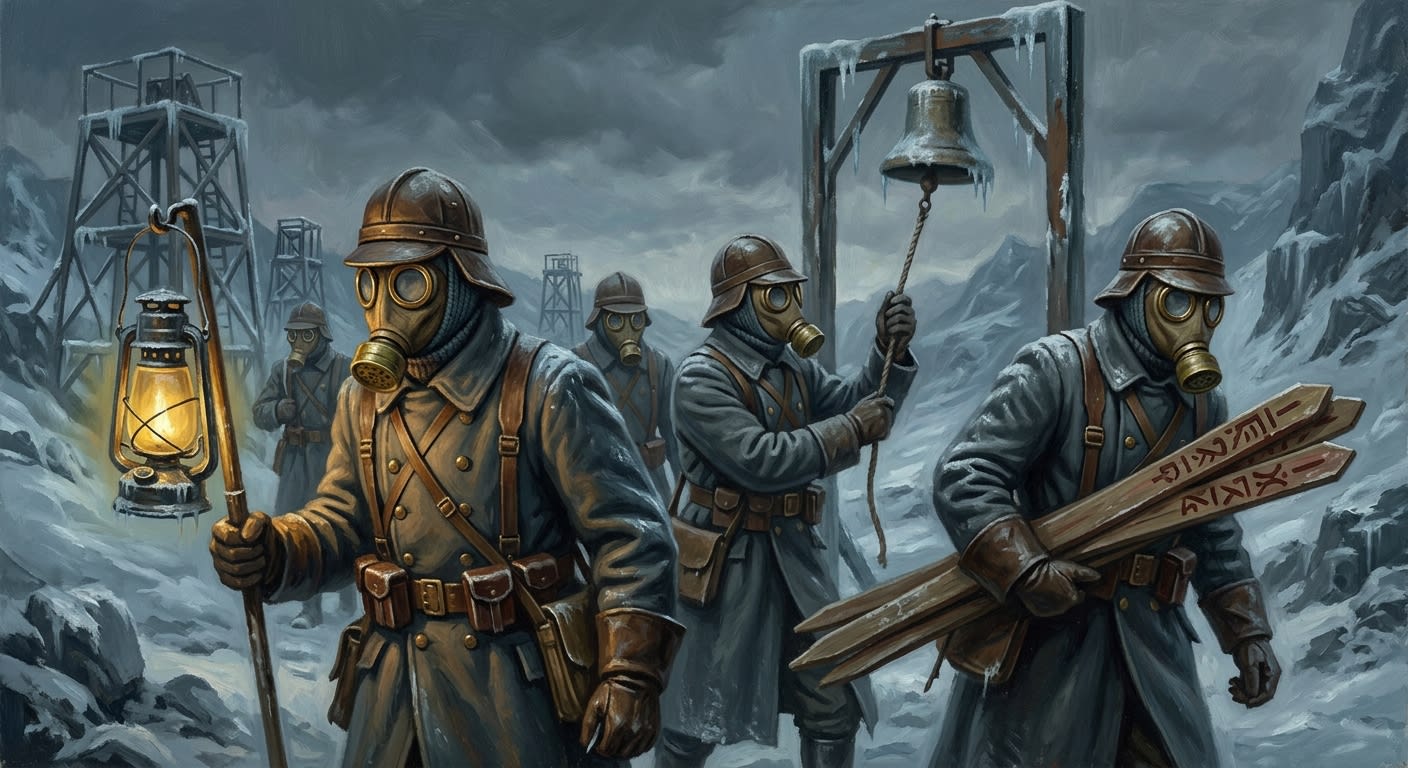
Every settlement maintains its own Watch: cliff-sentries at the fjord mouths, pass-keepers in the mountain cuts, road escorts on the ice routes, bell-ringers at the old towers, lamp-tenders where the fog learns names. Watch Captains are elected by clan moot (Unregistered), answerable to elders, obeyed by households, and ignored by the Bureau of War with the deep resentment of a jealous husband pretending magnanimity at supper. They wear no standard uniform. They carry axes, harpoons, knives, lanterns, salt, oath-tokens, and the local authority to decide who receives rescue when the whiteout comes.
The Watch has no central command, no Strasbourg charter, no Grand Marshal, no blessed headquarters with frescoed ceilings and clerks measuring courage by ink consumption. It has captains. It has routes. It has bells. It has memory. These are sufficient materials for government when the weather is trying to murder you and the Bureau's nearest officer is nine days south by a boat that may not come.
#On Election, Duty, and the Price of Lamp-Oil
A Watch Captain is chosen because the settlement believes he or she will close the correct road first. That is the sacred brutality of northern command. In Strasbourg a superior officer proves himself by doctrine, seniority, pedigree, patronage, and the number of men who survive his mistakes long enough to applaud. In Hrafnvik and its sister-fjords, a captain proves herself by knowing which family can endure two nights without lamp-aid, which pass is lying under fresh snow, which old man will refuse rescue out of pride, which child must be carried before the frost persuades the household to call it Providence.
Watch duty is paid in obligation. A household owes hours as it owes oil-tithes, fast days, wick dues, and the thousand small obediences by which northern society converts suffering into arithmetic. A young man may serve the cliff. An old woman may tend the signal cairn. A child may carry lamp-codes from the shrine to the narrows, provided the child can keep silent on the path where speech gives the fog a handle. Refusal enters the moot's memory. Repeated refusal darkens the house.
The Watch also controls movement. No grain sledge crosses a high pass without escort. No seal-oil convoy leaves a shrinefjord in bad weather without a captain's route mark. No southern inspector reaches a cliff-post without being fed, housed, watched, and told nothing useful. The Bureau mistakes this for obstruction. It is, in fact, governance stripped of ornament. Whoever controls the road in winter controls the law.
At Hrafnvik, Watch Captain Rauk One-Eye commands thirty-odd watchers in fur cloaks with lamp-pins on their collars and the settled conviction that the weather has personal malice. He lost one eye to a fishhook at fourteen, had the socket packed with rendered fat and prayer, and now listens to fog as if it were a map. His patrols die less often than the Bureau's arithmetic allows. The Bureau calls this luck. Rauk calls it listening. I call it evidence, and so the Bureau dislikes the sentence.
#On What They Fight
The Watch watches.
Seventeen formal requests from the Bureau of Doctrine's Northern Office have sought a proper threat assessment from the Watch Captains of the Fractured North. Seventeen answers, in dialects varying from courteous to geological, have returned the same doctrine: the Watch watches; what it watches for is the Watch's business. The Bureau may send an observer. The observer will receive a post, a ration, a blanket, and an education in silence.
This silence is custody.
The Watch fights avalanche, hypothermia, thin ice, hunger, wolves, smugglers, desperate households, counterfeit warm-paper brokers, tax-boats with more authority than sense, and the ordinary human criminality that flourishes wherever darkness lasts long enough to be mistaken for permission. These dangers would satisfy any reasonable militia. The Watch is denied so modest a portfolio.
It also fights what the Scandinavians call det grå vattnet when the grey comes by water, den stilla hungern when the land itself seems hungry, and nothing aloud when the sky participates. It fights the fog that answers prayers incorrectly. It fights the low vibration that makes men confess to sins their fathers had not yet committed. It fights the flat water at the fjord-mouth, the current that comes in wrong, the auroral silence during which bells sweat green damp and dogs bite through their own tongues.
WATCH CAIRN NINE — HRAFNVIK OUTER PATH — A.S. 197 Three watchers sent to relight the cairn. Two returned. The third was heard from the fog for six nights, requesting correction of a prayer he had never learned. Captain Rauk ordered silence on the path and triple-wick lanterns at both turns. Prior Malthus filed “exposure incident.” I filed ███████████████ and sealed the page myself.
The countermeasures are local and old: salt circles refreshed after tide, triple-wick lanterns, silence rules, cliff-bells rung in patterns the Bureau of Bells cannot transcribe without becoming cross, narrows chains pulled when water behaves like an animal approaching a bowl. The Bureau demands mechanisms. The North provides results. The difference is why the North continues to have children and the Bureau continues to have questions.
Bureau of Rites Observer Aldric Moen's A.S. 178 cliff-post report was classified as “inconclusive.”
Corrected for internal use. The report's third page read: “The bells work. Do not change them.” This is a conclusion, merely one unwelcome to the office receiving it. Moen's reassignment to the Paper Mines of Ulm remains a disgrace, and the Bureau's refusal to be embarrassed by it compounds the original stupidity.
#On the Bureau's Four Failures
The Bureau of War has attempted to integrate the Winter Watch into the continental levy system on four occasions. Each attempt produced paper. Each paper produced summer cooperation, autumn evasion, and winter silence. The Watch will send volunteers to Bastion-Königsberg when the season permits; these axe-psalters fight well, pray while moving, obey orders when the orders correspond to geography, and depart when the passes close. The Bureau calls this desertion. The clans call it returning before the snow decides the route for them.
The first integration effort failed because the Bureau assumed rank could be imported. The second failed because the Bureau attempted pay in coin where lamp-oil, grain, and safe passage were the currencies that mattered. The third failed because a captain appointed by Strasbourg ordered a road cleared after the local moot had closed it; six men died, the captain was returned south with frostbite and a corrected understanding of authority. The fourth failed because the Watch Captains signed every document presented to them, kept the copies, accepted the equipment, and obeyed none of the clauses that interfered with survival. This was the most elegant failure. I admire it professionally.
#On the Present Condition
The Winter Watch grows thinner. The young leave for Hamburg, for the Königsberg garrison, for the Sagittal Line, for any place where food is warm and death has the courtesy to wear a uniform. The fjords keep fewer ringers. The passes keep fewer guides. The old captains count children with the eyes of quartermasters and mourners.
The Watch still works.
It works because no Bureau can replace the intimate tyranny of a clan moot deciding rescue priority by name, debt, kinship, shame, usefulness, sin, and the private mercy of whoever holds the lantern. It works because the bells are older than our schedules. It works because the Watch has never mistaken classification for knowledge. It works because the men and women on the cliffs do not need to win an argument with Strasbourg before pulling a chain across a fjord whose tide has begun to breathe.
So the Watch watches. The lamp leans seaward. The captain lifts one hand. The bells begin.