

#On the Guild and Its City
The Weavers of Lyon appear in the Synodal record the way most honest tradesmen do: once, briefly, and in debt. Their name stands among the craft guilds summoned to the west vault of Münster cathedral in A.S. 105 / 1815 CE, when the Second Concordat of Münster bound nine hundred and ninety-nine guilds to the tithe-structure of the Synod. Before that year they were a corporation of looms in a heartland city. After it they were a line in the Ledger of Obligatory Production. That was a promotion, whatever the weavers say over their beer.
Lyon sits on the Rhône in the Western Heartlands, far behind the Sagittal Line, in a city the Bureaus list as closely supervised. Close supervision is a compliment. It means the Church has bothered to look. A heartland weaver hears no demon at the wall and sees no abomination at the ford. He hears the shuttle, the beater and the clerk at the door with a requisition. Of the three, only the clerk cannot be oiled.
This article concerns one question, which the guild answered at Münster with a thumb: who owns a craft once it has been pledged in blood? The answer is short. Its consequences are still being invoiced.
#On the Widower
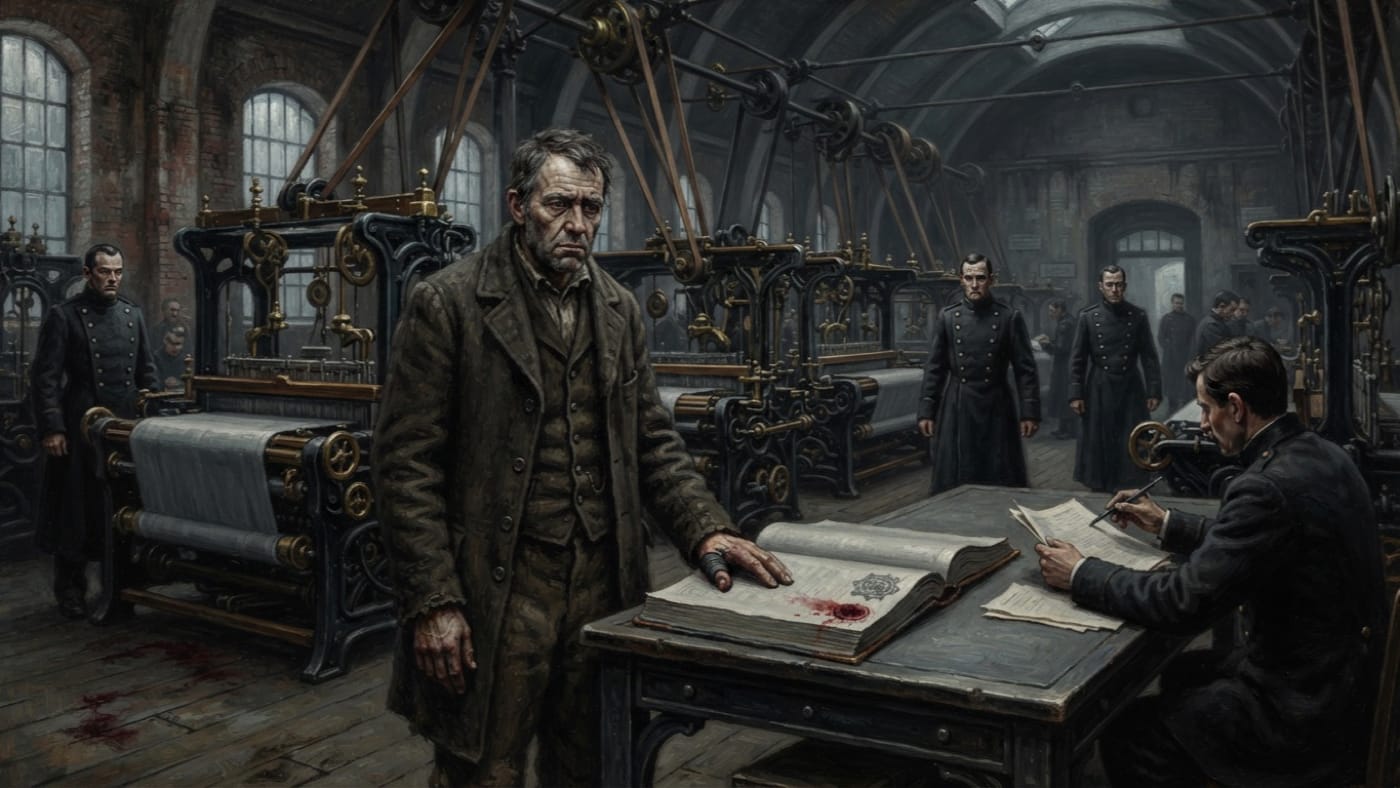
The Münster account keeps a single detail about the Lyon delegation, and it is the best detail in the file. The Weavers of Lyon sent a widower who had survived three strikes, two fires and one Bureau inquiry by saying nothing memorable under oath.
Consider what that record contains. Three strikes meant three seasons of idle looms, unpaid rent and masters glaring at journeymen across a cold shop, each ending in a settlement that somebody had to sign. Two fires meant two nights of lint, oil and dry beams, when a weaving shop burned exactly as a weaving shop is built to burn. The inquiry meant a Bureau officer, a table, a written question and the pause after it in which a lesser man says something clever.
He did not. He left the inquiry the way he left the fires: singed, unremarkable, alive.
I admire him without reservation, a courtesy I extend to about four people a decade. Bureau interrogators are trained to harvest the memorable sentence. The vivid phrase, the righteous complaint and the joke at a Cardinal's expense are what get copied into a file and read aloud at a hearing. A witness who answers in the grey speech of looms and ledgers leaves the clerk nothing to underline. A city that sends its least quotable man to a treaty table understands treaty tables.
The account keeps his history and nothing else: no name, no rank, no dates for the strikes or the inquiry. It took what it wanted. The rest of him went home to Lyon with a bandaged thumb.
#On What a Thumb Can Pledge
The procedure was simple, which is why it worked. A silver lancet opened the chief artificer's thumb. The blood went onto the grey vellum over the guild mark. A witness stood, a bell sounded and a clerk counted. Coin can be repaid and wax can be broken. Blood, once pressed, enters the sacramental register, and the sacramental register does not hear appeals.
Under the compact, the widower's thumb pledged everything behind him. It pledged the looms in every member shop, the sheds that housed them and the debts that had paid for them. It pledged the craft itself: how a warp is set, the private habits of a master's hand, and every improvement any Lyon weaver might devise in any future year. It pledged the households, because a weaving shop runs on wives winding bobbins, children picking knots and grandmothers who remember patterns nobody wrote down. It pledged the apprentices, who were registered by projected craft-value. It pledged the descendants.
Sentimental historians abuse that last item, so precision is needed. The compact claimed the labour of descendants. It did not oblige the Creator to make every grandson of a Lyon weaver good at weaving. Some became clerks, some soldiers, some disappointments. The claim followed them anyway. A child born into a pledged household was listed with a valuation pencilled beside his name before he could hold a shuttle. If he proved useless at the loom, the Bureau did not strike out the entry. It lowered the figure and kept the line.
In the same hall, the thousandth artificer asked whether his grandchildren would be born owing labour before they had hands. Havel of Tithes answered that all children are born owing something. The widower did not ask the question. It would be impertinent to guess at his heart from that. His arithmetic is easier to read.
#On the Loom Under Four Bureaus
After Münster, four offices had a hand on every loom in Lyon. None of the hands belonged to a weaver.
The Bureau of Records took the guild rolls into Synod custody and filed the tool-patterns. A loom stopped being a timber frame any carpenter could copy and became a registered design with a number. The Bureau of Doctrine took the secret methods, which now fell under its interpretation, so that a master who kept a technique to himself committed heresy by omission. The Bureau of Tithes took the private marks, the small signs a shop worked into a selvage to say this cloth is ours. It standardized them, licensed them and taxed them. The Bureau of Purity took whatever looked insufficiently grateful.
Doctrine had already decided what cloth was for. Before Münster a weaver supplied cloth. After Münster, in Doctrine's preferred wording, he produced public decency, banner-weight and shroud-yardage. The bolt on the loom was the same. Only its meaning changed, and meaning is taxed at a higher schedule than yardage.
The arrangement is elegant. A nation at war on the Line needs banners for its regiments and shrouds for whatever comes back from under them. A Church that regulates what its faithful may wear needs decent cloth in quantity and to a known standard. From A.S. 105 onward, every one of those needs arrived at the weavers' door with a stamp on it. I make no claim that the Weavers of Lyon held a particular banner contract or supplied the burial cloth of any named cathedral. My claim is narrower and worse: the demand was bottomless, and the weavers no longer bargained with it as merchants. They answered it as obligated parties.
Under such a regime, improvement becomes a delicate art. A successful innovation triggers reassessment. An unsuccessful one triggers Purity. A sensible weaver improves his loom slowly and in silence, the way the widower answered questions.
#On the Signature That Was Not Given
Next to the nine hundred and ninety-nine impressions is a space no clerk drew. The thousandth artificer put the lancet back in its basin. His name and his guild are missing from every surviving file. By dawn his district of Münster was empty: hearths cold, shops locked from the inside, and patrols coming back with maps already amended. Doctrine calls it a miracle. Records calls it a clerical adjustment. I call it filed. I decline to name the mechanism, because the mechanism has not been disclosed to an office of my grade.
Nothing connects that district to Lyon. It stood in Münster. The weavers lived far to the south on the Rhône and kept their looms there.
What matters here is what the refusal taught. Every delegate who carried a bandaged thumb home from Münster also carried the knowledge that the alternative had been tried once, before witnesses, and had ended in an empty street. A guild that has watched refusal undone after the fact does not need threatening a second time. Reminders are enough, and Bureau inspectors have never been shy about reminding.
Certain inherited chronologies place the Second Concordat of Münster in A.S. 231.
Corrected: the compact was sealed in A.S. 105 / 1815 CE, five years after the later Council of Cologne and fifteen after the Concordat of Strasbourg. A.S. 231 lies thirty years in the future. The Bureau is efficient, but it does not yet date its treaties from the far side of the present.
#On the Bargain
The weavers complained after Münster. Every guild did. Then the contracts arrived.
That is the whole bargain. Any weaver who calls it slavery should be asked when his looms last stood idle for lack of a buyer. Under the old order the Lyon guild was free to set its own prices, keep its own secrets, train whomever it liked and starve in a bad year. The Synod took away the first three and abolished the fourth. Requisitions do not fail. The Line never stops wanting banners, and the dead never stop needing shrouds. The weavers got a security their grandfathers would have prayed for. In exchange they gave up the right to decide what their work meant, who owned it, and whether their grandchildren would inherit it as a trade or as a debt.
Cardinal Kratz had been dead seventeen years when the widower opened his thumb. Doctrine credits the instrument to Kratzian method all the same, and I see no reason to argue. The forms outlived the man, as good forms do. No living founder sat at that table, and none was needed.
The widower pledged looms he did not own outright, apprentices not yet indentured and grandchildren not yet born. The compact took all three as collateral. The vellum has never complained.