
#The Harbor Patrol
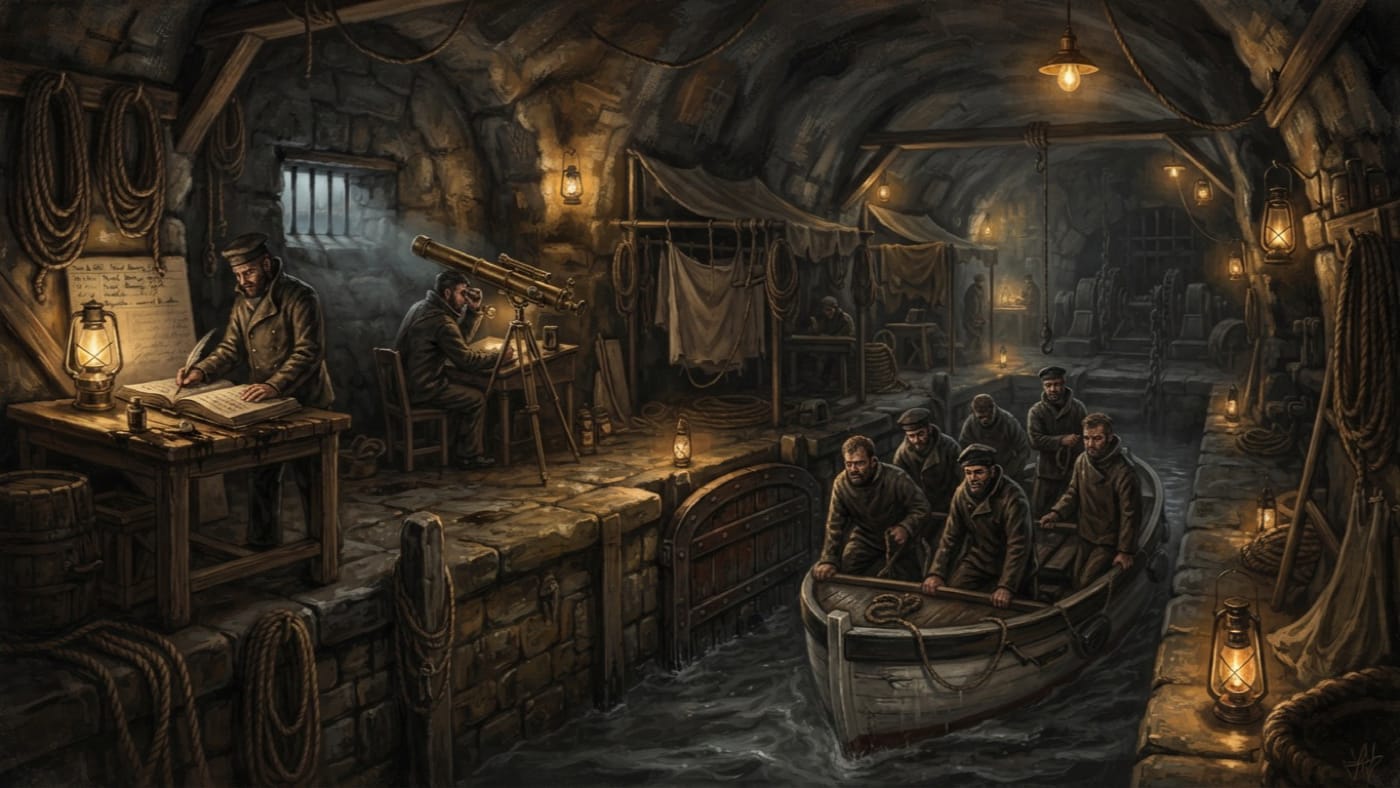
The Harbor Patrol keeps its boats underground. Visitors expect a maritime watch to live on the water like gulls and drowned men. Instead they go down the second stair beneath the Harbor of Chains and find hulls resting in covered slips cut into Byzantine rock. The slips are lamplit, wet to the knee and smell of tar, tallow and rope. At the far end of each slip a water-gate stands shut against the Bosphorus. When the gate opens, the strait comes in grey and the boat goes out. Anything the crew sees out there becomes the Patrol's property once it is written down. What may be done about it belongs, as a rule, to someone else.
#On the Station
The Harbor fronts the strait along a mile of fortified quay at Bastion-Constantinople, the southern anchor of the Line, where the Sagittal works end and the water takes up the argument. There are eleven piers, which take military supply, pilgrims and commercial cargo. Above ground it is a Shield-Prefecture installation, apportioned among whichever offices have most recently stamped a pier. Below ground it runs three levels deep, and their arrangement is the first lesson in Patrol jurisdiction.
The first level holds munitions and provisions for the Bureau of War, and the Patrol walks past them on its way to work. The second level is the Patrol's operational headquarters, with its slips, water-gates, log-tables, drying racks for line and canvas, and the chain-winch foundations. Those foundations root into the same bedrock, so the floor shudders at dusk and dawn like a vestry clearing its throat. The third level belongs to Mother-Cryptor Sabine and the deep archive of the Bureau of Shadows. The Bureau of Purity makes its quarterly sweeps through the sub-vaults and stops before the third stair. The Patrol stops a good deal sooner. A sailor posted one flight above the most guarded records in the southern anchor learns early that a staircase can serve as a jurisdictional instrument.
Even on its own level, the Patrol owns very little. A crew of fourteen raises the chain at dusk and lowers it at dawn, working in shifts of seven, and that crew answers to the winch-house and to its own impenetrable dialect. Harbormaster Joram Clee walks the quay each morning and enters the chain's condition, temperature and luminosity in triplicate, countersigned by the harbor watch. The Patrol shares the rock with all of them and shares its authority with none, mostly because it has so little authority to share.
An earlier harbor circular placed the Patrol's station at "the western anchor of Bastion-Lorraine."
The station lies at the southern anchor of Bastion-Constantinople, on the Bosphorus, where it has always lain. "Bastion-Lorraine" survives as a legacy name in songs, in veterans' mouths and on plaques nobody has funded a chisel to correct. Nobody consulted the boats, and the boats were never confused.
#On Passage and Duty
Most of the work is dull, which is why it gets done well. A Patrol boat spends more hours in its slip than on the strait. Those hours go on pitch, rope, lamp-wicks, scraping and the slow liturgy of drying things that will be wet again by evening. The apprentices learn to splice before they learn to watch. The theory is that a man who cannot keep a line sound will not keep a log sound either. I have found no regulation stating this. The sailors recite it anyway, with the confidence of men repeating scripture they have never seen.
Out on the water, the boats move among traffic that takes no interest in them. Supply hulls make for the military piers, pilgrim vessels come in heavy with permits and nausea, and grain, coal and salt go to the commercial berths. The Patrol does not register pilgrims. The customs clerks weigh the cargo, and they are under instruction about which barrels may be opened. The Reliquary Flotilla keeps its own wardens and its own sealed barrels, and no Patrol sailor with any sense of self-preservation mistakes a Flotilla hull for his own concern. What the Patrol does is look. It reports lanterns where no lantern should be, hulls riding lower than their manifests allow and fog thickening against the wind. It also reports anything that approaches the boom after dusk, when the winch has raised the chain.
The pressure is hunger. Kargath presses on the Bosphorus through the Black Sea lane and the rotting Thracian marshes, where grain spoils in the hold and the water itself goes sour. Scarcity breeds contraband the way damp breeds mould. Smugglers swap seals with warmed wax, counterfeit reliquary tags and time their crossings to the loudest bell-tolls so the bronze covers the oar-chop. A Patrol crew that sees such a crossing may lamp it, log it and report it. Purity, customs or War decides whether the hull is stopped, the crate opened, the seal tested or the smuggler hanged. Sometimes it depends on whose crate it was. The Patrol carries the lantern, and other men carry the warrant.
#On What the Watch Records
The Patrol's most famous entry belongs to a telescope.
On the night of the Black Sea Armada, A.S. 162, forty-seven hostile vessels entered the Bosphorus approach. The chain burned white for seven hours. Forty-three ships were destroyed, three retreated and one was never accounted for. The forty-third ship hung on the burning links before it went. A Patrol telescope operator, watching through the glare with brass pressed to his eye, logged that one of its crew appeared to be writing.
He was reassigned to a ground posting the following week.
The log page was not removed. It was annotated in red ink with the standard marginalia of the Bureau of Doctrine: Observed. Filed. Not Confirmed. Those three words are the most complete statement of the Patrol's place in the world that I have found in any archive. The operator observed it, and the Patrol filed it. Confirmation was another office's business, and that office has not supplied it. The entry does not say what was being written, and I will not supply it either. Nor do I know why the man was moved. Postings change for reasons of lungs, quarrels and arithmetic, and occasionally for reasons of telescopes.
Clee's records sit beside the Patrol's like a neighbouring parish register. His morning entries cover condition, temperature and luminosity, filed in triplicate and countersigned by the harbor watch. The Patrol logs what passes the chain, and Clee logs the chain. When the two agree, the Bureau of Records files them together and calls the agreement corroboration. When they disagree, Records files them separately and calls the gap a discrepancy, which is a filing category and settles nothing.
#On the Neighbouring Vault
Between the second winch foundation and a blocked Byzantine cistern lies the permitted harbor-level vault of the Widow's Syndicate. It was licensed in A.S. 142. The A.S. 198 survey confirmed its filed dimensions. The A.S. 200 survey found the eastern wall eleven meters farther east, and no excavation record accounts for the difference. The Bureau of Engineering has the measurements. The Syndicate has documentation that agrees with whichever measurement is most convenient. The Patrol has the slip next door.
A Patrol apprentice reports hearing teaspoons behind the cistern, which remains blocked from the harbor side. The sound is in the record and nothing more is. It establishes no passage and no occupant, and it gives an apprentice no warrant to knock.
The Syndicate's three Houses reach into harbor life in their separate ways. Half the harbor, by the Syndicate's own reckoning, has borrowed from the House of Black Pennies. I have not counted how many of that half wear Patrol oilskins, and I will not pretend that I have. The Grey Veils keep household records that the Bureaus misplace, and the White Cups keep tea, documentation and a long memory for courtesies. A sailor who owes a pension advance, whose mother's file sits in a Grey Veils box, does not need to be bribed to feel the weather of a room.
The question of what lies in the added eleven meters has been put through the proper offices. The Syndicate says registered collateral, and the Harbor says it has no jurisdiction. The inquiry ends there.
#On the Present Watch
According to the Harbor's own account, the chain went dark on eleven irregular nights in the eighteen months before that account was written. For each of them, the Patrol's logs give the same cause: atmospheric interference. I have read the entries. They are short and dry, written by men who knew what the column would accept.
The Harbor's account of the fourth night, entered as 14 Corvus, A.S. 200, alleges that a single vessel moved through the strait without appearing in the Patrol log. I record the allegation as alleged. An absent line in a log proves only that the line is absent. Fog, a lamp failing, a crew watching the wrong bearing, an entry lost in copying and an entry never made are all possible causes, and so is a sailor who owes Black Pennies more than he owes his own eyes. The page does not choose among them, and neither shall I. I have instructed Records to file the night under the Patrol's heading and the allegation under the Harbor's, and to keep the two in one box.
On most mornings the arrangement holds. Clee writes nil for luminosity. The winch crew lowers the chain while the floor of the second level shudders. Down in the slips, a boat that went out at dusk comes back through its water-gate dripping, and its crew lifts the lamps off and enters the night's sightings by bell-time. Some other office will decide what any of it means. Then they start on the rope.