

#On the Recorded Name
"White Mercy (Inquisition): Branch specializing in 'cleansing without flame'; euphemism for quiet disappearances." (glossary entry, given here entire)
White Mercy is a branch of the Inquisition. The record establishes that much, and it does so in two places in the same glossary. The first is the branch's own entry, quoted above. The second is the standing list of the Inquisition's notable branches, where White Mercy comes third: after the Chancery of Keys and the Red Lanterns, and before Black Oath and the Chamber Penitentiary. The Red Lanterns entry repeats that list, and so does the Chancery's. A sentence cited three times is still one sentence. It has simply been read more often.
An institution is known on paper by its name, its classification and its function, and White Mercy has all three. The paper gives no roster, seat, commander or founding instrument. It also gives no date on which any of these began or ended. This dossier was commissioned in A.S. 201 / 1911 CE, and that year belongs to the compilation alone. It is not the year the branch was founded, the year it first appears, the year it last acted, or the year it was struck from anything.
#On Cleansing Without Flame
The specialization takes up four words. In the next breath the glossary translates them, with a frankness I find almost indecent in an official text: cleansing without flame means quiet disappearances.
The Church has never been shy of cleansing. Its usual instrument for the work comes with a full liturgy: the scaffold raised in the square, the sentence read over the kindling, and a clerk counting the faithful in attendance. The pyre teaches, and it is worth something only because people watch it. A sermon delivered to an empty square is a waste of firewood.
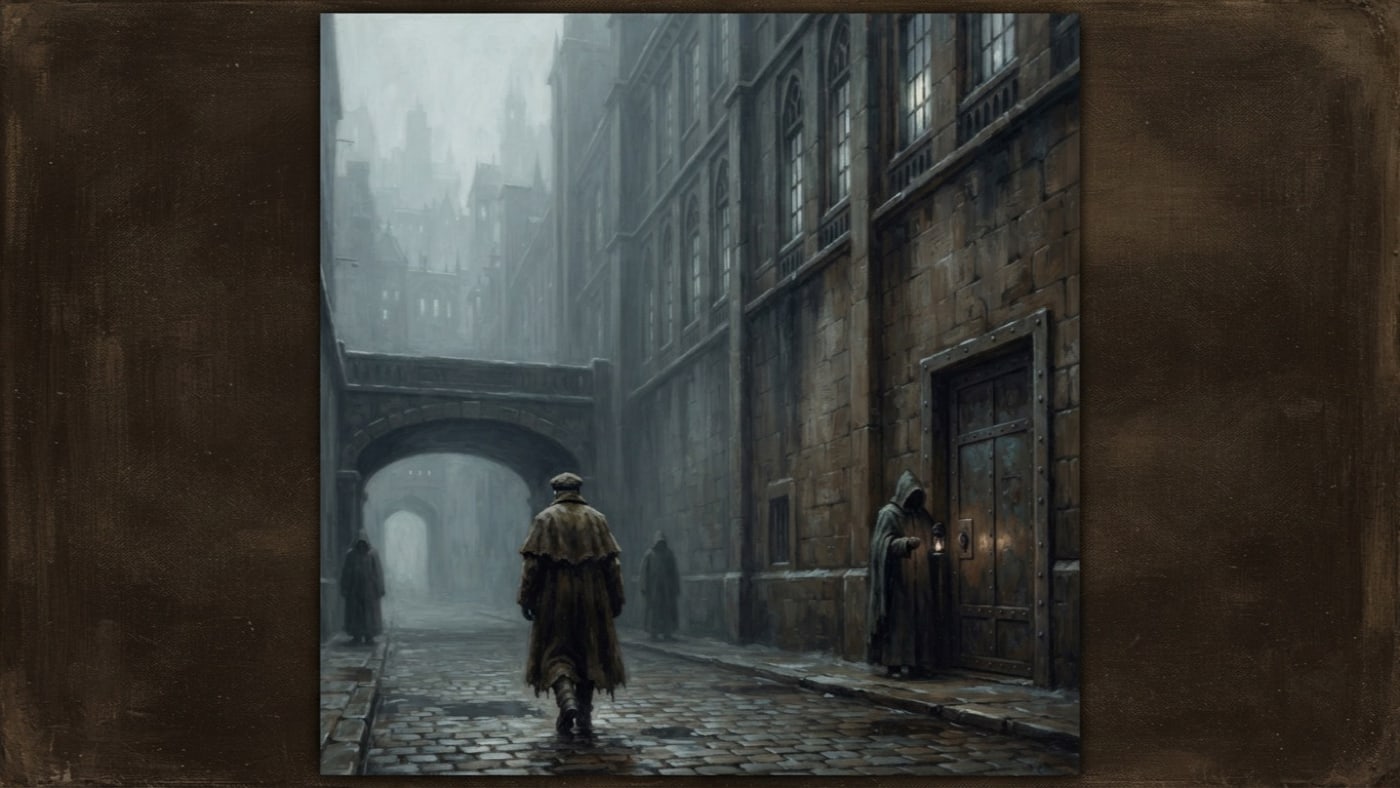
The branch's specialization takes away the fire and keeps the verb. Cleansing goes on. What has been removed is the audience, and with it the scaffold, the reading and the clerk's tally. From the glossary's own words, what remains is a person who was counted among the living and then is not. Nothing is said about where that person went, and nobody is invited to look.
That is all the glossary says, and this dossier says no more. The phrase does not tell me how anyone disappears or who takes them. It does not say where they are taken or what is done once they arrive. A disappearance recorded only as a disappearance must not be quietly turned into an execution, a hospital death, a conjuring trick or a peaceful retirement. Each of those would be a claim about the missing person, and there is no evidence for any of them.
The noun mercy certifies nothing either. In the Synod's vocabulary it has had many employers. The Bureau of Mercy uses it for broth-kitchens and hospices. The Lantern Mercy Preachers use it as sedition. The White-Mantled Inquisitor wears the colour without the noun. A shared word does not make any of them kin to this branch. A cleansing without fire spares the reader the smell. It is not shown to have spared the person cleansed anything at all. If the name describes any mercy, it is the one shown to those who never had to watch.
#On the Neighbouring Branches
The Inquisition is the Synod's terror arm, and terror is easier to administer when it is divided into departments. The glossary's list names five of them. The list establishes that the five share a classification. It does not establish that they shared a chain of command, a building, a budget or a single year of operation. Being listed next to another office is not the same as reporting to it.
Some readers have assumed a bond with the Red Lanterns, because this dossier was commissioned on a referral from their entry. A referral is a clerical courtesy, and it creates no superior office. The Red Lanterns are documented as street squads of the Bureau of Purity, whose crimson glass makes correction visible on a citizen's face. That method and its paperwork are theirs. Nothing in the record lends any of them to White Mercy.
The two entries can be compared only at the level where both are recorded. The Red Lantern brand is meant to be seen, and the record says correction must be seen. White Mercy's specialization is defined by the opposite: quiet, and the absence of anyone to see. Set next to each other in the same list, the two entries form a fair diagram of the Inquisition's range. The diagram shows no shared targets, no handing over of prisoners and no joint policy, and I have no evidence of any.
The Bureau of Doctrine defines what the Church holds, and Purity enforces it. Which office White Mercy answered to, if it answered to any office I could name, is not on file.
#On the Register and the Office
"The list has never been revised. The office it names has been dissolved." (this Codex, on the Chancery of Keys)
The standing branch list proves less than its tone implies. Its first name is the Chancery of Keys. The Order of Severance dissolved the Chancery for "joyous irregularities." The office is gone, and the only remnant the Lore Book records is a gap in the bell schedule it used to keep. The glossary still names it in the present tense, among the Inquisition's notable branches, without comment.
So the register cannot serve as a roll call. An office can stand in it long after its seals have been broken and its clerks reassigned, because nobody amends a glossary for the convenience of the people who read it. A name being present in the list shows that the name was once entered. It does not show who answers to it today.
The same caution applies to White Mercy, and it must be applied evenly in both directions. The Chancery's dissolution does not show that White Mercy has been dissolved as well. Being listed together does not mean sharing the same fate. Black Oath, whose name sits next to White Mercy's in the same line, is in no stronger position. Listing the two names side by side establishes neither when either came into being nor whether one ever took the other's place. Anyone who reads a line of succession into that comma is reading his own hopes into it, and I will not seal his reading.
For the present survey, then, the standing list shows that White Mercy was recorded as an inquisitorial branch. It does not show that the branch was deployed in A.S. 201. It does not show that the branch had been dissolved by A.S. 201, or that another branch had replaced it. None of the three claims can be certified.
#On the Present Survey
This dossier certifies four things: the branch's name, its classification under the Inquisition, its recorded specialization, and the glossary's plain reading of that specialization as quiet disappearances. Everything else about it remains unrecorded here. That includes its headquarters, leadership, founding, any dissolution, its personnel, procedures, instruments, victims and successors. An unrecorded fact is one this record does not support. It has not been shown to be absent, and it has not been shown to be concealed. I make no accusation of secrecy against an office whose very existence I cannot currently confirm.
Readers who want the operational particulars should apply to the Bureau of Doctrine, under whose seal this survey is filed. Their applications will be received.