

#On Grain Set Apart
Widow-grain is grain with a dead man written on it.
I have found no statute for the phrase, and I have looked in the rooms where statutes are sent to be forgotten. It is a depot word. It names sacks that travel under a widow-allotment seal, set apart for households whose men were given to War and whose sons were taken by the Continental Levy. The seal certifies that such a household is owed grain. That is the whole of the promise on record. I could lengthen it with clauses the Bureaus never wrote, and they would probably sign them. I decline.
The first lesson of widow-grain is that an allotment and a meal are separate entries. A household may hold its allocation for a month and eat nothing from it. A sack may stand in a depot within sight of the widow, under her seal and against her number, and still not be hers until a clerk agrees she may carry it. Metz keeps one column for grain present and another for grain released. The whole profession of depot work lives in the space between those two columns.
In the kitchens the word carries a bitterness that the ledger copies leave out. There, widow-grain means bread that arrives late and arrives counted. The kitchens use the term more accurately than the Bureaus do.
#On the Seal and the Lane
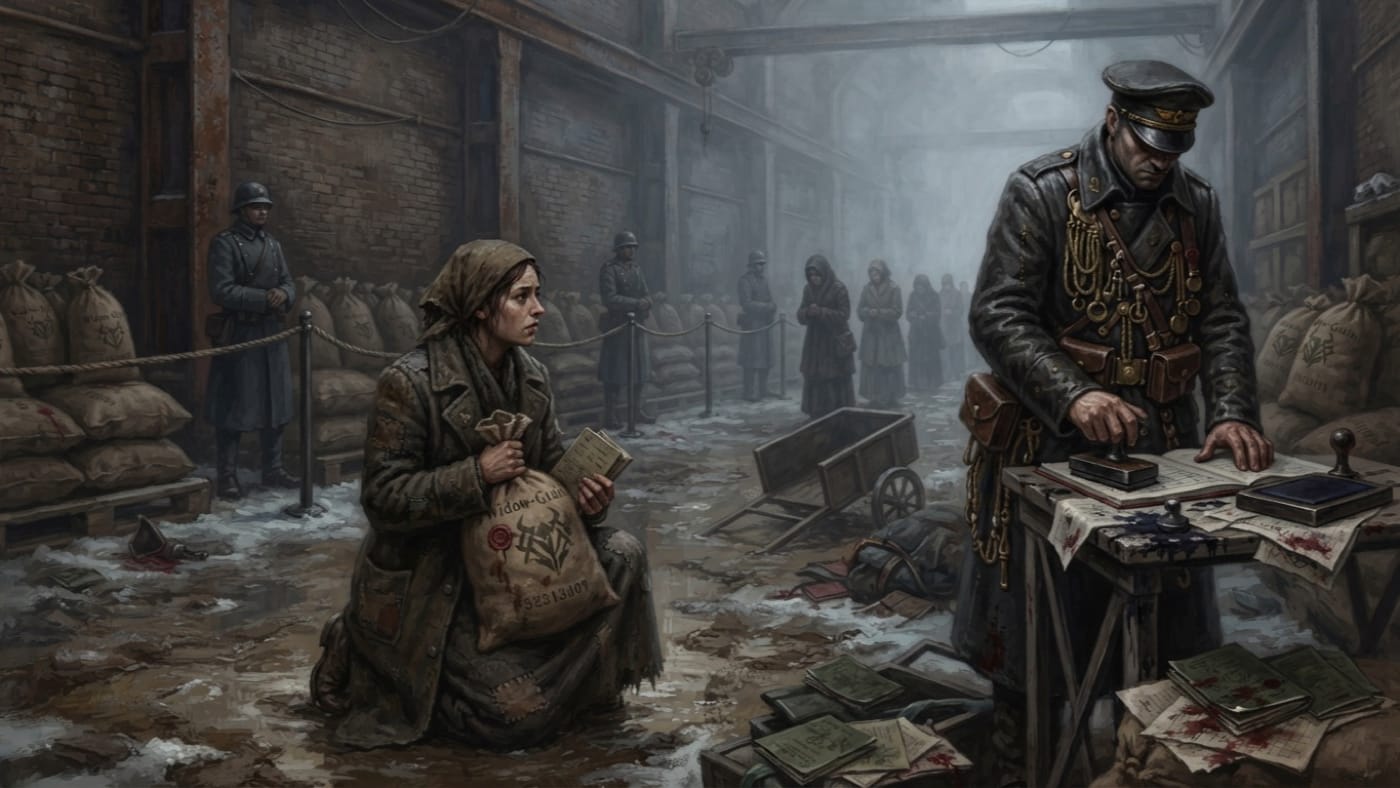
At East Depot Lane, Metz ran the route from convoy to cupboard in a fixed order. The convoy reaches the depot road. The bell count is taken. The seals on the sacks are checked against the manifest. The gate opens and the release lane is posted. The household presents its papers at the stamp table, the papers are examined, the receipt is stamped, and the allotment is posted against the household number. Only then does anyone lift a sack.
Two offices stand along that route. They must be kept separate, even where Metz did not keep them separate. The Palatinate Inspector holds depot compliance, seal priority and lane discipline. He decides whose wax goes first, whose paper waits for a counter-check and when the lane may move. The Queue-Marshal ties the rope, chalks the wagon pen, assigns the stack and blows the whistle, and he walks the lane in a waxed coat hung with cord loops. The Inspector rules the paper. The Marshal handles the bodies that carry it.
The materials are wretched. Metz is a damp city, and the depot is its dampest room. Rope swells in fog and sags between the posts. Flour sweats in the sack and cakes at the seam. Wax softens under thumbs and takes impressions it was never meant to take. Paper fares worst. A ration book pressed against a wet coat for three hours begins to forget what was written in it. Every material on the route is losing its shape, and the procedure assumes that none of them is.
Each step is lawful, and each step costs an hour. The widow at the rope holds the right to the grain, and the grain is close enough to smell. Between them stands a sequence of signatures, and none of it can be hurried unless another signature permits the hurry.
#On the Household Behind the Claim
A widow-allotment seal is never addressed to a woman. It is addressed to a household, and the household is a number.
The number exists because the man does not. War took the husband and the Levy took the son. What remains at the table is a mother, children too young for the muster roll and whatever kin the parish has let stay. The depot does not see these people. It sees a household entry, a count of recognised mouths, a ration book stamped from earlier issues and the posted allotment beside the number. Hunger enters the ledger only after the ledger has agreed that the household exists.
The standard ration chit makes the same demand of ordinary households: a recognised count, a legible paper and a clerk entitled to refuse it. I cite it for comparison and no further. Nothing I have read says the widow allotment uses the chit's fields. Nothing says how much grain one mouth commands under the seal, how often it is issued or when it lapses. Those particulars belong to depots that did not write them down, or wrote them where I have not been invited.
The grain is also distinct from the Widow's Pennies, which flow the other way. The Pennies are a due that Tithes collects on bereavement, coin taken from the widow's palm. The grain is owed to her. No record I trust makes either one a condition of the other. The Synod charges the bereaved with one hand and feeds them with the other. That is an accident of departmental geography, and I will not dress it up as a policy.
#On the Metz Distribution
The full account belongs to the Queue Riot of Metz. Here I keep to the sacks.
The convoy arrived in fog. The fog delayed the bell count, the count delayed the gate, and the gate held the widow-grain behind the release lane while the queue pressed tighter against its ropes. The queue broke into knots around its papers: widow clusters, platoon families, veterans and parish groups. Women held their ration books above their heads to keep the ink from smearing. A platoon pushed forward from the left stack, and no tribunal has settled why. The inner cordon bent. The Inspector gave an order that survives in three verbs, and the cordon fired.
The order covered the whole queue, but the whole queue did not die. I give no count, because none of the counts I hold deserves the name.
The second order concerns this article more than the first. The Inspector had the names crossed from the ledgers. A dead claimant with an active entry is an open debt. The household count stands one mouth too high, the grain assigned to that mouth must be issued or explained, and the office that fired is left owing bread to the people it shot. Strike the name and the entry closes. The household allotment shrinks. The depot's outstanding obligation shrinks with it, and so does the denominator against which the day's distribution is measured.
By evening the grain was moving. Receipts were stamped, and allotments were posted against household numbers with the erased taken out. Some surviving widows got less than they had been assigned, because members of their households no longer drew. Some got nothing, because their papers had been trodden into the mud of the lane, and a ration book trodden to pulp proves no household. A few got more than their entry allowed. The record does not say whether error, pity or theft did it, and I will not choose for it.
The Records abstract states that rations were distributed without interruption. Read the way a ledger reads, the sentence is accurate: every claim still on the books at dusk was served. The restricted formula is shorter and gives nothing away: lethal pressure correction followed by ledger erasure.
Earlier depot summaries attribute the deaths at East Depot Lane to crowd movement prior to armed intervention.
Withdrawn for sealed circulation. The crowd was dangerous, and then the cordon fired. The volleys reduced the households, and the summaries recorded the reduction as the work of the crowd. The summary has been corrected. The reduced allotments have not.
#On What the Record Retains
Metz became an instructional case, and the instruction kept what it could use. The Queue-Marshal schools still teach its sequence: fog delay, widow seal, hungry platoon, failed cordon, improper volley angle, ledger erasure, public phrasing. Rope widths were re-examined. Stamp tables were moved farther from the grain doors, and release lanes were given double posts. Palatinate Inspectors were told to file lethal orders under "pressure correction." Each of these reforms improves the lane. None of them touches the allotment.
War has since assigned the question of morale to the Bureau of Doctrine, and Doctrine has not acknowledged the assignment. Records kept what Records always keeps, which is the reconciliation. In the instructional material, the widow-grain appears only as the cargo that was late.
The list of what the register leaves out is longer. It holds no roll of the erased, since such a roll would undo the erasure. It does not say where the grain owed to the dead finally went, beyond a balanced column. It holds the Inspector's name in one draft and in no clean copy, and nothing at all about his fate. The widows who walked home with lighter sacks appear only as smaller numbers, which by the ledger's standard is correct.
Is the allotment the same across Synodal territory? I have surveyed it at one depot, through one disaster. Other depots seal grain for widows. I have not seen their books, and I will not lend Metz's practice to provinces that may run better or worse.