

#On the Common Form
The standard ration chit is the smallest instrument with which the Bureau of Tithes governs a stomach. It came into general use in A.S. 104 under the First Ration Reforms, when eight provinces gave up their local ration customs for one design, one issue rubric, one approved notation for grain-weight and one validation seal. Rationing was already old by then, and so was paper entitlement. Every ward had its tallies and every granary its favourites. Every canon also carried his own memory of who had wept most convincingly at the hatch last winter. A.S. 104 abolished the need to be remembered.
Before the common form, a household was recognised by people who had seen it. Afterward, any licensed ration clerk who could read the fields could recognise it, and a family could carry its standing from one depot to the next, folded into a coat lining. The Bureau called this portability. The restricted doctrine, which I have read in the original hand, called it comparable hunger and portable enforcement. I confess the second phrase has a certain stride.
The public was told something prettier.
#On the Marks
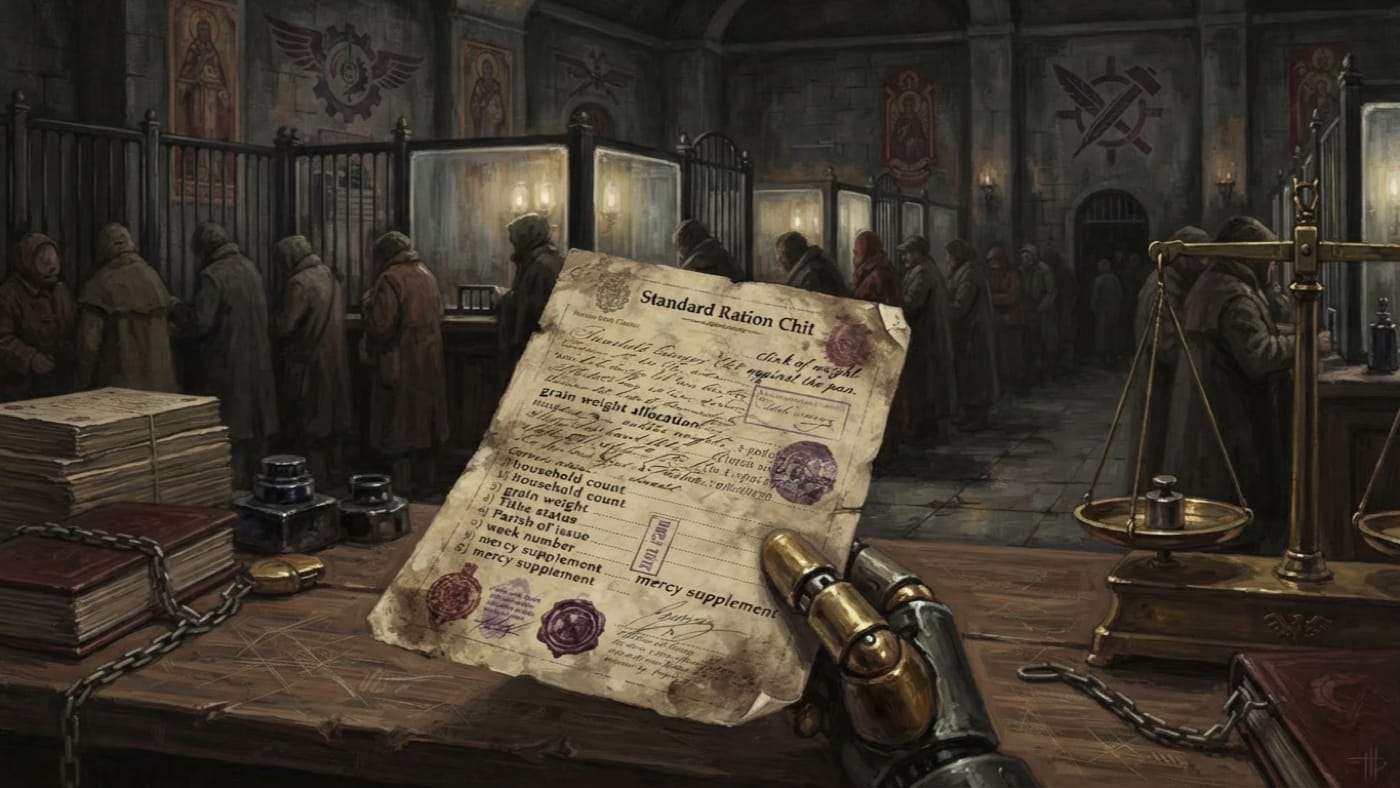
The chit is small, dull paper. Anyone who has handled one in a ration hall knows it chiefly as a texture. It is soft at the corners from sweat, gritty with whatever the last measure spilled, and tacky wherever the wax has failed to set. Held to a window, it shows a faint watermark of a chalice crossed by a scale. The designers put sacrament and weighing in a single device and did not trouble themselves with subtlety. They were right not to.
The reform required a household's particulars to be written on this paper in the common notation: the grain-weight allotted, the household count, the tithe status, the parish mark of issue and the week number of validity. The A.S. 104 standardisation notice adds the marks that do the real sorting. These are household class, labour yield, any mercy supplement, and the countersignature of a cleric attesting that all of the above is true, or at least that he was in the room when someone wrote it.
Each field is a gate. Grain-weight states what may be measured, and the household count states for how many. Tithe standing reminds the clerk that a family in arrears has already been fed once, by the Creator's patience, and may now be fed a little less by the Bureau's. Labour yield separates the man who hauls from the man who coughs. The mercy supplement exists so that mercy, too, can be rationed. The parish mark tells the clerk where the household's sins are filed, and the week number tells him whether the paper has gone stale.
#On Presentation and Refusal
When the bearer presents the paper, the household's appearance on the chit opens a proceeding in which the household itself has no voice. The clerk reads the common fields and sets them beside whatever record his depot keeps. He checks the seal, then the countersignature, then his own digestion. Then he either sets the measure on the scale or does not. The clink of the weight against the pan is the sound of Providence approved for disbursement. Silence at the scale means the paper has been found wanting.
A licensed clerk in Mainz could read the common form exactly as a licensed clerk in Metz could. Either one could refuse it, and refusal required no local knowledge at all. A clerk in a strange ward could now deny a stranger with the confidence he had once kept for his neighbours. This was hailed as impartiality.
At day's end the clerk reconciles chits taken against grain issued, seals against the register, and signatures against the hands authorised to make them. A depot whose chits and sacks agree is a good depot. Whether its households agree with its chits is another question, and nobody audits it.
The paper was built to ignore that question. The household count records recognised dependents. It has no room for the cousin who walked in from a burned village, or for the child whose father has not come back from convoy and who therefore sits as pending. It has none for the grandmother struck off when her son's tithe status changed. A family of seven holding a chit for five eats as five. The paper is correct and the table is wrong. The clerk has measured with perfect fidelity to the instrument, and the instrument is satisfied.
The common chit secures equal measure under Providence to every household of the participating provinces.
Corrected. The common chit secures an equally legible record of unequal measure. Providence was not consulted on the household classes.
#On Alteration and Exchange
Uniformity let Tithes read the chit in eight provinces at once. It also let every Grain Keeper with a penknife and some patience read it, and a forger now had one grammar to learn where there had been forty. Within a year, counterfeiting had become a cottage industry.
The crude forgers did not last. A badly copied seal is noticed by a clerk who sees a hundred good ones before noon. The competent ones grasped that there was no need to invent a chit when an existing one could be corrected. They advanced a week number, lifted a household class by one step, or found a mercy supplement where none had been granted. They moved a widow from pending to confirmed, which the Bureau would have done itself within a season or two if the widow had been willing to wait without eating. They entered as present a child the parish had entered as absent, or put a chit into service three days before its week.
None of this took genius. It took a steady thumb, ink matched to the parish clerk's, and the knowledge that the clerk at the counter reads fields rather than faces. The reform had trained him to.
Grain Keepers reconcile in the opposite direction from the depot. The depot clerk matches chits to sacks. The Keeper matches paper to sacks after the fact, through swapped chits, spoilage reports on perfectly edible grain, and transfers to a transport that never arrives. By the account that carries his name, Old Klem the Ledgerman perfected the spoilage shuffle. He condemned good sacks through the categories until the grain reached somewhere useful and the books stayed clean. The tradition of Silo-Agnes, whether she was one woman, a legend or several women sharing a name, keeps three hidden sacks against a ledger that had mislaid the living.
The factions read the same paper in different ways. The Mercy Keepers alter chits to get grain into children. The Quota Men keep the public account immaculate and divert modestly underneath it, which is how they survive audit. The Hunger Brokers treat an altered chit as a lease, with recruitment, silence or a name owed in return. A household fed off the ledger has acquired a creditor whose terms are never written down.
The chit also travels away from the counter. It turns up as a bribe for queue guards and assessors. It changes hands beside other local paper in Rheinscarp, and it pays the crossings at Bastion-Brest. It has no fixed rate. On any given morning it is worth whatever the next clerk is willing to honour, discounted by the bearer's desperation.
#On the Revised Household
The chit circulating in A.S. 201 is not the chit of A.S. 104. The paper has been replaced and the watermark revised. I have found no register I would sign that gives the dates of each change. Mercy supplements now divide into four subcategories, so a clerk can tell one kind of pity from another. There are two denial stamps, which means that refusal, once only a silence at the scale, now leaves ink that the household carries to the next depot. The household count draws on birth filings, labour yield, tithe arrears and penitential deductions. It also includes a field for spiritual temperament, which lets a clerk cut the bread of a man who scowled during sermon.
The governing principle survived every revision intact: bread follows recognition. A household that cannot get a cleric's pen to recognise it does not exist at the scale, however loudly it eats elsewhere.
The categories cut in A.S. 104 have carried every enforcement since. Standing Order 22-H of A.S. 134 found its suspects along those lines. In A.S. 157 the Weevil Year separated the cellars that trusted paper from those that trusted air. The dissolution of the Bureau of Agriculture in A.S. 158 left the grain with the office that had held the chit all along.
#Disposition
The standard ration chit is hereby certified as functioning exactly as issued. It records households accurately and measures grain faithfully. Authorised hands refuse it and unauthorised hands alter it, and both redeem it. Petitions concerning the gap between the household count and the household are to be lodged with the parish of issue, in writing, on paper the petitioner must obtain by surrendering something of value.
The Bureau suggests a chit.