

#On the Name and the Substance
"Some relics climb out of the mud on purpose." — Reed Market saying
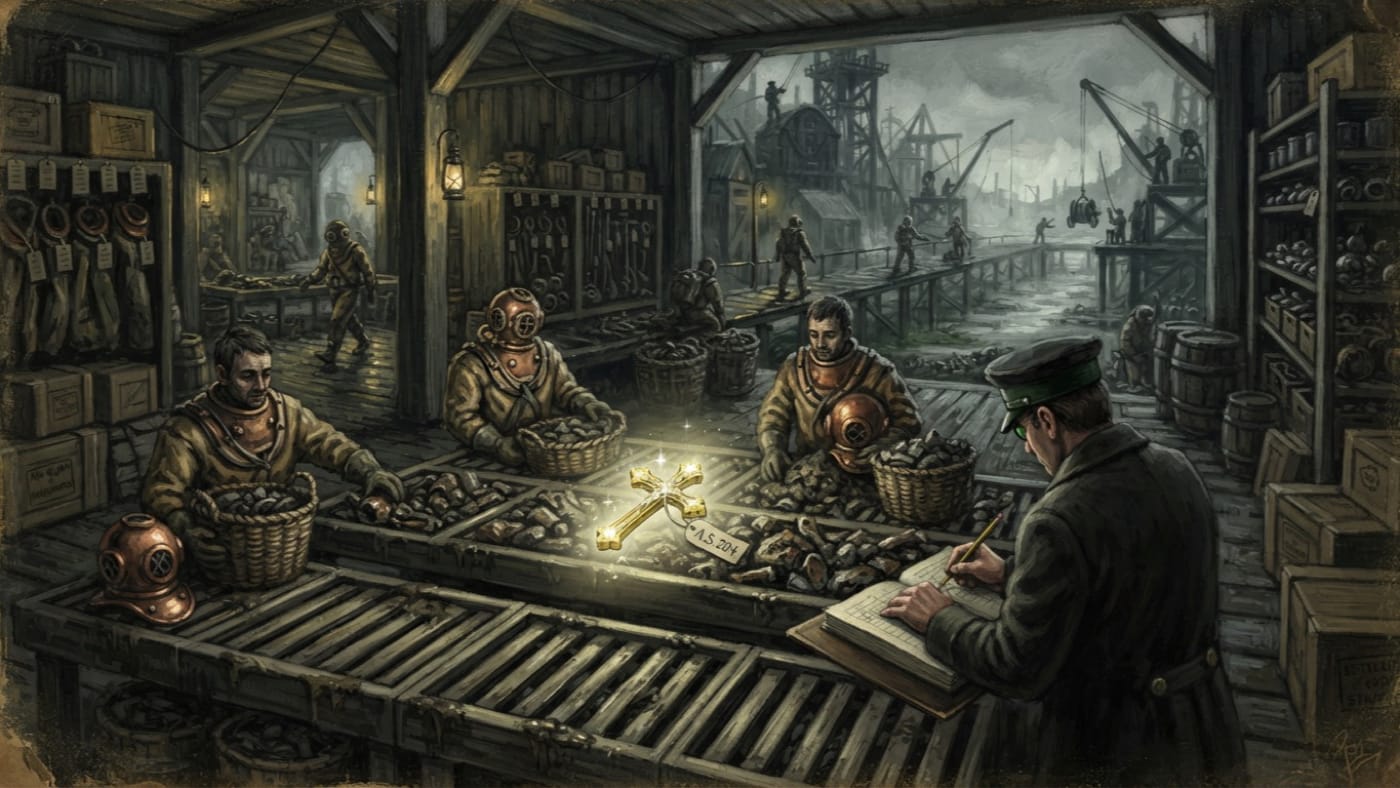
The Ash-Glyph Marshworks exports what the dead carried down with them. A soldier goes into the delta mud with a medallion at his throat, a regimental cup and a sliver of consecrated iron his mother bought from a pardoner. The brine takes thirty years over each of them and gives back a green lump, a black lump and a lump with a hinge. The trade calls this ordinary salvage: bone, corroded metal and waterlogged timber. The sorting boards of Diver's Gut were built for it. They have slatted planks, a bucket of vinegar, and a clerk with a pencil who does not look up.
A yesterday find is the object that makes him look up. The divers' definition is short, and the Bureau has produced nothing better: a relic with impossible freshness. It might be a reliquary fragment with its gilding intact, or a saint's medallion whose die-lines can be read with a thumbnail. It might be a consecrated instrument, such as a censer chain or an aspergillum head, drawn bright from mud that has eaten every rivet around it. The Reed Market calls suspiciously clean salvage tag-sweet. Among tag-sweet salvage, a yesterday find is the sweetest kind.
The reader must keep the objects apart from the men who sell them. The Mud-Relic Syndicate is known on the Reed Market as the Yesterday Finders. It took the name from the merchandise and kept it, because a cartel, like a diocese, prefers a title that sounds like a vocation. This tract concerns the finds. The Finders enter it wherever the finds pass through their hands, which is often.
#On Recovery and Intake
Finds come up from the burial shallows, where the Mortuary Cartography Office has sealed its grids and the marsh holds its own opinion of the sealing. The more remarkable reports come from the False Shore, a stretch of delta that shifts with the tides and that no cartographer has persuaded to stay put on vellum. Divers who work it say that some recoveries come out of the mud already warm. I record this as divers' testimony. These are people who have been cold since dawn and are paid by the piece, and I set their account down unaltered. No thermometer of mine was present. They were.
The False Shore yields corroded iron as readily as any grid. A fresh object may surface in the ordinary shallows. The Ledger assigns no exclusive source.
The divers are bonded labour. Debt in the Marshworks is paid off in diver rotations or in night shifts on the lantern routes, and the causeway fees ensure that nearly everyone owes. A diver on rotation goes down into brackish water among the war-dead of the Sagittal Line's eastern drainage. There he closes his hands on whatever is there and comes back along the Lantern Guild's coded routes, or he does not come back. Lantern passes are their own currency. The relics are not his to keep.
Everything that rises crosses Maro's tables. Diver-Boss "Softstep" Maro controls intake at Diver's Gut and takes his percentage of whatever passes his boards, fresh or corroded, before any of it moves on. Locals report that he leaves no footprints. They also report that before each dive he makes a small gesture which the divers copy and none of them can name. I enter both as reported and conclude nothing from them. The marsh's own record says one thing about Maro that is worth more than the footprints: he fears relics that arrive already tagged.
From Maro's boards the salvage goes to Seal Shed Row, where tag clerks stamp, seal and countersign. Nothing leaves without a tag. No tag holds without a seal. There are never enough seals. Seal capacity is the settlement's bottleneck, and tags have a habit of disappearing. A find can sit for days on a shelf in reed matting, sweating brine onto the planks, until a clerk has a free hand and a pressing reason to use it.
#On Tags That Precede Their Issue
The Ledger keeps two observations apart. Freshness is a condition of the object. The tag is a condition of the record.
Some recoveries surface with a salvage tag already stapled on before any clerk on the Row has touched them. Some of those tags carry tomorrow's date, and others a date further off. The Ledger does not join the two observations by habit. A pristine medallion may come up with nothing attached. An anomalous tag has not been shown to accompany every fresh object, and freshness has not been shown to accompany every anomalous tag. Anyone who joins them in conversation does so on his own authority.
I decline to say what the date means. The Church has doctrine for miracles, for counterfeits and for the gifts of the Great Deceiver, and the Reed Market has a word for each. Some say a forger's clerk set his date-wheel ahead. Some say a seal clerk dated forward to beat his own queue. Other explanations are offered more quietly, nearer the water. None of them has been entered into the record. The tag has.
The central recorded instance is the casket of A.S. 199. My survey of the Marshworks gives the account. A recovery team working the False Shore brought up a reliquary casket containing a finger-bone. The Bureau of Alchemical Standards reportedly matched the bone to no known saint, no known soldier and no known species of primate. The casket's tag was dated three days ahead. The finger-bone was confiscated and the divers were reassigned.
The account stops there. The record gives no names for the crew and no day of recovery. It does not reproduce the tag's inscription. It does not say where the casket now rests or who holds the bone. In that survey I supposed a Strasbourg vault. That was a supposition. It is marked as one here, and no reader should cite it as custody.
#On Authentication and Purchased Histories
Since A.S. 194 the Bureau of Alchemical Standards has inspected eleven such recoveries. Eight were certified authentic. Three were classified indeterminate.
The figures establish what they establish and nothing beyond. They do not name a maker or prove a mechanism. They do not warrant that every object from the mud is safe to hang in a chapel, and they do not vouch for a single date on a single tag. The full examination reports have not been published. The record does not say how many of the eleven came from the False Shore, or whether the casket of A.S. 199 was among them.
The relic authenticator's trade has several stages: reconstructing custody, physical examination, response testing, judging fit with Doctrine, and finally disposition. The published record gives only verdicts for the eleven Marshworks objects and does not say which stages were carried out. I will not invent a laboratory to fill the gap. The trade's oldest sin is well known, though. A broken custody chain gets smoothed over with two words, lost record, and everyone in the profession commits that sin while condemning it.
The finds expose a gap in the system. Authentication speaks to the object. Provenance speaks to its history. A consecrated medallion can be true metal, true die and true blessing and still carry a false account of how it reached the sorting boards. A relic cannot enter the Church's supply with only its holiness. It needs a story: a grid coordinate, a regiment, a recovery date, and a seal from the Row. The Yesterday Finders sell that story.
The Syndicate plants relics, launders provenance, forges tags and bribes seal clerks. When those methods fail, it uses violence. The record holds that anomalous recoveries have entered the authenticated supply this way, as ordinary battlefield salvage carrying histories bought at the Reed Market. The supply the Bureau of Relics keeps for the faithful accepts a tag that looks correct. Once a relic is in that supply, nobody reads its history again.
The record names no officer of the Row as a Syndicate member. It makes nobody the cartel's master. Nor does it settle which objects reached the market by planting and which came up from the mud of their own accord.
#On the Present Recovery Demand
"Too bright to work safely." — Guildmaster Orren Pike, on the marsh, A.S. 201
The Mortuary Cartography Office's annual report for A.S. 198 states that relic recovery rates "remain consistent with historical averages."
Relic recovery at the Marshworks tripled between A.S. 194 and A.S. 200. The figure covers the settlement's recoveries as a whole and gives no count of yesterday finds within them. The A.S. 198 assurance is withdrawn. Its author has not been identified, and the Office reports that the matter is closed.
This survey records conditions as of A.S. 201. The authorities want higher recovery yields. Guildmaster Pike, whose lamps decide who crosses the marsh at night and comes back, says the marsh is too bright to work safely. Both statements stand in the record. Only one of them comes with a quota.
The cost of meeting the quota falls where every cost in the Marshworks falls. Bonded divers go down more often, on rotations already known for breaking the people who work them. Night crews make more crossings on routes that kill more of them than any other work in the settlement. Each new recovery adds another bundle to the Row's shelves, another tag waiting for a seal there are too few of, and another chance for the Yesterday Finders to sell a history to a find that came up without one.
Nobody has entered an origin for the yesterday finds. The record holds eight certified objects, three indeterminate objects, a casket somewhere and a finger-bone somewhere else, and a stack of tags that arrived ahead of their dates. For the present the Ledger asks no more of the marsh. It asks more of the Row. Seal capacity is to be increased and the diver rotations lengthened to suit. Divers cost less than seals.