

#On the Row and Its Authority
"The dead are placed. The map is mercy." — Public formula of the Mortuary Cartography Office
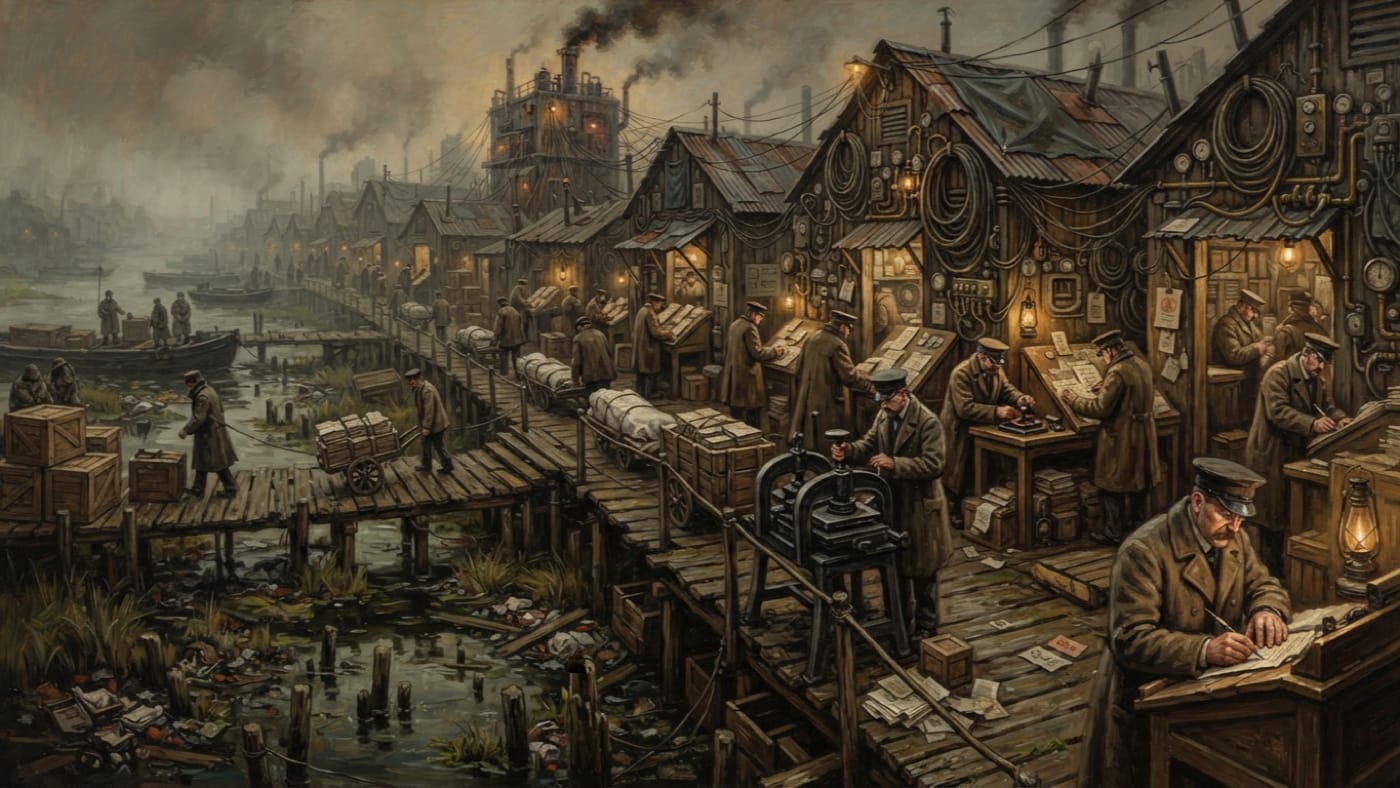
Every corpse that comes down the Danube to the Ash-Glyph Marshworks arrives with two bodies. One lies wrapped in vinegar-soaked linen in the hold of a barge. The other is made of paper and does not yet exist. Seal Shed Row is where the second body is made, and in the Marshworks the second body is the one that counts.
The Row is a line of timber sheds on the settlement's raised planking. It smells of ink and damp wood, and the wood is winning by the end of every season. Inside, the tag clerks of the Mortuary Cartography Office stamp, seal and countersign the documents that make remains and salvage recognizable to the Church. The Office holds the sheds as it holds the Glyphyard, under Cartographer-Provost Lysa Vane, and it claims both on the same public warrant: dignity and order for the dead.
The Row has no founding decree of its own. I have looked. The settlement was chartered in A.S. 74 (1784 CE) by the wartime and record-keeping offices that the Synod's constitutional settlement of A.S. 90 would afterward file as the Bureau of War and the Bureau of Records. The sheds appear in no instrument as a separate foundation. They gathered, as paperwork does, around the first stake that needed a receipt.
What the Row practises is a habit with a liturgy attached. The local formulation runs: purity through placement, obedience through naming the dead correctly. No council has ratified it. Every clerk on the Row works by it, and the Marshworks punishes grave misplacement as a sin.
#On Tags, Seals, and Countersigns
"If it stamps, it stands." — Saying among seal-forgers, repeated without irony by the honest
The work begins with the manifest. A barge ties up at the Charnel Moorings carrying its dead and a list of them by number, rank and unit designation, which is about as much as the Line knows of a man by the time he has stopped moving. The manifest goes to the Row. The dead, for the present, stay where they are.
At the clerk's desk the manifest is broken down into tags. Each tag carries a designation, and each designation is entered against a burial-grid coordinate in the Office's ash-glyph numerals. Where the dead man confessed before he became cargo, a confession receipt is fastened to his name or his tag. Salvage from Diver's Gut goes through the same rite with less linen and more argument.
Three marks follow, and the Office gives a precise name to the lack of each. A body without a tag is unprocessed. A tag without its seal is invalid. A seal without its countersign is unrecognized. None of these words describes the body, which is exactly as dead as it was before. They describe its standing before the Church, and in the Marshworks standing is the only property the dead keep.
The Row does not close graves. That is a separate act. The grid of ten paces by ten is staked and filled, a Seal Magistrate seals it, and its map is filed. The Row prepares the papers the closure requires and receives the disposition back afterward, so a single corpse may pass under the same wet thumb several times before it is permitted to rot officially.
The clerks write the names. The prohibition on speaking a dead name over open water binds the mouth, and the Office has always held that ink is no mouth. During my visit of A.S. 197 I noticed that the clerks still lowered their voices when reading a tag back for checking. Doctrine permits the pen. The man holding it takes no chances.
#On Capacity and Permission
"Nothing moves without a tag, and tags vanish." — Marshworks commonplace
The sheds are the settlement's bottleneck, and everyone in the Marshworks will tell you why in the same words. Nobody can tell you where the tags go. Clerks blame the damp, divers blame the clerks, the Office blames theft, and the Reed Market has a reputation for selling replacements before the loss is reported. I record the accusations. I endorse none of them, which in my office counts as endorsing all of them.
A missing tag stops everything behind it. A barge cannot be cleared while its manifest is short. A grid cannot be closed on a coordinate nobody can document. Salvage cannot be traded, tithed, or even honestly stolen without the paper that says what it is. The glyph-stakers, haulers, barge-handlers and debt-rotation divers all wait on a clerk's desk. In a quarantine settlement, labour that waits is labour that falls further into debt.
So access to a clerk is worth money. The Marshworks says the tag clerk sells legitimacy by the staple. That is true of some of them. Others are merely slow, and their slowness is sold anyway, by whoever stands nearest the queue.
The Row's paper does not travel alone. At the Causeway Gate the wardens check seals and quarantine status for all movement by land, under the permanent quarantine instituted in A.S. 112 (1822 CE) and maintained for eighty-nine years since. A salvage tag is no quarantine pass. Neither is a lantern route mark from Guildmaster Orren Pike: his lamps decide who survives the channels after dark, but he cannot validate a single coffin. A worker can hold one paper, lack another, and stay in the marsh indefinitely because of the difference.
#On Provenance and Its Manufacture
"Provenance is purity." — Maxim of the relic authenticators
The Mud-Relic Syndicate, whom the Reed Market calls the Yesterday Finders, launders provenance through forged tags and bribed seal clerks. Its other methods are relic-planting and violence. The Row is where those methods get their coat of wax. A relic recovered anywhere, by anyone, becomes on the Row's paper a legitimate battlefield recovery from a stated grid, and it enters the Church's relic supply under that description.
Everything recovered passes first across the sorting tables of Diver-Boss "Softstep" Maro. He controls what comes up from the mud and takes his percentage before anything reaches the sheds. Nothing in the record makes him the Syndicate's master, and I decline to promote a man who leaves no footprints into a man who leaves a signature. His tables come before the Row. The Row's seal still governs what leaves it.
Local lore links the Row to audit raids and to a counterfeit stamp press. The record gives the press no owner, no date of discovery, and no seizure. The sheds speak of it the way chaplains speak of the Great Deceiver: a presence assumed in every irregular stamp and found in none. Rotating Synod auditors arrive, the desks are emptied, and ledgers are compared against ledgers. An audit can show that a seal impression is false. It cannot show whether a true impression was bought.
Most clerks are not Syndicate men. The Syndicate does not need most clerks. It needs one desk, on the right day, with the right countersign.
"If the relics are genuine — and the Bureau's own tests say they are — then something in the marsh is manufacturing consecrated objects from the raw material of the dead."
— Ash-Glyph Marshworks, On Relics That Arrive Without Invitation
The Bureau of Alchemical Standards tests what an object is made of. It does not test where an object has been. Of the eleven anomalous recoveries it has inspected since A.S. 194, it certified eight authentic and three indeterminate, and those certificates concern the material only. A genuine object can carry a false history. A convincing history does not make an object holy. The Bureau of Relics and the Church's authenticators hold custody and recognition of relics; the Row's tag is evidence offered to them, nothing more. The sentence above drew a conclusion about origin from a test that does not examine origin. It is withdrawn. Its author regrets the haste and notes, for the record, that he was its author.
#On Papers That Precede Their Objects
"The marsh counts differently at night." — Marshworks saying
Recovery rates tripled between A.S. 194 and A.S. 200 (1904–1910 CE). Part of the increase is what the divers call yesterday finds: pristine relics that surface already tagged, the tags stamped with dates that have not yet come. In A.S. 199 a recovery team brought up a reliquary casket whose tag was dated three days ahead of the calendar.
This is something other than forgery, and the clerks know it. A forged tag imitates the Row. A yesterday tag arrives as though the Row had already done its work, and the Row has no form for receiving its own future output. A clerk may not seal a document dated after the act of sealing. Nor may he throw away a tag attached to an object in custody. The paper is held. The object is held. Both wait.
The burial maps, meanwhile, drift. Lysa Vane redraws them each morning and files the discrepancies as seasonal drift, so a coordinate a clerk enters on a tag at dusk may describe ground that has rearranged itself by dawn. The Row certifies placement, and the marsh does not stay placed. The Bureau of Alchemical Standards has had the corpse-light's classification under review since A.S. 143, fifty-eight years. No clerk on the Row expects the anomalous tags to be dealt with faster.
I offer no account of how a tag comes to bear a date that has not yet arrived. The Office offers none either. The divers offer several, and the Office has filed them.
The barges keep coming. At the desks the present intake is broken into manifests, the manifests into tags, and the tags into seals awaiting countersign. The future-dated papers lie in their own tray under a stone, so the damp cannot lift them and nobody has to read them twice.