

#On the Nuisance
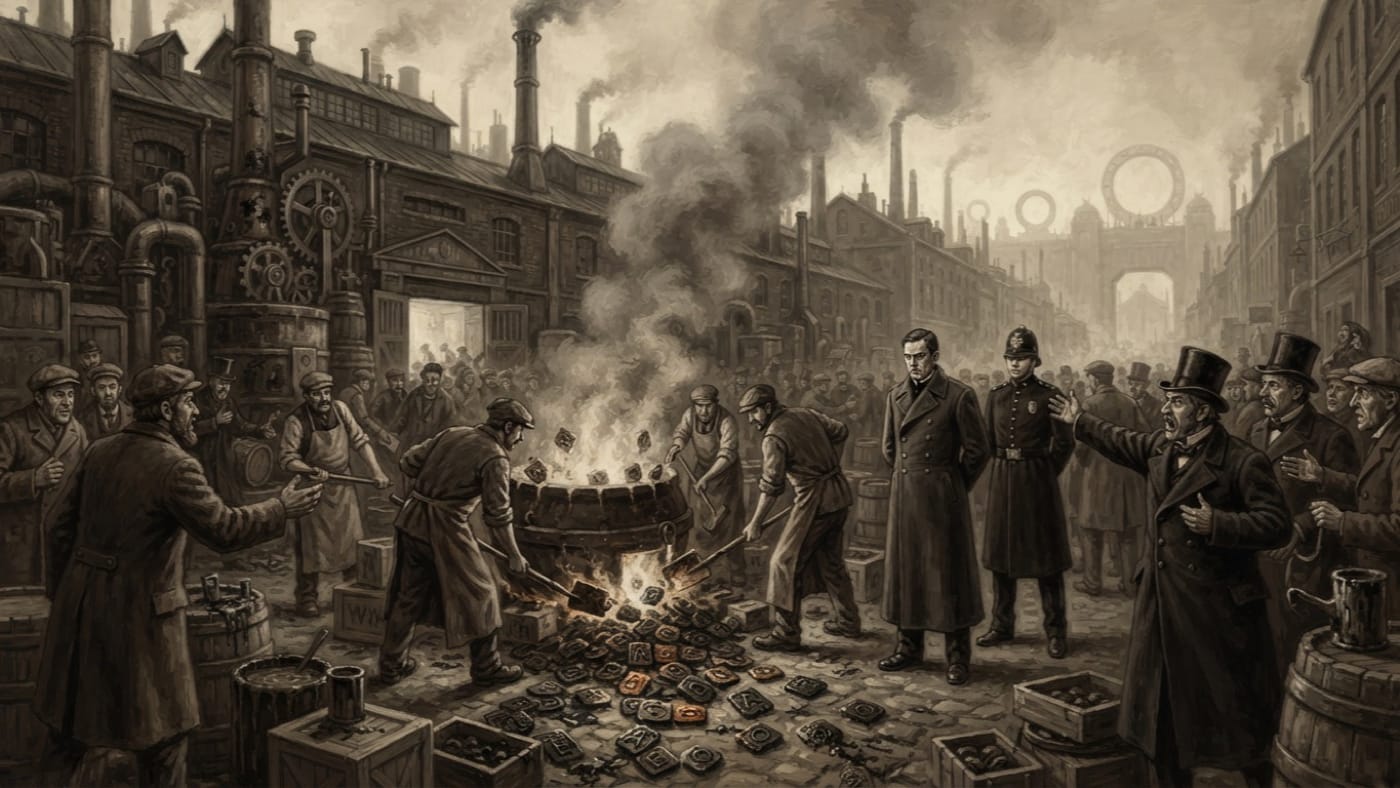
In A.S. 129, or 1839 CE by the heartland calendar, six hundred escort seals on Seal-House Row at the Steppe Gate each developed a blister shaped like a vowel. They were burned under the supervision of the Bureau of Purity. The smell lingered for weeks, and so did the lawsuits. After that, singing near the wax vats was forbidden. The prohibition is still in force. The record files the whole affair as the Blue Bubble nuisance.
The record calls it a nuisance. Six hundred instruments of licensed passage were spoiled in the wax. A Bureau was summoned to watch them burn. A street stank for weeks. A rule followed that the apprentices still obey seventy-two years later. All of this sits under the word a district magistrate uses for a neighbour's pig. I approve of the word. A frontier town that called every ruined batch a catastrophe would run out of ink before its real catastrophes arrived, and the Steppe Gate has had real ones.
The name is a filing label, and that is all it is. The record does not say who gave it, and it does not say the wax, the blisters or the smoke were blue. Clerks name things quickly and leave posterity to wonder why. I will not repaint six hundred seals to fit two words of clerical shorthand.
#On Wax and Certification
An escort seal certifies an escort contract. By A.S. 129 that certification belonged to one body only. The Caravan Court ratified the Seal-House Consortium's monopoly in the last quarter of A.S. 94, after the Red Pronunciation, on the argument that central certification would prevent another cascade. The blistering came thirty-five years later. The monopoly was already old, already lawful and already resented, and the nuisance did not found it.
What the wax promises is narrow. It attests that a paper is what it claims to be: issued by a hand entitled to issue it, and sealed with wax from where wax ought to come. It does not make an escort honest. It does not teach a drover's tongue the clause he must speak before the Treaty Ring. The certification trade, filed separately under the Seal-Houses, has never claimed otherwise. Six hundred blistered escort seals therefore meant six hundred authentications in doubt. They do not mean six hundred escorts, caravans or deaths. The record gives no count of journeys affected. It names no injured party and gives no casualty figure. I have found no surviving specimen.
The published register now gives escort contracts to House Orik. Nothing in the record says Orik's furnaces failed in A.S. 129, or any other house's. The responsible workshop goes unnamed in my file because it goes unnamed in the source.
The Consortium's published accounts describe the ordinary work of the south furnaces. Wax is clarified in iron pans. Apprentice casters stir by counted turns while a pronunciation boy reads the class table aloud, and a misread table ruins the batch. I give this as attested practice at the Row. I do not offer it as a reconstruction of the particular working day in A.S. 129. Nobody wrote that day down for me.
A Strasbourg commercial digest once described Steppe Gate seals as "wax receipts with frontier ornament."
Corrected in the Consortium's own published entry, after three merchants attempted passage on ornamental receipts and required medical extraction from the Treaty Ring. The correction belongs to the digest and the merchants. It is no ruling on A.S. 129. I reprint it for the reader who still thinks of an escort seal as a receipt and cannot see why six hundred of them were burned under a Bureau's eye.
#On the Blisters and Their Destruction
The defect, as recorded, was a vowel-shaped blister. The record does not say which vowel, or whether all six hundred bore the same one. It does not say how the blisters were found, by whom, or how many days passed between pouring and discovery.
The shape needs no embellishment from me to explain the alarm. At the Steppe Gate a vowel is a working part. The Scribe Bazaar drills vowels with ivory pointers, the stones of the Ring hear them, and the Red Pronunciation taught the town what a mispronounced one costs. A seal that rose into the shape of a letter its die never cut had added something to the instrument that no licensed hand had authorized. I do not claim the stones would have objected. I claim only that no receiving clerk on the Row would have passed it, and none appears to have tried.
The seals were burned, and Purity supervised the burning. That division of labour is familiar to anyone who has served the Synod. The Bureau of Doctrine defines what is wrong. The Bureau of Purity stands beside the fire while the wrong thing is put into it. The record does not name the officer, the place of burning, the fuel or the rite, if there was one. I supply none of them.
The record speaks of seals. It says nothing of the contracts they were meant to close. The town forbids the burning of paper, and I will not burn any in a sentence when the record burns none.
#On the Smell and the Suits
The smell lingered for weeks. The record says so and adds nothing on its character. I am told burning wax mixed with caravan fat is not a perfume, and I believe it without needing to stand downwind.
A smell matters more on the Row than in most streets. The Consortium certifies legitimacy partly by scent: when the steppe wind passes through the Ring, licensed wax gives off its recognised pitch and counterfeit wax smells wrong. A workshop street that reeks for weeks is an inconvenience to a trade that works by the nose. The record does not say whether any verification suffered, and I raise the point only so that the reader understands why the Row would mind.
The lawsuits lingered for weeks as well. That is the whole of the record. It names no parties, pleadings, court, damages or verdicts. It does not say whether the suits concerned the odour, the destroyed seals, the delayed escorts or something else that a frontier litigant thought worth a filing fee. To join the smell and the suits by cause would be convenient, and the source does not permit it. They share a duration and a sentence. I leave them sharing both.
A fire disposes of wax. It disposes of no claims. A merchant whose escort seal went into the furnace still held an escort contract that wanted sealing, a caravan that wanted to leave and a grievance that wanted a defendant. The Bureau can supervise a burning in an afternoon. A lawsuit takes weeks, and the record says these did.
#On Singing Near the Vats
After A.S. 129 nobody sang near the vats. The Row survey of A.S. 201 finds the rule still kept. The apprentices obey it without asking why. Talk is permitted, counting is encouraged, and humming, by the survey's account, earns a ladle across the knuckles.
The scope of the ban is narrow. It does not silence the furnaces. The pronunciation boy still reads the class table aloud beside the pans, and the casters still count their turns. Speech remains part of the work, and the work cannot be done without it. Only song was put out of the furnace end of the street.
The town keeps a separate rule against singing near the stones. The Row's rule concerns the vats. The two rules share a verb, and nothing in the record connects them.
The evidence will bear one plain statement. The administrative response is recorded, and the mechanism is not. A ban that follows an incident shows what the Row chose to prevent afterward. It does not show what caused the incident. The record names no singer and no song, and it never says that anybody sang on the day. It does not say the blisters were caused by song, by a bad ingredient, by malice or by any power, natural or otherwise, that the Bureau has a heading for. Six hundred seals rose into vowels. The Row stopped the singing near its vats. Between those two facts lies a gap that no surviving page fills, and I decline to fill it with a melody of my own composition.
Bureaus have legislated on thinner evidence. I have drafted some of that legislation myself, and I know the difference between a precaution and a finding. A frontier workshop watched a batch go wrong in a way that resembled speech, and it banned the nearest kind of voice it could spare. That is prudence. If it were a diagnosis, someone would have written the diagnosis down.