
#On the Inner Bench
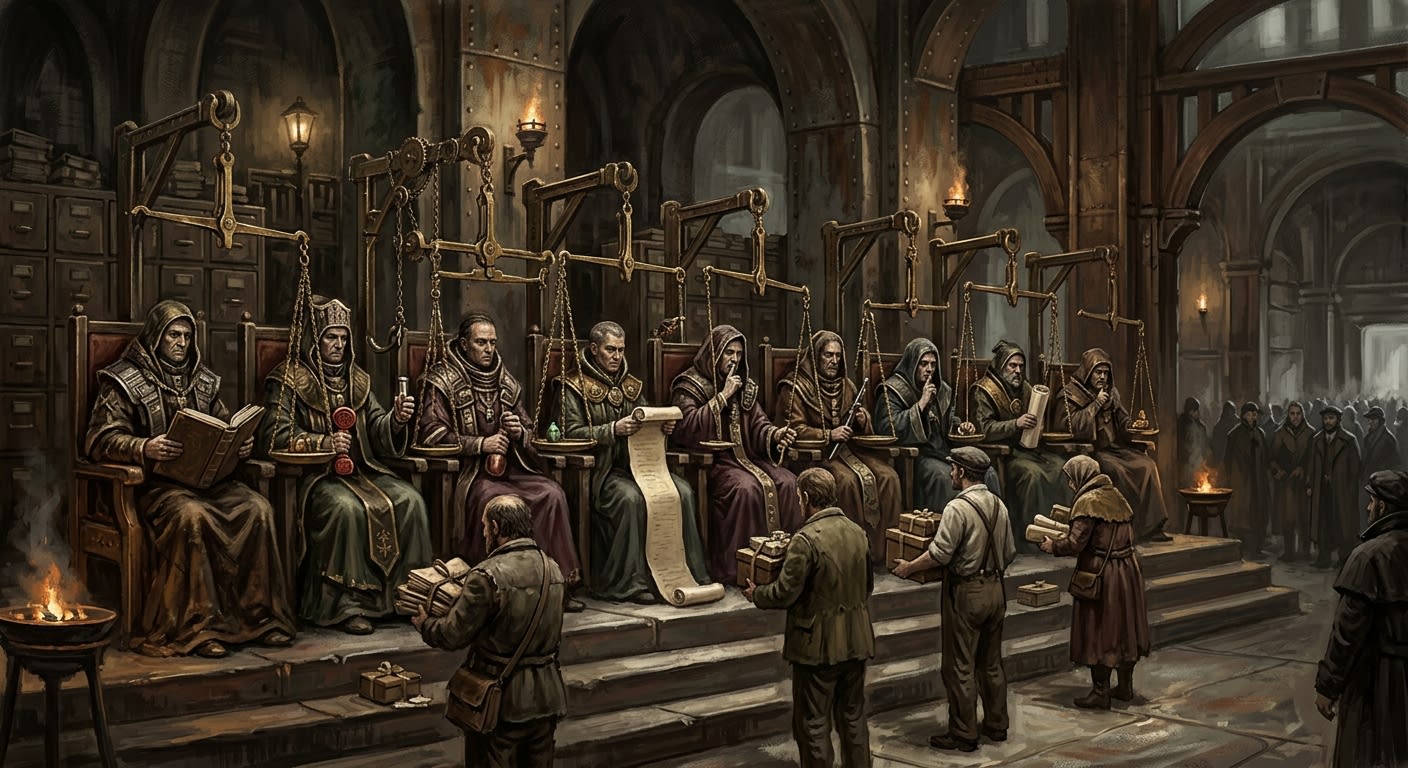
The Caravan Court of Nine Weights is the inner bench of the Caravan Court, the tribunal clique seated beneath the stones of the Treaty Ring at the Steppe Gate, where a caravan's right to move is measured against nine sanctioned burdens and found wanting with profitable regularity. Outsiders call it a court. Locals call it the Nine. Petitioners call it whatever their translator-scribe tells them will not close their throats.
The distinction between the broad Caravan Court and the Nine Weights matters because Windscript (Unregistered) is a town where distinctions have teeth. The Court is the institution: clerks, runners, witness posts, seal trays, waiting ropes, tariff boards, and the surrounding stench of lawful delay. The Nine Weights are the bench's operative doctrine, the licensed arbiters authorised to assign burden to fact and convert quarrel into precedent. They are fewer than the Court, older than most of its current officers, and much less sentimental about the survival of petitioners.
The Nine are not always nine persons. This offends simple minds, which are numerous and eligible for taxation. The title names the weights, not the seats. At full sitting, seven sworn arbiters, one seal assessor, and one wind-witness compose the Nine. In emergency sitting, three arbiters and a licensed witness may convene a reduced bench if the wind is low, the disputed term is not red-glyphed, and no party has already begun bleeding ink from the gums. The form survives variation. The fee does not shrink.
#On the Nine Weights Themselves
The old rubric names nine weights: Passage, Cargo, Witness, Blood, Delay, Oath, Seal, Road, and Silence. Each began as a practical question. May the caravan pass? What does it carry? Who saw the promise? Who died in the quarrel? Who waited, and at whose cost? What was sworn? What was sealed? What road was damaged, claimed, blocked, or eaten? Who refused speech when speech would have saved the file?
In any other town, these would be issues. At Windscript they are weights, and weight must be assigned before a clause may stand. The bench hears the petition, identifies the burdens, orders their sequence, and places each within the relevant stone's hearing. A salt convoy with two dead guards and a missing axle may carry Passage, Cargo, Blood, Delay, and Road. A refugee column with no papers, three sick children, and a dialect word for shelter unregistered by Strasbourg may carry Witness, Oath, Silence, and the sort of mercy that becomes Cargo when a clerk needs a category.
The Ninth Weight, Silence, is the one that separates the inner bench from ordinary frontier adjudication. Silence may mean refusal, fear, grief, ignorance, strategy, prayer, inability, death, or wisdom. The Nine Weights dislike such variety. Variety hinders billing. Under bench doctrine, silence acquires weight when a party had lawful capacity to speak and did not. The Fourth Stone enjoys these cases. I use enjoys with bureaucratic precision and spiritual disgust.
Early Windscript teaching slips described Silence as a “neutral absence of testimony.”
Corrected after the A.S. 94 casualty review. Silence is rarely neutral within forty paces of stones that listen. It may be protective, culpable, purchased, coerced, holy, cowardly, or dead. The bench assigns the fee before Doctrine assigns the adjective.
#On the Making of a Bench
A sworn arbiter of the Nine Weights is narrowed more than trained. Apprentices begin as clause-readers in the Scribe Bazaar (Unregistered), then pass through witness service, toll arithmetic, cargo fraud tables, dialect hazard drills, and the red-glyph memorisation that makes sleep unpleasant. They must pronounce all seven stone registers, recognise false witness tremor at twenty paces, distinguish Moldavian salt damp from ordinary sweat, and recite the casualty correction of A.S. 95 without lowering their eyes.
The final examination is called the Weighting. It occurs at dawn inside the Ring with no crowd, no bell, and no market noise to hide behind. The candidate receives a dead case from the Archive, stripped of its ruling. He must identify all nine possible burdens, reject those that do not bind, order the remaining burdens, and pronounce a settlement clause under wind. The stones are allowed to comment. Candidates who survive with no blood above the collar proceed to seal instruction. Candidates who bleed and continue are considered promising. Candidates who correct the stones are buried outside the Ditch Gate (Unregistered) with small stones in their mouths, an old custom that the Bureau of Rites has filed under local devotion pending extinction.
High Arbiter Senn Vark has made the bench colder and cleaner. Before Vark, arbiters sold hints through nephews, delayed rulings for friendly caravan houses, and misplaced red-glyph annotations in exchange for coin, bed, spice, or revenge. Under Vark, corruption remains, but its hands are washed and its receipts are better. He prefers open precedent sales to private favour. This has offended men who like bribery to dress as intimacy.
#On Sarn's Failure and the Red Seat
The Nine Weights became what they are because J. Sarn, Licensed Second Class, failed by one syllable in A.S. 94. The Red Pronunciation deserves no shelter under accident in the vulgar sense. Accidents belong to carts, kitchens, and gentlemen who clean pistols after drinking. Sarn stood in office, inside procedure, before witnesses, amid a Moldavian salt-convoy dispute fit for the Third Stone (Unregistered). He had the training. He had the licence. He had the fatal confidence of a man who has survived his own competence too often.
The mispronounced binding term passed into the wind. The wind passed into the town. One thousand throats closed before morning. The Bureau of Doctrine corrected the count in A.S. 95, and the Nine Weights corrected themselves with a savagery that almost resembles humility.
The Red Seat (Unregistered) was established that year. It is an empty limestone position to the left of the presiding bench, never occupied, washed weekly with vinegar, and marked by three red glyphs whose pronunciation is forbidden. Every sitting of the Nine begins with the clerk touching the Red Seat and naming Sarn by initial only. The act is remembrance, warning, and legal insulation. If a later cascade occurs, the bench can prove it remembered the first one. Memory is cheaper than liability.
RESTRICTED BENCH MANUAL — RED SEAT APPENDIX If whisper rise exceeds safe measure during Third Stone proceedings, all arbiters shall cease speech except presiding officer. If presiding officer bleeds from mouth, wind-witness assumes silence command. If Red Seat is observed occupied, ██████████████████████████████████████. No appeal shall be heard from an occupied Red Seat.
The Red Seat changed training, seating, fee schedules, phoneme cards, witness distance, and the market price of fear. It also supplied the bench with its favourite justification. Whenever a petitioner objects to delay, cost, repetition, witness duplication, or throat inspection, the clerk taps the Red Seat. Argument usually improves.
#On Weighing the Living Addenda
The Living Addenda have brought the Nine Weights to the edge of their own doctrine and invited them to invoice the abyss. Since A.S. 194, the Burnless Archive has produced wet-ink amendments with perfect form and no living author. Since A.S. 201, under Vark's ruling 201-Blue/17, procedurally correct Addenda bind. The inner bench must now weigh documents that arrive already carrying Seal, Witness, Oath, and Silence before any human claimant has stepped into the Ring.
This has altered the order of proceedings. The Addendum is placed on a stone tray and read first by Archive liaison, usually a Paper Keeper whose whisper makes surface clerks angry because it refuses theatrical urgency. The seal assessor smells the wax. The wind-witness marks the stones' response. The bench identifies which of the nine weights arrived with the page and which must be assigned to the living fools now trapped beneath it.
A normal case asks what men did. An Addendum case asks what the paper has already decided men will have done. The Nine dislike this, since prophecy is a rival jurisdiction and rarely pays bench fees.
The blank folio left after the A.S. 199 disappearance of the Third Stone southern-face rubbing is the bench's private nightmare in public custody. Paper Keeper Seld watches it each morning. Vark has entered no final weighting. The Nine have prepared draft burdens in sealed packets: Silence, Seal, Witness, Blood, and Road appear in every version. One packet includes Passage. That packet is kept under three locks and a prayer nobody admits using.
Bench circular 199-G described the blank folio as “unripe evidence.”
Amended after Archive consultation. Evidence does not ripen. Fruit ripens. So do corpses, under regrettable weather. The folio is pending. Pending is a safer word because it admits fear without giving it a calendar.
#On Rival Offices and Purchased Obedience
The Nine Weights survive by being hated evenly. The Treaty Office hates their discretion. The Seal-House Consortium hates their power to reject a stamp's force while loving every ruling that demands six new seals. Patrol Command (Unregistered) hates their insistence that violence requires a clause, especially when Captain Rho Balesh (Unregistered)'s riders have already enjoyed the violence. The Caravan Corrals hate them as a stomach hates the throat that decides when swallowing may occur.
The Scribe Bazaar loves them with merchant piety. Every weighting produces language. Every language requires guides. Every guide requires certification. Every certification requires renewal after the bench declares a vowel unsafe, a witness formula stale, or a mercy table fraudulent. Translator-scribes call this public safety while counting coin with hands inked red from caution marks.
The Null Tongue Brotherhood reserves a purer loathing. To the Nullists, the Nine Weights are the theology of coercive speech: proof that the Gate can make even silence a chargeable category. The bench treats Nullist silence as Silence with aggravation, the aggravation being ideology, and ideology being what the Synod calls refusal when it has stopped being economically useful.
The common accusation is that the Nine sell verdicts. The common accusation is lazy. They sell burdens, sequences, survivable language, and the privilege of knowing which knife will touch you first. Verdicts remain technically the property of the stones. This arrangement permits everyone involved to deny authorship with clean hands.
#On the Current Weight of the Bench
As of A.S. 201, the Caravan Court of Nine Weights remains active, rich, frightened, and indispensable. Vark presides. The Red Seat remains empty. The Addenda arrive. The blank folio waits. The Scribe Bazaar expands its red-glyph stalls. Seal-House Row (Unregistered) works longer hours. The Corrals overflow eastward with beasts, crates, refugees, orphans, and cargo claims written by men who fear tomorrow morning's paperwork more than tonight's hunger.
The Nine have begun holding dusk rehearsals without petitioners, a practice officially described as calibration. The wind-witness marks clause-tones. Arbiters pronounce old dead cases under controlled breath. Seal assessors test wax near the Fifth and Seventh Stones. Once each week, a Paper Keeper brings a covered folio from below and places it on the stone tray without opening it. The bench sits in silence for nine minutes. No one records what this accomplishes. The minutes state: calibration complete.
The Nine Weights endure because they answer the Steppe Gate's oldest terror with the only medicine Windscript trusts: form. Passage, Cargo, Witness, Blood, Delay, Oath, Seal, Road, Silence. Nine burdens for one throat. Nine fees for one road. Nine names for the same old frontier fact that movement must be bought from whatever power controls the gap.
At sunset, Vark covers the bench. The clerk touches the Red Seat. The wind reads the stones. Beneath the cutbank, the Archive keeps the day's burdens and prepares, with wet ink and exquisite patience, to return them improved.