

#On the Market of Correct Mouths
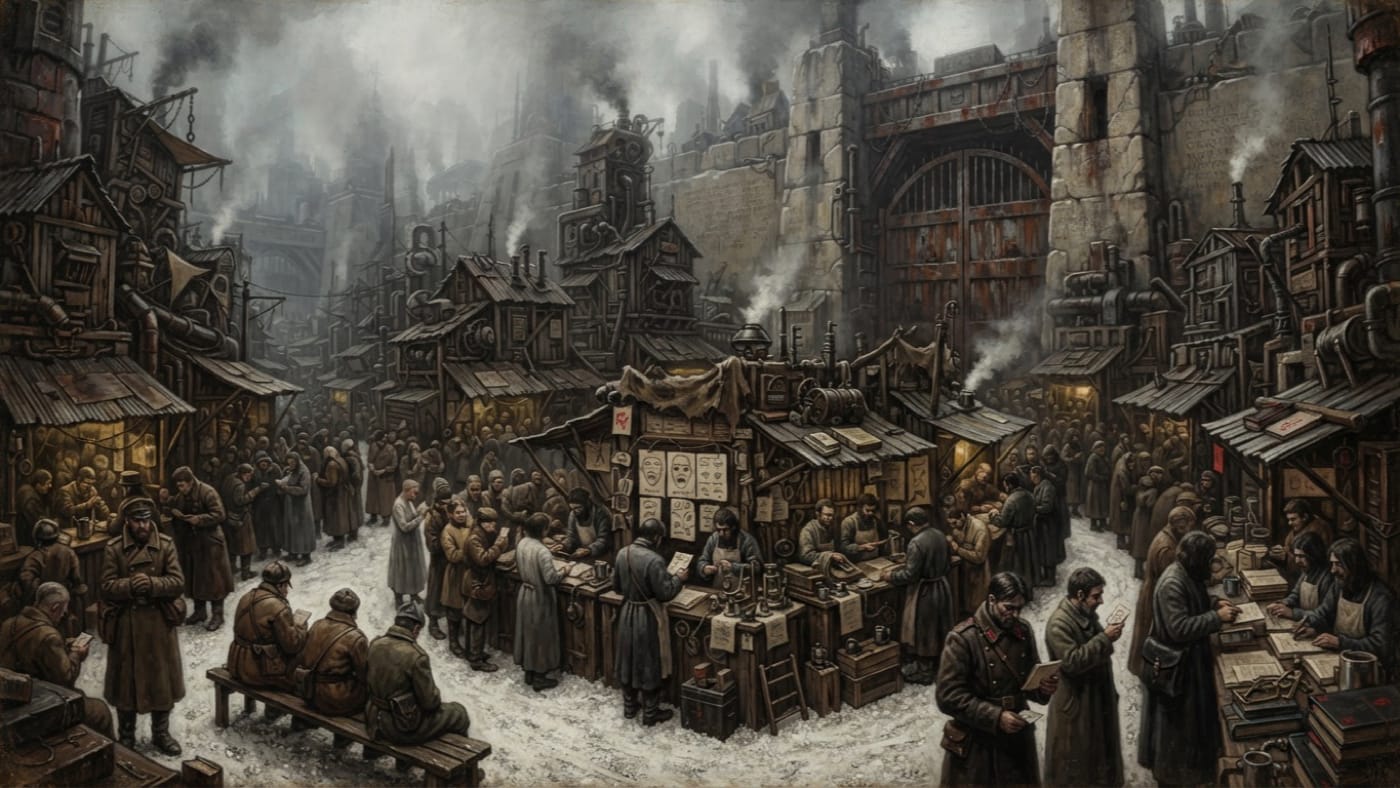
The Scribe Bazaar is the district of the Steppe Gate where a contract goes when its owner discovers he cannot safely read it aloud. It is a low quarter. The roofs are kept beneath the wind's notice, the timber is lashed with hide because nails rust and hinges scream, and every counter carries a fine white grit off the limestone that no scribe has ever finished brushing away. Its stalls are numbered by arc around the Treaty Ring. No surveyed plan of the district's edges has come to my desk, and I suspect none exists, since the Bazaar's boundary is wherever a frightened man stops walking and starts paying.
It smells of leather glue and tea. The glue belongs to the binders, who stitch goat-hide over precedent and clause-slips in sheds behind the counters. The tea belongs to everyone else. It is bitter, brackish and always hot, because a customer whose throat is dry pronounces badly, and a customer who pronounces badly is a liability to the house that coached him.
The merchandise is competence. Translator-scribes in ink-stained sashes render steppe dialect into Treaty form and Treaty form back into something a muleteer can survive. They sell certified translations, witness formulas, clause-slips, dialect attestations, mouth-guards stamped with correct syllables, and the small diagrammed phoneme cards that every passage master now carries the way a pilgrim carries a rosary. Salvaged glass weighs down papers against the gusts. Caravan masters wait on benches. Refugees from the Ditch Gate queue wait standing.
#On the Trade in Tongues
The danger being sold against is real, and I will not insult the dead by calling it superstition. Within the jurisdiction of the seven Treaty-Stones, binding speech that is damaged in the mouth draws the clause-spirits. The Treaty Office's own descriptions are plain: tightening at the throat, ink weeping from the ears, paper edges opening skin, and corrections appearing unbidden on documents whose authors had considered them finished. A man mispronouncing his grocer's name in the Oath Inns risks only the grocer. A man misreading a binding term within hearing of the stones risks the stones.
The phoneme card is the Bazaar's answer. It diagrams lip, tooth, tongue, palate and breath for a single term, marks stop and release, and tells the bearer where his mouth must be before the syllable leaves it. The local name for the fee is tongue-toll. The local proverb is cheaper: If you do not know the word, do not try the word. Most of the Gate's poor follow the proverb. Most of its rich buy the card.
Licensed guides are sold over the counter. Unlicensed ones travel inside hymn books, bound between the psalter leaves where a patrol rider leafing for contraband finds only devotion and loses interest. I record this without approval and without surprise. The Church has always been a fine hiding place for useful knowledge.
Nothing a scribe sells guarantees survival. Instruction narrows the odds; the stones keep their own count.
#On the Night the Shutters Closed
How old the Bazaar was in A.S. 94, the registers decline to say. It existed. It had shutters. It had wool.
That year Licensed Arbiter Second Class J. Sarn misread a binding term on the Third Stone during a salt-convoy judgment, and the Red Pronunciation went out across the Gate on the wind and on every mouth foolish enough to repeat what it had heard. The night watch recorded ink from the ears in Bazaar witnesses. By second bell the scribes had closed their shutters and packed wool into every keyhole, as though sound respected carpentry. The district's men of language had understood before anyone else that language was now the weapon, and they stopped talking.
By dawn the Gate had lost approximately one thousand people. That figure belongs to the whole town, to the Ring and the Inns and the Corrals together. The Bazaar's own share is not separately recorded.
The first Registry notice listed approximately one hundred casualties of the cascade.
Corrected by Doctrine erratum in A.S. 95 to approximately one thousand. The smaller figure counted only bodies classified before removal. The Bureau regrets the clerk's arithmetic and has retained his instincts.
The Bureau of Bells dispatched an emergency Cantor-team, which arrived nine days later. The translator-scribes did not wait for it. They had the first phoneme cards inked before the Cantors had cleared their second routing slip: crude mouth-maps, drawn by men who had watched colleagues bleed from the ear and wished to learn exactly which tongue-position had done it. The Treaty Office ratified what the Bazaar was already doing.
Read the last line twice. Grief had not finished its first week, and the scribes had already secured immunity for their prices. I have sat on Bureau committees that took eleven sessions to agree a font. These people took one night to agree a tariff and one emergency to make it lawful.
By A.S. 95 the Bazaar had tripled in size. Pronunciation certificates became mandatory for passage masters, which converted a habit of prudence into a condition of employment and a condition of employment into steady custom. The Seal-House Consortium took its stamping monopoly out of the same wreckage. The Bazaar taught the mouth; the Consortium sealed the paper; between them the dead were invoiced twice.
The Bureau of Doctrine later classed the night as proleptic validation of the Triune Alphabet Edict of A.S. 178. The Bazaar's cards preceded that Edict by eighty-four years. Purity standardised the alphabet; the scribes of the Steppe Gate had already standardised the palate, and charged for it.
#On Vark Sold by the Hide
The best-documented article of trade in the present Bazaar is the work of High Arbiter Senn Vark, and it is sold in the open like salt.
A Vark precedent volume is bound in goat-hide and carries the Caravan Court's nine-weight stamp. Its indexes run by clause, dialect, disputed vowel, cargo class and fatality, and that final heading is the reason caravan lords keep the books locked in strongboxes beside their coin. The cheaper copies omit the marginal risk tables. The dearer copies carry Vark's approved pronunciation marks, his witness formulas, and the red caution glyph beside every clause whose enforcement history includes blood. A buyer can tell the price of a copy from across the stall by how much red is in its margins.
Precedent peddlers work the lanes with satchels of earlier rulings, and the specialist titles have their following. Vark on Salt moves with the convoys. Vark on Silence is bought in quantity by the Null Tongue Brotherhood, who claim no interest in it.
The arrangement is elegant. The book teaches its owner how to speak a clause without bleeding, and that teaching saves lives; I have read the fatality index and do not doubt it. Every owner who cites the book has also accepted Vark's reading of the clause, and a scribe who argues against Vark in court must first admit he paid Vark for the argument. The Bazaar profits by selling the protection. The Court profits because every copy sold extends its authority.
#On Seals, Forgeries, and Buyers
The Bazaar does not certify. Certification lives on Seal-House Row, under Seal-Mistress Ylena Korr, whose wax-black fingers control the bottleneck through which every edition must pass before it may call itself genuine. The Consortium buys certified Vark editions and resells them at triple price, on the reasoning that a seal improves the text. At the Steppe Gate this reasoning is often correct, which is the worst thing one can say about it.
Down in the Gully Market the Gully Ledger Cartel produces Vark counterfeits so poor that a frightened caravan master, having handled one, runs back up the steps and pays full price at Stall Fourteen. Whether Vark gains by this is plain enough. Whether he arranged it is a separate question, and the evidence does not answer it.
The Bazaar's customers sort themselves by fear and by purse. Caravan lords hoard volumes. Passage masters buy certificates because they must. Witnesses-for-hire buy coaching. Refugees buy one card for one term and practise it in the queue, lips moving without sound, until the clerk calls them forward.
The scribes have lately threatened to strike. They have not struck. A Gate that cannot pronounce cannot trade, and both sides know the size of that threat to the copper.
#On the Present Condition
Since A.S. 194 the Living Addenda have appeared in the Burnless Archive: wet-ink amendments without a known author, correct in form, and therefore binding in Vark's court. Every precedent sold in the Bazaar now competes with clauses written after the book left the binder. A volume bought at Stall Fourteen is accurate until it isn't, and the purchaser learns which when he speaks.
In A.S. 199 the rubbing of the Third Stone's southern face vanished from the Archive and left a blank folio with the ink still wet. Paper Keeper Seld inspects it each morning. Nobody in the Bazaar has yet offered a phoneme card for a clause that has not appeared, though I would not wager against the Western Arc producing one.
The glue still sets. The tea is still bitter. The notice at Stall Fourteen still tells the buyer that the risk of pronunciation is his.