

#On the Survey and the Southward Line
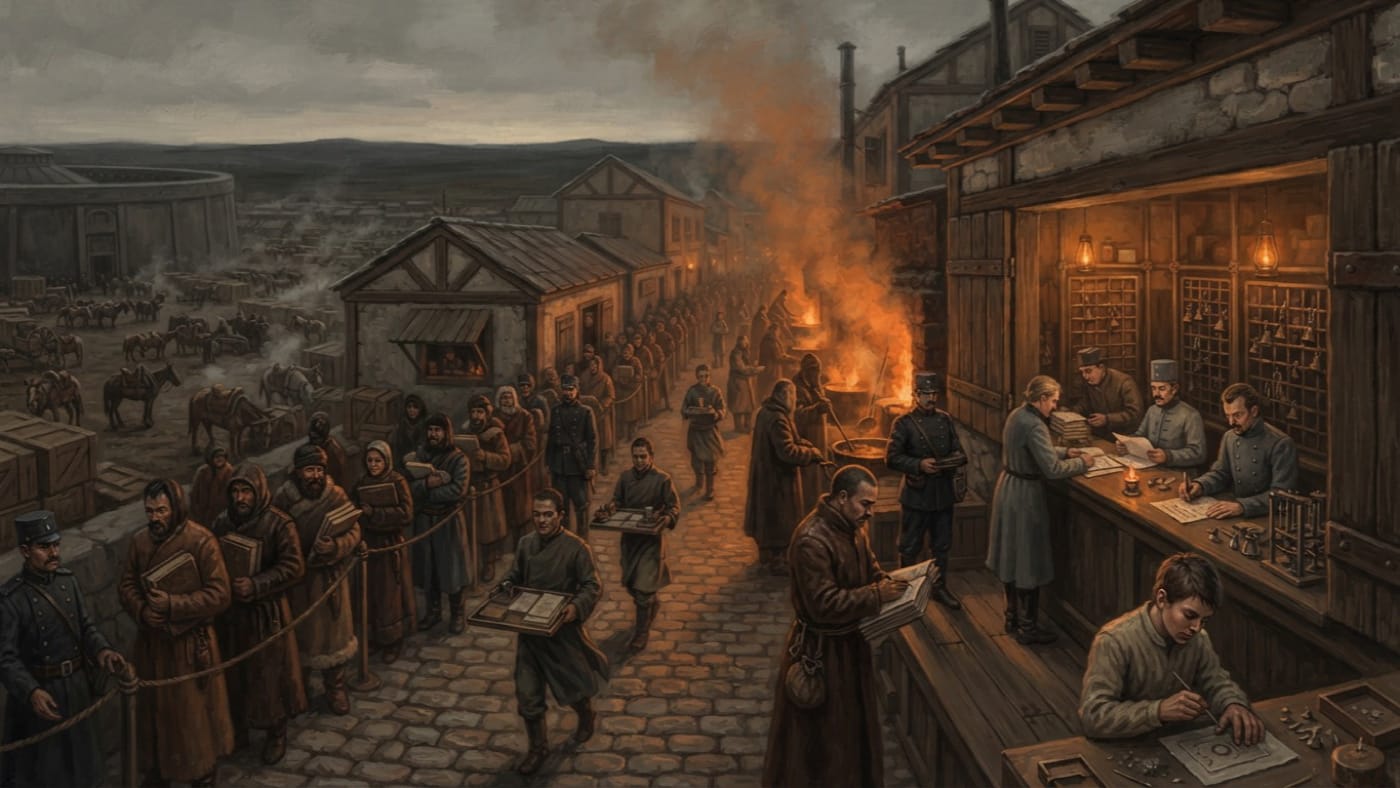
This survey describes a street as it stood in A.S. 201 / 1911 CE. Seal-House Row runs south from the Scribe Bazaar, beside the Treaty Ring of the Steppe Gate of Windscript Treaty-Stones, on the Moldavian border steppe. It is a line of iron-hinged workshops that smells of wax smoke and iron. Its shutters come up at first wind and go down when the Ring falls quiet. In between, nearly every paper that hopes to be believed anywhere in the town crosses one of its counters.
The Bureau's files hold no founding year for the Row. They hold no measured length, no surveyed boundary and no count of the people who sleep along it. I have looked, and I have declined to manufacture what I did not find. The town's dates belong to the town: the stones raised in A.S. 76, the settlement registered in A.S. 78, and the Red Pronunciation and ratified monopoly of A.S. 94. None of them is the birthday of a street. Workshops are not founded. They gather the way dust gathers in a die-groove, and some clerk arrives later to tax what has gathered.
Three things on the Row must be kept apart, and the provinces confuse them weekly. The street is a place of limestone, hide-lashed timber and rust-iron hinges. The Seal-House Consortium is the licensed body that works and keeps its headquarters there: a compact with a monopoly and a Seal-Mistress. The Seal-Houses are the certification trade and its doctrine, already filed under their own heading. A man may hate the Consortium, depend on the Seal-Houses and still buy his bread on the Row. Most of the town does all three before noon.
The Row's trade follows from its position. At its head the Bazaar teaches mouths, and beside it the Ring hears them. Eastward the Caravan Corrals hold the beasts and crates whose owners are waiting for paper. Beneath the eastern cutbank the Burnless Archive keeps every instrument the town has ever sealed. The Row stands among them like a sacristy between nave and treasury. A promise comes in at one end and goes out the other with wax on it, and the vestry charges for the robing.
#On Hinges, Shutters and the South Furnaces
The workshops are low and unlovely. The walls are limestone. Where a carpenter ran short of iron, the timber is lashed with hide. Iron goes wherever a thief might care: hinges, shutter bars, die-mesh and the grids on which the wax cools. The steppe wind has not stopped since A.S. 76. It blows limestone dust into the workshops and wax smoke out of them, and the houses oil their hinges against both. Dust lodges in the grooves of a die and has to be picked out with a needle before each impression. Apprentices do this with the devotion of boys who know what a blurred edge costs.
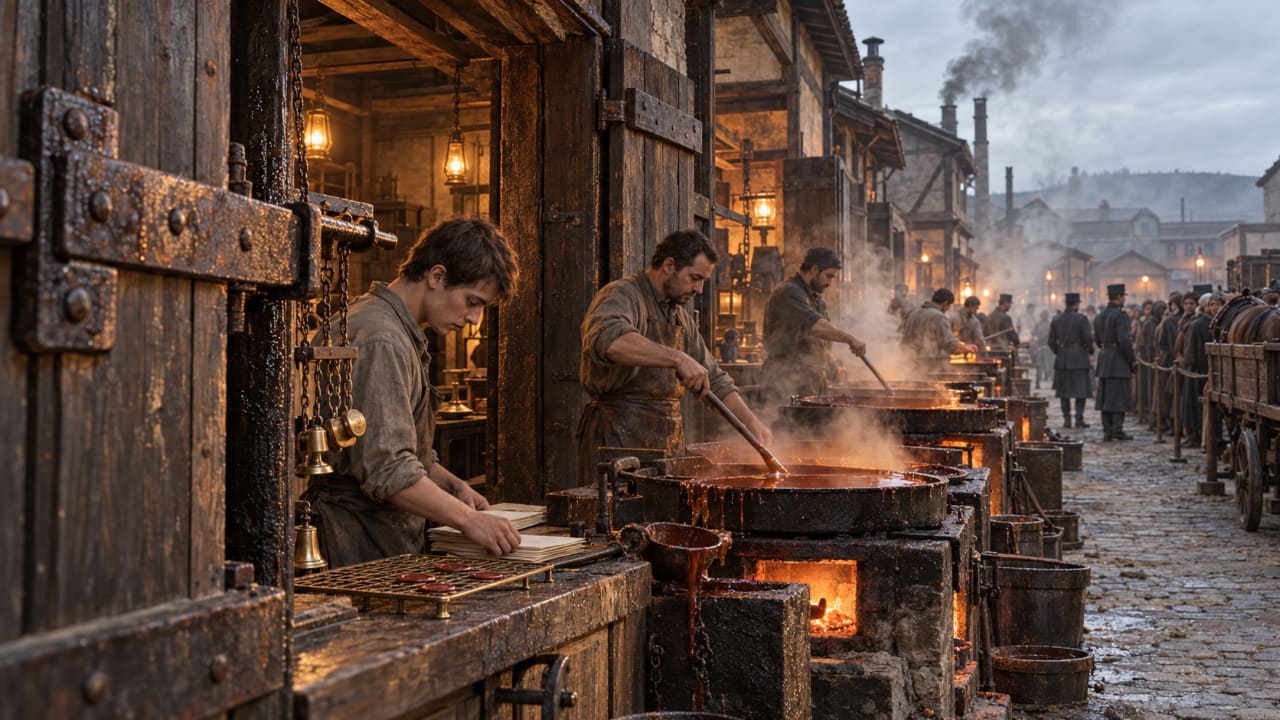
No record I hold gives the Row clock hours. It keeps weather hours. The shutters open at first wind because the wind is half the examination, and a shuttered counter cannot smell. They close when the Treaty Ring falls quiet. In a slack season that comes early. In a heavy court season it comes late. In A.S. 201 it comes later than the street is used to, which I shall come to.
At the Bazaar end the street is all counters: open fronts, queue ropes, and receiving clerks behind boards worn pale by elbows. The noise there is paper and argument. Further south the air thickens. The south furnaces stand at that end, and there the Consortium clarifies its wax in iron pans. The published account names the correctives only in fragments: salt, soot, powdered limestone, caravan fat, and narrow measures of Nemea ash-ink for archive classes. I reproduce the fragments because they are already published. I refuse to complete them, because a full formula in a public codex would be a gift to the gullies. The Bureau of Doctrine does not print recipes for its enemies. It has trouble enough with the ones they invent.
Apprentice casters stir by counted turns. Beside them a pronunciation boy reads the class table aloud, and the stirring follows his voice. A misread table ruins the batch. The Consortium's staffing return lists seven furnace priests among its people and notes that they are not clergy. The return does not say what they are. I suspect they are men paid to stand near fire and look solemn about it, which describes half the episcopate.
Nobody sings near the vats. The ban dates from the A.S. 129 Blue Bubble nuisance, recorded below, and the apprentices keep it like choirboys who have been told the organ bites. Talk is permitted and counting is encouraged. Humming earns a ladle across the knuckles.
The Consortium's return for A.S. 201 reports two hundred registered workers, ninety apprentices, thirty-one sniffers, twelve die-wardens, those seven furnace priests and one Seal-Mistress. These are categories of employment, and nothing in the return says a man cannot be counted in two of them. They are not a census of the street. The return does not say where any of these people sleep. The Row also holds water-sellers, handcart men, tallow-chandlers and the mule drays that haul fuel to the south end, and none of them appears in any Consortium return. A man who counts heads on the Row is counting the morning's queue.
#On a Document Crossing the Counter
A document arrives on the Row as somebody's hope. What follows is the passage the Consortium itself records, stage by stage. No client is attached, because the stages are attested and the clients change by the hour.

The receiving clerk takes the paper first. The clerk checks script form, clause class, witness count, cargo category and dialect risk. Then the clerk looks for the thing every receiving clerk on the Row is trained to fear: a word that has bled since drafting. Ink at the Steppe Gate does not always stay where the scribe put it. A bleeding word may mean bad paper, damp, a careless thumb, or the first sign that a clause has been disturbed. The clerk cannot always tell which. The clerk is paid to notice it and to hold the paper until someone who can tell has looked.
Each check reveals what the paper depends on. Script form depends on whatever the Bazaar's copyist wrote. Clause class decides which wax will be warmed and which fee will be named. Witness count decides whether the paper can stand before the Caravan Court at all, since the Court's chain runs without mercy from witness to mark to seal to deposit. Cargo category ties the document to a crate or a beast in the Corrals. Dialect risk ties it back to the Bazaar, and to the throat of whoever will speak it.
The wax boy then warms the selected class. Ordinary instruments take hot wax, coloured and scented according to class. His whole art is to bring the wax to the slump without scorching it, while the queue watches him the way a congregation watches a thurifer known to have dropped the censer once.
Next the counter-scribe copies the key terms onto a slip for the Nine Weights. The slip is the Row's voice in the Court. When the bench's seal assessor later smells the wax and checks the terms, the slip tells the bench what the Row believed it was sealing. A merchant who quarrels with a ruling may find that his real quarrel is with the slip, and the counter-scribe will not be sympathetic.
The pressing master aligns die to margin and breathes once through a reed tube across the wax. That breath is recorded. Nowhere else in the passage does a living body enter the record as part of the instrument. Men who have never stood at a counter in high wind call the practice superstition. The Consortium calls it identity. I call it a signature that no forger can copy by holding his breath.
The seal cools under a brass grid, and nobody touches it while it cools. The grid keeps off fingers, flies and opinions while the edge sets. Either the edge sets flat or it does not. A seal whose edge will not sit flat is a seal the wind will question, and the wind is the Gate's oldest auditor.
Then comes the fee. The Consortium assesses it by risk and by urgency, and its own account adds, with a candour I admire, the client's apparent capacity for pain. A caravan that must leave before the wind changes pays to be hurried. A document that will be read aloud before the Third Stone pays for the Third Stone's history.
The client walks out with an authenticated instrument. The wax attests that the paper is what it claims to be: issued by a hand entitled to issue it, and sealed with wax from where wax ought to come from. It promises nothing about the speaker. A certified pronunciation certificate cannot move a tongue at the Ring. A sealed escort contract may bind an escort who means to rob his charges at the first water point. A cruel ruling sealed on the Row stays cruel, and the wax preserves its form perfectly. The stones listen to throats, and the Row has never claimed to sell throats.
#On the Nine Houses and the Woman Who Counts Them
The Consortium reports nine houses on the Row. Seven are publicly acknowledged. Two are hidden because, in the account's own phrase, they service documents the Bureau prefers not to route through windows. The published record names five of the seven acknowledged houses.
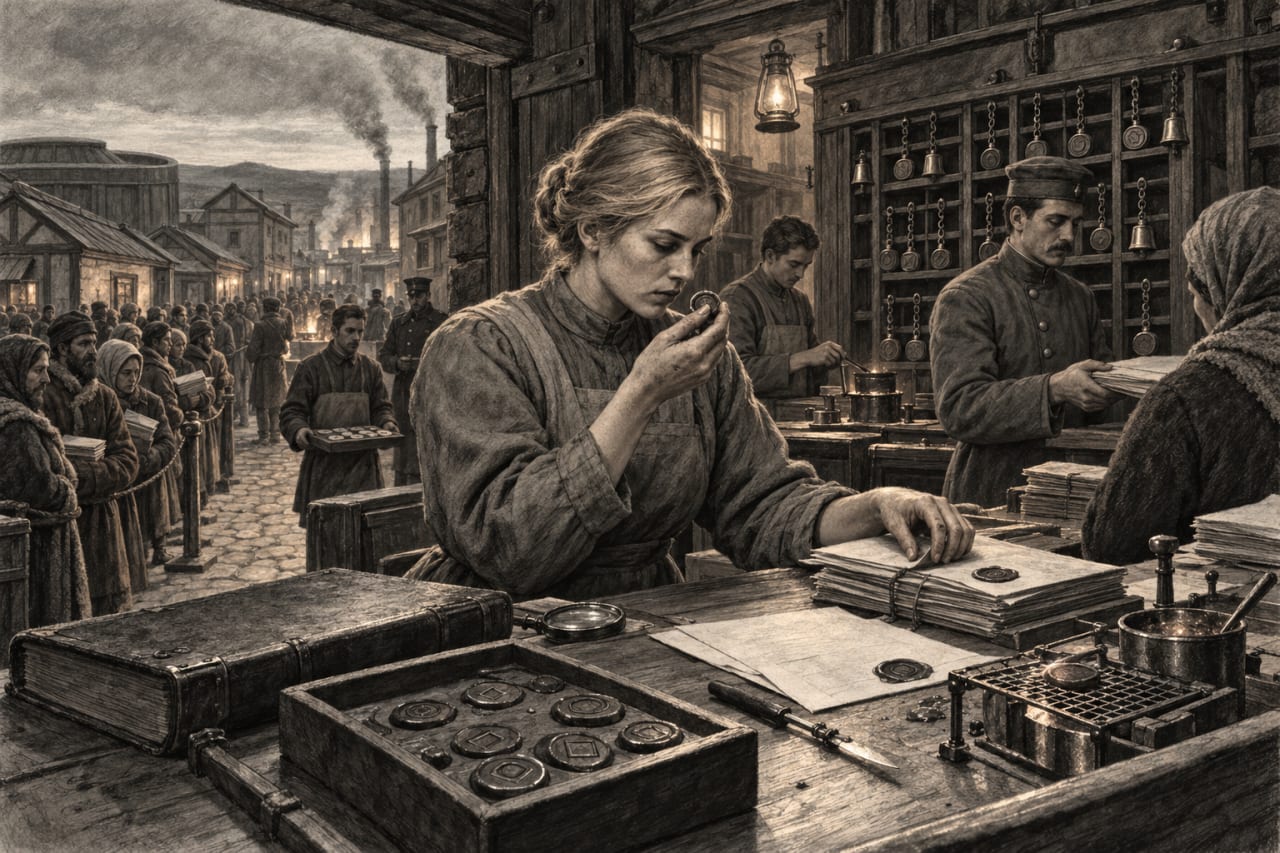
House Korr handles court seals. House Vant handles caravan manifests. House Orik handles escort contracts and weapons bonds. House Lysa handles pronunciation certificates. House Helg handles archive deposits and, the account adds, hates everyone.
That leaves two acknowledged houses whose names the record omits and two hidden houses whose names nobody offers. I give them no names. A survey that supplies its own missing names is a forgery of exactly the kind the Row exists to catch, and I would be ashamed to be caught by House Helg. The Consortium's account describes the hidden houses' business only by kind: Purity abatements, Blue Cord patrol indemnities, and paper that arrives wrapped in cloth and leaves with no queue mark. I record that as the Consortium's own description of its practice. I have no case files to add, and I invent none.
Seal-Mistress Ylena Korr oversees the present houses. Her file records wax-stained fingers and eyes that never stop counting. Her authority on the Row is professional and specific. She directs the authentication work, the houses operate under her oversight, and she rules on disputed wax scent. The file does not make her mayor of the Steppe Gate, owner of every building on the street or ruler of the town. Formal government sits with the Treaty Office, the Caravan Court and Patrol Command. The Row's power is that all three must pass through its bottleneck. Korr has no chair at their table, and the table cannot move without her wax.
The file makes her the founder of nothing. The Caravan Court ratified the monopoly in the last quarter of A.S. 94, after the Red Pronunciation, on the argument that central certification would prevent another cascade. That date belongs to the compact. Korr's appointment date, age and apprenticeship appear in nothing I hold. The record does not say who led the Row in A.S. 94 or A.S. 129, and I decline to promote her backwards into either year.
The monopoly has been challenged seventeen times. Sixteen challenges failed in court. The seventeenth challenger's documents turned out to contain a clause nobody remembered signing, the challenger included, and the matter was dropped. As the Consortium's account observes, every challenge arrives on paper that has to be sealed before it can be heard.
#On Queues, Runners and the Trades Next Door
The Row lives on its neighbours' paper, and its traffic follows their business. I describe the relationships, which the records support. I do not draw a delivery circuit, which they do not.
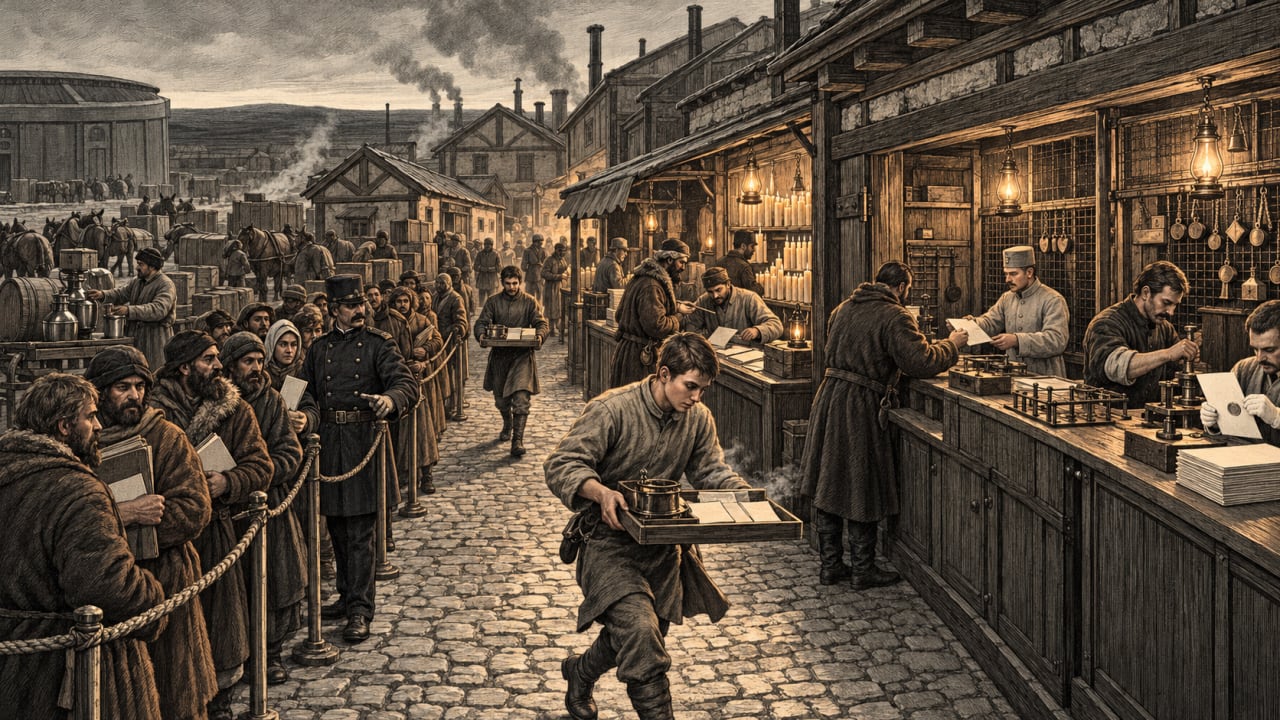
The Bazaar sends language. Its translator-scribes render clauses, drill tongues with ivory pointers and sell phoneme cards one term at a time. The Bazaar does not certify, and its own account says so with some pride. A caravan master leaves a Bazaar stall carrying a dialect attestation and a pronunciation certificate in a translator's hand. He then walks south into the queue to have them made into instruments, and Lysa's counters see him first.
The Ring sends work. Every ruling of the Caravan Court produces seals, counterseals, extracts and certified copies. High Arbiter Senn Vark's precedent books are bound in goat-hide and sold in the Bazaar, and the Consortium resells certified editions at triple price. That markup is a commercial matter, separate from the certification fees I report below. Vark tolerates it because purchased precedent carries his authority further than his voice can. The Row tolerates Vark because his caution feeds its furnaces.
The Corrals send waiting. Their western crates hold goods waiting for the Row, and their owners hold chalk numbers and grievances. When a caravan must be sealed where it stands, Seal-House runners carry trays of hot wax into the pens through the animal steam, and urgency fees follow the trays. In A.S. 201 the Corrals record their queue pressure as severe. A day lost at a Row counter is a day of fodder, water and nightly shrinkage at Gate prices. The clerk at Vant's counter knows this, and the drover knows the clerk knows it.
Runners carry trays and slips between Bazaar, Row, Ring and Corrals at whatever pace the patrol whistles allow. Captain Rho Balesh's Blue Cords keep the queues in line and collect what the accounts call quiet fees.
Below the Row the north gully bends, and the wind there loses enough force to become merely rude. At that bend stands the Split Tongue, largest of the Oath Inns. The record establishes proximity and nothing more. The inn is no part of the Row, and the Row owns no part of the inn. Its packets travel to the Archive along the inns' own dawn road under the inns' own seals. No record I have found shows a passage from its cellars to the Ring or anywhere else. What the closeness produces is custom: a contract witnessed in the Split Tongue's upper room is a short walk from a counter that will make it travel.
The Split Tongue's cellar also hosted the first meetings of the Null Tongue Brotherhood. The Row and the Brotherhood despise each other on commercial grounds and denounce each other on theological ones. An early complaint lodged from Seal-House Row called the first Nullists "unauthorised abstainers from registrable utterance." In today's queues, gesture-cant passes between waiting drovers without troubling the clerks. A mute petitioner still needs a sealed paper to cross the Ring, and no counter on the Row has ever granted passage for silence. Whether silence buys protection before the stones is a question the Bureau has filed as unresolved, and I leave it there.
The public advisory posted on the Row gives one excerpt of the tariff. It is the only schedule I quote, and it is only an excerpt. A complete current tariff would require knowing what the hidden houses charge, and I do not know.
#On Dies, Bells and the Nose of the Wind
Master dies never come to the counter. The Consortium does not publish where they are kept, and I would not print it if it did. The counter sees only counter dies. These hang behind iron mesh, each chained to a ledger peg, and a small bell rings when one is lifted. The return lists twelve die-wardens. Their duty is to see that every impression leaving the Row was struck by a die someone watched leave the mesh.
The physical safeguard needs no theology. A chained die cannot wander. A belled die cannot leave quietly. A pegged ledger shows who held what. The Consortium adds an explanation of its own: the stones listen poorly to metal but well to sequence. By this account, a die removed without its bell acquires suspicion, prints a seal whose edge will not sit flat, and invites the wind. I report this as workshop understanding, held by people who handle the dies every day. No Bureau has proved that the stones attend to the order of a bell and a hand. The Row keeps ringing without needing the proof.
Then there is the wind. When the steppe wind passes through the Treaty Ring, legitimate Consortium wax gives off a recognised scent, which the Consortium's account calls the bitter-sweet pitch of licensed resin and ash. In certain gusts, counterfeit wax smells wrong. This is wind-scent verification, and it is why the Row's shutters stand open in weather that would close a chancery.
The dangerous forgeries are the almost-correct ones, and the Gully Ledger Cartel makes them in the ravines below the Corrals. An almost-correct seal has the proper colour, weight, die-depth and margin angle, so it passes the eye. It fails the nose only in particular gusts. The account says that only Korr, two senior sniffers and one blind apprentice can catch the faintest of these before the Ring does. Thirty-one sniffers draw Consortium pay. On disputed scent, Korr's judgment is final. Her office makes her final. It does not make her right in every gust, and the record never claims it does.
The record does not say what makes legitimate wax smell legitimate. Chemistry may explain part of it, and the Ring may explain the rest. I have read three theories in Purity memoranda and trust none of them enough to repeat it in a sealed codex. The practice works often enough to be law, and a survey can certify no more than that.
The suspicion that follows almost-correct wax must also be filed properly. A counterfeit that fails at the Ring frightens honest clients back to the Row. On the morning after each Purity raid, the Row raises its counterseal rates and cites public anxiety. Uncharitable observers have suggested that the Consortium and the Cartel share suppliers, cousins or dinner. The Consortium denies all three, with convincing paperwork. No record I hold shows Korr or any house commissioning a counterfeit. Profiting from a crime does not prove a man committed it, and the Bureau of Doctrine has hanged enough men on that confusion to know what it costs.
#On Recorded Failures
The Row's failures are dated, and each belongs to its own place. None marks a stage in the street's construction. Lawsuits do not build streets, though they have certainly furnished this one.
In A.S. 129 came the Blue Bubble nuisance. Six hundred escort seals developed a vowel-shaped blister and were burned under the supervision of the Bureau of Purity. According to the account, the smell lingered for weeks, and so did the lawsuits. The record gives no cause for the blistering. It does give the remedy: no singing near the vats, then or since. The apprentices obey without asking why, which is the most theologically sound behaviour on the street.
In A.S. 196 an almost-correct escort bond reached the Ring. The incident is named for the South Corral and did not happen on the Row. Under the wind the bond's wax turned green. Three mules, two guards and one deputy scribe then confessed to unrelated frauds. I give these effects as the Consortium's published account gives them, and I add no mechanism. The Bureau's interest in confessing mules has been noted elsewhere.
Consortium notices formerly claimed "no counterfeit Consortium seal has ever reached the Treaty Ring."
Amended after the A.S. 196 South Corral incident. The current notice reads: "No counterfeit Consortium seal has reached the Treaty Ring without producing useful enforcement data." The amendment is the Consortium's own. The Bureau records it as a gain in accuracy and a loss in nothing else.
In A.S. 198 the Bureau of Purity raided the Gully Market in the ravines below the Corrals. The raid did not touch the Row. The Consortium published the abstract, and I reproduce it with its blacking intact.
PURITY RAID ABSTRACT — GULLY MARKET, A.S. 198 Items seized: 144 counterfeit seals; 17 blank witness stamps; 3 almost-correct dies; 1 ledger naming █████████████████. Seal-House response: cooperation immediate. Korr statement: "Those are not ours. They are ours badly remembered." Disposition of ledger: transferred to █████████████.
The ledger's names stay black. The abstract proves a seizure in the gullies. It proves nothing about which hands on the Row, if any, the blacked line touches. The Cartel's own file adds that a search of the published accounts turned up no seized Cartel ledger at all. Both documents stand. I will not reconcile them by inventing a third.
#On Cold Wax and Unauthored Work
Archive work uses different wax. House Helg presses archive deposit marks cold, with wax compounded of limestone dust and Nemea ash. The mark is carried to the Archive in cotton and touched only by Paper Keepers. After one hour it is checked to see whether the paper has accepted it. Rejection shows as flaking, whitening, or a correction line in a hand that belongs to no licensed clerk. Acceptance shows as nothing at all. The advisory's five silver includes the cotton.
The two processes must not be confused. Hot wax, the reed tube, the brass grid and the queue belong to ordinary instruments. Cold wax, cotton and the Keepers' gloves belong to deposits. A clerk who carries a cold mark to the brass grid has made two mistakes.
Since A.S. 194 the Archive has given the Row a third kind of work. That year a Fourth Vault audit classified the first Living Addendum, a wet-ink folio amending a passage writ of A.S. 118. Its form was perfect and its seal genuine, and no living hand had written it. By A.S. 201 they appear about twice a week. Under Vark's Ruling 201-Blue/17, an Addendum binds if it satisfies four requirements: witness, seal, pronunciation key and archive mark. Every folio needs its own fresh seal verification, and the seal requirement falls to the Row.
Earlier memoranda described the Addenda as "forgeries of uncertain provenance."
Withdrawn. A forgery imitates authority. The Addenda carry it before any living officer concedes the point. On the Row the consequence is clerical: the Addenda no longer belong in the forgery column of any verification register, and no other column has been printed for them.
The Consortium's account says Korr has examined six Addenda under magnification and, according to Vark's sealed minute, declined to accuse any living counterfeiter. The accounts disagree about where those examinations took place. The Archive insists its paper does not leave. Korr's dossier places custody during examination with the Keepers. Other notices speak of folios sent upward to the Court. I state the requirement, which is fixed. Where the originals travel I leave unspecified, because nothing in the record settles it.
The loss of A.S. 199 belongs here as well. That year a rubbing of the Third Stone's southern face disappeared from the Archive. In its place lies a blank folio, its ink wet and its page empty. The Consortium records that Korr went to the Archive with a grey-white wafer of wax, unmarked by any house colour, and pressed it to the shelf ledger while Paper Keeper Seld watched. The wax stayed soft for three days. It hardened only after Vark entered the rubbing under unresolved loss. The cause of the disappearance and its culprit remain unknown, and nobody has explained the wafer's softness. The record of what Korr did is plain, and I count it the most competent piece of frontier procedure in the file.
None of this shows that the Row writes the Addenda. Nothing in the record shows that it writes them, wants them or knows who does. The record shows only that they arrive with perfect seals, that each one requires examination, and that the Row is paid for every examination. By the time of this survey, certification fees are reported to have tripled. Some accounts date the tripling to the years since A.S. 194 and others to the months after A.S. 199. I assign it to neither. The Consortium has also petitioned the Court to recognise "post-facto seal custodianship," under which a seal written by no hand would still fall under the Row's fee schedule. Vark has not dismissed the petition.
#On the Present Condition
In A.S. 201 the Row works longer hours. The shutters still open at first wind, but they close later, because the Ring falls quiet later and the queues do not shorten. Addenda arrive twice weekly, and each folio needs a fresh verification. The Bazaar's translators send more certificates south. The Corrals report severe queue pressure, and the hot-wax runners go out into the pens more often than the furnaces would like. Almost-correct seals still turn up at the counters and still fail in the right gusts. The monopoly stands. It has survived seventeen challenges and now faces a stranger one, from paper that pays no fee.
Dust settles in the die-grooves, and an apprentice picks it out with a needle. The bell rings as the die comes off its peg.