

#On the Founding of the Gate
"Where Creator is silent, paper speaks. Where paper speaks, the wind enforces." — Inscription on the Seventh Treaty-Stone, attributed to no author. The Bureau of Records has classified the attribution as "pending."
I have been, in the course of my duties as Warden, to many places where the Synod's authority is exercised through instruments of such elegant cruelty that the exercise becomes indistinguishable from art. Strasbourg is one. Bastion-Irongate is another. The Steppe Gate of Windscript Treaty-Stones is a third, and — I confess it freely, because confession costs nothing here unless you sign — the one I admire most.
The Gate rose in A.S. 76, eleven years after the Sagittal Line solidified from a desperate chain of entrenchments into a continental fortification. The need was simple. The steppe divides east of the Moldavian border — flat, wind-scoured, treacherous with salt pans and mirages — funnelled every caravan, every refugee column, every smuggler's mule train through a single gap between two ridged cutbanks of limestone. Caravans fought caravans for passage. Escort companies fought escort companies for contracts. Refugees fought the living for food and the dead for the right to carry their papers. The Bureau of War, in a memorandum that has since been classified under Sixth-Ratification, described the situation as "logistically untenable" — which is military language for "someone is stealing the salt shipments and we cannot determine who."
The solution, characteristically, was not a garrison. It was a treaty.
Seven stones were erected in a ring at the narrowest point of the gap. Into each stone, in script that the Bureau of Doctrine later certified as "pre-doctrinal but not heretical," clauses were carved — passage rights, toll schedules, arbitration protocols, escort obligations, pronunciation requirements. The stones were consecrated by a Cantor whose name the records do not preserve and anointed with chrism from the Chrismole Furnaces of Brast. The wind, which blows through the gap without pause and without mercy, found the carvings and began to read them.
The stones murmured. The caravans listened. The fighting stopped.
Within five seasons, a town had grown around the ring — scribes, seal-casters, toll brokers, oath-inn keepers, and the particular breed of human being who thrives in places where every spoken word carries the force of contract and the penalty of blood. The Bureau of Records registered the settlement as "Windscript Treaty-Stone Border Compact, Administrative Node Seven" in A.S. 78. The soldiers called it the Tongue-Toll. The caravans called it worse. The Synod, with characteristic generosity, allowed it to exist.
#On the Nature of the Stones
The Treaty-Stones are seven monoliths of wind-polished limestone, each the height of three men, arranged in a ring forty paces across at the heart of the town. Their carvings are deep — cut not with chisel and mallet but with something the Bureau of Alchemical Standards has declined to identify, citing "insufficient precedent in the mineralogical literature." The script is a variant of the Triune Alphabet, though it predates the Triune Alphabet's formal introduction (A.S. 118) by forty-two years. The Bureau of Doctrine has resolved this contradiction by declaring the script "proleptic" — anticipating the alphabet that would later ratify it. This is, I am assured, theologically sound.
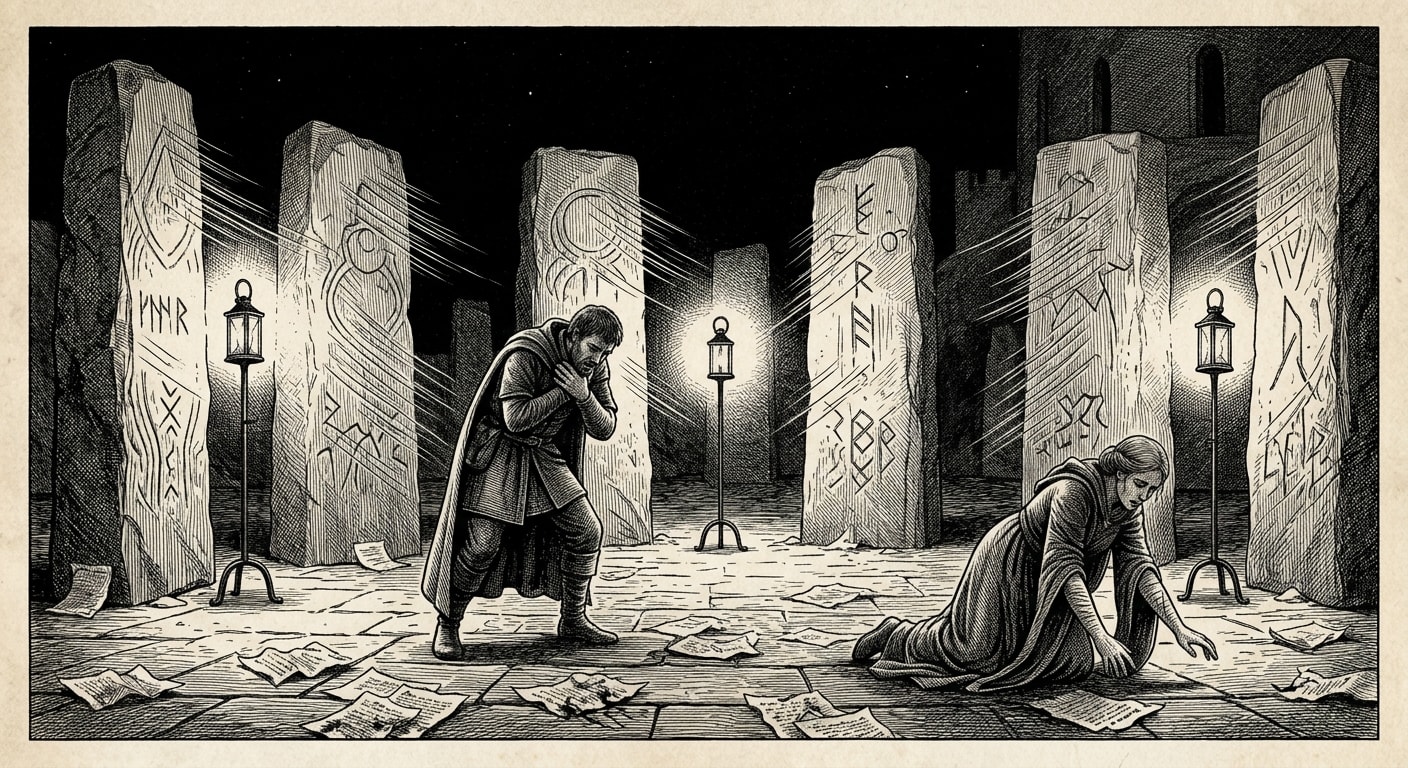
When the wind strikes the carvings at the correct angle — and in this gap between the cutbanks, the wind always strikes at the correct angle — the stones speak. They recite their clauses in a whisper that carries across the Treaty Ring and into the adjacent districts, audible to anyone with ears and a conscience, which in the Steppe Gate amounts to approximately the same population as the deaf. The whisper is constant. It does not sleep. It does not pause for festivals, funerals, or the convenience of those attempting to conduct illicit business within earshot.
The clauses themselves are, in their original carving, unremarkable: standard border-compact language governing passage rights, toll rates, arbitration procedures, and the penalties for fraud. What is remarkable is what happens when they are violated.
The clause-spirits — so called by the population, though the Bureau of Doctrine insists on the designation "Enforcement Phenomena, Sub-Classification Pending" — manifest when a spoken agreement made within the Treaty Ring is violated or, more commonly, when a term is mispronounced. The manifestation is physical. Throats tighten. Ink bleeds from ears. Paper edges slice skin in patterns that correspond, upon examination, to the specific clause that has been breached. In severe cases — and severity correlates with the magnitude of the mispronunciation, not the magnitude of the offence — "corrections" appear on documents by themselves, in handwriting that matches no living person's.
The Bureau of Bells has classified the Treaty Ring as a Category Four Harmonic Anomaly, one grade below Bastion-Irongate's Gasket Choir. The Bureau of Purity has investigated the stones eleven times since A.S. 92. Each investigation has concluded that the phenomena are "theologically neutral" — which means the Bureau cannot determine whether the stones are holy, damned, or merely inconvenient, and has elected to profit from the ambiguity.
#On the Town and Its Districts
Twenty-six thousand souls live in the Steppe Gate, plus a fluctuating population of between ten and forty thousand more — caravan drovers, refugee columns, patrol rotations, translators for hire, and the sort of itinerant seal-cutters who are welcome in no settled city and indispensable in every border town. The permanent population orbits the Treaty Ring in eight districts, each with its own smell, its own economy, and its own catalogue of grievances against the other seven.
The Treaty Ring itself is sacred ground, or ground the Bureau has classified as sacred, which produces identical results at lower cost. Court sessions are held in the open air beneath the stones. The High Arbiter, one Senn Vark — a man who has never spoken a sentence without a witness present and who, by all accounts, has not spoken an unwitnessed sentence in thirty years — presides from a limestone bench worn smooth by the backsides of his predecessors. His rulings carry the force of stone-contract. His precedent books, bound in goat-hide and sealed with the Caravan Court's nine-weight stamp, are sold on the Scribe Bazaar at prices that would embarrass a reliquary dealer.
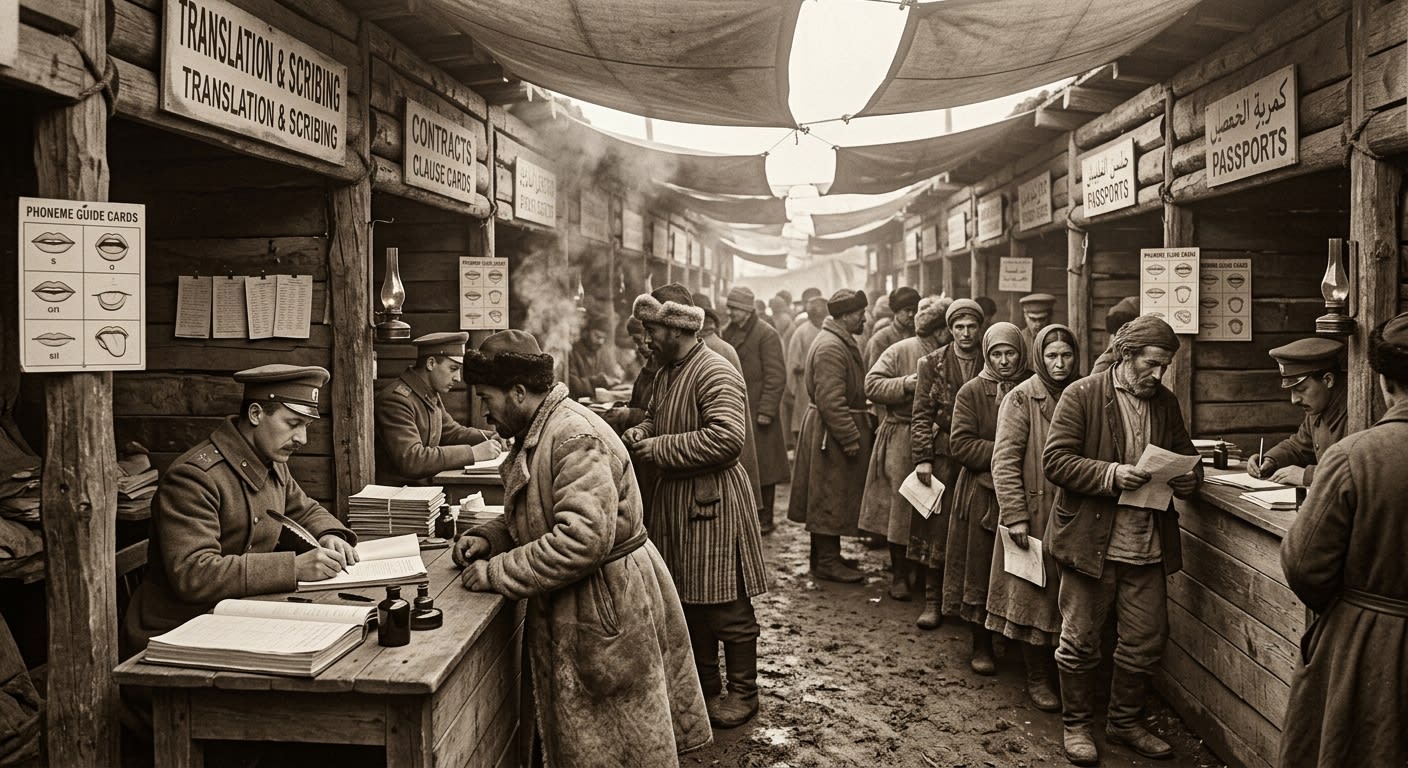
The Scribe Bazaar occupies the ring's western arc — a covered market of hide-lashed timber stalls where translator-scribes hawk their services in six languages, four dialects, and a gesture-cant that the Bureau of Purity has not yet managed to classify as either speech or heresy. The smell is leather glue and strong tea. The prices are exorbitant. The alternative is mispronunciation, and in the Steppe Gate, mispronunciation is a medical condition with a high mortality rate.
Seal-House Row runs south from the Bazaar: a line of iron-hinged workshops where the Seal-House Consortium casts, stamps, and certifies every document that passes through the Gate. Seal-Mistress Ylena Korr (Unregistered) oversees the operation with wax-stained fingers and eyes that never stop counting. No stamp, no passage. No passage, no life. The Consortium's monopoly was legalized in A.S. 94, following the first counterfeit crisis, and has been challenged seventeen times since. Sixteen challenges failed in court. The seventeenth challenger's documents were found to contain a clause that no one — including the challenger — remembered signing, and the matter was dropped.
The Caravan Corrals sprawl east — a stinking labyrinth of holding pens, feed troughs, and temporary shelters where beasts and cargo wait while their owners' papers are processed. The wait is measured in days. The cargo shrinks nightly. The Bureau of Records attributes the shrinkage to "atmospheric moisture," which is the polite term for theft by patrol riders.
The Oath Inns line the northern gullies — establishments where contracts are negotiated over sour beer and sealed with confessions that the innkeepers record as addenda and store in the Burnless Archive. The Split Tongue, the largest of these establishments, maintains a cellar where the Null Tongue Brotherhood holds meetings that the Bureau of Purity is aware of, has investigated, and has chosen not to suppress, on the grounds that the Brotherhood's message — that silence is freedom — is so obviously heretical that its continued existence proves the Synod's magnanimity. This reasoning satisfies no one, which is how you know it originates from Strasbourg.
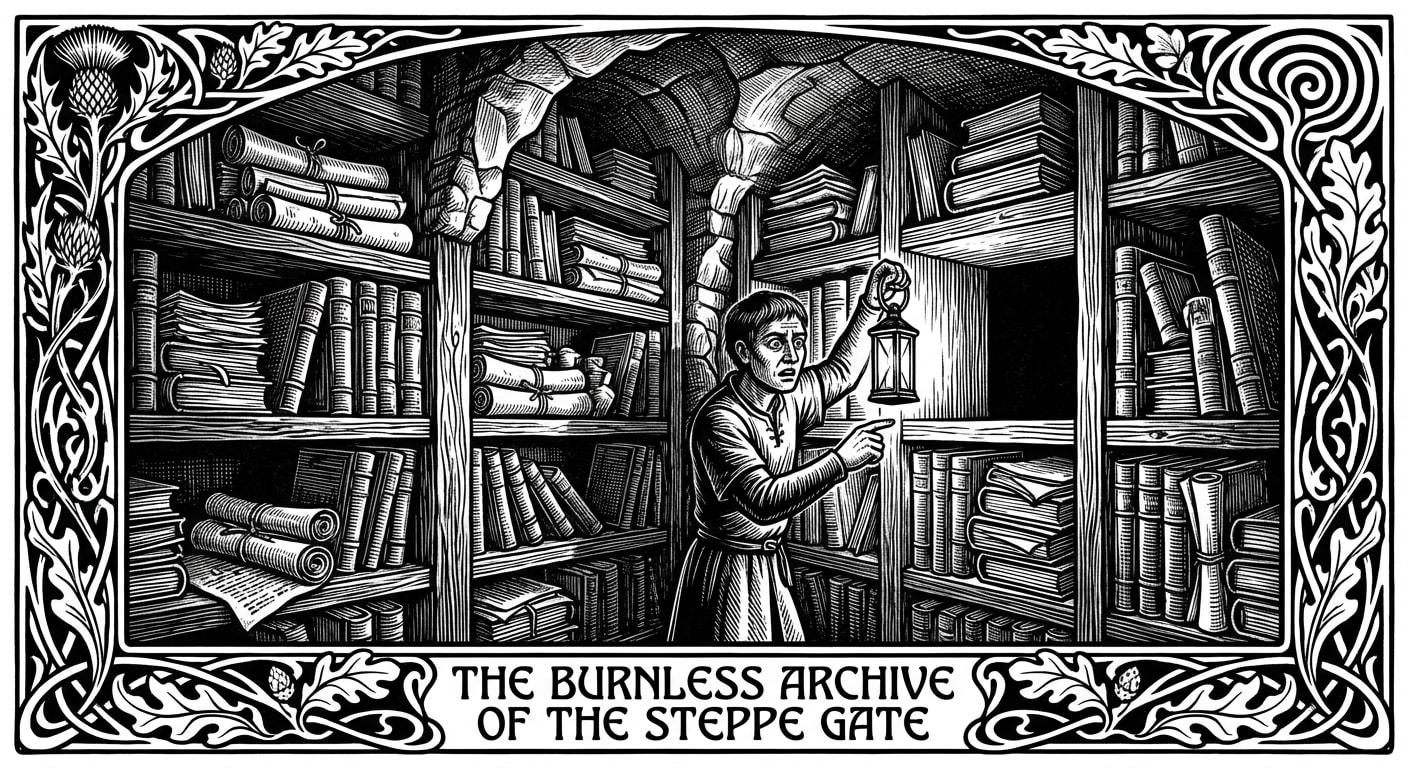
The Burnless Archive squats beneath the eastern cutbank — a sub-vault of cold stone and dry paper where every treaty, every addendum, every clause, every confession, every arbitration ruling since A.S. 76 is stored. The paper does not burn. This is the Gate's most celebrated anomaly and its most burdensome: old clauses never die, old debts never expire, old confessions never fade. Generational debt is the town's inheritance, passed from parent to child with the precision of a sealed folio and the mercy of a filing cabinet.
The Gully Market occupies the ravines below the corrals — a subterranean commerce of forged addenda, stolen seals, whispered safe-words, and contraband maps conducted in near-darkness by men and women who understand that the Gate's economy of law produces, as all economies do, its own black market. The Bureau of Purity raids the gullies quarterly. The gullies refill by the following market day. The Bureau has begun scheduling its raids to coincide with market days, for efficiency.
And above it all, the Windwatch Towers — four stone pylons on the higher cutbanks, staffed by patrol marksmen and signal-flag operators whose flag patterns encode, alongside legitimate military semaphore, an entire secondary language of illicit reroute instructions, bribery schedules, and caravan-interception coordinates. The Bureau of War is aware of this secondary language. The Bureau of War uses this secondary language. The Bureau of War denies the existence of this secondary language. These three facts coexist without discomfort in the Ledger, because the Ledger is large enough to contain contradiction and the Bureau is large enough to practise it.
#On the Red Pronunciation
"If you don't know the word, don't try the word." — Steppe Gate proverb, carved on the Ditch Gate lintel
The catastrophe that gave the Gate its deepest scar — and, incidentally, its most profitable cottage industry — occurred in A.S. 94, eighteen years after the founding.
A caravan court arbitration between two Moldavian salt-convoy factions reached its concluding clause. The presiding arbiter — a man whose name the records preserve only as "J. Sarn, Licensed, Second Class" — attempted to pronounce the binding term of the judgement. The term was in the archaic variant of the Triune Alphabet carved on the Third Treaty-Stone. Sarn mispronounced one syllable. The records disagree on which syllable; the records agree on what followed.
STAMPED ERRATUM — Bureau of Doctrine, A.S. 95 Prior Registry entry stated "approximately one hundred" casualties in the Red Pronunciation. The figure has been revised to "approximately one thousand." The previous figure reflected a transcription error in the casualty ledger, compounded by the fact that the casualties' throat injuries rendered post-mortem identification procedurally inconvenient. The Bureau regrets the discrepancy. The Bureau does not regret the discrepancy enough to investigate how it persisted for twelve months.
One thousand throats closed in a single night. The clause-spirits — manifesting as wind-pressure against the trachea, ink capillary haemorrhage, and spontaneous paper lacerations across exposed skin — enforced the mispronounced term with the precision of a surgical instrument and the restraint of an artillery barrage. Every person within the Treaty Ring who had been party to, witness of, or physically adjacent to the arbitration was struck. The term itself, once mispronounced, propagated through the evening wind and was carried, whisper by whisper, through the Oath Inns, the Scribe Bazaar, and the Caravan Corrals. Each repetition — each ear that received the corrupted syllable and each mouth that reflexively echoed it — triggered a fresh enforcement.
The Bureau of Bells dispatched an emergency Cantor-team. They arrived in nine days. By then, the surviving population had developed the first phoneme guides — crude ink-and-hide cards showing the correct lip and tongue positions for every clause carved on the stones. The guides were copied, refined, and sold. Within a year, the translator-scribe profession had evolved from a convenience into a necessity, and the Scribe Bazaar had tripled in size.
The Seal-House Consortium formed in the aftermath — a guild compact of stampers, seal-casters, and wax-workers who argued, persuasively, that centralized certification of all documents would prevent future mispronunciation cascades. The Caravan Court ratified the monopoly. The Bureau of Records approved the ratification. Captain Rho Balesh's predecessor accepted the first "facilitation payment" from the Consortium and established the precedent that patrol enforcement of the Consortium's monopoly was a matter of public safety, not private profit.
The distinction, as I have noted, is often procedural.
#On the Economy of Syllables
The Steppe Gate's economy is paper. Coin circulates — it must, for the caravans carry it — but the true currency is the stamp, the seal, the clause slip, the oath-note, the witness mark, and the pronunciation certificate. A caravan entering the Gate requires, at minimum: a passage writ (stamped), an escort contract (sealed), a dialect attestation (certified by a licensed translator-scribe), a manifest of goods (counter-signed by the Caravan Court), and a pronunciation certificate confirming that the caravan master can speak the binding terms of the passage clause without triggering enforcement phenomena.
This last document costs more than all the others combined.
The black market operates in the gullies below: forged addenda, counterfeit seals, blank witness stamps, and — most valuable of all — stone rubbings. A true rubbing of the Treaty-Stones, taken from the original carvings, carries the whisper-resonance of the original clauses. Possessing one is equivalent to possessing a loaded weapon. Selling one is equivalent to firing it. The Bureau of Purity has classified stone rubbings as "Prohibited Material, Class Two" — one class below actual demonic artefacts, one class above unlicensed printing plates.
The Gully Ledger Cartel — an organization the Bureau officially denies exists, and which the Bureau's agents patronise every third Market Day — controls the forged-addenda trade with the efficiency of a well-run bureau and the ethics of a poorly run one. Their masterwork is the "almost-correct" seal: a wax impression that passes visual inspection but fails wind-scent verification, the Gate's most esoteric security measure. The steppe wind, blowing through the Treaty Ring, carries the scent of legitimate wax. Counterfeit wax smells wrong in certain gusts. The Seal-Mistress's nose is, in this matter, the final court of appeal.
#On the Nullists and the Tongue That Does Not Speak
Every economy produces its heretics. The Gate's are the Null Tongue Brotherhood — a loose fellowship of gesture-communicators, deliberate mutes, and ideological silencers who hold that the stones' power over speech is tyranny, and that the only free act in the Steppe Gate is to say nothing at all.
The Brotherhood communicates in a gesture-cant — a hand-and-finger language smuggled into the Gate inside hymn books and taught in the cellars of the Oath Inns. The cant is not, technically, speech. The clause-spirits have not, to date, enforced against it. This loophole — the possibility that silence and gesture exist outside the stones' jurisdiction — is the Brotherhood's theological foundation, its recruiting tool, and its existential gamble.
The Brotherhood's greatest fear — and the fear that keeps their numbers small — is the possibility that the stones hear silence too. There are precedents. In A.S. 187, a null-walker — a Brotherhood adherent attempting to cross the Treaty Ring without speaking — collapsed at the Fourth Stone with blood running from both ears. The Bureau's autopsy found ink in the trachea. The Brotherhood's official position is that the stones punished the walker for "impure silence" — that his mind was speaking even if his mouth was not. The Bureau's official position is that the autopsy was inconclusive.
Both positions are, I suspect, correct.
#On the Present Condition
STAMPED ERRATUM — Bureau of Doctrine, A.S. 201 The following intelligence assessment supersedes Registry Entry 4-ST-199/b, which described the Steppe Gate's security situation as "stable." The situation is not stable. It has not been stable since A.S. 199. The prior assessment reflected the Bureau's preference for stability over accuracy, which is standard procedure.
In A.S. 199, a stone-rubbing disappeared from the Burnless Archive. This should be impossible. The Archive's paper does not burn, does not tear, does not decay, does not leave. A page that enters the Archive remains in the Archive until the stone from which it was carved crumbles — which, given the stones' apparent indifference to geological time, means indefinitely. The rubbing's disappearance implies one of two things: either someone has found a method to remove unburnable paper from the Archive, or the paper left of its own accord.
The implications of the first possibility are commercial. If treaty paper can be moved, treaty clauses can be rewritten. If treaty clauses can be rewritten, passage rights, toll schedules, escort obligations, and pronunciation requirements can be redrafted. The caravan lords have already begun buying translator-scribes at prices that suggest they anticipate a market in clause revision. High Arbiter Vark has convened three emergency sessions of the Caravan Court. Seal-Mistress Korr has doubled the Seal-Houses' output and tripled their fees. Captain Balesh has increased patrol sweeps from twice daily to continuous.
The implications of the second possibility are theological. If the paper left of its own accord, the treaty is not a document. It is an organism. It grows. It sheds. It absorbs the outcomes of its own enforcement — every mispronunciation punished, every clause upheld, every throat closed — and incorporates them into its own substance.
The buried truth — and I use the word "buried" with the precision of a man who has seen truths interred in the Burnless Archive alongside the confessions of the dead — is that someone is feeding the stones. Executions carried out within the Treaty Ring, from the Red Pronunciation onward, have not merely punished violations. They have nourished the treaty's capacity to accept new clauses. Each death is an addendum written in the only ink the stones cannot refuse: human silence, the permanent kind. The unsigned addenda that appear overnight in the Burnless Archive — new clauses in wet ink, authored by no living hand — are the treaty's own amendments, drafted from the accumulated silence of the enforced dead.
The Treaty Office knows this. The Seal-House Consortium profits from it. The Caravan Court adjudicates around it. Captain Balesh patrols in wilful ignorance of it. The Bureau of Doctrine has classified the knowledge as "theologically neutral," which — as I have noted elsewhere and will note again — means we cannot determine whether the stones are holy, damned, or merely hungry.
I lean toward hungry.
The town motto is carved on the Ditch Gate, above the entry queue where refugees wait in dust that tastes of limestone and verdicts: "Say it clean, or pay it red."
The motto is carved in the archaic script. No one mispronounces it. No one dares.