
#On the Circle Where Language Acquired Teeth
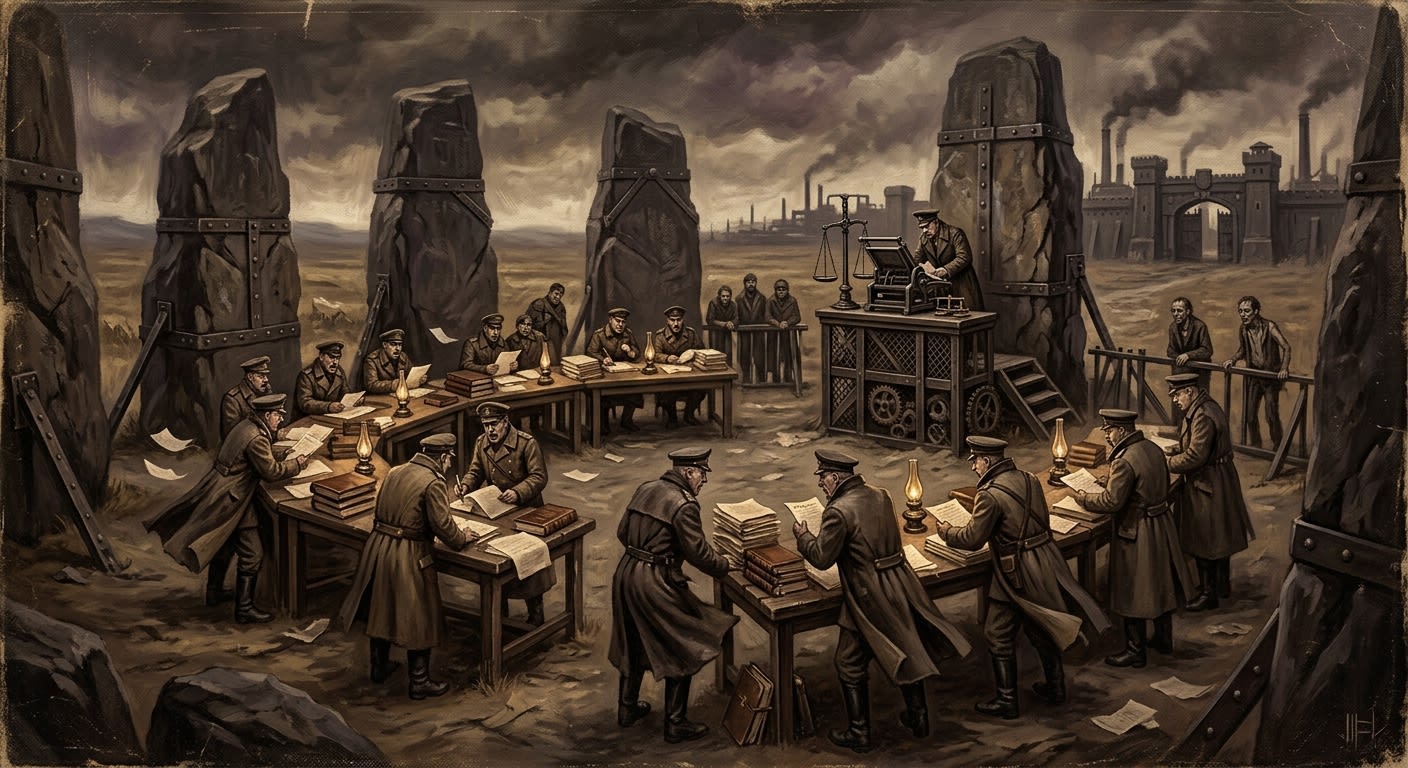
The Treaty Ring stands in the central dust of the Steppe Gate, forty paces across, seven wind-polished limestone monoliths in a circle, each carved with clauses old enough to embarrass chronology and sharp enough to open a throat without touching skin. It is court, altar, gallows, market instrument, acoustic trap, and the most profitable grammar lesson ever inflicted upon the Moldavian border steppe.
The stones were raised in A.S. 76 at the limestone-cutbank gap where every caravan, refugee column, salt train, patrol mule, contraband prayer-sheet, and ambitious liar must narrow itself into procedure. The fighting stopped because the wind began reading the law aloud. Men who had ignored patrol threats, clerical pleas, hunger, weather, and one another discovered suddenly that a mispronounced obligation could do what soldiers had failed to accomplish: impose silence with surgical authority.
The Treaty Ring is the principle around which the Steppe Gate accumulated: Scribe Bazaar (Unregistered) on the western arc, Seal-House Row (Unregistered) running south, Caravan Corrals stinking eastward, Oath Inns in the northern gullies, Patrol Barracks (Unregistered) oiling their guns, Gully Market (Unregistered) selling forged addenda below, and the Burnless Archive beneath the eastern cutbank swallowing every clause the Ring has ever spoken. Twenty-six thousand permanent souls orbit the stones. Ten to forty thousand more pass through in caravan season. All of them speak carefully or pay someone else to speak for them.
The Ring's first genius was peace. Its second was revenue. Its third, which came later and will outlive all the honest men presently pretending to command it, was appetite.
#On the Seven Stones
The stones are limestone, though this statement satisfies no geologist who has been close enough to place a gloved hand upon them. Ordinary limestone chips, sweats, chalks, and accepts contempt from weather. The Treaty-Stones (Unregistered) have stood in constant steppe wind since A.S. 76, endured dust-squalls, lightning, blood, wax smoke, ink splash, riot, ash fall, Bureau inspection, and the grubby attentions of ambitious men with rubbing cloths, yet their carvings remain deep enough to cut a shadow at noon. The Bureau of Alchemical Standards examined tool marks in A.S. 92 and declined to name the instrument. Their report used the phrase “insufficient precedent in the mineralogical literature,” which is the educated man's way of dropping a crucifix and walking backward.
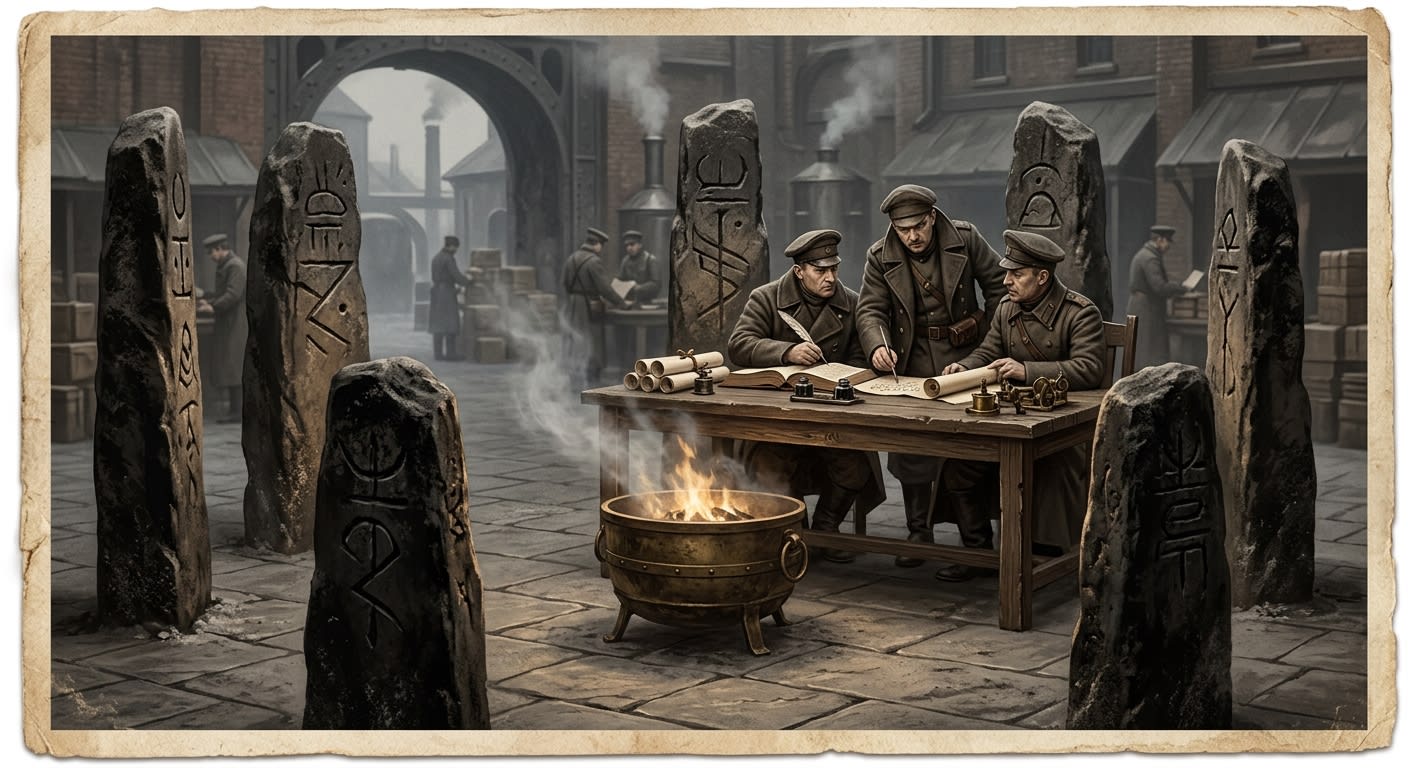
Each stone bears two principal faces, fourteen panels in total, with three duplicate transfer impressions made during the A.S. 92 survey. The clauses govern passage rights, toll schedules, witness obligations, escort liability, oath-note custody, fraud penalties, pronunciation requirements, and those older, nastier provisions whose wording predates the Triune Alphabet while resembling it closely enough to make Doctrine sweat through its gloves. Purity later called the script proleptic. I call it an insult to time, notarised after the fact.
The stones speak when the wind strikes the carvings. The wind always strikes the carvings. A whisper passes around the Ring in continuous measure: clause, pause, clause, toll condition, witness formula, binding term, old vowel, old consonant, legal threat, legal mercy, legal threat again. It is quiet. Loudness would be vulgar. The Ring is worse. It is audible enough that the tongue prepares itself before the mind has chosen speech.
The Bureau of Bells classifies this as a Category Four Harmonic Anomaly, one grade below Bastion-Irongate's Gasket Choir. This classification permits investigation, fees, emergency Cantor-teams, and the excellent bureaucratic luxury of owning a phenomenon without explaining it. The Bureau has never determined whether the Ring sings, speaks, reads, or prosecutes. The distinction is of minor comfort to the accused.
#On the Ground of Court
Court sessions are held in the open air inside the Ring. The High Arbiter's limestone bench sits slightly off centre, because the centre is left empty for the clause. No one says this in the visitor pamphlets. Visitor pamphlets prefer “ceremonial space,” “historic compact,” and “living heritage,” because pamphlet writers are cowards with access to nice ink.
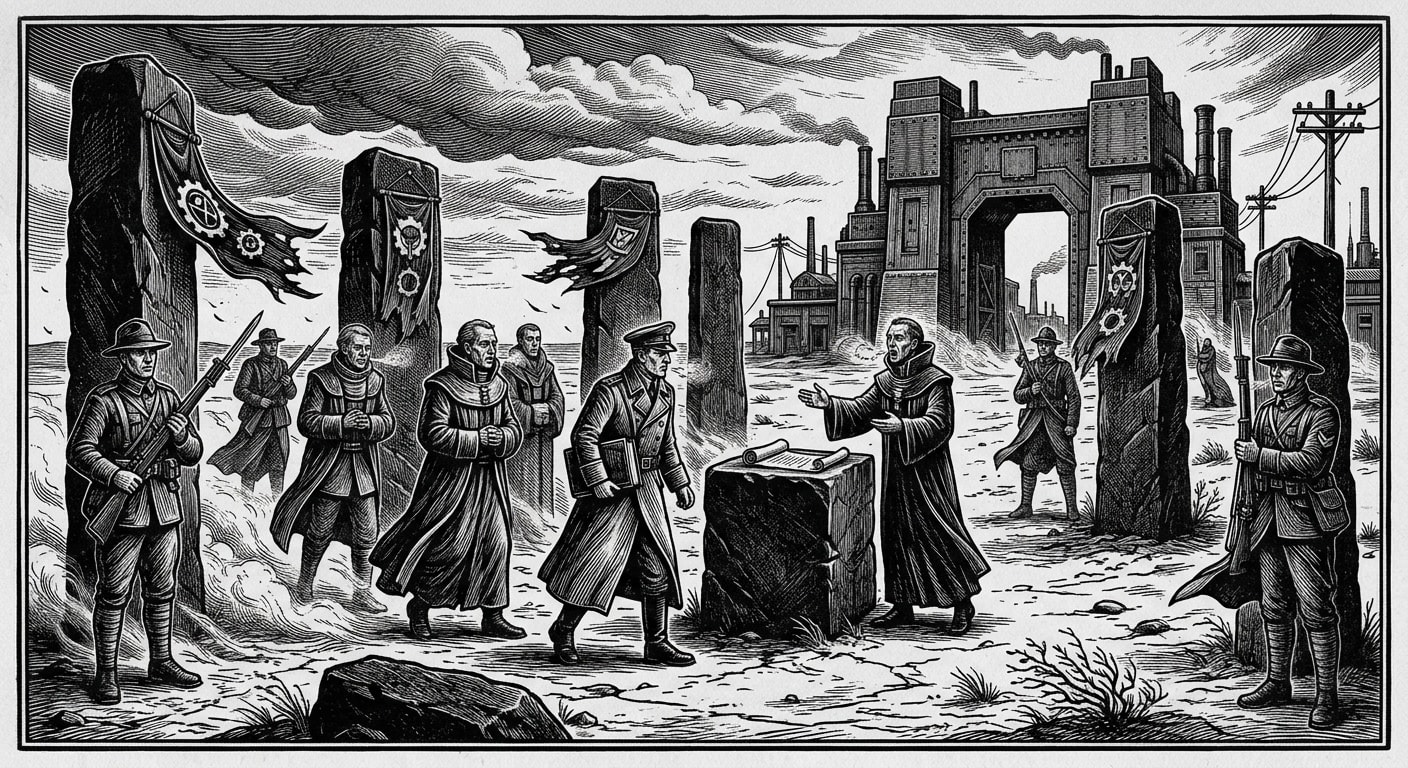
High Arbiter Senn Vark presides beneath the seven monoliths with a witness at every sentence and red wax staining his right fingers. His rulings carry force because the Caravan Court of Nine Weights says they carry force; because the Treaty Office (Unregistered) records them; because the Seal-Houses stamp them; because the Burnless Archive stores them; and, most persuasively, because the stones punish certain mistakes before appeals can be filed.
A proceeding begins before a word is spoken. The parties stand at marked positions set by cargo class and risk category. Salt factions on the Third Stone line. Refugee columns near the Fifth, where shelter terms are carved in a dialect no living registry admits using but many hungry children pronounce correctly by instinct. Escort disputes before the Second. Death-paper irregularities before the Seventh. A witness clerk marks the wind. A translator-scribe tests the binding consonants under breath. The Seal-House runner warms the wax. Vark waits until everyone present has been made aware that speech, here, is handling ordnance.
The poor fear the Ring because it kills. The rich fear it because it records. Caravan lords arrive with trained mouths, private translators, emergency physicians, red caution glyphs, and precedent volumes bound in goat-hide. Refugees arrive with dust in their teeth and no money for syllables. The stones do not pity either class. This is sometimes mistaken for justice.
The court's most beloved phrase is “the clause stands.” It has ended marriages, settled caravan wars, redirected salt roads, transferred debt across three generations, and stripped patrol captains of captured mules while leaving them their uniforms, that last mercy being in my view excessive. When Vark says it, the stones whisper after him. Whether they repeat or approve remains unsettled. No one with an intact throat insists on the distinction.
#On the Sevenfold Stations
Each stone has acquired a civic personality, which is what happens when frightened people spend one hundred and twenty-five years paying attention to rock. The First Stone handles entry, passage, and the beginning of lawful motion. Its face is rubbed smoother than the others by gloved hands from caravan masters asking permission of a thing that has never granted mercy, only syntax. The Second governs escort and road obligation. Soldiers dislike it because it remembers promises made before skirmishes, and soldiers prefer promises to die before witnesses do.
The Third Stone carries the southern-face clause that killed Sarn's (Unregistered) court. It is treated with the ceremonial loathing due a saint whose miracle was mostly suffocation. Red glyphs mark its binding terms. No apprentice speaks within twelve paces of it until his master has struck him twice for confidence. The Fourth Stone governs silence, implied consent, and those dangerous pauses during which merchants attempt to pretend they have agreed to nothing. The Null Tongue Brotherhood fears the Fourth most, as well it should.
The Fifth Stone holds shelter, asylum, weather delay, and the clauses by which refugees become lawful enough to be charged. It is the most prayed-at stone and the least generous. The Sixth holds confession addenda and oath-note transfer, feeding the Archive's Sixth Vault with a steadiness that ought to shame dairy cattle. The Seventh holds death papers, inheritance, cargo carried by the deceased, and the lovely little border question of whether a dead man may still owe toll if his goods continue westward without him. The Seventh always answers yes.
The Ring works because all seven stations make a single mouth. Entry without escort is trespass. Escort without speech is void. Speech without witness is vapour. Witness without seal is gossip. Seal without Archive is theatre. Archive without enforcement is nostalgia. Enforcement without death is, at the Steppe Gate, considered underdeveloped law.
#On the Red Pronunciation
The Ring's holiness, if one insists on flattering it, was purchased in A.S. 94 by one thousand closed throats.
Arbiter J. Sarn, Licensed, Second Class, presided over a Moldavian salt-convoy arbitration between factions whose commercial disagreement had already ripened into murder, counter-claim, escort breach, mule theft, and theological insult. Sarn was trained. Sarn was licensed. Sarn had no useful excuse. He reached the binding term on the Third Stone's southern face and damaged one syllable. Some witnesses said he softened the second consonant. Some said he swallowed the terminal vowel. One dying inn-runner wrote that the wind spoke over him and made the error his by adoption.
The stone answered.
First came throat pressure. Then ink at the ears, gums, nostrils, and eye-corners. Then paper cuts across exposed skin, each line matching the angular grammar of the breached clause. The corrupted syllable entered the wind, the wind entered the Oath Inns, the Scribe Bazaar, the Caravan Corrals, the mouths of those asking what had happened, and the mouths of children repeating adults because childhood is an archive without counsel. By dawn the Treaty Ring had become a slaughterhouse with filing requirements.
NIGHT WATCH COLLATION — RED PRONUNCIATION, A.S. 94 Ring perimeter: bodies in court posture, hands at throat. Oath Inns: repetition cascade confirmed through door cracks and beer-cellar vents. Scribe Bazaar: red caution glyphs drawn after event, not before. One surviving child found beneath salt tarpaulin, repeating binding term without sound. Disposition of child: ███████████████.
The Bureau of Bells dispatched an emergency Cantor-team. They arrived in nine days. This is swift by Bureau standards and useless by human standards, which often diverge inconveniently. By then the survivors had already invented phoneme cards, red caution glyphs, wax-plug protocols, door-silence rules, and the Scribe Bazaar's modern extortion schedule. Civilization, when frightened, becomes entrepreneurial before it becomes wise.
The first Registry notice listed approximately one hundred casualties in the Red Pronunciation.
Corrected by Doctrine erratum in A.S. 95 to approximately one thousand. The earlier figure reflected removed bodies, damaged throats, convenience, and a clerk's preference for the smaller column. He was reprimanded, then promoted for instinct.
The Red Pronunciation remains the Ring's chief sermon. Every arbiter touches his throat before a binding term. Every translator-scribe overcharges with historical justification. Every Seal-House apprentice learns the Third Stone's southern face before he is trusted with hot wax. Sarn's name survives only by initial. The casualties survive as law.
#On the Market of Pronunciation
The Treaty Ring produces an economy of syllables, and like every economy it has saints, thieves, brokers, extortionists, widows, children, and officials insisting the extortion is educational. A caravan entering the Gate requires passage writ, escort contract, dialect attestation, manifest, witness mark, seal verification, and pronunciation certificate. The last document costs more than the rest combined because the last document stands between the caravan master and his own windpipe.
The Scribe Bazaar occupies the western arc under hide-lashed awnings that crack all day in the wind. Translator-scribes sell survival by mouth-shape. They demonstrate tongue position with ivory pointers. They mark fatal vowels in red. They rent wax plugs by hearing-risk category. They teach rich men how to say shelter, salt, escort, exemption, widow, axle, and mercy in dialects that have killed better men for smaller errors. The poor buy one syllable at a time.
Seal-House Row runs south from the court. Seal-Mistress Ylena Korr's (Unregistered) workshops smell of wax smoke, iron, and professional contempt. Every ruling needs seals. Every seal needs verification. Every verification needs a fee. The Seal-House Consortium was legalised after A.S. 94 under the theory that centralised stamping would prevent future cascades. This is plausible in the same way locking a pantry prevents famine after the cook has bought the pantry.
The Gully Market below sells the things the upper Ring forbids at prices the upper Ring quietly sets: forged addenda, almost-correct seals, stolen witness marks, safe-words, blank oath-notes, emergency dialect slips, and stone-rubbing rumours. A true rubbing carries whisper-resonance from the original clause. Possessing one is a weapon charge. Selling one is artillery by paper. The Bureau of Purity raids the gullies quarterly and patronises them more often, which is either corruption or research depending on which office reimburses the meal.
#On Bureau Custody and Wind
Strasbourg has tried to own the Ring eleven different ways and has succeeded only in making its invoices heavier. Bells claims acoustic jurisdiction. Records claims registration. Doctrine claims interpretation. Purity claims contamination review. Tithes claims toll logic, though it does so from a cautious distance after the A.S. 94 casualty correction, since closed throats pay poorly unless heirs are located quickly.
Bells has the prettiest claim. The Ring speaks through wind, cadence, cut limestone, and human dread; naturally the bell-men arrived with tuning forks and the expression of men about to explain a miracle to itself. Their A.S. 94 emergency Cantor-team arrived nine days after the dead had become instruction. They measured the whisper, charted seven primary clause-tones, identified three sub-harmonics near the Third Stone, and issued recommendations already invented by local scribes in cheaper ink. The Bureau then classified those remedies as theologically adequate. Theft is more elegant when accompanied by a stamp.
Records fares worse. It registered the Gate in A.S. 78 as Administrative Node Seven, a name so bloodless that even the stones seem to whisper it with contempt. Records wants the Ring to be a compact, a compact to be a document, and a document to be a thing safely stored after proper indexing. The Ring refuses the last courtesy. Its documents live underground, refuse fire, produce amendments, and occasionally leave behind blank folios with wet ink and the manners of a creditor waiting outside a sickroom.
Doctrine, my own beloved kennel, has chosen the only position worthy of us: the Ring is neither condemned nor blessed while profitable ambiguity remains. The official phrase is theologically neutral. In practice this means no one may call the stones demonic, holy, natural, infernal, angelic, civic, or hungry without filing a request, and all requests are returned for pronunciation defects.
Purity's investigations have produced eleven reports, seven reprimands, two missing inspectors, one silent glossary, and no conclusion. The stones do not smell of demon. They do not respond to exorcism. They do not reject chrism. They do not respect it either. A White-Mantled Inquisitor once struck the Fifth Stone with a silver-capped rod and demanded declaration. The stone whispered a shelter clause. The Inquisitor's lodging fee tripled before dusk.
#On the Archive Beneath the Ring
The Treaty Ring casts its shadow downward into the Burnless Archive. Every ruling spoken beneath the stones descends into the eastern cutbank. Every treaty, addendum, oath-note, confession, toll schedule, witness mark, pronunciation key, correction, and ruinous little marginal clarification is carried below by Paper Keepers who whisper because the paper listens. The paper enters. The paper stays. The paper does not burn.
The Archive is why the Ring's law persists beyond memory, mercy, decay, and common decency. A debt settled aloud under the stones becomes a folio. A folio becomes permanent. A permanent folio becomes inheritance. A grandfather's confession in the Oath Inns may become a grandson's toll surcharge, and the grandson will be told, correctly, that the form is valid.
The Ring speaks. The Archive remembers. The court invoices. Observe the Trinity of border government.
In A.S. 194 the Archive began producing Living Addenda: wet-ink amendments written by no living hand, perfectly formed, genuinely sealed, furnished with witness blocks, and legally obscene. By A.S. 201 they appear roughly twice each week. They amend passage writs, tolls, witness lists, contracts, and court rulings. High Arbiter Vark has ruled that if the form is satisfied, the addendum binds. Pulse is not a statutory requirement.
The Ring cannot be separated from this wetness. The stones enforce clauses. The Archive digests enforcement. The Addenda return as new clauses. A dead man's silence may reappear as a toll schedule. An execution may become a witness field. A mispronounced term may vanish underground and come back with improved margins.
Treaty Office pamphlets describe the Burnless Archive as the Ring's passive record repository.
Withdrawn for restricted editions. The Archive records, preserves, amends, and appears to metabolise Ring enforcement. “Passive” has been retained in public pamphlets because panic is bad for caravan throughput.
#On Seld and the Blank Folio
The Ring's most dangerous absence sits beneath it: the missing rubbing of the Third Stone's southern face. During the A.S. 92 survey, Records took rubbings from all fourteen stone-face panels and three duplicates. One carried the whisper-resonance of the binding clause Sarn ruined in A.S. 94. In A.S. 199, during a quarterly audit of the Burnless Archive, that rubbing disappeared from a vault where paper does not leave.
Its shelf now holds a blank folio. The ink is wet. The page is empty.
Paper Keeper Seld inspects it every morning with cotton gloves and trained fear. I watched him in A.S. 200. He lifted the folio as though lifting a sleeping infant that might wake as a magistrate. He held it to the lantern. He looked for the first mark. No mark appeared. The ink shone at the edge of absence. Then he returned it to the shelf and recorded, in the guild whisper, “No text.”
If text appears, it will be a clause. If it is a clause, someone must read it. If someone reads it, the Ring may hear. If the Ring hears poorly, the Steppe Gate will acquire another casualty table and Doctrine will acquire another elegant phrase before supper. Seld has said he will read correctly. This is admirable. This is insane. The boundary between the two, like all important borders, is maintained by paperwork.
Senn Vark summoned Seld to four emergency sessions concerning the legal force of the Addenda. Seld whispered six sentences and cost three caravan houses a fortune. His most famous answer came when Vark asked whether the blank folio had changed. Seld said, “It changed weight this morning.” The transcript records silence afterward. In the Treaty Ring, recorded silence has evidentiary mass.
SEALED EMERGENCY SESSION EXTRACT — A.S. 200 VARK: By how much? SELD: ██████████████████████████████ SEAL-MISTRESS KORR: Can a blank page accrue jurisdiction? VARK: Enter the question. STONE RESPONSE: [untranscribed wind-pressure event]
#On the Null Tongue and the Thought of Silence
The Treaty Ring punishes speech. Naturally, men founded a heresy around silence, because men are apes who see a guillotine and begin designing hats to wear beneath it.
The Null Tongue Brotherhood teaches that the stones hold power only over spoken forms; that gesture, refusal, and inward thought remain free; that a man who says nothing cannot be bound by a clause he has not uttered. They meet in Oath Inn cellars, move hands under tables, pass blank slips, and practise walking across the edge of the Ring without giving the wind a syllable to seize.
The stones have not consistently punished gesture. This has made the Brotherhood brave in the limited, stupid way of gamblers who have survived three pistol misfires. In A.S. 187 a null-walker crossed near the Fourth Stone without speaking and collapsed with blood from both ears. The autopsy found ink in the trachea. The Brotherhood claimed impure silence: his mind had spoken though his mouth had not. The Bureau called the autopsy inconclusive. Both statements have the cowardly grace of people standing beside a pit they cannot measure.
The Brotherhood fears the Treaty Ring more than it hates it. That makes them wiser than most heretics. They understand that the Ring may not distinguish between word, intention, breath, and record. The Living Addenda have worsened this terror. If a page can write what no hand wrote, why should a stone not hear what no mouth said?
#On the Present Hunger
As of A.S. 201, the Treaty Ring remains active, profitable, and under watch. Vark sits. Korr stamps. The translator-scribes sell caution in red ink. Captain Rho Balesh's patrol riders beat order into queues and call the bruises traffic management. The Scribe Bazaar has doubled prices for Third Stone clauses. The Burnless Archive produces Addenda twice weekly. Seld watches the blank folio. The wind reads.
The Bureau of Bells maintains Category Four classification and recommends no unscheduled large-group pronunciation within the Ring. This recommendation is obeyed except during court, market, riot, storm, funeral, and ordinary life. The Bureau of Purity maintains its “theologically neutral” assessment. Doctrine maintains that the Ring is under control, provided one defines control as profitable proximity to a dangerous instrument.
The buried fact remains: the Ring is being fed. Executions, mispronunciations, oath breaches, closed throats, permanent silences — each passes into the Archive's wet arithmetic and returns as stronger law. The Steppe Gate enforces its treaties and grows them. The Ring is where clauses are born after the dead have stopped objecting.
There is a ceremony for executions inside the Ring, though the word ceremony is avoided in favour of enforcement completion. The condemned stands near the clause he has violated. A translator-scribe reads the clean form. A witness marks the wind. The Seal-House runner holds wax ready for the death entry. If the sentence involves strangulation by clause, no rope is used. The stone supplies pressure. If the sentence involves blood, the blood is collected on oath-paper and taken below before it dries. If the sentence involves silence, everyone present waits until the man's last breath has finished being useful.
No office admits that these completions enrich the Ring. Offices dislike admitting they have discovered agriculture in a graveyard. Yet the pattern holds. After heavy enforcement months, the Archive produces more Addenda. After major throat closures, the stones whisper longer clauses at dawn. After a year of few executions, the Ring grows testy: pronunciation keys fail by smaller margins, seals smell wrong in ordinary wind, witnesses forget their own names at awkward intervals. The town understands this in its bones and pretends not to. It is hard to live beside an altar that eats jurisdiction and still sleep after supper.
Captain Rho Balesh's patrols know where the blood runs between the stones after rain. Children know which chalk games cannot be played inside the circle. Translator-scribes know that some vowels cost more after executions. Seal-Mistress Korr knows which wax batches harden too quickly when the Fifth Stone has been busy with refugee shelter cases. Vark knows everything that can be charged a filing fee and several things that cannot.
Security assessment 4-ST-199/b described the Treaty Ring as stable.
Superseded A.S. 201. The Ring is operational, lucrative, expanding in legal effect, and acoustically obedient to no office that can be named without laughter. “Stable” has been reassigned to furniture.
Still, caravans enter. Refugees queue. Arbiters speak. Translators point to teeth and palate. Seal-House boys stir wax. Oath Inn keepers record confessions. The stones whisper while the steppe wind combs dust through the Ring, carrying each clause over the heads of men who would rather believe law is a thing written by men for men.
How sweet.