
#On the Funeral Route
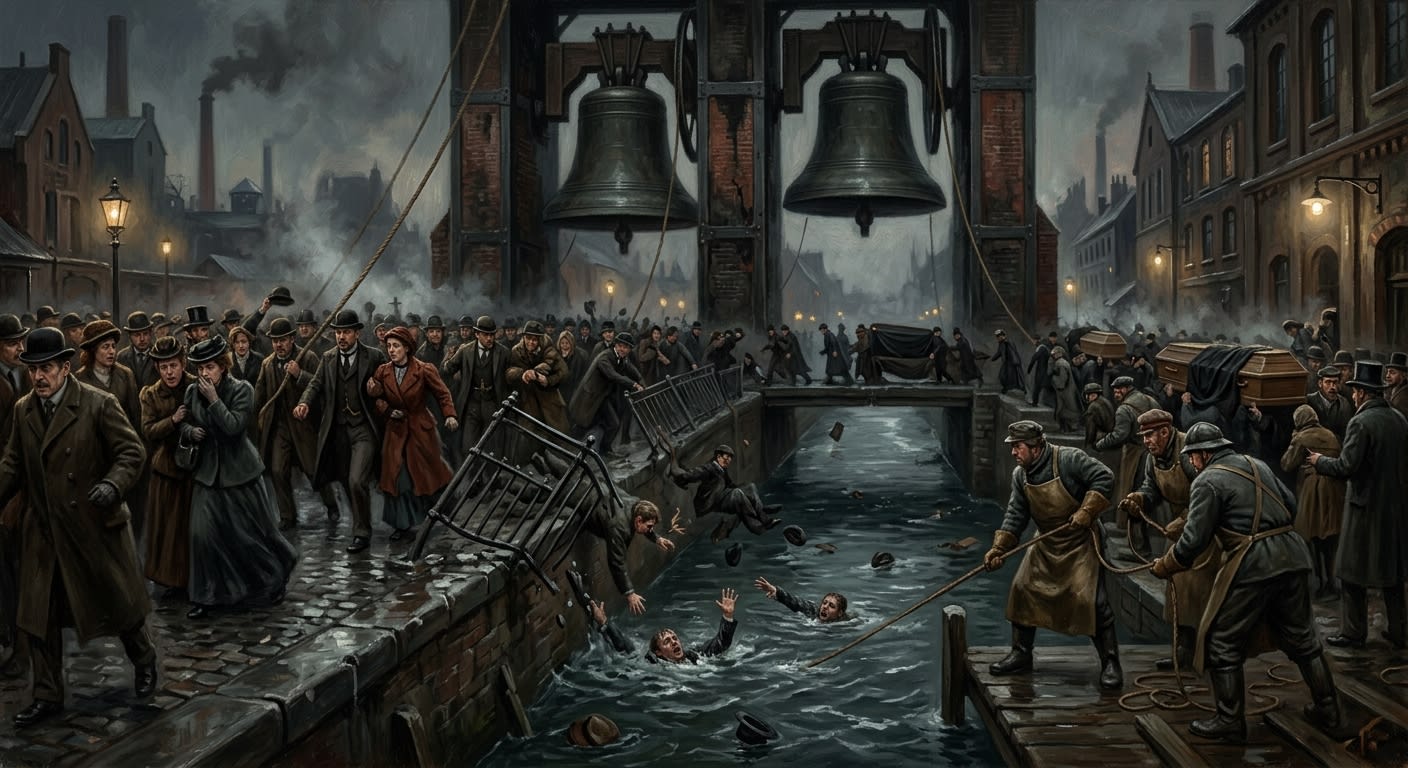
The Night of Two Bells began in A.S. 129 as a funeral, which is to say it began with citizens behaving as instructed while grief did its best to escape through the permitted apertures. Eight hundred mourners assembled in the cathedral quarter of Strasbourg, black cloth registered, candles counted, route tokens stamped by Bells and countersigned by the local Cadence Corps desk. The dead man in the coffin has been reduced by Records to “subject of procession.” His name matters less to the file than the fact that his mourners walked where they were told.
The assigned route ran from Saint Erasmus through the west cloister lane, across the little bridge behind the Cathedral of the Perpetual Writ, and down toward the ossuary steps. It was a narrow route, old before the Synod learned to make maps behave. Its alleys bent around shrines, sealed wells, shopfront chapels, and those stubborn medieval walls that Strasbourg preserves because demolition requires a committee and committees prefer new victims.
The lead Marshal tuned his whistle to the funeral bell of Saint Erasmus. The mourners were given the slow cadence. Two steps, breath, one step, bell. Two steps, breath, one step, bell. It is a decent rhythm for sorrow. It keeps the old upright, the young from running, the paid mourners from overacting, and the genuinely afflicted from throwing themselves on the coffin at inconvenient corners.
#On the Second Bell
At the sixth turning, Saint Erasmus tolled. The Marshal lifted his baton. The column breathed, shifted, moved.
Then the vespers bell of the Cathedral of the Perpetual Writ struck at the same instant.
The two notes met above the lane and made a third sound: wrong, rich, plausible, and false. The Marshal’s whistle cut across it, tuned to a frequency that no longer owned the street. The front rank heard Saint Erasmus. The middle heard the Cathedral. The rear heard both and obeyed neither. The coffin-bearers slowed. The paid chanters corrected toward vespers. The family line kept funeral pace. Eight hundred citizens, each obedient to a sound the Bureau had authorized somewhere, began to separate.
A crowd split by panic is vulgar. A crowd split by obedience is a finer horror. No one screamed at first. No one ran. Three streams emerged with dreadful politeness. The west stream followed the Marshal and reached the ossuary steps. The south stream drifted into market alleys, lost two candle carts, and dispersed under a baker’s awning. The third followed the Cathedral bell into a repair quarter whose gas-line permit had closed its lamps, narrowed its roadworks, and removed the canal rail for reasons later described as sequentially necessary.
BUREAU OF ENGINEERING — GAS-LINE REPAIR QUARTER WORK ORDER Incident date: A.S. 129. Rail removal authorized: yes. Lamp extinguishing authorized: yes. Temporary barrier requisition: filed, unfunded, refiled, misplaced. Night watch assigned: ███████. Reason for absent watch: ███████████████. Bodies recovered below embankment: 19. Do not cross-file with bell schedule until Records review.
#On the Canal
The canal behind the Cathedral quarter is not wide. Width would have made it honest. It is narrow enough for a man to believe he can step back from it and dark enough, when the lamps are out, for that belief to become wet.
Approximately two hundred mourners entered the closed quarter. The first rows slowed at the exposed embankment. The rear, still answering the Cathedral’s vespers tone, continued. The pressure was mild by the standards of Bastion-Brest. Mild pressure is still pressure. A widow fell. Two men bent to lift her. The line folded around them. Someone carrying a candle saw water. Someone else saw a wall where there was no wall. The first body went over without a cry. The next three cried enough for all of them.
Nineteen died. This number is reliable because the canal returned them before Records could become imaginative. Eleven drowned. Four broke necks on the lower stone lip. Three were crushed against the mooring post before falling. One old woman survived the fall and died after being told she had survived; Mercy lists this as “delayed conclusion,” which is why Mercy should never be allowed near poetry.
The first inquiry attributed the Night of Two Bells to sabotage by unknown agents seeking to destabilise civic mourning procedures.
Corrected: no saboteur was required. Two bell-ringers, each certain of his bell-table, rang on instinct. The Empire of Error needs fewer conspirators than the frightened suppose.
The dead were laid in the vestry of Saint Erasmus until second bell. Their shoes were placed beneath the pews in matched pairs, except for three missing from the canal mud. The coffin that began the procession arrived at the ossuary before them. This displeased the family, the parish, and the file, though for different reasons.
#On Blame and Bell-Tables
Bells blamed the weather. Records blamed the route sheet. Engineering blamed the lamp order. Rites blamed the mourners’ insufficient chant discipline. The Corps blamed the whistle tuning. War, having no troops in the street, blamed civic softness and requested a copy of the casualty diagram for training purposes. Doctrine blamed sabotage because sabotage has the decency to sound like an enemy.
The revised inquiry was less satisfying and more useful. Saint Erasmus had funeral priority until the west cloister turn. The Cathedral vespers bell had standing authority at the hour. The bell-table listed both in separate columns. No one had been tasked with reading both columns at once, since such an assignment would have implied that columns possess relationships and might require judgment.
The punishment was merciful, by which I mean cowardly. Neither bell-ringer was hanged. One was sent to wax inventory. The other was assigned to rope inspection in a tower that had no ropes. The lead Marshal retained rank after a six-month censure and spent the rest of his service teaching recruits never to trust a single sound in a city with more than one steeple.
#On the Route-Timing Concordat
The Route-Timing Concordat was born from those nineteen bodies. It required strict synchronisation of every procession route with the published bell schedule, mandatory two-bell clearance on funeral routes, and the creation of Cadence Architects: senior Marshals trained to design movement through streets whose stones were laid by men with no suspicion that the future would contain bureaucracy.
The two-bell clearance rule is simple. No bell within harmonic range may strike during a funeral passage. The bellway must be emptied ahead of the coffin as a nave is emptied before a relic. Silence becomes infrastructure. Mourning receives a corridor of withheld sound.
A devotional pamphlet printed in A.S. 161 claimed the Concordat arose from “the Synod’s renewed tenderness toward civic grief.”
Corrected: tenderness was unavailable for comment. The Concordat arose because nineteen dead mourners cost less to prevent than to explain.
Cadence Architects now map corners, alleys, bridge mouths, canal lips, market stalls, shrine steps, and echo pockets with a severity that would shame old campaign engineers. They know where grief slows. They know where chant accelerates. They know which bell makes a widow stop, which bell makes children turn their heads, which bell carries across wet stone and returns altered from the water.
#On the Lesson
The Corps calls the Night of Two Bells “the lesson.” It does not say “tragedy” unless public clergy are present. Tragedy belongs to theatre and families. Lesson belongs to professions, and professions prefer their dead converted into training material before they begin to smell.
Every Cadence recruit hears the story after the Malven beat and before the first canal drill. They learn that a lawful sound can become lethal beside another lawful sound. They learn that obedience can split a crowd as neatly as panic. They learn that the city is an instrument played by too many hands, most of them gloved, stamped, and convinced of their own authority.