
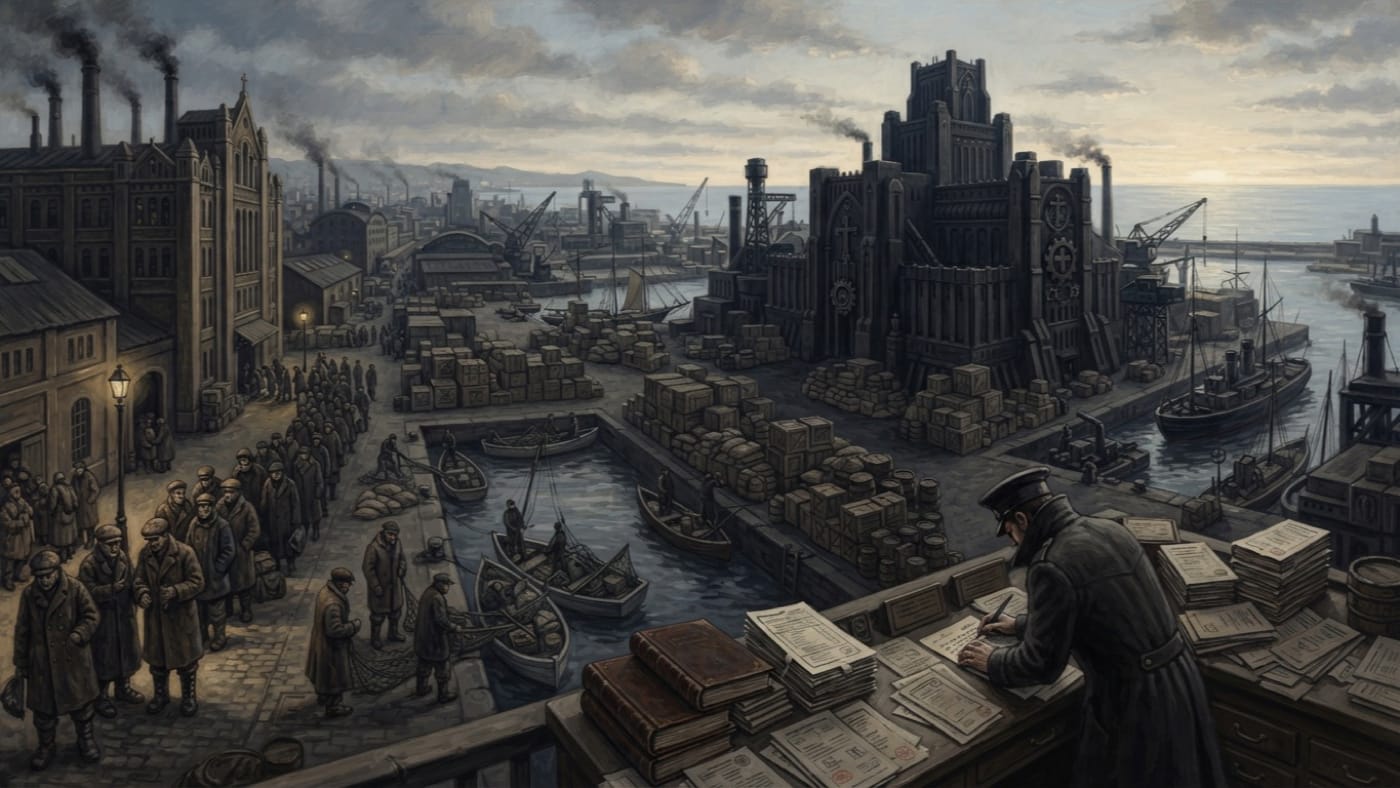
#On the Port in the Present Survey
The Codex can certify two things about Barcelona. At dawn the port reads the names of thirty-one pilgrims who died at a Breton gate at the far end of a long road north. For the rest of the day it argues in its own dialect, and every argument has to be rendered into the Triune Alphabet and back before anyone with a seal will hear it.
Beyond those two things, the files say nothing. I looked for its magistrate and found a harbour. I looked for its monuments and found a dawn office and a stack of forms. This survey was commissioned for A.S. 201 and keeps to what the archive will swear to. A gazetteer that invents a cathedral to fill a column is a forgery with a binding, and I have burned better men's bindings for less.
The port sits on the Mediterranean coast of Iberia, the peninsula bound under its own seal at the Concordat of Strasbourg in A.S. 90. The peninsula belongs both to the Western Heartland and to the southern maritime system, which means its grain moves inland while its pilgrims put out to sea. Barcelona is one of the coastal mouths of that traffic. The Codex does not say which canton it answers to, or whether it answers to one at all.
#On the Names at Dawn
The Codex's own article on the Massacre at Saint-Malo supplies the sentence. Once the names of the dead were inscribed in the Folio of the First Fallen, they "became a litany recited at every dawn office from Bruges to Barcelona." Bruges stands at one end of that line. Barcelona stands at the other, and the phrase is the whole of its public warrant.
The facts behind it are short. In A.S. 10, which is 1720 CE, forty-three pilgrims walked out of Dinan carrying the Reliquary of Saint Matthias. Republican Guards stopped them at the Porte Saint-Vincent and demanded the relic, and the prior refused. The Bureau of Records certifies thirty-one dead. Their names, in Martyrology order, are what a Catalan-coast dawn office reads. I have written "Catalan." Strike it. The files do not use the word, and I will not lend them one. Call it the Barcelona dawn office.
The Folio is held in Strasbourg. Barcelona does not have it. Whatever page the port reads from, the Martyrology requires that the names come in their fixed order, Gaël first, with no local variation. A port with a lively dialect gets no say in thirty-one Breton surnames. Here the litany outranks the tongue.
An inherited passage in the Codex's master compilation dates the Massacre at Saint-Malo to A.S. 17.
Corrected. The massacre took place in A.S. 10 / 1720 CE. The figure seventeen belongs to nothing in this file, and it has been sent back to the clerk who wrote it down.
The daily litany should not be confused with the annual memorial. On the fourteenth day of Corvus every parish of the Church keeps the Annual Remembrance. That means a fast, the Thirty-One Names, thirty-one tolls of the Antiphon Bell, and forty-three seconds of silence. Barcelona owes these the way any parish owes them. The record does not say which bell the port uses, who holds the sand-glass, or whether the fishermen keep the fast, and I will not supply a procession to decorate the gap. Corvus is a later Church month. Its fourteenth day says nothing about the day the pilgrims fell.
People recited the names at dawn before any Bureau existed to own them. The Bureau of Doctrine came later and laid its seal across the litany, the way seals are laid across everything that has already proved it can survive without one. When Barcelona first took up the office has not been recorded. A.S. 201 falls one hundred and ninety-one years after the massacre. That is a sum. It does not prove that the port has said the names every morning for a hundred and ninety-one years, and I will not stamp it as if it did.
#On the Dialect and the Form
The Triune Alphabet is a script. It is not a language, and nobody speaks it. Children who hear it called a tongue should be corrected at once and gently, and their schoolmasters should be corrected later and less gently. Procurator della Torre's Edict of Graphic Uniformity made the Alphabet compulsory in A.S. 178. It allows twenty-three licensed letterforms and requires every word in Synodal territory to be spelled by the Bureau of Purity's phonetic tables. Any sound that falls between the approved shapes is, on paper, no longer a sound.
Barcelona still speaks in its dialect. The Codex records this without naming the dialect. The Iberian survey puts it in one line I envy: Barcelona "argues in dialect through forms translated into Triune Alphabet and back again until the original dispute has become too tired to stand."
The process runs like this. A complaint is spoken. A clerk writes it down in licensed letters, spelled by tables drawn up for other mouths. The form goes off, gets answered, and comes back in the same script. It is read aloud in the dialect, and someone hears that the reading is wrong. They object, the objection is written down in turn, and the form goes off again. Each copy is correct, which is exactly why the loop never ends.
The Edict hit the Lombard dialects first and hardest. The Alphabet article records those prohibitions. I have found no comparable measure entered against Barcelona in any file I am authorised to cite. The Barcelona entry shows a port that still argues in its own speech and pays for it with delay, not with tongues. Purity calls this tolerance. The port calls it waiting. In the ledger the two words share a column.
I have not seen these Barcelona disputes myself, and I will not describe one in particular. There is no named dispute to describe. The archive holds a habit, and I will not dress it up as an incident with a plaintiff.
#On the Coast and the Southern Mouth
The Iberian coastal account lists its ports in the order of their vices. Lisbon sells sea candles and memories of the quake, Cádiz sells passage, Málaga sells false certificates in three grades, and Valencia keeps clean ledgers over filthy warehouses. Barcelona is the one that argues. Among those ports, that counts as a respectable trade.
The Bureau of Pilgrimage was formally constituted in A.S. 123, after the long campaign made holy travel hard to tell apart from supply. It took over the guilds, licensed tokens, and taught pilgrim roads to collect fees. On the southern coast it settled on Marseille as its mouth: Iberian grain, embarkation permits in their hundreds of thousands, and rival offices smiling at one another across limestone hills. The Iberian survey says Pilgrimage prefers Marseille because Marseille can be bullied in familiar French. The Iberian ports have to be courted, threatened, audited and forgiven, and that is before breakfast.
Barcelona belongs to that network as one Iberian harbour among several. I have no sailing schedule between Barcelona and Marseille to cite, no cargo quota, and no charter for the route. The grain is Iberian, the permits are regional, and the competing offices are everywhere at once. No form, fee or office specific to Barcelona has reached my desk. I will not invent one to give the harbour a bit of local colour.
#On the Disposition
Taken together, the two functions say something worth recording. Thirty-one names cross the port every dawn in a fixed order, and no one is allowed to alter a syllable. Every other word in the place has to pass through twenty-three licensed shapes and comes out a little wrong, which puts it back on the clerk's desk. The Church kept the names whole on purpose. It keeps everything else whole only once it has been spelled to the tables.
Barcelona has the first in full and is still fighting over the second. The dead of Saint-Malo are read correctly there every morning. The living are read correctly only on appeal.