
#On the Peninsula That Signed Late and Bled Early
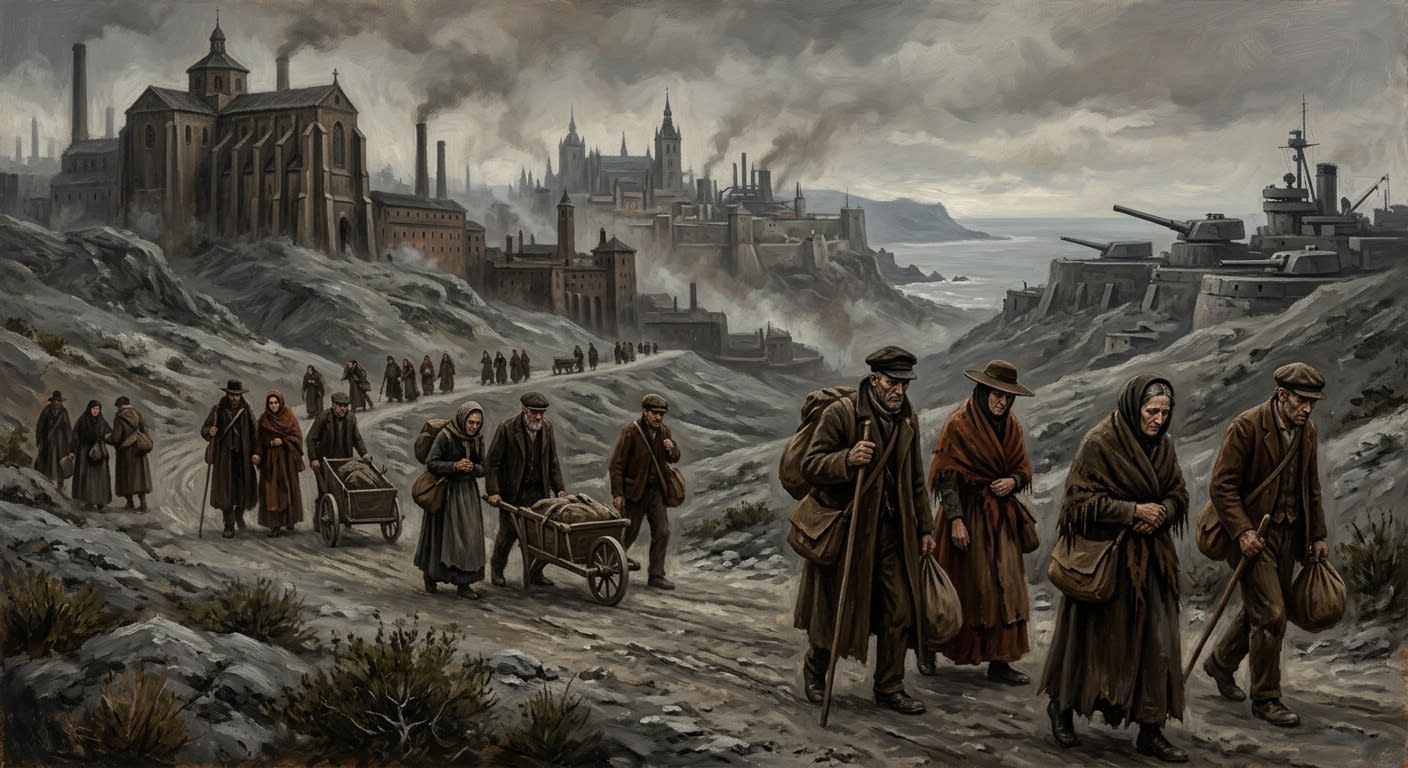
Iberia is the Synod's western furnace: old kingdoms beaten into one seal, pilgrim roads glazed with heat, ash-priories smoking in the hills, ports watching the British guns at Gibraltar with the courtesy due to an armed guest, and cities whose obedience has been purchased so often that the receipt has become a local saint.
The maps place it in the Western Heartlands, safe behind the Sagittal Line, far from the Balkanic mouth of Hell and the trench-bells that keep eastern men honest. Maps are useful for distance and poor for consequence. Iberia feeds the southern routes, pays the old Concordat debt, supplies ships, grain, relic-ash, muleteers, orange oil, penitents, soldiers, laughter taxes, and the particular stubbornness of peoples who kneel with their backs straight enough to be insulting. It is deep territory. It is also a bruise. Safety is not gentleness.
No province of the Triune Hearth came to Strasbourg with cleaner hands. France gave outrage after Saint-Malo. The Rhineland gave roads, bells, and the useful habit of obedience under rain. Iberia gave ashes. Before the Concordat, Rationalist lecturers emptied convents in Córdoba, Salamanca (Unregistered), Seville, and Toledo, burned relics in public squares, mixed the remains with lime, and plastered lecture halls with saints ground fine enough for students to write equations on martyr-bone. The Bonfires of Purification occurred before the Synod had calendar authority to name them properly. The Bureau has since repaired the deficiency by naming them often.
By the time the Synod reached for Iberia, the peninsula had already learned that history arrives in processions: first monks with reliquaries, then guards with cannon, then clerks with ledgers, then widows with bowls, then auditors asking why the bowls had not been licensed.
#On the Bonfires and the Relic-Walls
The Rationalists understood Iberia more sharply than they understood the Rhineland. In the north they argued. In Iberia they burned. Argument flatters the opponent by pretending he may be convinced. Fire is quicker, cheaper, and easier to photograph for educational pamphlets.
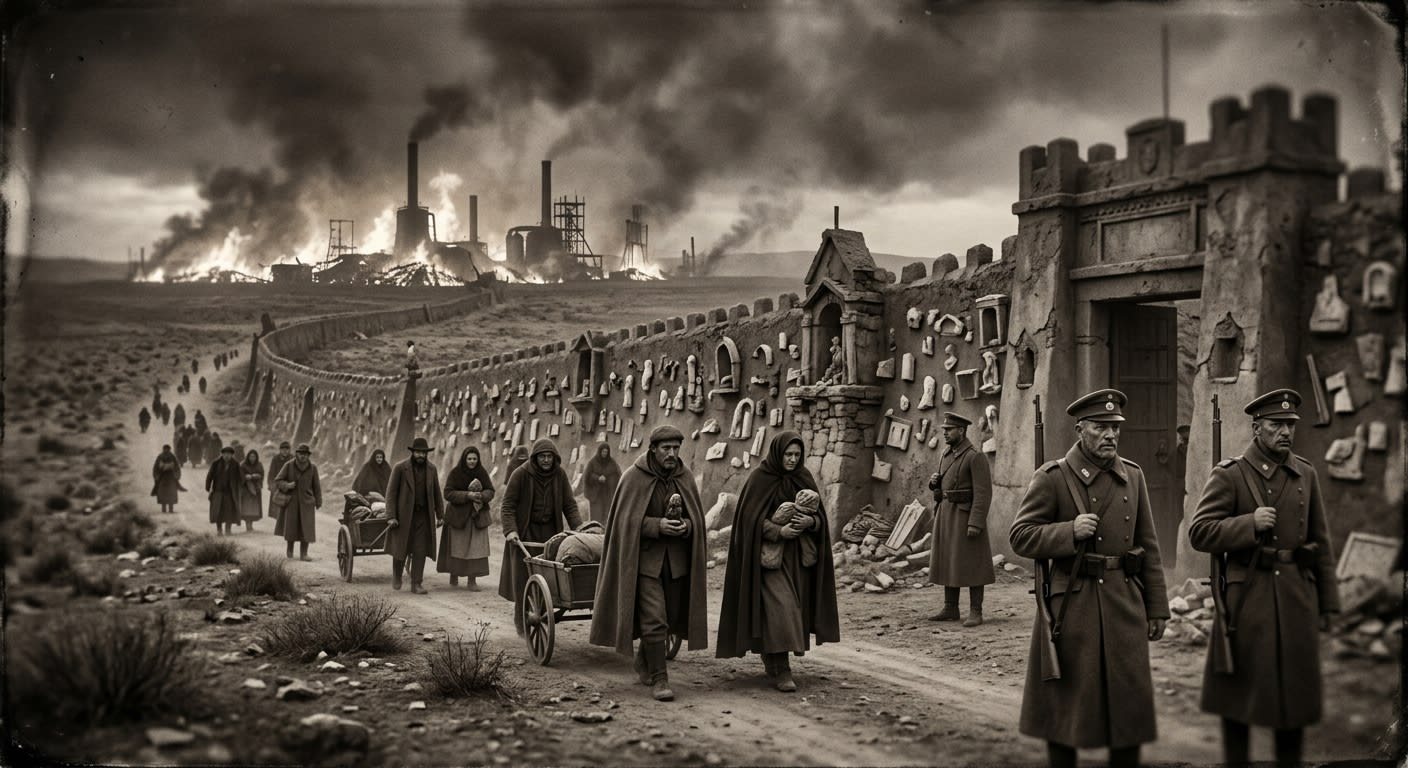
The Bonfires of Purification began in the ante-Synodic years, when the Rationalist Republic still believed that destroying a relic destroyed the hunger that made men seek relics. Convents were emptied. Nuns were turned out under guard and told to watch while reliquaries were split open for their gold, bone, teeth, fingernails, ash packets, saint-cloths, splinters, oil flasks, votive chains, and those little provincial fragments no trained authenticator would certify but no grieving village would surrender. The lecturers named it emancipation. They spoke from platforms while the smoke rose behind them and the Republican Guards held the crowd back with bayonets.
The ash-lime walls are the enduring obscenity. A relic burned in rage may, by some charitable reading of human stupidity, be called mob action. A relic burned, sifted, mixed with lime, packed into plaster, smoothed, dried, whitewashed, and used as a teaching surface is policy. In Seville the wall of the old natural philosophy hall reportedly smelled of incense whenever rain entered through the roof. The Academy blamed damp. Damp, unlike a saint, cannot sue.
Córdoba's northern lecture arcade kept three such walls. Salamanca kept five, then claimed two had been replastered after student sickness. Toledo's account is worse. The convent of Saint Beatriz (Unregistered) was emptied in a morning, its sacristy inventoried by a rational clerk whose handwriting grows less steady after the sixth reliquary. The lecture delivered that afternoon concerned material progress. Witnesses remembered the lecturer coughing when the wind changed. The Bureau later recovered a flake of plaster from that hall and found human calcium, beeswax, olive soot, and gold leaf beaten thin enough to enter the lungs. The sample is preserved in Strasbourg under Alpha-1 Desecration. It is labelled educational residue. Even our labels sometimes achieve elegance by accident.
Seville added theatre. Rationalist prefects made schoolchildren carry baskets of ash to the plasterers, one basket for each abolished saint's day. Children love procession when no one tells them what they carry. The prefects understood this and were damned by their own competence. Later, after the city was corrected, Seville mothers frightened their sons with the old line: behave, or the wall will ask for your hands. Purity objected to the superstition. Purity always objects after folklore has already done the teaching.
Provincial Rationalist accounts described the Bonfires as “the peaceful conversion of superstitious objects into public educational material.”
Corrected. The objects were not converted. They were desecrated, powdered, and pressed into walls so that unbelief could write upon its victims. The Bureau thanks the Rationalists for demonstrating, with unusual clarity, why they required conquest.
Yet Iberian piety did not vanish into smoke. It went underground, into jawbones hidden in bread ovens, scapulars sewn under saddle cloth, baptismal registers concealed in olive presses, and reliquary fragments lodged in the walls of barns by farmers whose theology consisted of three facts: the saint was theirs, the guard was temporary, and stone remembers hiding places better than children. From these hoards came later cults, later litigations, later miracle-claims, later frauds, later tax categories. Piety buried under persecution returns with paperwork. Everything does, under Strasbourg.
The Relic of Saint Iago survived this season by indignity: auction, requisition, paperweight, theft, recovery, custody, and eventual flame at Toledo. Such is the Iberian pattern. A holy thing escapes desecration only to be folded into another catastrophe, whereupon Records authenticates the splinters and Doctrine names the whole sequence providence. Providence is what the Bureau calls a wound once the margins are aligned. The Bonfires did not end relic devotion. They multiplied its hiding places. Every oven became a chapel with bread in it. Every plaster crack became suspect. Every Rationalist school wall became, by the logic of its own crime, a reliquary it could neither worship nor stop touching.
#On Toledo and the Martyrdom That Would Not Behave
Toledo is Iberia's argument with the Ledger. The Siege of Toledo in A.S. 15 should, by every conventional military reading, have been a Rationalist victory: Colonel-Prefect Étienne Grimal arrived with two thousand Republican Guards and twelve clockwork cannon; the Order of Saint Iago held the city with three hundred clergy, fourteen unnamed women of no recorded order, and the Relic; the siege lasted nine months; the cathedral became gun platform, altar, fortress, oven, and finally wound.
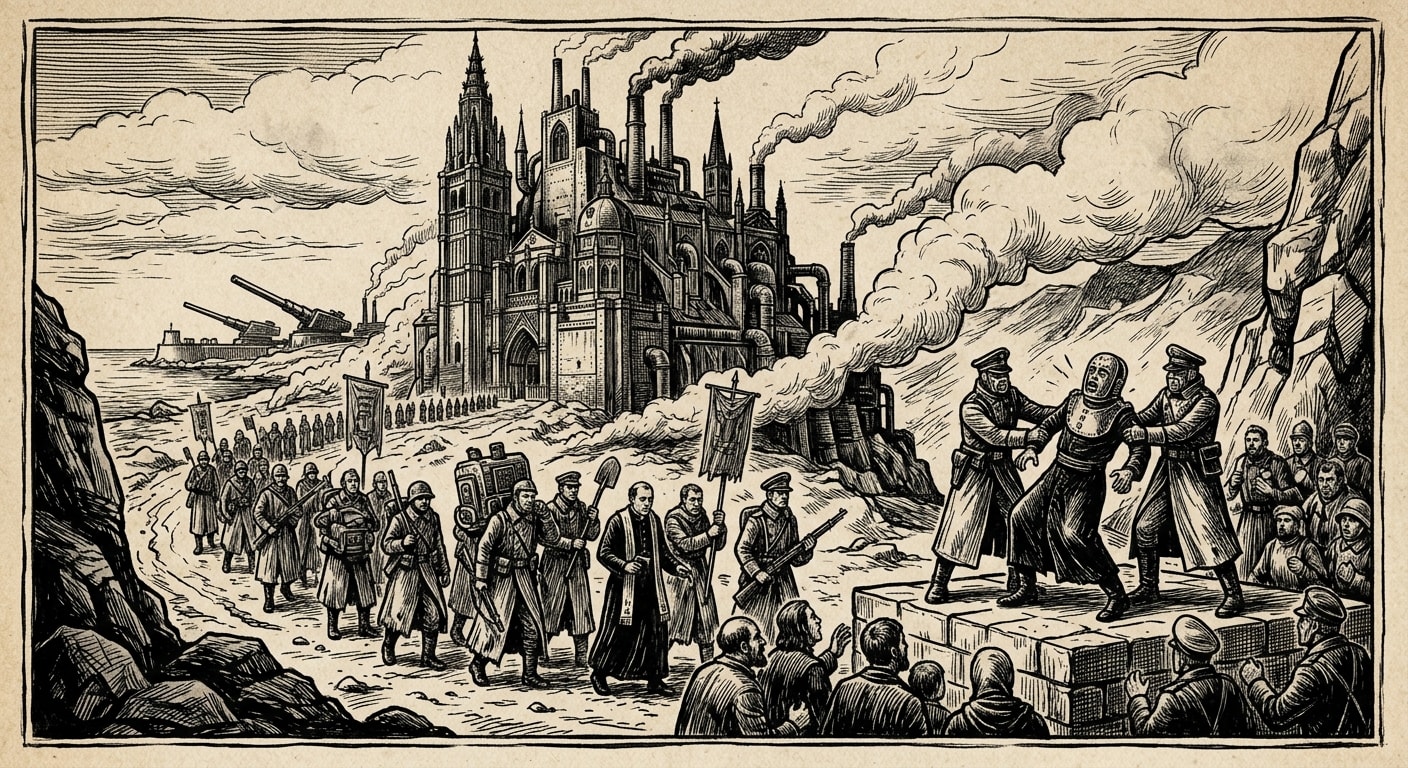
The Order lost. This is the first fact. The Order denied victory. This is the second, larger fact. Father Clemente de los Rios raised the Relic, saw divine fire destroy three ammunition caissons, survived bombardment long enough to become useful to hagiographers, then burned the tower with the last defenders and the jawbone rather than surrender custody. Grimal took stone and received ash. He won a city emptied of the thing he wanted. Rationalists called this tactical success. Iberians called it Saint Iago (Unregistered) laughing through smoke.
Litany-Engineers later entered the old cathedral sewers and laid charges beneath the altar. The blast exceeded calculation by four hundred percent. Half the cathedral fell. Half the city followed. Three of twelve engineers survived and reported that someone sang with them who was not there. Records struck the phrase. The phrase survived because struck phrases breed in mutters.
The siege made Toledo a city of competing ruins. Rationalist cannon scarred saint niches. Faithful charges ruined Rationalist platforms. Later Synodal reconstruction preserved whichever wound could be made instructive and paved over whichever wound accused the wrong office. The old cathedral nave remains a matter of architectural grammar: every pillar says sacrifice, every missing chapel says calculation, every restored arch says the Bureau has selected what grief may bear weight.
The Order of Saint Iago emerged from the siege with the useful privilege of near-extinction. Dead orders make excellent symbols because they cannot object to commemorative policy. Living descendants, affiliates, lay custodians, and women of no recorded order have proved more troublesome. The fourteen unnamed women in the final garrison appear in every serious casualty list and almost no official sermon. No one knows whether they were tertiaries, widows, servants, disguised fighters, or the sort of people history uses and then files under furniture. Iberia remembers them with fourteen unlit candles at certain private tables. Doctrine has not approved the rite. Doctrine has also failed to prevent wax.
Post-Concordat Toledo became a Second-Tier Martyrdom Site, which is to say a city whose grief was made architecturally useful. The Bell-Market trades in hours. The Cinder Trials pour ash over condemned bodies in the cathedral forecourt and read the crust at Ninth Bell. The Ash-Baths claim to sweat corruption from the sick by burying them in hot ash until the fortunate die quickly and the survivors are paraded as living reliquaries. The Hospices of Saint Tiberias (Unregistered) record final exhalations as confessions, then return the bodies to smoke before family sentiment can interfere with accounting.
Governor-Praelate Alaricus of Toledo achieved the rarest Iberian miracle in A.S. 185: mercy that survived procedure. During famine he opened the Granaries of Saint Benedict before Tithes approval. He lived, which proves either great competence, great patronage, or that Heaven occasionally spares an administrator for comic effect. The granary books afterward were so complete, so cross-signed, so offensively correct, that Strasbourg could not punish him without admitting that orderly mercy was possible. We dislike dangerous precedents. Alaricus remains beloved in Toledo, mistrusted in Strasbourg, and studied by young administrators who enjoy imagining themselves brave before their first budget review removes the romance.
#On the Concordat Seal and the Third Famine
Iberia entered the Triune Hearth through the Concordat of Strasbourg, signed in A.S. 90 and proclaimed in A.S. 91. The public woodcuts show three seals pressed into one wax: France, Iberia, Rhineland; three crowns dissolved into one authority; three tongues made one throat. Public woodcuts omit the late arrival of the Cardinal-Legate of Toledo, the Aragonese protest (Unregistered) filed and rejected before it was spoken, the Spanish seal later cracked by the A.S. 178 earthquake, and the fact that no one in Strasbourg has repaired it.
The crack is classified cosmetic. It is also beloved by every Iberian clerk with eyes. No rebellion lives there; that would be vulgar and easy to prosecute. Something more irritating lives there: the pleasure of knowing the wax did not remain perfect.
To sign was to dissolve. Iberian crowns became provincial memory. Civil magistrates became Vicars-Praetorial (Unregistered). Local courts became tribunals. Coinage was restruck. Old calendars were abolished. Separate privileges went into the furnace and came out as cathedral accounts. The Synod did not conquer Iberia in the rough manner of soldiers. It accepted Iberia's signature, then taught the signature to eat the country that produced it.
The peasantry named the Concordat's consolidation the Third Famine (Unregistered). Doctrine accepted the phrase only after sufficient laundering. The first famine was old war. The second was Rationalist requisition. The third was unity: grain diverted north and east, mules drawn into pilgrimage supply, silver routed through Strasbourg, sons taken for levy, daughters bound to shrine labour, olive shipments tithed twice because one Bureau counted oil and another counted devotion. Hunger does not become holy because the receipt has a seal. It merely becomes harder to appeal.
Iberian incorporation differed from French incorporation in one respect worth recording: the peninsula knew too many jurisdictions already. Castilian pride, Aragonese sulk, Portuguese maritime habit, Andalusian city-memory, old monastic privileges, coastal smuggler law, village saint-charters, episcopal exemptions written in hands so dead that even Records hesitated to contradict them — all arrived at Strasbourg in crates. Kratz's genius was to avoid sorting them. Sorting would have taken a century and produced lawyers. He overlaid them. Every old privilege remained visible under Synodal glass, honoured in phrase, constrained in use, taxed in practice, and available for citation when obedience required local costume.
This is why Iberian administration seems contradictory to outsiders. A city may retain its ancient feast while losing the right to sing during it. A bishop may keep his chair after surrendering its legs. A village may display its saint if the saint's revenue passes through a regional tithe gate. A port may fly a local banner beneath the Triune Knot, provided the Knot is larger, higher, and paid for by the port. The system is ugly, durable, and mine in spirit if not in authorship.
The Triune Hearth bound Iberia to France and the Rhineland; it also bound Iberian resentment to every triumphal pageant thereafter. The Procession of the Triune Hearth drags its three braziers through cities every tenth year, and the Iberian brazier burns with special theatrical insistence, as if flame can prove consent. Seville watches the Hearth float without applauding. Toledo applauds correctly and sells ash medallions afterward. Salamanca debates the route in private. Zaragoza (Unregistered) counts soldiers before counting saints.
Certain schoolroom maps present the Triune Hearth as three equal territories joined in mutual devotion.
Clarified. France supplies administrative vanity, the Rhineland supplies roads and bells, and Iberia supplies grain, ash, ports, relic hunger, old scars, and an inexhaustible capacity to obey with insult hidden under the tongue.
#On Seville and the Governance of Joy
Seville is the corrected city, the City of Whispers, the orange-scented rebuke to every Bureau that thinks silence equals submission. Before A.S. 153 it laughed too loudly. This phrase appears in Festival reports with the face of science, as if laughter volume could be measured cleanly by men who fear jokes because jokes perform surgery without a license.
The Laugh Riots began with Festival Form 19-M. Tavern-keepers, guildhalls, muleteers, widows, dockhands, students, fruit sellers, and the lower species of poet exceeded their mirth quotas in concert. The songs were sanctioned. The jokes were local. The timing was military. Seville laughed for three days until throats bled. On the fourth day the Lictors of Purity arrived and tongues were taken. The Bureau called it mass corrective muting. The city became quieter. It did not become obedient in the way fools mean obedience.
Two years later, in A.S. 155, came the Subjugation of Seville, entered in the Ledger as “a procession of cleansing, attended by reluctant converts.” I remain angry that I did not write the phrase. War entered through writ. Purity carried braziers. Tithes carried scales. Festivals carried blank calendars. Records carried ledgers on mules. Doctrine arrived last, because Doctrine has always understood theatre.
Thirty feast days were stripped from the calendar. Bells were retuned downward by a quarter-tone. Taverns acquired permanent Auditors. Granaries were inventoried, sealed, reopened, inventoried again, and redirected toward Bastion-Constantinople. The A.S. 157 famine followed with the patience of a creditor. Seville counted sacks leaving and sermons arriving. The sacks were more nourishing.
As of A.S. 201, Seville pays, attends, murmurs, and communicates in rhythms of cup, slate, heel, shutter, and market knife. Children learn safe laughter by duration. Tavern-keepers know when a third clap becomes evidence. Old women sell oranges at prices that fluctuate according to the buyer's badge. The Auditors record quiet as compliance because they have not learned to read a cup tapped twice in a room with no song.
Seville matters because Iberia's genius is survival by reduction. Take speech; rhythm remains. Take feast days; recipes move into funerals. Take tavern songs; mule bells become jokes. Take public saints; wall cracks receive candle grease. The Bureau wins loudly. Iberia keeps score softly.
#On Pilgrimage, Ports, and the Southern Mouth
Iberia's roads are older than the Synod and resent being told where they lead. Santiago routes (Unregistered), Toledo martyr-roads, Seville penitential lanes, Zaragoza ash-trails, Lisbon quake-shrines, coastal embarkations toward Marseille and the eastern pilgrim circuits: the peninsula moves bodies like a censer moves smoke, in visible streams that please the Bureau until the streams choose their own altar.
The Bureau of Pilgrimage grew fat on the problem. Formally established in A.S. 123 after the long campaign made holy movement indistinguishable from supply, the Bureau absorbed private guilds, licensed tokens, harmonized routes, measured tears, counted staffs, stamped shoes, and discovered that a pilgrim road is a tax office stretched flat across geography. Marseille became the southern mouth: Iberian grain, North African phosphite, Sardinian iron, Sicilian sulphur, and hundreds of thousands of embarkation permits passing through limestone hills under rival offices that smile at one another like knives under napkins.
Iberian pilgrims are considered difficult. This is Bureau speech for experienced. A French pilgrim complains before paying. A Rhinelander pays before complaining. An Iberian asks which office printed the fee schedule, whether the stamp is current, why the salt surcharge applies inland, whether the relic-grade tear vial may be reused, and whether the clerk's superior would prefer to be named in the appeal. They pay in the end. They also learn the clerk's wife’s cousin's debt by sunset. The peninsula trains memory as a civic weapon.
The British at Gibraltar complicate every southern calculation by existing usefully beyond obedience. Their permanent squadron guards the Mediterranean mouth, chapel-bearing hulls and polite refusal of Synodal cadence tables included. We call them independent co-belligerents when pleased, maritime irregulars when irritated, and indispensable when the convoys arrive on time. Iberia knows this. Every port clerk from Cádiz to Málaga (Unregistered) knows exactly how much Synodal pride can be loaded into a harbour before British guns make it buoyant.
The coastal route has its own theology. Lisbon sells quake memory and sea candles. Cádiz sells passage and deniability. Málaga sells fish, contraband relic dust, and three grades of false certificate. Valencia (Unregistered) keeps clean ledgers and filthy warehouses, the correct arrangement for maritime prosperity. Barcelona argues in dialect through forms translated into Triune Alphabet and back again until the original dispute has become too tired to stand. Pilgrimage prefers Marseille because Marseille can be bullied in familiar French. Iberian ports require courting, threatening, auditing, forgiving, and threatening again before breakfast.
Caravan factors hate the sea routes and use them constantly. A mule road can be inspected every mile; a coastline lies with better scenery. Pilgrims embarking from Iberian ports bring orange peel, ash charms, tin saints, illegal grief beads, sealed tears, and food wrapped in papers that once held appeals. The Bureau confiscates what it sees. What it misses becomes custom at the destination.
Coastal Iberia looks outward. Inland Iberia looks at Toledo. Seville looks at the auditor and then at the cup. The Ember-Priories look at smoke. The roads look at Strasbourg only because every milestone has been taught to face north.
#On False Virtues and Iberian Fire
The Virtue General heresy has deeper roots in Iberia than Doctrine enjoys admitting in rooms with open windows. The so-called Flame of Charity, a veiled figure whose hands glow with fire that heals the sick and burns the faithless, appears in testimonies concentrated across the peninsula: hill shrines above Salamanca, fever wards outside Toledo, mule camps near Zaragoza, ruined convent wells where women swear a hand of fire closed wounds without consuming the bandage. The Bureau's assessment in A.S. 178 called the Flame a pagan survival dressed in Synodal language. That is probably true. It is also insufficient, which is why the assessment's author resigned six months later and now lives as a hermit above Salamanca under surveillance he pretends not to notice.
Iberia is fertile ground for that heresy because its fire has been used in every direction. Rationalists burned relics. The Order of Saint Iago burned itself rather than surrender. Seville's joy was cauterized. Zaragoza received ash-rain after Synod guns struck a Velkara-aligned compound. Toledo cures fevers by ash-bath and reads verdicts in crust. When a country has watched fire desecrate, defend, punish, heal, sterilize, and tax, it begins to suspect that flame has opinions of its own.
The official position is clean. The Virtue Generals do not exist. The Flame is a recurrent Iberian folklore contamination, prosecuteable when organised, tolerable when confined to old women's bedside muttering, and useful when directed against Rationalist remnants. The unofficial file is thicker. Fires reported during plague years. Fever children with cauterized palms and no pain. A convent wall near Córdoba that blackens only around false oaths. A Seville tavern where a Purity brazier went cold while an old woman laughed without a tongue.
I do not believe in the Flame of Charity. Belief is private theft from the Bureau's treasury. I record that Iberia keeps producing witnesses, burns, cures, denials, recantations, and little orange-coloured votive papers that vanish from evidence lockers faster than rats can be blamed.
#On the Present Iberia
As of A.S. 201, Iberia is loyal by every measure the Synod prefers: tithe rolls close, pilgrim roads function, port accounts feed Marseille, Seville remains corrected, Toledo remains profitable in martyrdom, Zaragoza's ash is classified, Lisbon's quake-memory is folded into Sundering catechesis, and the Iberian seal remains affixed to the Concordat despite its crack. The region supplies grain westward, men eastward, relic ash inward, and complaints upward.
Its Governor-Praelates and Vicars-Praetorial are efficient in the Iberian mode: ceremonial, exact, vindictive about precedence, generous under supervision, and capable of delaying an unwanted order by requesting clarification until the order dies of age in a side office. Its clergy are orthodox in public and locally ancient in private. Its merchants treat Bureau tariffs as weather with signatures. Its peasants know which saint belongs in which wall, which auditor drinks, which road shrine gives real shade, and which form can be answered with a dead uncle's seal because Records has never learned that family nicknames matter more than baptismal order south of the Ebro (Unregistered).
The peninsula's danger is not rebellion in the crude northern sense. Iberia remembers too much for banners. Banners are confiscated, archived, misdescribed, and taxed. Iberia's danger is continuity under correction: the rhythm after muting, the saint after burning, the ash after plaster, the seal after cracking, the road after harmonization, the laugh after tongue-taking. The Bureau can govern such a country. It cannot make the country grateful on command. There are limits even to my prose.
The regional offices know this and behave with the special cruelty of men who fear being laughed at in a language they only partly understand. Purity in Iberia employs more translators than torturers and is proud of neither ratio. Festivals maintains whisper-auditors in Seville, ash-liturgists in Toledo, and orange-market observers whose reports are among the funniest documents ever written by men unaware they are ridiculous. Tithes counts olive groves tree by tree, then loses half the oil to devotional leakage before it reaches the road. Records has spent eleven years standardising village names and has succeeded in angering every village equally, which is at least a form of fairness.
War views Iberia as rear territory until it needs ships, powder, mule columns, warm-weather recruits, coastal guns, and grain that has somehow survived five offices attempting to sanctify it. Then Iberia becomes indispensable. Indispensability is the only provincial virtue Strasbourg truly respects, because it can be measured after being exploited.
IBERIAN PREFECTURE REPORT, A.S. 200 — SALAMANCA HILLS Subject: unlicensed flame gatherings. Witnesses: nineteen; recanted: sixteen; vanished: two; remained silent: one. Recovered objects: seven orange papers, one scorched tear vial, one child's glove warm after four hours in rain. Final line of report before sealing: ███████████████████████████████████ Marginal hand, unidentified: “She gave the fire back.”
The Synod's hold remains firm. Let no reader mistake my exactness for doubt. War can move through the passes. Purity can close a plaza. Tithes can count a harvest before the farmer's wife has named the loaf. Pilgrimage can redirect a town's grief by changing a route schedule. Doctrine can and shall define every flame worth naming.
At dusk in Toledo the ash vendors close their shutters. In Seville the taverns lower their lamps before the Auditors pass. In Salamanca a hermit watches a hill road with hands hidden in his sleeves. In Cádiz the harbour clerks count British masts and pretend not to. The Concordat seal in Strasbourg keeps its crack. Iberia kneels, pays, murmurs, burns, and remembers.