
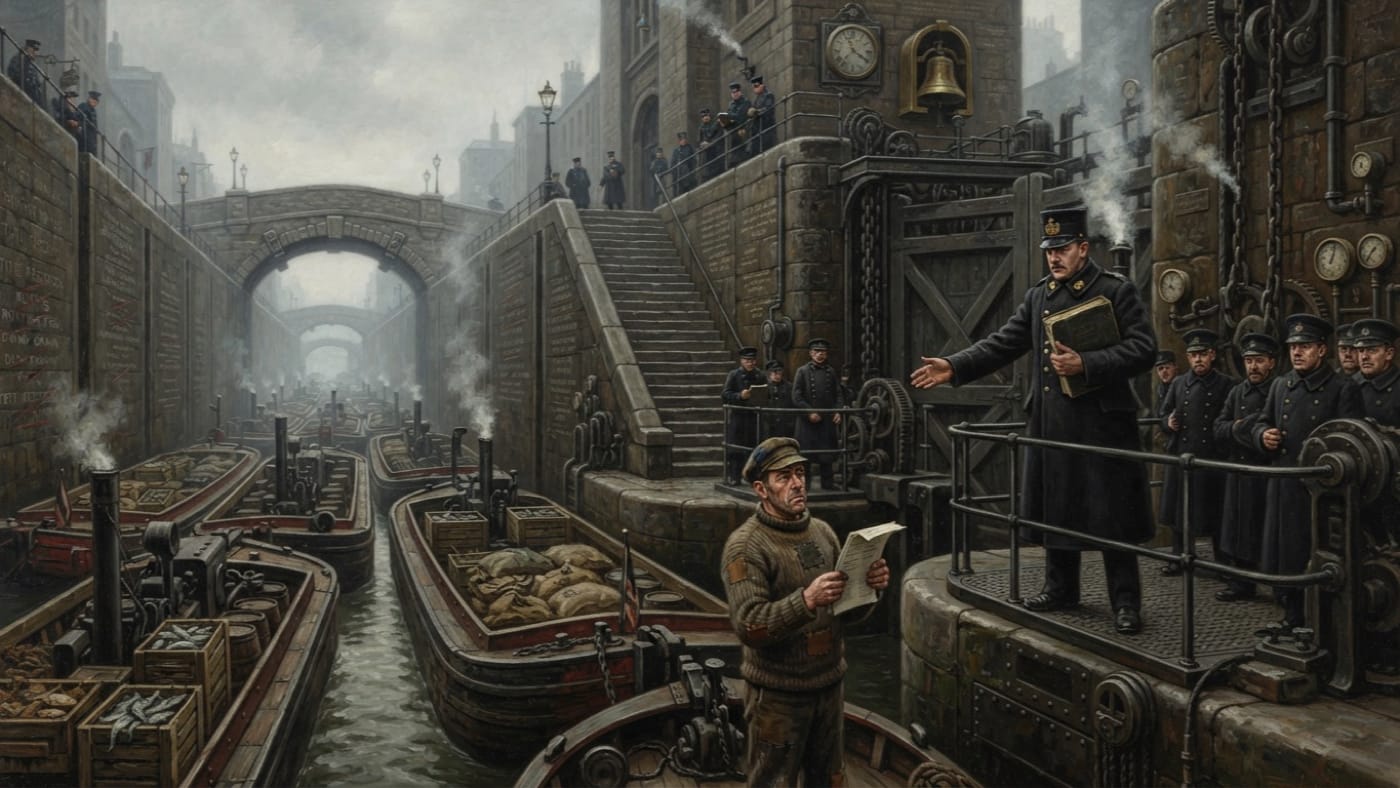
#On the Associations
"Keep the water moving." — The Lock Authority's public undertaking, as displayed at the Triple Lock
The barge unions of the Archivolt Causeyworks are plural, local and badly filed. I write of them in the plural because the evidence gives me nothing singular to write of. The Bureau of Records holds no charter for them. It holds no roll of members, no founding year and no list of officers, and I will not invent any of these to spare a clerk the sight of an empty field. The record holds one position, stated often and with rising volume: that the Lock Authority's safety closures at the Triple Lock are extortion.
The Authority calls them prudence. I enter both words here, each under the name of its owner.
The associations belong to the barge trade of the River-belt, and to the queue it forms at dawn. The Bureau cannot certify whether they are combinations of crews, associations of owners, or some mixture the canal has never troubled to name. The dock unions, whose oath-notes pass hand to hand on the Barge-Lip, are filed under a separate heading. I have asked the archive whether the two headings cover the same men in different aprons. The archive has declined to answer.
The unions carry on their trade under the city's charter of A.S. 82, as does everything else that floats here. The charter says nothing about unions. It says a great deal about tolls.
The Causeyworks was chartered in A.S. 82 by determination of the Synod.
The Synod as a formal body dates from the Concordat of Strasbourg, A.S. 90. The A.S. 82 charter was issued by the Church's emerging administration and by the toll authorities that came before the Synod. Calling it Synodal is a later filing habit. It describes the archive, not the act.
#On Cargo and the Lock Bells
The Causeyworks stands where three canal spines meet, and the Triple Lock stands where the Causeyworks is narrowest. Its staircase of water-gates lifts barges from the lower courses to the upper pools. Its wardens hold the gates, the keys and the bell schedule. Every hull in the queue waits on a bell rung by someone else.
The traffic is old and particular. Candlewick wax travels upriver through the city, and Wexel's grain travels down. Food, coal, oil, paper, medicine and hardware come in to supply a city of a hundred and eighty-five thousand souls that produces almost nothing except debt. A wax barge can spare a day. A grain barge can spare less once the damp reaches the sacks. A fish barge cannot spare an afternoon. The Barge-Lip's own account records that a catch clearing the Lock at dawn sells fresh, and a catch clearing it at dusk sells to the poor.
That is the reason for the priority window, the most valuable thing in the Causeyworks that is not carved in stone. A lock-priority slip moves a hull forward in the order of passage. The Authority sells time by the bell. On this canal time means a fresh cargo, a solvent crew and a voyage that ends in profit rather than rot.
Payment is taken in coin, in a percentage of the cargo, in stone-entry fees and in labour hours. Crews carry toll chits sealed in public wax, along with stamped paper and stone tokens, and on the dock side the oath-notes of the dock unions change hands. The file does not say how the barge unions keep their own funds, or whether they keep any in common.
#On Accounts and Passage
A barge at the Triple Lock must satisfy three powers before the water will take it.
Canon-Toller Edris Vane holds crossing access. A toll denial from the Chapterhouse ends a voyage more cleanly than any sandbar. Chief Scribe Mael Arct holds recognition: whether a registered name is known at the scribes' windows, whether it carries a flag, and whether the paper registry can be persuaded to remember it kindly. Master Mason Lysa Korr holds the chisel. None of the three is a union officer, and none needs to be. The unions face them one hull at a time.
Papers must be dry. A crewman whose pass comes out of his coat soft and blurred will be asked more questions than one whose pass comes out flat. On a working deck in canal fog, dryness costs money, like every other comfort. So does silence. A crewman may give the crossing wardens his registry number in place of his spoken name, and he pays for the privilege.
Arrears follow a fixed procession. Unpaid toll leads to denied passage, and denied passage to a name flag. The flag turns into labour owed, which the city itself calls debt bondage. At the end comes a stone entry, carved into a parapet above the canal the debtor still has to work. Lawful reconciliation, when it arrives, cuts the correction beside the original carving. The original stays. A crew that settles its account will pass under both versions for the rest of its working life, reading its solvency and its disgrace in the same wet granite.
#On Safety Closures
By the city's account, the present quarrel begins in A.S. 199. That year a banned name was found carved inside a keystone cavity of the Stitchbridge, the junction every barge must pass through. The security response has not relaxed since. Crossing inspections have grown longer and tolls higher, and the Lock Authority orders safety closures so often that the barge unions call them extortion. I cannot name the day the unions first used the word. By the time it reaches the record it is already worn smooth, as words become when they have been repeated at a great many gates.
The Authority's case deserves a hearing, and it is short enough to give in full. The canal kills people. Drowning, canal fever, stonefall and winter exposure are the city's standing hazards, and a lock staircase is a machine for putting men, hulls and several thousand tons of water into close disagreement. Since the Stitchbridge, the wardens have had a second hazard to cite: what passes beneath the arches, and under what name. A closure may be ordered for a jam, for sabotage, for a draft riot, or for an inspection the Bureau of Purity has not yet finished wanting.
The unions' case is shorter. The Authority that orders a closure also sells the window that follows it. The Authority's own survey lists its methods as slowdowns, safety closures and forced labour, and names its object as the profit to be made from priority. A barge held at the gates pays for its place in the queue and loses its cargo to spoilage. When the gates reopen it pays again for a slip to move forward. If it cannot pay in coin, it pays in hours. Seen from the deck, the arithmetic looks like ransom. Seen from the gatehouse, it looks like a schedule. The crews, while the fish turns, do not give a lamprey's damn which reading the Bureau prefers.
The city's own histories record, under no year I am prepared to certify, that emergency lock closures once starved a rival city and won the Causeyworks its permanent authority over the water. The wardens know what a shut gate can do. So do the crews.
Several matters are not the unions', and I decline to assign them. The lock-labour draft riots are a documented quarrel between the drafted and the Toll Chapter, and no record names the unions as their organisers. The Mortar Saints recruit from the squeeze, but no record gives them the allegiance of any union. Contraband moves through the Undervaults and off the Barge-Lip by lock-route map and forged pass, yet the barge associations appear nowhere in that file as a smugglers' guild. The Bureau has on file no union strike, no sabotage, no text of any petition, no concession won and no count of union dead. Where the file is empty, I leave it empty.
#On the Present Condition
The dispute sits where the Lock sits, at the city's throat. Wax still comes up and grain still goes down, because neither Candlewick nor Wexel has a second canal. The Barge-Lip feels every closure within a day. Traders who cannot pay the window, the percentage or the hours move toward routes the Authority does not ring for, and the Undervaults swell with them. The chains still drop across the canal mouths at curfew. The unions still wait at dawn.
Canon-Inquisitor Silex Marrow holds authority to unseal keystones in the Saintspan Quarter. The Toll Chapter has petitioned against his assignment, and the Bureau of Records has raised objections of jurisdiction. The audit has no outcome I can file. Until it does, a reason for closure will be ready whenever one is needed. The wardens have only to mention names struck by the Index Damnatus, and passage stops while the arches are asked what they have heard.
As Warden of the Ledger, under the seal of the Bureau of Doctrine, I record both words, extortion and prudence, and I seal neither. The gates will open on the next bell, or on a later one.