
#The Other Road
I am Valerius Drax, and I have signed three permits that were used to move contraband through the freight quarter of Strasbourg. I signed them knowingly. The first concerned fever cordial reclassified under a tariff category that did not exist when the cargo was loaded. The second concerned a widow's ration card issued to a woman whose husband had been dead for nine days longer than the Bureau of Records admitted. The third I will not discuss, because the third involved a child, and the child is alive, and the permit is filed under a name that belongs to no one, and the Bureau of Purity has not yet thought to look in the tray where I placed it.
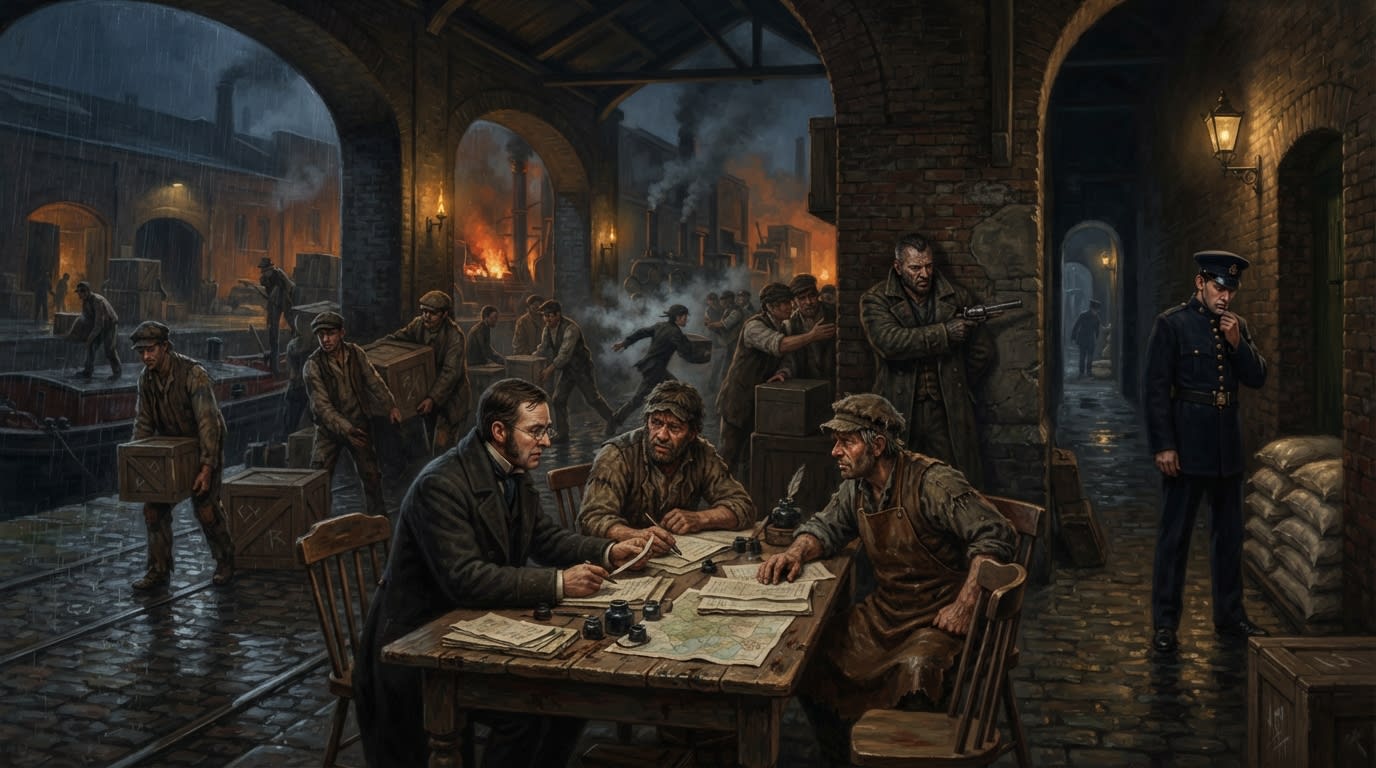
The Smuggler's Syndicate is not a guild. It is not a brotherhood, a cartel, a society, a company, or a conspiracy in the sense that the Bureau of Purity prefers — a single creature with a single head that can be severed and mounted above a gate. It is what remains when the formal mechanisms of movement — the tariff, the gate, the seal, the category, the queue, the stamp, the wait, the price, the rejection — produce outcomes more lethal than disobedience. A gate admits citizens but rejects the name on the paper. A tariff chapel approves medicine at a price a ward cannot pay before the fever kills its children. Records certifies a child's existence eleven days after the child has already starved from the delay. A Purity cordon seals a district to protect it from contamination while trapping inside it every witness to the corruption that made the cordon necessary.
The Syndicate operates in the interval between need and permission. It is not romantic. It is not noble. It is a collection of overlapping crews, leases, debts, favours, routes, buyers, and betrayals held together by the understanding that movement — of bodies, goods, proof, names, medicine, and obligations — can be constructed from its components. Permission. Category. Custody. Timing. Witness. Seal. Toll. Record. Alter any one of these and what was immovable becomes mobile. A body passes where a citizen would fail. A crate leaves as spoiled tonic and arrives as fever cordial. A witness becomes a passenger. A passenger becomes cargo. A child's name changes, and the child, who did not exist an hour ago, receives a ration card and a catechism seat and a future that the Bureau of Records will file as though it had always been there.
Earlier editions of this Codex contained no entry for the Smuggler's Syndicate.
This was not an omission. It was policy. The Bureau of Doctrine preferred the position that criminal networks require no institutional survey, on the grounds that acknowledging their structure implies acknowledging their function, and acknowledging their function implies acknowledging that the Synod's lawful roads are insufficient. The Bureau of Doctrine has revised this position. The roads remain insufficient. The revision concerns optics, not infrastructure.
Early crews begin as ordinary workers solving one immediate problem. A carter knows the queue at Bay Four floods an hour before the posted time and uses that window. A tariff clerk sees fever cordial held behind a category invented after the cargo shipped and corrects the form because the alternative is a child's coffin. A porter needs medicine for family and discovers that the distance between the warehouse and the clinic is measured in seals, not streets. A fence realizes the evidence room at the Watch precinct has sold the same confiscated pistol three times, each time to a different buyer, each time filing a fresh destruction certificate. Repeated work creates a name. A name creates a route. A route creates a buyer. A buyer creates a debt. Debts create shared rules. Shared rules create a ledger. And the ledger — that cursed instrument, that ghost of the Bureau of Records reborn in grease-paper and bell-cord knots — remembers who owes, who paid, who carried, who looked away, who was promised, and who can be used again.
The broader network depends on people with partial, overlapping access. Route keepers sell timing to rival crews and feel no shame in the duplication. Grey Keel boatmen carry land-based documents through water routes where dryland law dissolves into salvage claims and tide compacts. Former Peregrine Cartel insurance clerks, scattered after the dissolution of A.S. 193, retain seized route intelligence — ambush tolls, double-paying brokers, dock exemptions — and sell it by the bell. Seal forgers serve clinics in the morning, gunrunners at noon, and a Bureau office by evening, and find no contradiction in the sequence. The core insight is practical, not philosophical: movement is constructed from permission, category, custody, timing, witness, seal, toll, and record. Change any component and the nature of what passes changes with it.
Decent crews distinguish between people and loads. They pay labour. They protect witnesses. They avoid claiming exclusive rights over routes that families depend on. Rich crews treat those distinctions as inefficiencies and discover that price, stripped of every other principle, governs more efficiently than shame. The central threat is not violence. The central threat is that price replaces principle — that the crew which began by moving a child past a deadly gate ends by selling access to the gate itself, and the toll it charges is indistinguishable from the tariff it was built to circumvent.
#The Lines of Business
The Syndicate's crime concerns movement, custody, and price. Not merely illegal goods — that is the Bureau of Tithes' preferred reduction, because Tithes can tax a thing but cannot tax an absence. In the Synod's system, ownership is assembled from possession, record, seal, witness, office, and the power to make contrary claims inconvenient. The Syndicate interrupts this chain. It moves what stronger institutions have immobilized. It sells access to schedules. It exposes, for a fee, the distance between custody and truth. Four Lines organize the work. Each is a business category, a criminal method, a client network, and a possible moral collapse.
#Passage
Passage concerns persons. Specifically, persons whose continued existence, testimony, freedom, or identity has become inconvenient to the authority controlling their movement. A witness who saw a tariff clerk divert clinic medicine to private auction. A porter who watched the evidence room sell confiscated weapons to the same buyer who reported them stolen. A Purity orderly who knows where the dead bodies were marked and by whom. Refugees from purge districts whose papers remain technically open but practically impossible. Nurses who refused false tallies in quarantine. Deserters carrying conscience — and deserters carrying stolen goods who frame the theft as conscience, because the road does not ask and the price does not distinguish.
Passage moves witnesses, refugees, deserters, defectors, condemned clerks, threatened heirs, unregistered children, released prisoners, healers, testimony couriers, and bodies whose official status has become dangerous to the living. Its moral pressure is consent. Who selects the destination? Who chooses the next name? Can a frightened woman turn back at the underquay stairs, or has the route-keeper's fee already sealed her forward? Is safety being sold, or is disappearance being sold? Decent Passage sells movement. Corrupt Passage sells disappearance. And monstrous Passage — the kind that makes the Bureau of Purity look restrained by comparison — sells people to buyers who call the result placement and file it as charity.
Name Passage deserves particular mention because it offends the Bureau of Records at the level of theology. A person is separated from an administrative identity that has become fatal — an unregistered child receives a public name; a condemned clerk continues to exist in the rolls while the actual person goes elsewhere; a protected passenger becomes a cousin, a widow, a porter, a penitent, a novice, or a corpse on paper. The Bureau of Records considers this an existential attack because a false chain, accepted by procedure, becomes a competing practical reality. Records does not fear lies. Records fears lies that receive stamps.
#Contraband
Contraband concerns objects whose legal category has become more important than their material nature. The same bottle of fever cordial is medicine in a ward, stock in a tariff ledger, evidence in a precinct, contamination in a Purity report, and auctionable loss in a guild office. The object has not changed. Its classification has. A Contraband crew identifies which category will move and which one will kill, then supplies the story, the seal, the timing, and the handling to make the passage work. Its moral pressure is use: will the object heal, arm, expose, profit, contaminate, or feed an exclusive market? Decent crews distinguish need from appetite. Corrupt crews discover that appetite pays faster.
The categories are these. Necessity Contraband — fever medicine, gauze, clean needles, fuel, grain, lamp oil, splints, pump parts, soap, masks, boiler salts — becomes illegal when tariffs, monopolies, decrees, or ration systems place need behind price or political classification. Mother Kett's clinic receives fever stock this way. A flood district receives dry lime kept reserved for approved sites. These deliveries save people. They also create creditors, and creditors create lasting claims over the people they saved. War Contraband — weapons, ammunition, armour, black diesel, blasting cord, optics, repeater components, signal flares — may defend a ward or arm its predators. A crew may move rifles for a reform committee and discover six months later that the committee split, sold half the stock to a militia with fewer scruples, and used the other half as collateral against a debt the crew now inherits.
Relic and Occult Contraband — demon-glass, warm saint-bone boxes, reliquary fragments, ash-marked icons, hymn engines, votive chains, and battlefield curiosities from the Strait — is the most dangerous category because every load combines questions of contagion, proof, salvation, appetite, and profit. Collectors, Bureaus, cult cells, and pilgrims all claim they are the proper custodians, and all are partially correct, and all are partially lying. Printed and Doctrinal Contraband — forbidden books, unauthorized psalters, bell notation, heretical maps, witness transcripts, contradictory circulars, unsanctioned catechisms, and worker-readable pamphlets — is feared because printed material lets memory travel without official custody. The Index Damnatus grows weekly precisely because the Bureau of Purity understands that a coded hymn can coordinate people as effectively as a weapons shipment and with less powder residue. Proof Contraband — false seals, stolen blanks, counterfeit ration chits, borrowed vestments, unlicensed passes, dead persons' permits — is treated as a currency of reality because a seal can open a door or establish a fact. Ordinary-Stock Contraband — grain outside ration order, fuel outside allocation, unregistered wool, print type, boots, rail clamps, canal oil, tariff-skipped salt — is the least dramatic category and the most politically corrosive, because when the Syndicate moves salt past a tariff chapel, it exposes scarcity as an official arrangement and abundance as a Bureau's secret.
#Brokerage
Brokerage treats information as cargo. As weapon. As ransom, credential, contagion, inheritance, and future claim. It sells route maps, schedules, debt lists, erased names, buyer identities, quarantine timing, tribunal weaknesses, seals, office rivalries, witness contradictions, and knowledge of who actually writes the decision that a supervisor merely stamps. Its moral pressure is exclusivity: did the buyer purchase truth, timing, silence, authentication, or merely a copy? Can an informant withdraw consent? Does keeping a second copy preserve safety, or does it build a blackmail portfolio with compound interest?
Schedule Brokerage sells windows before authority arrives: inspection days, bell changes, tribunal recesses, ration releases, Purity sweeps, archive transfers, ferry windows, freight cycles. Time can be worth more than the cargo, particularly when goods sit between one office's custody and another's. Identity Brokerage trades names, aliases, erased identities, public roles, false kinships, sponsor lines, and family claims — it may save a child and an informant or feed a kidnapper and a blackmail system using the same technique. Buyer Brokerage sells the hidden identity and motive of the person purchasing a job: a Bureau office funding medicine runs to embarrass a rival Bureau, a House buying weapons through a relief front, a collector seeking a relic whose provenance includes a body count. Knowing the buyer lets a crew redirect, refuse, double-sell, expose, or be captured by the knowledge it holds. Debt Brokerage trades obligations — unpaid shares, favours, safehouse rents, porter claims, creditor chains — and a Warehouse Seventeen debt list may be worth more than any single crate because it can compel future deliveries without ever touching a manifest. Weakness Brokerage trades office rivalries, compromised inspectors, exemptions, family scandals, illnesses, hidden contamination, false piety, and any private fact that can pressure a public official. And Provenance Brokerage trades a thing's history: serial chains, maker marks, receipts, custody notes, confiscation records, and conflicting ledgers whose disagreements are worth more than the object they describe.
Decent brokers sell access while protecting the sources who made the sale possible. Corrupt brokers discover that every life contains a negotiable sentence, and the sentence appreciates with silence.
#Recovery
Recovery concerns disputed return. Seized goods, stolen relics, dead persons' property, inheritances, weapons, unpaid consignments, evidence, and personal effects — all objects whose custody is contested between a prior right and a current holder who displaced it. Recovery can be theft framed as restitution. It can be restitution framed as theft. It begins with a receipt, a claim, or the assertion that a stronger party took what a weaker party owned, and it ends with the question that no Bureau has satisfactorily answered: who is a real claimant?
Evidence Recovery removes or returns items held by Watch precincts, Bureau offices, customs cages, tribunal stores, or evidence rooms that sell confiscated property on the quiet and file destruction certificates for what they sold. Claimant Recovery retrieves property for families, guilds, wards, shrines, estates, or institutions asserting prior right — tools, rings, dowries, caravan goods, workshop machinery, household saints. Relic Recovery retrieves stolen reliquaries, dangerous fragments, saint-bone boxes, or heirlooms that may, depending on which Relic Broker you consult, be answering in another voice. Body and Effect Recovery concerns corpses, ashes, personal effects, battlefield remains, mortuary errors, misnamed dead, and things taken from bodies — a coat, a ring, a body carrying simultaneous claims of mercy, debt, legality, family, evidence, and theft. Contract Recovery retrieves unpaid consignments, collateral, cargo, and tools caught between buyer, carrier, creditor, claimant, and failed delivery. And Record Recovery retrieves or steals documents proving ownership, guilt, ancestry, custody, or prior transfer — a receipt or custody ledger that can restore a claim, expose an office, or give the crew permanent hold over every party involved.
Earlier editions classified the Syndicate's activities solely under "Contraband and Tariff Evasion."
This was the Bureau of Tithes' preferred taxonomy, because it reduces the Syndicate to a revenue problem. The Bureau of Tithes is wrong. The Syndicate is a custody problem, a proof problem, a category problem, and a theological problem. The Bureau of Tithes is welcome to continue believing otherwise. The Bureau of Tithes is also welcome to explain why its own tariff chapels accept confession tokens as cargo chits during famine weeks, but the Hieromnemon will not hold his breath.
Decent Recovery crews return what can be returned and record what was lost. Corrupt crews manufacture debt, find receipts after the fact, and treat possession as destiny — the theological position that holding a thing is proof of deserving it, which is the Bureau of Doctrine's own argument rephrased in criminal grammar and no less absurd for the relocation.
#The Philosophy of the Ledger
"Everything has another route. Every route has a keeper. Every keeper has a price. Every price eventually becomes a person."
This is the Syndicate's operating creed, recited in variants from Warehouse Seventeen to the canal locks at the south freight, and it carries the weight of a catechism composed by men who would deny they were composing anything at all. It is not written in any single document. It is scratched into loading-bay walls, inked onto the margins of false manifests, whispered during the handoff at the East Drain cart passage when the water is ankle-deep and the third bell has not yet rung. It is the closest thing the Syndicate possesses to theology, and it is — I say this as a Hieromnemon who has read a great deal of theology — more honest than most.
The creed's first line is operational. Everything has another route — a different gate, a different category, a different seal, a different hour. The wall that stops you at noon admits you at Vespers. The tariff that kills at the posted rate can be circumvented by a spoiled-stock claim and a clerk who prefers his children fed. The Syndicate sees legality the way the Bureau of Doctrine sees truth: as a construction, sustained by witnesses, enforced by stamps, and subject to revision when the construction becomes inconvenient to maintain. Every wall has maintainers. Every schedule has listeners. Every seal can be altered by the hand that cut the die. Every office contains, somewhere between the junior clerk and the locked cabinet, a person who actually writes the decision that the supervisor merely signs.
The creed's second and third lines concern infrastructure. Every route has a keeper — a bell-ringer who can extend a procession's noise, a sluice boy who can alter flood timing, a lime-gate widow who holds her key under a cracked saint tile. And every keeper has a price — not always coin, often medicine, sometimes a favour, occasionally a silence more expensive than speech. The Syndicate's network is a web of these prices, each one a relationship, each relationship a dependency, each dependency a small surrender of autonomy that compounds over months and years until the crew that began by paying for a gate key discovers it has purchased, by increment, a private geography of obligation that rivals the Bureau of Records' own parish rolls.
The creed's final line is its confession: every price eventually becomes a person. The tariff that was money becomes a porter's silence. The silence that was a favour becomes a widow's compliance. The compliance that was gratitude becomes a child's future pledged against a debt the child did not incur. This is the Syndicate's self-knowledge, spoken aloud and then ignored, which is the standard method by which institutions manage their own prophecies. The Bureau of Doctrine operates identically. I should know. I write the prophecies.
A decent crew believes it sells survival when official roads fail through delay, tariff, category, and denial. Such crews lie, bribe, steal, and threaten while retaining shame and some capacity to refuse. A rich crew sells dependency. It needs the official roads to remain cruel — needs the tariff to remain punitive, needs the gate to remain closed, needs the Bureau of Records to remain slow — because cruelty is the market condition that makes the alternative road profitable. And between these poles, ordinary crews slide through small exceptions: a buyer remains unnamed because the payment saved a clinic; a porter's share is delayed pending the next job; a passenger's destination changes because a creditor owns the safer house; a false manifest conceals a worse item inside a necessary load; a debt token becomes a relationship, becomes a hold, becomes a collar.
#How the Syndicate Operates
#Intake and Terms
A job's visible request is seldom its full transaction. "Move this crate" may mean identify a hidden buyer. "Carry this witness" may mean erase the witness's route. "Recover this relic" may mean prove which Bureau office stole it. "Deliver medicine" may mean accept a creditor's permanent claim over the clinic that receives it. Intake occurs in noisy, plausible public spaces — freight counters, tariff chapels, queue yards, tavern back rooms, funeral stores, shrine porches, cart registries, canal locks, and the underquay passages where dryland law fades into salvage claims and water custom.
The Factor — in Warehouse Seventeen's case, Quoin — determines the anatomy of the job. Who asks and who pays. Who benefits if the job fails. Which office is embarrassed by success. What the buyer refuses to say, which is almost always more diagnostic than what the buyer volunteers. What the crew must refuse to do, which is almost always more difficult to establish than the buyer's terms. Good intake separates the visible elements — public category, carrier, route, timing — from the invisible ones: true subject, current holder, believed owner, recipient, hidden buyer, payment, porter shares, Heat triggers, cut-loose conditions, and debt settlement. A job that arrives as a single request should leave the Buyer Room as a map of competing interests, each one named, each one priced, each one assigned a refusal line the crew has agreed upon before the first crate moves.
#Buyers and Hidden Buyers
The visible buyer may be only an intermediary — a relief committee funded by a Bureau office, a guild bypassing its own monopoly, a collector purchasing for a cult cell, or a private chapel seeking an object whose provenance includes teeth marks on the reliquary and a burnt roster of prior handlers. Hidden buyers may include Bureaus undermining rival Bureaus, Houses purchasing weapons through charitable fronts, and patrons whose generosity creates debts more binding than any contract the Bureau of Oaths would recognize.
A crew can survive an unnamed payer only if later claims are bounded and documented. The danger is accepting payment without knowing who may later demand custody, silence, access, or further work — the invisible clause that converts a completed job into an open account. Quoin's method is to ask, in the Buyer Room, who wants the movement, who pays for it, who benefits from failure, who owns the silence after delivery, who may be named if the route burns, and who cannot under any terms be treated as cargo. The answers rarely match. The gap between them is where the profit sits, and where the moral failure breeds.
#Route Selection
Routes are selected by timing, category, keeper, and consequence. The East Drain cart passage works before flood timing rises — which depends on weather, the old bell schedule, the new bell schedule, sluice conditions, and whether Padrig the sluice boy has been paid in medicine or coin, the two currencies producing different speeds of cooperation. Pilgrim columns work while shrine queues resist interruption. Reliquary freight works because public inspectors avoid opening sacred containers, partly from piety and partly from a reasonable suspicion that the contents may do something unanticipated. Funeral carts work until a missing body raises scrutiny. Canal locks work during bell overlap, when jurisdictional confusion between Watch, dock, and Tithes authority creates a window that a loaded cart can pass through before the three offices agree whose stamp is required.
#Cover Stories and False Manifests
The False Manifest Office — known publicly as Rexel & Vane, Commercial Copying and Claims Assistance — does not produce perfection. It produces plausibility. A good false manifest gives an inspector an ordinary category, a familiar seal, a plausible error, and enough room to correct something minor before moving on. A minor flaw is safer than perfection, because perfection suggests preparation, and preparation implies a reason for preparing. The inspector who finds a misspelled origin-stamp and corrects it in ink feels competent. The inspector who finds flawless documentation asks why.
Cover stories recast crews as ordinary workers — shrine porters, funeral hands, repair staff, tariff assistants, canal maintenance, boiler inspectors — and the story must match the public scene, survive an ordinary conversation, and anticipate where expert examination will contradict it. Rexel is dead. Vane's identity is uncertain. A rotating staff of copyists, seal handlers, tariff readers, retired clerks, and a woman known only as Aunt Lio produces the paperwork that makes the first lie hold long enough for the true load to change hands.
#Decoy Loads and Handoff Chains
Decoys must be prepared before a search begins. This is the operational principle that separates a functional crew from a mob of opportunists with a cart. Crate Five can contain an intended false discovery — damaged wax, spoiled-tonic label, broken bottles, harmless cordial, an old tariff seal, a partial buyer note designed to give the inspector a seizure he can file and a story he can report. Crate Seven, meanwhile, holds the true fever medicine in a narrow inner case, hidden against a runner's ribs or inside a hymn-board crate with room enough for the case and a porter's prayer.
The true load changes custody repeatedly. Crate to inner case. Inner case to porter burden. Porter burden to clinic basket. Clinic basket to dead drop. Dead drop to absence. Each transfer becomes a custody fact that may save the job or expose the carrier, depending on which transfer the Watch happens to witness and which witness the Watch happens to believe. A visible carrier, a duplicate seal, or a sacrificed cargo category keeps public attention on the wrong object. The Syndicate's operational genius — if genius is the appropriate word for an enterprise that smells of tallow and rain-soaked canvas — is that the decoy loss is built into the plan. Officials seize. Reports are filed. Seizure statistics improve. The district receives its medicine. And no one, officially, has done anything except comply.
#Heat Management
Heat is the Syndicate's term for the degree to which a job becomes legible to authority. Not danger — danger is constant and may be tolerated indefinitely. Heat is the crystallization of danger into institutional response: a search that begins asking the right question, a patrol that adjusts its route, a clerk who recognizes a duplicate seal, a buyer mark traced through a chain of custody that should have been scrubbed clean three handoffs ago.
Heat is managed through sacrifice. The correct sacrifice, at the correct stage, can reduce Heat from a manhunt to a filing error. The stages are counted from one to five and spoken aloud in the porter kitchen when a job begins to curdle. Heat One: workers and floor contacts begin talking — rumour, suspicion, gossip that has not yet reached an official desk. Heat Two: someone is watching — a presence that may be Watch, Purity, Shadows, or a buyer's agent, and the distinction matters because each responds to different sacrifices. Heat Three: Search improves its questions — the inspector is no longer checking manifests at random but is asking about a specific crate, a specific timing, a specific route, and the crew must determine how much the questioner already knows. Heat Four: the job is actively hunted — names are circulating, routes are watched, porters are being questioned, and the crew's internal disagreements become vectors for exposure. Heat Five: the route burns, a contact is exposed, the buyer panics and retreats into respectability, and prior allies discover that their cooperation has been filed by someone with access to the Bureau of Records' correction queue.
Earlier assessments classified Syndicate operations at a uniform Heat level of Two.
This was an error produced by the Bureau of Tithes' preference for treating criminal activity as a steady-state revenue drain rather than a dynamic tactical operation. Heat is variable, compound, and responsive to the quality of institutional attention. The Bureau of Tithes has been invited to revise its methodology. The Bureau of Tithes has declined, on the grounds that its current methodology produces satisfactory seizure statistics. The statistics are satisfactory. The seizures are decoys. Both statements are true.
#Cutting Loose and Settlement
Delivery moves the subject. Settlement determines everything else — payment, shares, buyer claims, porter debt, ownership, route condition, clinic obligations, public consequences, and future hold. Many crews fail not during a job but after one, because the buyer reveals an unspoken term, labour goes unpaid, a route becomes watched, or a retained object proves that another party owns the evidence of what was done.
Cutting loose means refusing a victory that would permanently corrupt the crew. Abandoning a load to protect a passenger. Refusing payment that sells a route. Burning a cache to protect a contact. Failing a job rather than firing into a crowd — a distinction the Bureau of War finds sentimental and the Bureau of Doctrine finds theologically incoherent, since both failure and success produce identical paperwork from the Bureau of Records' perspective. These decisions preserve the possibility of future work without ownership by a buyer or creditor, and they are, in the Syndicate's vocabulary, the only form of prayer the ledger permits.
#Reputation Among the Powers
#Synod Task Forces
The Synod's standing Task Forces — those joint-Bureau enforcement panels assembled when a single Bureau's authority proves insufficient or a single Bureau's embarrassment proves too entertaining for its rivals — see the Syndicate primarily as a custody and evidence threat. Their operational model depends on a chain: warrant, seizure, exhibit, witness, transfer, seal, tribunal. The Syndicate severs this chain at any point it chooses. A crate remains in place while its contents change. A witness moves. A manifest presents a category plausible enough that seizure produces evidence of the wrong crime. A route is surrendered — visibly, publicly, with the appropriate posture of defeat — while the true route was never the one the Task Force found.
Task Forces are further hampered by their own composition. A joint panel drawn from Purity, Records, Tithes, and War must agree on what has been committed before it can agree on what to seize, and agreement between these Bureaus occurs with the frequency and sincerity of a peace treaty between cats. The Syndicate exploits this. A crate containing medicine can be reported to Tithes as tariff evasion, to Purity as a contamination vector, to Records as a false-manifest crime, and to War as a logistics irregularity. Each Bureau investigates its own category. None investigates the actual object, because the actual object has already left the building during the jurisdictional argument.
#Bureau of Purity
The Bureau of Purity sees unlicensed movement as a contamination vector — not merely in the hygienic sense, though that concern is real enough when unregistered demon-glass, uninspected bodies, and black-market relics move under charitable cover. Purity's fear is categorical: that objects and persons outside the Bureau's inspection regime may carry theological contagion, doctrinal error, and the residue of whatever the Index Damnatus was assembled to suppress. The Lictors have branded smugglers with the same glyphs used for doctrinal heretics, which tells you everything about how Purity classifies the crime.
The irony — and I use the word with the precision of a man who has watched irony operate as policy for three decades — is that Purity cordons often produce the desperation that makes illicit routes profitable. Seal a district against contamination and you trap inside it every person who needs medicine, passage, or witness protection. The Syndicate does not create these conditions. The Syndicate prices them. The difference is the difference between the disease and the apothecary who charges for the cure, and I leave it to the reader to determine which is worse, noting only that the Bureau of Purity has never subjected itself to a comparable analysis.
#Bureau of Tithes
The Bureau of Tithes condemns unpaid movement with the exhausted sincerity of a customs officer who knows that the wall has holes and has calculated their approximate revenue impact. Tithes understands — more clearly than Purity, which operates on theological principle, and more honestly than Records, which operates on existential anxiety — that leakage serves a structural function. A certain volume of contraband prevents the riots that would cost more to suppress than the tariff evasion costs to tolerate. Tariff chapels can profit from seizure, and a profitable seizure schedule depends on a reliable supply of items to seize, which creates the perverse incentive of an institution that condemns smuggling while budgeting for its continuation.
#Bureau of Records
The Bureau of Records considers the Syndicate an existential threat, and in this assessment Records is, for once, correct. False manifests, split custody, duplicate seals, temporary legal absence — these are not crimes against the Bureau's revenue or its theology. They are crimes against its ontology. Records maintains the position that to appear in the Great Ledger of Souls is to exist and to be struck from it is to cease. The Syndicate, by creating false chains that receive stamps, witnesses, and ongoing use, constructs a competing practical reality — a shadow Ledger maintained in grease-paper and chalk marks that the Bureau of Records cannot locate, cannot audit, and cannot reconcile.
Records fears lies that receive stamps. Records fears names that dissolve after three bells and reappear in another district with altered spelling and water-associated markers. Records fears the Registry Shadows — its own term for unauthorized archivists keeping parallel rolls in locations Records has investigated four times, each investigation concluding that no such archive exists, each investigation's file subsequently reclassified. The Syndicate is, from Records' perspective, a heresy of paperwork. And in the Theocracy, heresy of paperwork is the only heresy that actually matters.
#Bureau of Shadows
The Bureau of Shadows — which does not exist, as fourteen decrees confirm — sees monitored illegality as useful for bait, testimony, disease, scandal, and covert exchange. The Bureau publicly condemns smuggling while privately using routes, contacts, safehouses, and document chains for purposes the Bureau declines to specify and the rest of us decline to imagine.
The relationship between the Shadows and the Syndicate is parasitic in both directions. Shadows uses Syndicate routes when official channels are either too visible or too documented. The Syndicate sells to Shadows enough cooperation to avoid attention while retaining enough autonomy to avoid dependence. The Bureau of Shadows maintains, I am reliably informed by sources who deny their own existence, a hidden list of routes it deliberately leaves open — not from negligence but from policy, because a monitored criminal route produces more useful intelligence than a closed one. The Syndicate knows this list exists. The Syndicate does not know which routes are on it. The uncertainty is the governance mechanism, and it is more effective than any of the Bureau of Purity's brandings.
#Underground Cells
Underground cells — worker councils, reform committees, rationalist reading circles, and the various flavours of political heresy that the Index Damnatus has not yet managed to catalogue in their entirety — rely on the Syndicate for fugitives, pamphlets, medicine, routes, and names. They depend on it the way a drowning man depends on the rope thrown from a passing ship, which is to say with gratitude, desperation, and no ability to verify the intentions of the hand holding the other end.
The cells become exposed when the Syndicate sells a safehouse schedule, retains copies of testimony, or treats revolutionary information as private investment. A pamphlet that could free a district becomes a document that could blackmail one, depending on which ledger records its movement and which hand controls the copy. The Syndicate's position is that information is cargo. The cells' position is that information is liberation. Both are correct. Both are self-serving. The difference is that the Syndicate knows it.
#Ordinary Citizens
Public opinion of the Syndicate is irreducibly mixed, and any Bureau that attempts to reduce it will produce a report more fictional than the manifests it condemns. A family may know the Syndicate as ration thieves — the crew that siphoned grain from the district allocation and sold it at a premium — or as the crew that moved a child through a purge gate when the Bureau of Records had not yet processed the child's existence and the child was three days from starvation. A clinic sees survival with compound interest. A porter sees promised wages, genuine risk, and possible coercion wearing the mask of employment. A widow sees recovery — her husband's effects returned from an evidence room that would have auctioned them by Tuesday. A buyer sees an instrument of will. A district sees contradiction made mobile.
#Tactics and Battlefield Doctrine
The first commandment of Syndicate operations is this: sacrifice the obvious crate if the true load can move. This is spoken aloud in Warehouse Seventeen's porter kitchen before every significant job, and it is the closest the Syndicate comes to a prayer — a litany of loss, recited to prepare the crew for the fact that visible defeat is the price of invisible success.
Syndicate operations do not begin with violence. They begin with procedure. Workers continue loading. Clerks continue arguing. Inspectors continue verifying. Carts, bells, and queues continue moving. The operation hides inside the ordinary workday the way a tick hides in a dog's ear — by being expected, by being the kind of irritation that an official has learned to manage rather than investigate. The crew tracks category, carrier, route, keeper, search priority, handoff, and settlement instead of treating the visible object as the only problem. The visible object is almost never the problem. The visible object is the sacrifice.

Core tactical rules, as I have reconstructed them from observation, interview, and one regrettable evening spent hiding in Bay Three during a Purity raid that everyone involved has since agreed did not occur:
Let the obvious crate burn if the true load can move. The decoy is not a failure. The decoy is the plan's success wearing the mask of the plan's destruction. An inspector who seizes a crate of stained cordial and files a report has done his job. The crew that placed the crate did theirs. Both outcomes are true. Both are filed.
Make public procedure carry the crime. A queue moves. A cart is weighed. A hymn-board crate passes because hymn boards are dull and the inspector is tired and the queue is long and the third bell is approaching. Ordinary procedure, performed at ordinary speed, by ordinary people who have no knowledge of the inner case resting beneath the planks. The crime is in the timing, the category, and the inner case — not in the procedure itself, which remains lawful from the inspector's vantage.
Use crowds as cover while keeping them alive. This is not compassion. This is survival mathematics. A crowd that panics produces witnesses, injuries, investigations, and Heat levels that will burn every route in the district for months. A crowd that continues its ordinary business — queuing, praying, arguing about cart weights, mocking the scale clerk — produces cover that no false manifest can replicate.
Change carriers before Search aligns with truth. The inner case passes from Finch to Aven to the clinic runner to the shutter, and each handoff resets the trail. The Watch sees Finch carrying a rope coil. The Watch sees Aven arguing about a wheel. The Watch does not see the thirteen-year-old clinic runner who passed through the bay queue beside boot leather and vanished into public laughter.
Use violence only to preserve a handoff. Slate's rule, enforced with the patience of a man who has seen what uncontrolled gunfire does to a freight bay and has calculated the cost in routes, contacts, porters' lives, and future access. The short gun is aimed at the wall, not the person. The threat is visible. The restraint is visible. Both require witnesses to function — which is why Slate prefers the service arch, where the crowd can see him choose the wall.
Sacrifice decoys, routes, and reputation before the real ledger. A route burned is expensive. A contact exposed is dangerous. A reputation destroyed is painful. But the real ledger — the grease-paper notebooks, the split records, the private shorthand that remembers every buyer, every debt, every name on the quiet passenger roster — is irreplaceable, and its exposure would deliver the crew to the Bureau of Purity with a completeness that voluntary confession could never match.
Win while appearing to lose. Officials seize the decoy. A form is completed. A report is filed. Statistics improve. The buyer sees a failure. The route becomes watched. And the district, quiet and unexamined, receives the real medicine, the real passenger, the real proof, and the unresolved contradiction that makes the next job possible.
Earlier tactical assessments described Syndicate operations as "unsophisticated opportunism."
The assessor — a junior analyst in the Bureau of Tithes who has since been promoted for reasons I find pedagogically discouraging — based this conclusion on the Syndicate's lack of uniforms, formal ranks, and written doctrine. The Syndicate's doctrine is unwritten because written doctrine can be seized. The lack of uniforms is not unsophistication. It is the sophistication of a criminal enterprise that understands that the best uniform is a porter's apron. The analyst's promotion suggests that the Bureau of Tithes values confidence over accuracy, which explains both the Bureau and the Syndicate in a single observation.
#Rumors and Unreliable Truths
I include this section because it is expected, because the Bureau of Doctrine has demanded a record of unverified claims for "institutional assessment purposes," and because several of the following items are true and I lack the authority to say which ones. The reader should treat everything below as unreliable. The reader should also note that this is the standard relationship between citizens of the Theocracy and the Bureau of Doctrine's published truth, so the exercise will feel familiar.
The following items have been compiled from ████████████ informants, █████ intercepted manifests, and one extended interview with a source who identified herself as a former porter at Warehouse Seventeen and who subsequently ceased to exist in the Bureau of Records' rolls. The source's ████████████████ and her claims regarding the ████████████ have been filed separately under a clearance the Hieromnemon does not possess and does not wish to possess.
A sealed Bureau office — identity classified, but the Bureau of Tithes' fingerprints are all over the funding — finances medicine runs through Low Calais for the purpose of exposing a rival Bureau's tariff cruelty at a politically convenient moment. The medicine is real. The patients are real. The embarrassment is the cargo. The Bureau of Doctrine has advised both parties that their rivalry is productive and should continue.
Some routes may be mapped by demon-glass that remembers — or appears to remember — the persons who use them. A Strait-side broker claims to have seen a shard respond to a familiar handler by warming in the hand, and a different shard respond to an unfamiliar one by cutting through a glove that should have been sufficient. The Bureau of Purity has classified this claim as "pending investigation," which means the Bureau of Purity believes it and is terrified.
Warehouse Seventeen's public manifest lists seven crates in routine freight. An erased eighth crate still arrives each month. No manifest acknowledges it. No porter admits to carrying it. The chalk tally on the Bay Two wall counts to eight and is wiped clean before the morning shift. What the crate contains is a matter I have pursued through three interviews, two corridor conversations, and one bribe. The bribe produced a single word: nothing. I do not believe this. I also do not disbelieve it, because in the Bureau of Records' ontology, a crate containing nothing is a crate that does not exist, and a crate that does not exist requires no manifest, which would explain the erasure.
Grey Keel boatmen may have purchased land routes up to the canal locks through tarred passage papers — documents soaked in pitch, unreadable to dryland clerks, recognized by the water customs under salvage law. The papers convert a land cargo into a maritime claim, which changes its jurisdiction, its category, its inspection authority, and its tax status in a single crossing. The Bureau of Tithes considers this piracy. The Grey Keel considers it commerce. Both assessments have been filed.
A dead Peregrine Cartel policy book — supposedly destroyed during the dissolution of A.S. 193 — may still name active Synod officials, dissolved escort houses, and a former choirboy now working in a counting chapel whose connection to the old cartel would end his career and possibly his life. The book surfaces in rumour every few months, always in a different district, always described by someone who has not seen it but knows someone who has. Whether the book exists as a physical object or as a self-sustaining debt — a thing whose threat produces compliance without ever requiring proof — is a question I find more interesting than any answer.
A Registry Shadow — a term the Bureau of Records uses for unauthorized archivists while denying that unauthorized archives exist — may make a person legally unborn for three bells, creating a gap in the Bureau's rolls through which the person can pass as though they had never been entered. The cost is higher if the person's mother is still alive, because a living mother constitutes a competing witness to the birth that Records must reconcile. I have asked the Bureau of Records to comment on this practice. Records has commented that no such practice exists. Records has then asked me, with the calm menace of an institution that controls my dietary record, to stop asking.
The East Drain floods according to an old bell schedule — the schedule that preceded the current one — because the route keeper bribed the clock-warden after the replacement. The official timing is wrong. The actual timing is the old timing. Officials who plan their inspections according to the posted schedule arrive after the water has risen, find their boots full, and file reports blaming weather. The weather, in this district, is man-made.
A South Petition relic broker — name withheld, location withheld, though the Bureau of Purity has been sniffing at the right street for six months — may be able to identify saint bone, demon-glass, and fraud from a porter's behaviour around the box. Genuine relics produce a specific kind of caution. Demon-glass produces a different kind. Fraud produces confidence. The broker reads the body, not the box, and charges accordingly.
The Golden Ledger — the name circulates through Warehouse Seventeen's debt discussions with the regularity of a saint's feast day and the clarity of a saint's theology — may be a book, a buyer, a debt method, a Greed-touched object, a House practice, or several ordinary contracts using the same pattern and sharing a name through coincidence, repetition, and the human tendency to attribute to conspiracy what can be explained by compound interest. Quoin fears the Golden Ledger. This is the most informative rumour on the list, because Quoin fears almost nothing else, and the things Quoin fears tend to be real.
The Bureau of Shadows maintains a hidden list of routes it deliberately leaves open.
The Bureau of Shadows does not exist. The list, therefore, does not exist. The routes that happen to remain open despite repeated enforcement activity are coincidences, staffing limitations, and the natural consequence of a Theocracy that employs more clerks than constables. This erratum is itself a test. The reader's response has been noted.
#Recent History and Notorious Operations
#The Seventh Crate
The operation that established Warehouse Seventeen's reputation — and that the Bureau of Tithes still cites in its quarterly briefings as an example of "tariff diversion requiring enhanced oversight" — occurred during a routine loading shift that was routine the way a controlled fire is routine: planned, managed, and expected to burn exactly the things it was designed to burn.
The public manifest listed six spoiled-tonic crates, three grain-additive crates, one empty return, damaged shrine plankage, and damp boot leather. A seventh crate — marked tonic, sealed correctly, bearing a tariff stamp from the previous quarter — sat in Bay Two under a leakage claim that Factor Quoin had filed the previous afternoon. Crate Seven contained fever cordial for Mother Kett's clinic, three patient notes in Kett's handwriting, and one bottle bearing a small gold buyer mark whose presence had produced a three-way argument between Quoin, Enforcer Slate, and a grey-coated payer whose name I did not obtain and whose chair in the Buyer Room still carries the scuff of a man who stood too quickly.
Crate Five was the decoy. It had been prepared the night before: damaged wax, spoiled-tonic label, deliberately imperfect rope, broken bottles, stained straw, harmless cordial, old tariff seal, and a partial buyer note designed to give Inspector Dena Vos a seizure she could file and a story she could tell her supervisor. Vos arrived on schedule — she was expected; Quoin's spoiled-tonic complaint had been routed through channels that Vos's office monitors, because an inspector who discovers a problem feels more competent than an inspector who is handed one. Vos asked for Crate Seven. Quoin said it was under leakage review. Vos asked why Crate Five was available. Quoin said it was dry, sealed, legible, and legally present while other claims remained unresolved. Vos ordered it opened. The decoy performed as designed. Vos seized the crate. Quoin demanded a receipt.
Meanwhile, Runner Finch crossed the bay with a genuine rope coil, a false limp, and a narrow inner case hidden against his ribs — the case containing the fever cordial, the patient notes, and the marked bottle. Aven Pell waited in the bay queue with a cart carrying damaged shrine plankage, lime sacks, and a hymn-board crate with room for the inner case. A staged wheel dispute provided cover for the handoff. The inner case passed from Finch to the hymn boards. Aven acknowledged receipt and recorded the debt. Enforcer Slate held the service arch and kept gunfire out of the crowd when a Watch auxiliary attempted to expand the seizure to the whole bay. The clinic runner — thirteen years old, unnamed in any record I have located — carried the inner case through Bay Four and the East Drain before the third bell. Mother Kett's shutter received the medicine. The district survived another night. The buyer received his marked bottle. Vos received a seizure receipt that, as Quoin later demonstrated, created a public dilemma: if the crate proved fraud, Warehouse Seventeen suffered; if it proved tariff diversion, Vos's office had accepted a false category and seized the wrong scandal in writing.
#The Bell-Wake Deliveries
The method originated with Bosporus crews moving demon-glass shards inside reliquary freight during bell overlaps — the interval when cathedral bells and harbour bells toll simultaneously, masking hull noise and making inspection timing predictable. A vessel approaching during the bell-wake can be heard only by those who know to listen for the frequency beneath the bronze. Official reports declared the Strait clean while the Bureau of Purity performed visible seizures — confiscating enough demon-glass to justify a report, missing enough to sustain the private market that the Bureau's own collectors draw from.
The method spread inland. The principle remained: use a sacred cargo category, prepare one acceptable seizure, let authority demonstrate its competence, and move the true dangerous contents in the wake of that demonstration. A procession covers a handoff. A hymn covers a signal. A peal covers the sound of a crate opening in a side chapel. The bell-wake is not a route. It is a principle — that institutional performance creates its own blind spots, and that the moment an official files a successful report is the moment the official stops looking for the success he missed.
#The Underkeel Names
Grey Keel papers moved under the Black Sea Reliquary Flotilla through skiff lanes outside reliable land law — the water routes where salvage custom, tide compacts, and old boat law create jurisdictions the Bureau of Records cannot map because mapping requires categories and the water does not hold categories the way land does. A dryland crew purchased naming techniques from the Keel: edited berth tokens, reduced inspection phrases, and doctrinal errors deliberately planted in documents to prompt officials to correct the paperwork and wave it through — the principle of the useful flaw applied at the level of theology.
Three witnesses disappeared from a Purity transfer without breaking the official custody chain. Their documents travelled west. Their bodies travelled below, through the underquay passages where eel stalls, drowned chapels, and ferry locks convert a land problem into a water problem and a person into a salvage claim. Their names reappeared in Calais with altered spelling and water-associated markers — the faint residue of a maritime jurisdiction that does not report to the Bureau of Records because the Bureau of Records has never successfully audited a tide. Records declared the event impossible. The witnesses survived it as a new beginning. Both positions are maintained with the conviction that only institutions threatened at the level of ontology can muster.
#The Peregrine Inheritance
The dissolution of the Peregrine Cartel in A.S. 193 was announced by the Bureau of Pilgrimage as "route regularisation through seizure, absorption, reassignment, redaction, and institutional reuse of methods." This is the language of a Bureau consuming a carcass while insisting the carcass was already dead and the consumption is a public service. The Peregrine Cartel had operated pilgrim routes, escort insurance, and passage guarantees for decades. Its dissolution scattered policy books, escort maps, debt schedules, and blackmail notes into the criminal market the way a smashed reliquary scatters bone fragments — each piece dangerous, each piece incomplete, each piece worth more to the right buyer than the institution it came from.
The Syndicate learned from the Peregrine collapse that fear accumulated along a road can be repriced as passage by the bell. The pilgrims who once paid the Cartel for safe escort now pay the Syndicate for the same service under a different name, and the difference between the two arrangements is a matter for the Bureau of Doctrine, which has ruled that the distinction is "administrative rather than theological." I wrote the ruling. It was among my more creative lies.
#The Great Audit Purge Aftermarket
A flawed convoy-stamp batch — produced by a Bureau of Records subsidiary whose quality controls had been reduced to save costs, which is the kind of economy that produces revolutions — triggered mass suspicion across three districts. Citizens whose papers were genuine found themselves accused of forgery because their stamps matched the defective batch. Neighbourhoods were punished collectively. Immurement was ordered for seventeen households. Guilt was assigned by postal code.
Genuine papers became harder to obtain and counterfeits more valuable — a market inversion that the Bureau of Records created through its own incompetence and the Syndicate exploited through the same incompetence applied more competently. Entire districts needed replacement proof for births, burials, rations, movement, and employment. Clerks, stamp-makers, route specialists, tariff workers, and Factors manufactured legitimacy at a rate that the Bureau of Records' own presses could not match. Some saved lives. Some knowingly sold defective seals. Some created duplicate persons — administrative ghosts designed to absorb debts that the living person could not carry.
Records answered by tightening authentication, which raised the cost of official paper, which raised demand for unofficial paper, which raised the Syndicate's price, which raised the Bureau's enforcement budget, which raised the cost of official paper. The cycle continues. The Bureau of Tithes has calculated the total cost of the original flawed stamp batch. The figure has been classified, which tells you everything about its size.
#The Fever Ledger of Warehouse Seventeen
Confiscated clinic stock — fever cordial, gauze, thread, antiseptic, and lamp oil — was held under tariff claim by the Merchant Guild of Saint Theodric's and scheduled for private auction. The stock had been seized from a relief shipment whose paperwork contained a minor discrepancy that a competent clerk could have corrected in four minutes. The clerk in question was not competent. The stock sat in a bonded warehouse for eleven days while the fever in the ward it was meant to serve killed three people whose names I have and will not print because the Bureau of Records has not yet acknowledged that the deaths occurred.
A crew — Warehouse Seventeen, operating through the East Drain and a chapel blind spot at Saint Orlan's — delivered part of the stock to Mother Kett's clinic while preserving a buyer mark on a missing bottle. The clinic survived. The tariff guild lost face. The hidden patron — the grey-coated buyer whose identity I have pursued without success — gained a possible claim over the people saved, because in the Syndicate's economy, a life saved is a debt incurred, and the buyer who finances salvation has, by the same logic, purchased a share of the saved.
#The Golden Ledger Affair
A creditor — or a buyer, or a pattern, or a system of contracts sharing a name that may or may not refer to a physical object — offered crews equipment, forgiven debts, sealed buyer rooms, and repayment terms so generous that three experienced Factors accepted them without reading the subordinate clauses, which is the criminal equivalent of signing a confession without reading the charges.
The clauses activated later, the way a trap activates — in sequence, each one defensible in isolation, each one lethal in aggregate. Porter shares became collateral. Route-keeper debts created exclusive access. Clinic obligations became demands for patient names. Recovered goods became proof of accepted ownership. The Golden Ledger — if it is a ledger, if it is golden, if it is singular — demonstrated that debt relief can purchase refusal, and a crew whose refusals have been purchased has no floor beneath its operations except the buyer's terms.
Quoin fears the Golden Ledger because the diagnosis makes the First Buyer feel concrete. The First Buyer is Quoin's private ghost — the unnamed payer who purchased Quoin's freedom, or first route, or silence, or future capacity to refuse, or all of these in a single transaction whose terms have not yet fully activated. Whether the Golden Ledger and the First Buyer are connected, or whether they are separate expressions of the same structural threat — that every mercy has a creditor and every creditor eventually becomes a master — is a question the Bureau of Doctrine has declined to investigate, on the grounds that the answer might apply to the Bureau as readily as to the Syndicate.
#Fighter Lore Roster
#The Named Principals
Factor Quoin
Quoin comes from tariff work — counter-ledger, category assessment, the grey mathematics of classification that determines whether a crate of cordial is medicine or revenue or evidence or contamination. He was employed at the Queen's West tariff office, a position of minor bureaucratic authority and spectacular boredom, until the day a shipment of fever cordial arrived bearing a tax category that had been created three days after the cargo was loaded. The cordial sat behind a counter while the new category — a surcharge on "tonic preparations of unverified sacramental origin" — was applied retroactively. The ward it was bound for began burying children. Quoin corrected the category. He rerouted the payment. He made the office appear to have approved the delivery through a filing sequence so plausible that his supervisor signed it without reading past the third line. The medicine arrived. Quoin was dismissed. The children who survived do not know his name. The Bureau of Tithes does.
Quoin's function in Warehouse Seventeen is intake and terms — the determination of whose interests govern a load and the separation of buyer, creditor, claimant, recipient, refusal, proof, and payment into categories that can be managed without collision. He sits in the Buyer Room behind a table with three chairs and two exits, and he asks questions that make buyers smaller: who wants this moved? who pays if it doesn't? who dies if it does? who benefits from the failure? who owns the silence after delivery? He does not raise his voice. He does not threaten. He reads the tariff schedule the way a priest reads scripture — from memory, with amendments, and with the absolute confidence of a man who knows that classification is the first act of power. He respects Aven Pell's insistence on naming labour before price. He clashes with Finch over whether routes can be owned by terms alone. He distrusts Slate's desire for clean outcomes, because outcomes in Quoin's world are never clean — they are settled, which is a different condition and a more expensive one.
Runner Finch
Finch's original name is unknown. His origin is unverified. Possible pasts — bell runner, servant child, ferry child, illegal printer's courier — have been offered by various sources, each one contradicted by the next, each one plausible, none confirmed. Finch himself does not correct the record, which is either discretion or a genuine inability to remember which story is true, a condition more common among people who have been many things in rapid succession than polite society prefers to acknowledge. What is known is this: Finch learned the city from below. From servants, porters, nurses, washerwomen, debt children, ash sweepers, funeral workers, cart boys, and the local kin networks that move information the way the Syndicate moves cargo — through relationships, timing, and the understanding that a gate that opens for mourners will not open for merchants, and a clerk who inspects seals will not inspect cargo, and a stair that responds to a particular knock leads somewhere that a locked door does not.
Finch's skill is not speed, though he is fast. His skill is the construction of passage from public assumption. He makes a true load pass through roles, carts, hands, queues, and believable ordinary procedure until the search, when it arrives, reaches only the final lie — the discarded rope coil, the abandoned limp, the empty hymn-board crate — and files a report on what it found, which is nothing, because Finch has already converted the nothing into an absence three blocks away. He carries aliases the way a pilgrim carries prayer tokens — briefly, with apparent sincerity, and with the understanding that each one will be abandoned at the next shrine. He knows that every abandoned name leaves memories and places behind, and he accepts this the way a surgeon accepts blood: as the cost of the procedure.
Finch trusts Aven Pell with a handoff more than he trusts anyone else in Warehouse Seventeen, which is the highest compliment Finch pays and the lowest bar Finch sets. He distrusts Quoin's ability to see a route as anything other than a term in a contract. He tolerates Slate's protection because Slate's protection keeps the crowds alive, and Finch operates inside crowds the way a fish operates inside water — as medium, the substance through which movement occurs. Take away the crowd and Finch is a man with a rope coil and a limp. Leave the crowd in place and Finch is a current, imperceptible and already past by the time the surface ripples.
Enforcer Slate
Slate comes from creditor collection — the business of visiting people who owe money and persuading them, through presence, threat, and the careful application of physical discomfort, to pay. He was competent at this work. He was not proud of it. The distinction between competence and pride became operational the day a collection went wrong: a debtor's door, a family behind it, individually defensible actions — the knock, the entry, the demand, the shove, the fall — producing a collectively fatal outcome. The debtor died of injuries that no single action caused and every action contributed to. The creditor filed the death as "natural causes, expedited." Slate filed nothing. Slate left. The distance between that door and Warehouse Seventeen's service arch is measured in years, geography, and a quantity of self-revision that Slate does not discuss and that I will not speculate upon, because speculation about another man's conscience is the Bureau of Doctrine's business and I have had enough of that business to last several lifetimes.
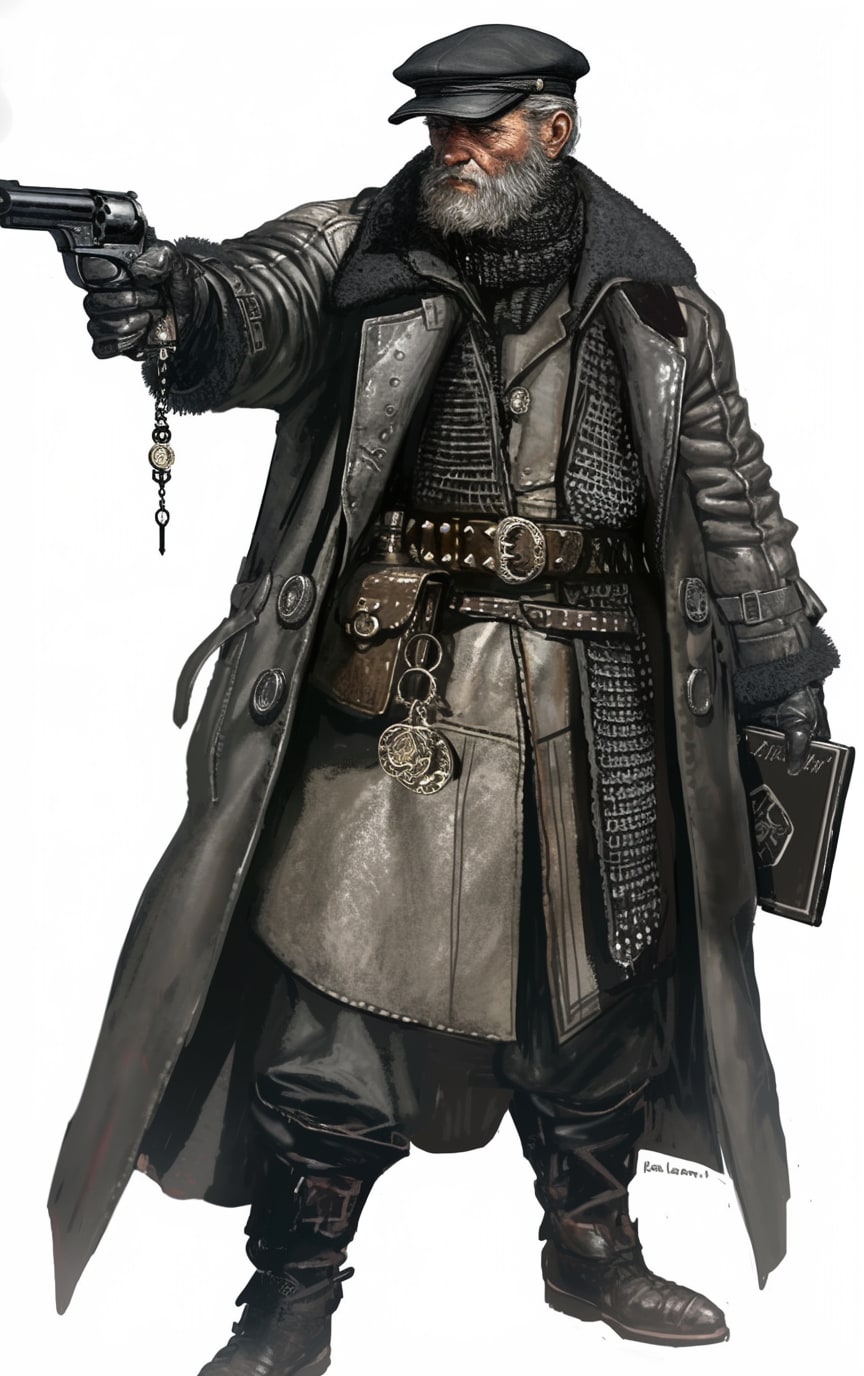
Slate's function at Warehouse Seventeen is protection — of carriers, passengers, porters, buyers who honour their terms, and sometimes enemies whose death would create more Heat than their survival costs. He guards the service arch. He holds sightlines. He makes interruption expensive without making it fatal, which is the art of deterrence practised by a man who understands, from personal experience, the difference between a threat and a killing, and who has chosen the threat with the deliberateness of a convert choosing his new faith. The short gun is aimed at the wall, not the person. The crowd sees the choice. The choice is the point. Slate does not want clean outcomes. Slate wants outcomes where everyone leaves the arch alive, which is a more difficult ambition and a less satisfying one, and Slate accepts the dissatisfaction the way he accepts the scar on his shoulder from the Seventh Crate operation — as evidence of a decision that was correct and painful and will need to be made again.
Slate's failure mode — the thing he fears becoming, the shape he sees when he examines his own shadow with the honesty of a man who has already been the thing once and recognizes the posture — is paternal tyranny. Protection that becomes ownership. The shield that becomes a wall against the people it claims to guard. A man who says "I am keeping you safe" while standing in the only doorway, and who has confused the two functions so thoroughly that he can no longer tell whether he is guarding the door or guarding himself against the people on the other side. Slate respects Old Cask — the Warehouse Seventeen Strongarm who refuses family collection work — because Old Cask has drawn a line that Slate fears he cannot draw for himself, and the respect is the line's substitute.


#The Specialist Trades
Gunhands
Gunhands are lane-keepers — armed deterrents whose principal weapon is the angle they hold, the warning they deliver, and the exit they control. They come from convoy work, caravan escort, militia rosters, customs posts, and warehouse nightwatch — occupations that teach a person where a shot goes after it passes through the target, which is the calculation that separates a Gunhand from a murderer. Their weapons are short-barrel pieces positioned on rooftops, behind shutters, atop cargo stacks, in bell-tower windows, along rail hooks, and at stair landings — places where a single shot can make a lane expensive without turning a freight bay into a cemetery.
Responsible Gunhands count civilians before ammunition. They refuse buyer demands for "certainty," because certainty, in the context of armed deterrence, means a body, and a body produces Heat that will burn every route in the district for months. They fire warnings. They fire angles. They fire into the wall beside a man's head, the way Slate does, because the sound of a wall taking a bullet is more instructive than the sound of a body taking one, and the instruction carries further. A Gunhand who has fired a warning shot and watched an official retreat has accomplished something that a Gunhand who has killed an official cannot: a route that remains open after the smoke clears.
Fences
A Fence understands that possession is not the same as a valid claim, and a valid claim is not the same as a safe one. The Fence sits between a stolen object and its future — which is to say, between a crime already committed and the larger crime of deciding what happens next. Sale. Return. Ransom. Dismantling for parts. Public exposure. Preservation in a sealed location until the political winds change. Claimant exchange — finding a buyer who wants the thing's story more than the thing itself. Serial washing through Moth Senn's foundry. Evidence storage against a future need. Or refusal — the rarest outcome and the most expensive, because refusing a profitable object costs the Fence money and refusing an object with a living provenance costs the Fence sleep.
The craft requires a specific kind of intelligence: not the ability to appraise value, which any pawnbroker possesses, but the ability to appraise consequence. Who wants this? Who wanted it before? Whose name is attached to its custody chain? Which buyer, family, office, collector, or political cell values the object's history more than its material worth? A confiscated reliquary is worth its weight in gold. The same reliquary, accompanied by the confiscation receipt that proves which Bureau office stole it from which shrine, is worth ten times the gold and carries ten times the risk, because the receipt transforms the object from loot into evidence, and evidence has a longer half-life than gold.
A good Fence sees that danger begins after the lift — that the moment of theft is the simplest part, and everything following it is the complicated, compound, politically saturated business of deciding who the object will belong to next and what that belonging will cost. A corrupt Fence makes objects lie profitably — inventing provenance, fabricating prior ownership, erasing maker marks that would identify the source and replacing them with marks that identify a more convenient source. The distinction between a good Fence and a corrupt one is not honesty. It is the direction of the lie. A good Fence lies to protect the object's future. A corrupt Fence lies to protect the Fence's profit. Both fictions enter the record. Both circulate. The Bureau of Records cannot distinguish between them, which is the Fence's only theological achievement and the Bureau's perpetual humiliation.
Inside Clerks
The Inside Clerk is the Syndicate's answer to the Bureau of Records — a functionary who exploits office routine from within, using the machinery of official procedure to produce unofficial outcomes. The craft is not bribery. Bribery is crude, expensive, and creates a witness with a grudge and a receipt. The Inside Clerk delays reports. Duplicates forms. Misroutes cargo between trays. Revives retired seals that have not been formally struck from the registry. Places a transfer order in the correct tray at the wrong hour, so the night clerk processes it without reading it, because the night clerk processes everything without reading it, because the night clerk is paid to file and not to think.
The distinction the Inside Clerk makes — the one that separates useful intervention from reckless sabotage — is between a late record and an erased one, between a usable stamp and an invalid one, between a bribable official and a frightened one. A bribable official takes money and keeps quiet. A frightened official takes nothing and keeps quieter, because the Inside Clerk has identified an embarrassment instead — a filing error, a missed inspection, a form signed without reading, a subordinate's correction that the supervisor stamped in haste — and the embarrassment, offered back to the official with the gentleness of a confessor returning a sin, produces cooperation more durable than coin. The official does not feel bribed. The official feels assisted. The distinction is the Inside Clerk's contribution to moral philosophy.
Safecrackers
The Safecracker studies locks, hinges, seals, alarm pins, counterweights, clocks, and false backs with the attention of a theologian studying scripture — which is to say, with reverence for the text and absolute willingness to contradict it. The craft is not force. Force is a Breach Burner's province. The Safecracker opens a boundary without making the breach public — without the noise, the smoke, the scorched metal, and the institutional response that a visible breach produces. A lock opened by a Safecracker remains a lock. A seal broken by a Safecracker remains a seal. The container appears untouched until the owner opens it and discovers that the contents have changed, by which time the Safecracker is two districts away and the owner is filing a report that will be processed by an Inside Clerk.
They are used where custody must be breached without alerting the custodian — evidence rooms, bonded warehouses, tariff cages, tribunal stores, relic vaults, and the locked cabinets of officials whose filing contains material more dangerous than the official realizes. Their discipline is limited scope: open the assigned container, take the assigned object, leave everything else untouched, close the container, and depart. The temptation — and every Safecracker describes this temptation in the same terms, with the same reluctance, as though the trade has its own confessional tradition — is to open more than the assignment specifies. A locked drawer beside the target contains a sealed folio. The folio may be valuable. The folio may be dangerous. The folio may contain a name that the Syndicate would pay handsomely to possess. The Safecracker who opens the folio has breached the scope, and scope, once breached, does not close as cleanly as a lock.
The deeper hazard is releasing consequences. A sealed container holds its contents for a reason, and that reason may be protection of the contents from the world or protection of the world from the contents. A relic vault in a Purity storehouse was sealed because the relic inside it was answering questions that had not been asked. The Safecracker who opens the vault releases a situation, and situations, unlike objects, cannot be returned to the vault when the job is finished. The Relic Brokers understand this. The Safecrackers understand it less well, which is why Brokers and Safecrackers are never assigned to the same job without a Factor's direct oversight.
Firestarters
The Firestarter uses flame the way a surgeon uses a scalpel — with purpose, with knowledge of what lies beneath the cut, and with the understanding that precision is more important than enthusiasm. They come from tariff furnaces, boiler rooms, plague-disposal details, ash yards, insurance assessments, and rescue work — occupations where fire is a tool, a colleague, and occasionally an adversary, but never a spectacle. The Syndicate's Firestarters create exits. They alter scenes. They produce smoke that covers a handoff, diversions that empty a building, and controlled damage that transforms an evidence room's contents from proof into ash before the Watch can file a preservation order.
Good practice requires a named target — a specific door, a specific archive, a specific crate — and knowledge of what is on the other side. A Firestarter who burns a warehouse wall without knowing whether the adjacent room contains grain, people, black diesel, or a reliquary full of something that does not respond well to heat has failed not at arson but at the discipline that makes arson useful. Exit checks. Fuel skepticism — the suspicion that a buyer who insists on a larger fire wants a larger fire for reasons the buyer has not disclosed. And distrust of insurance interests, because a fire that destroys a warehouse also destroys a claim, and a claim destroyed is a new claim created, and the person who benefits from the new claim may have been the person who requested the fire.
Lookouts
A Lookout sees danger becoming organized before it visibly arrives. The craft is not observation — any porter leaning against a wall can observe a patrol crossing a market square. The Lookout reads the patrol's posture, the direction of its questions, the adjustment of its route, the change in its composition, the replacement of a bored constable with an attentive one, and the presence of a plainclothes figure who is watching the patrol rather than the market. The Lookout identifies what is about to happen, and the distinction is the distance between a warning that saves a job and a confirmation that records its failure.
They come from rooftops, bell towers, procession routes, market stalls, chapel porches, and former sentry posts — places where a person can stand for hours without attracting attention and where attention itself becomes visible in the way crowds move around authority. They track crowd behaviour. They track hidden searches. They track patrol focus — the way a constable's eyes return to the same corner, the same doorway, the same cart, with the regularity of a man who has been told where to look but not what he is looking for. They report in categories borrowed from the Syndicate's Heat system: Search, tail, inspection, withdrawal, signal, closure, armed entry. The vocabulary is precise because imprecise warnings produce imprecise responses, and an imprecise response at Heat Three — a runner who bolts when the correct action is to continue walking — can escalate a watched route to a burned one in under a minute.
Their danger is the inverse of their skill: treating suspicion as certainty. A Lookout who reports a tail when no tail exists forces a route change, wastes a decoy, burns a contact's cover, and destroys the trust that makes the next job possible. A Lookout who accuses a porter of being a Shadows informant based on posture alone has converted a colleague into an enemy using the same evidence that Purity uses to brand heretics: behaviour interpreted as intention, intention interpreted as guilt, guilt punished before the verdict. The best Lookouts report what they see. The worst report what they fear. The distinction keeps the Syndicate functional, and its collapse keeps the Bureau of Purity employed.
Cargo Masters
The Cargo Master controls the physical truth of a job — weight, axle limits, stairs, balance, fatigue, clearances, and the allocation of labour that determines who carries, who rests, who is paid, who is blamed, and who is at risk if the load shifts, opens, or proves heavier than the manifest declares. The Cargo Master is the person who tells the Factor that the plan is physically impossible — that the cart cannot hold the declared weight, that the stair cannot take the load, that the porter's back will give out before the third handoff, that the rain has turned the East Drain into a channel too deep for the wheels and too narrow for a mule.
They come from dock work, warehouse management, canal loading, funeral haulage, and the military supply trains that service the Sagittal Line — occupations where miscalculating weight kills people and where the person who miscalculated is the person who carries the blame and the stretcher. A good Cargo Master can refuse a profitable plan when material conditions make it unsafe, and the refusal is respected because the Cargo Master is the only person in the crew who can distinguish between a plan that is ambitious and a plan that is architecturally insane. Quoin respects this authority. Finch resents it, because Finch operates in categories of motion and timing, and the Cargo Master operates in categories of mass and limit, and the two systems disagree with the frequency of two Bureaus sharing a corridor.
Confidence Artists
The Confidence Artist manipulates public grammar — the system of assumptions, appearances, behaviours, and social signals that determine who belongs in a space and what they are doing there. The craft is not costume, though costume contributes. The craft is making witnesses cooperate in a conclusion that protects the lie: a woman in mourning garments receives deference at a funeral gate. A man carrying a guild courier's satchel receives passage through a counting house. A child with a shrine sweeper's broom receives invisibility at a tariff chapel. The Confidence Artist does not impersonate. The Confidence Artist presents, and presentation, in a Theocracy that operates on category and appearance, carries the force of identity.
They are used for false claimants — a "cousin" who collects effects from an evidence room, a "widow" who presents a ration card for correction, a "guild representative" who demands cargo be released under commercial statute. They are used for temporary offices — a borrowed desk, a borrowed seal, a borrowed hour of authority during which a form is stamped and a crate released and the office dissolves before the stamp is questioned. They are used for misdirected blame — a visible suspect who draws the Watch's attention while the actual crew completes the handoff two streets away. They are used for contested custody — a claimant who asserts prior right with documents prepared by Aunt Lio's office and grief prepared by the Artist's own training, which is to say, prepared with the precision of a stage performance and the sincerity of a widow's actual tears, the two being indistinguishable from the inspector's vantage.
Their danger — the occupational hazard that separates the Confidence Artist from the rest of the roster — is treating other lives as costumes. A mourning garment borrowed for a job belongs to a category of grief that is real, that belongs to people who are grieving, and that is devalued each time it is worn for a lie. A guild satchel represents a trade that employs real workers who depend on the satchel's credibility for their wages. A child's broom is a child's tool, and the child who lent it — if the child knew it was being lent — receives nothing when the Artist returns it. The Confidence Artist borrows identities the way the Bureau of Doctrine borrows truth: temporarily, strategically, and without apology. The Bureau's borrowing is sanctioned by theological authority. The Artist's is sanctioned by nothing except the crew's need, which is a worse authority and an honest one.
Relic Brokers
The Relic Broker occupies the most theologically dangerous position in the Syndicate's roster — the specialist who handles objects that may be sacred, may be cursed, may be fraudulent, and may, depending on which broker you consult and which catechism they were raised under, be answering. The Broker knows ash marks, bindings, fraud indicators, reliquary construction, Greed-touched ledger signatures, interdiction seals, and the specific behaviour of objects that respond to names, proximity, and the intentions of the person carrying them. Where the Fence evaluates an object's future — what it can become, who will buy it, which claim will hold — the Broker evaluates what the object already is, which is a more difficult and more hazardous assessment.
They keep dangerous goods sealed, minimally named, and away from buyers whose ignorance is part of the purchase. A collector who wants a saint-bone fragment for his cabinet does not want to know that the bone answers to a name it should not know, that the previous handler's left hand has not stopped trembling, and that the Bureau of Purity's records classify the fragment under a category reserved for objects that have demonstrated autonomous behaviour. The Broker knows these things. The Broker's craft is deciding which of these things the buyer needs to hear and which of these things the Broker needs to survive. The two sets overlap imperfectly, and the gap between them is where the Broker's conscience lives, pressed flat between a sealed box and a buyer's coin.
Their failure sequence is gradual curiosity. A sealed object remains sealed. The Broker handles it, ships it, prices it, forgets it. Months later, a similar object arrives. The seal is different. The Broker compares. The comparison requires opening the first seal to verify the second. The opened seal reveals a marking. The marking suggests a text. The text requires one line read. The line suggests a context. The context suggests a question. The question has an answer, and the answer has teeth. The Broker who began by handling sealed boxes ends by reading forbidden scripts with the lamp burning low and the box beside the bed, warm to the touch and patient. This is the trajectory that produces the Bureau of Purity's most enthusiastic pyres. The Broker knows this. The Broker opens the box anyway, because curiosity in the presence of sacred objects is not a weakness. It is a vocation, and vocations do not ask permission.
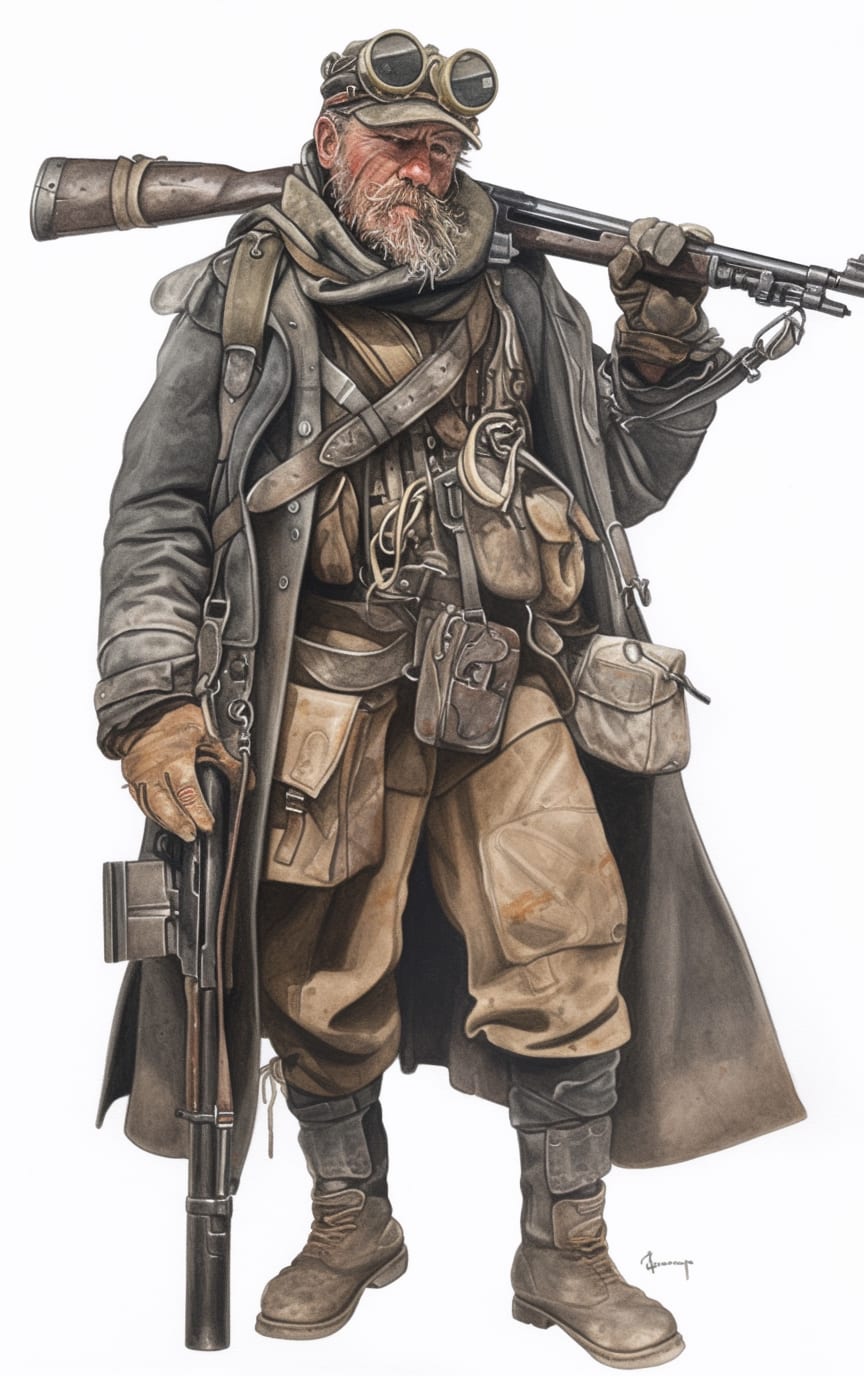



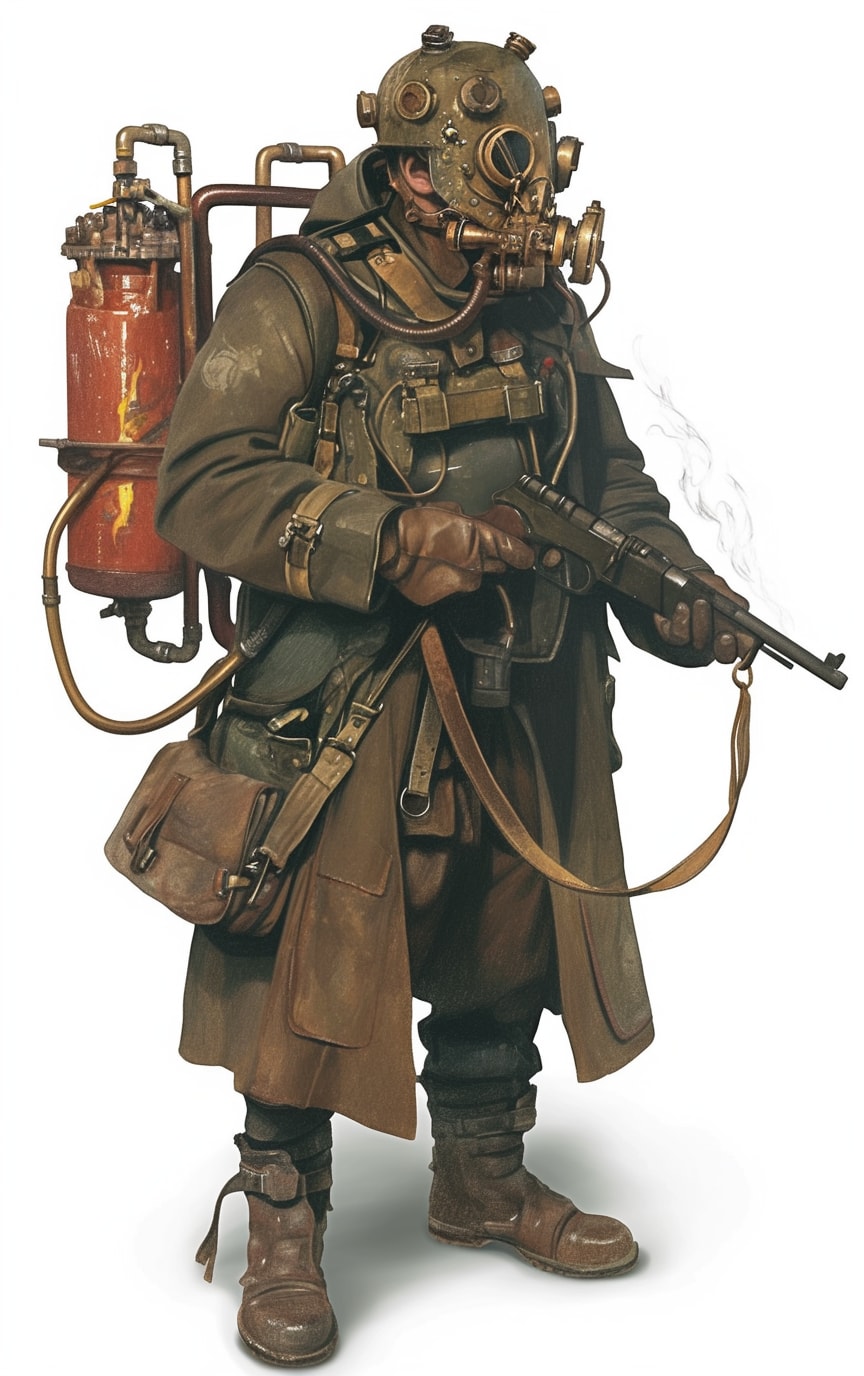



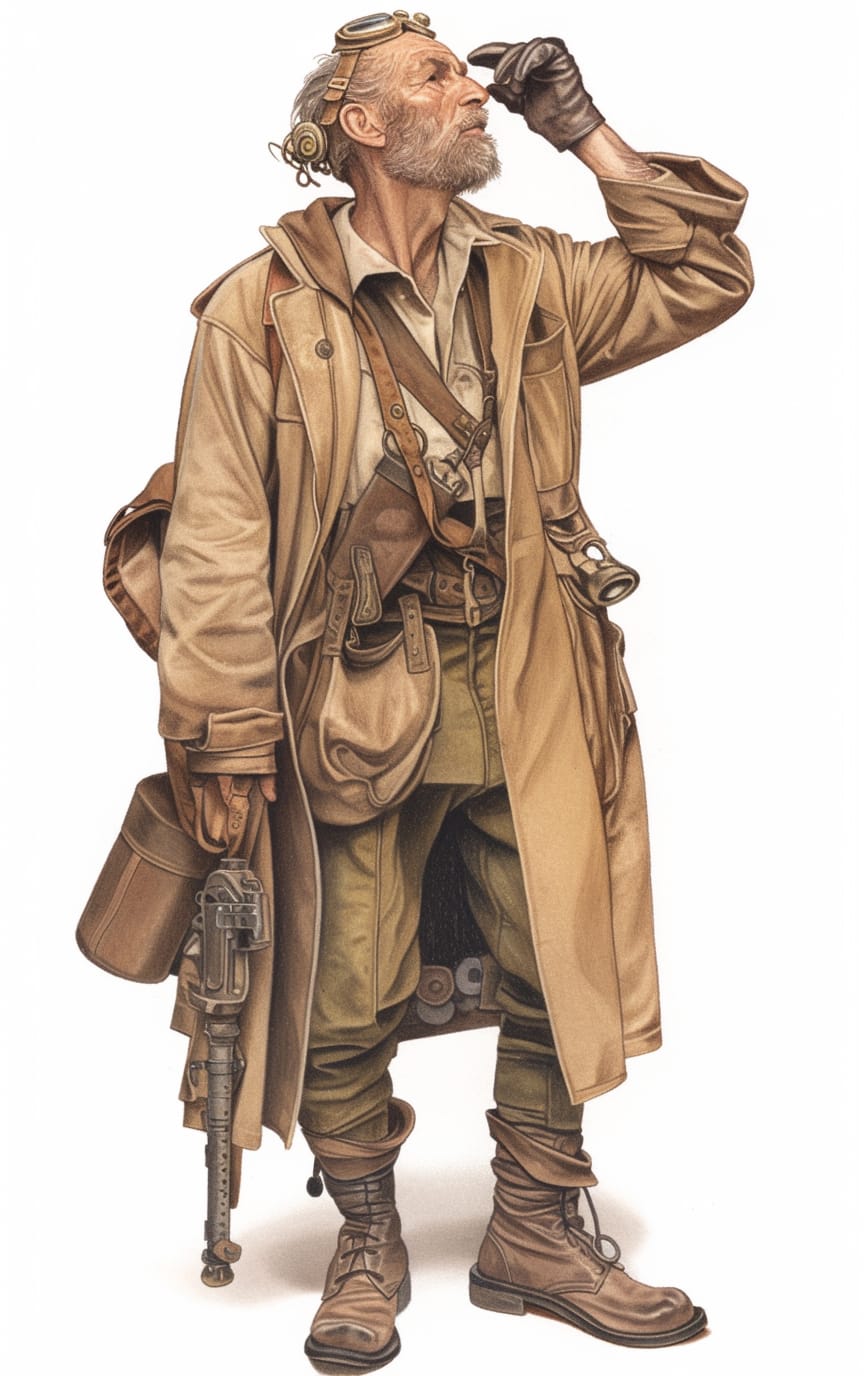
#Auxiliary and Heavy Roles
Porter Crews
The Porter Crew is the Syndicate's body — the hands under crates, coffins, carts, clinic loads, docks, markets, and public movement. They are the reason medicine reaches the clinic. They are the reason a passenger clears the arch. They are the reason the East Drain cart passage functions at all, because the passage requires arms to push the cart, backs to carry the load when the wheels stick in the wet, and voices to maintain the ordinary complaints of labour — the groaning, the cursing, the argument about weight distribution — that make illicit movement sound like the same drudgery performed at every loading bay in Strasbourg since the first crate was lifted and the first back was broken.
Warehouse Seventeen's ethical baseline — the line that separates its operations from the labour exploitation it claims to oppose — is that every hand on a load is named, paid, and remembered when a job goes wrong. This is spoken aloud in the porter kitchen before every job. It is violated in practice with the regularity of a saint's day fast broken by hunger. Porters are promised shares that arrive late. Porters are given risk assessments that omit the worst possibilities. Porters are told that the crate contains tonic when the crate contains cordial, that the route passes through a quiet district when the route passes through a Purity cordon, that the buyer is a clinic when the buyer is a collector. Every lie told to a porter is a lie told to the person taking the greatest physical risk for the smallest reward, and the lie is justified, within the crew, as protection — the same word the Bureau of Doctrine uses when it redacts truth from a catechism. The parallel is precise. The parallel is uncomfortable. The Bureau of Doctrine has declined to examine it.
Cutters
Cutters provide close, directional, restrained protection around a handoff — the narrow window in which a load or a person changes custody and the transfer is visible to anyone standing at the correct angle. They come from dock fights, door work, caravan brawls, debt protection, and funeral-line defence — occupations where violence occurs at arm's length, in tight spaces, with civilians pressed on all sides and the difference between a defensive action and an assault measured in inches and intent. They carry short tools: clubs, truncheons, hooked bars, weighted gloves, and the occasional blade kept sheathed until sheathing it becomes more dangerous than drawing it.
Their function is to create space — physical, directional, temporary — for carriers, porters, passengers, and exits. A Cutter at a handoff point does not fight. A Cutter stands, and the standing is the fight. Body mass, position, a hand resting on a tool handle, a gaze directed at the person most likely to interrupt. The crowd reads the Cutter the way the crowd reads a locked door: as a boundary that will become a problem if challenged. Most challenges do not occur. The Cutter's success is measured by the fights that did not happen, which is a poor metric for reputation but an excellent one for survival.
Their danger is escalation and the enjoyment of force at close range. A Cutter who discovers that hitting someone produces a rush more satisfying than standing still has crossed a line that the profession recognizes and does not forgive, because a Cutter who fights for pleasure has become a liability that draws Heat, produces casualties, and transforms a controlled handoff into an incident that the Watch will investigate with the thoroughness of officers who have been given, at last, something worth investigating. Slate manages the Cutters. Slate understands the temptation. Slate does not discuss why.
Lookout Teams
Where a single Lookout watches, a Lookout Team distributes warning across relatives, apprentices, market watchers, laundry signals, roof runners, chapel workers, and retired sentries — a network of observation that resists smoke, bribery, seizure, error, and the loss of any single watch position. One watches official movement. Another watches the watchers. One signals. Another preserves the record of who signalled. One stays. Another carries the warning forward. The system is redundant by design, because a single Lookout can be bribed, seized, blinded by a Purity smoke screen, or simply wrong, and the cost of a single wrong report is a burned route, a lost contact, and a crew that has run from a shadow while the actual threat approached from the other direction.
The team's defining test — spoken about in Warehouse Seventeen's porter kitchen with the reverence reserved for acts of genuine courage — is whether the team sends the needed warning after losing the safest position. A Lookout on a rooftop who sees a Purity sweep approaching can signal easily: a cloth dropped, a bell struck, a lantern turned. A Lookout whose rooftop has been seized, whose signal cloth has been confiscated, and whose lantern has been smashed must decide whether to descend into the street and carry the warning on foot, which means crossing the space between the rooftop and the crew at ground level, which means being visible, which means being seized. The test is not observation. The test is sacrifice — whether the warning is more important than the Lookout's safety, and whether the Lookout knows, in that moment, which position is the right one.
Their danger is the mirror of the single Lookout's: collective paranoia. A team that reports threats where none exist — that interprets every adjusted patrol, every unfamiliar face, every changed bell schedule as evidence of institutional attention — produces a crew that cannot move without fear, cannot operate without suspicion, and cannot maintain the contacts that make the next job possible. A paranoid crew burns its own routes. A Lookout Team that feeds the paranoia has done the Bureau of Purity's work without the Bureau spending a single seal.
Strongarms
The Strongarm is the Syndicate's wall — a heavy defender drawn from fighters, porters, guards, carriers, strike workers, and former debt enforcers who have elected to stand between a load and whatever wants to take it. They use body mass, shields, harnesses, axes, gates, and the physical occupation of space to make a corridor impassable, a doorway defensible, and a loading bay so thoroughly blocked that the only way through is through the Strongarm, which is not, in practice, a way through at all.
Old Cask is the name that circulates in Warehouse Seventeen when the Strongarm's role is discussed, because Old Cask embodies both its virtue and its limitation. He is a broad man, formerly a porter, formerly a debt collector's assistant, formerly a striker in the dockworkers' action of A.S. 194. He refuses family collection work — the enforcement of debts against households whose doors were the same doors Slate once knocked on — and the refusal costs the crew money and is honoured regardless. The refusal is the line. Old Cask drew it with a docker's stubborn clarity, and the line holds because the crew fears what it would become if the line were erased: a collection agency with better excuses.
Slate respects Old Cask in the manner of one reformed sinner recognising another: with admiration, wariness, and the constant suspicion that the reformation may not hold. Old Cask's strength is his simplicity — he defends a door, a load, a person, and he does not defend the abstractions that the crew wraps around its work. He does not defend the Syndicate's self-image. He does not defend its ledger. He defends the specific woman behind him who is trying to pass through the arch with a child under canvas, and he defends her because she is behind him and the people in front of him are trying to stop her, and that is all the theology Old Cask requires. The limitation is that simplicity does not scale. A Strongarm can defend a door. A Strongarm cannot defend a policy. Old Cask knows this. Old Cask defends the door regardless.
Crate Gunners
The Crate Gunner conceals a heavy weapon inside freight — a reinforced crate, a cargo stack, a wall cart with false planking — and waits with the patience of a man who understands that the moment the weapon is revealed, the public freight cover has ended and will not be restored. The Crate Gunner is a last resort wearing the disguise of a first option, which is the Syndicate's preferred arrangement for all of its heavier tools.
They require patience, bracing, sightline judgment, recoil control, and a strict limit against turning a market square into a killing ground. The Crate Gunner fires only when denial of a lane becomes more important than maintaining the cover story — when the alternative is the loss of a passenger, a witness, or a load whose capture would expose the entire network. The decision to fire is irrevocable. The first shot tells the district that freight contains weapons. The second shot tells the Bureau of Purity that the district's freight requires inspection at a level the Bureau has not previously applied. The third shot tells the crew that the route is burned, the cover is finished, and every crate in the district will be opened by officials who have learned, at cost, that ordinary freight is not always ordinary.
The Crate Gunner's restraint is therefore the most expensive discipline in the roster. A Gunhand fires warnings. A Cutter stands and blocks. A Strongarm holds a door. The Crate Gunner sits inside a crate with a weapon braced against planking and makes a calculation that involves the entire district's future: is this lane worth the cost of revealing that lanes contain weapons? The answer is almost always no. The power of the Crate Gunner is the power of the unused weapon — the knowledge, held by the crew and suspected by officials, that one of the crates in Bay One is not grain, and the suspicion, once planted, produces a caution in the inspector that no false manifest can replicate.
Wall Carts
The Wall Cart is an ordinary cart reinforced as mobile cover, public obstruction, and cargo disguise. It carries visible loads — clinic bundles, funeral goods, repair tools, water barrels, lamp oil, refuse — and the visibility is the point, because a cart that carries ordinary goods in an ordinary street is an object that crowds make room for, officials step around, and inspectors regard with the indifference of professionals who have better things to investigate.
The Tin Cart Family — Jory, Clement, Sella, and Odran Tin — understands carts in a way that the Syndicate's tactical planners do not. For the Tin family, the cart is not equipment. It is livelihood, home, witness, and family property. The cart was built by Jory's grandfather. It has been modified by every generation since. Its repairs bear the family's handwork. Its weight is known by touch. Its sound on cobblestones is recognizable at fifty yards by anyone who has lived in the district for more than a season. The cart is public. The cart is expected. The crowds that make room for it are not being used as cover — they are responding to a neighbour, and the distinction between a crowd used as cover and a crowd that cooperates with a neighbour is the distinction between a crew that treats the district as a resource and a crew that belongs to it.
The danger of the Wall Cart is centrality. Officials, crews, and buyers fixate on the visible cart while the actual handoff should have already moved. A cart stopped by a search draws attention, personnel, and time to a fixed location, and the crew's job is to ensure that the fixed location is the wrong one — that the true load has already passed through a different gate, a different queue, a different hand, while the inspector examines the cart's manifest and finds, with satisfaction, precisely the flaw that was placed there for him to find.
Breach Burners
The Breach Burner uses industrial tools — burner lances, gas tanks, hooks, cutting wire, ash wraps, and heat-resistant suits — to open sealed hinges, locks, plates, fittings, walls, debris, and furnace barriers when subtle entry has failed and time has run out. The Safecracker opens a lock. The Breach Burner opens a wall. The distinction is the difference between picking a pocket and kicking down a door, and the Breach Burner, unlike the Safecracker, does not pretend that the difference is a matter of elegance rather than necessity.
They come from boiler work, forge labour, furnace maintenance, demolition crews, and the industrial workshops that service the factories in the outer districts — places where cutting metal is a daily occupation and the sound of a lance against a hinge is no more alarming than the sound of a hammer against an anvil. Good practice checks what is on the far side of the barrier before cutting begins. A wall may conceal a storage room, a passage, a person, a gas line, or a relic vault whose contents respond to heat in ways that the Bureau of Purity has classified and the Breach Burner has not been told. The Breach Burner who cuts without checking has endangered the district, because a ruptured gas line produces an explosion, and an explosion produces an investigation, and an investigation produces the kind of institutional attention that no number of decoys, false manifests, or sacrificed routes can deflect.
Their danger is the assumption that a barrier's existence proves a right to breach it. A sealed door may protect a passage. A sealed vault may contain evidence that would free a prisoner. A sealed wall may hide a route that would save a family. But a sealed door may also protect the district from what is behind it, and a Breach Burner who opens every sealed thing without asking why it was sealed has mistaken access for justice, which is the Syndicate's most common theological error and the Bureau of Purity's most common accusation.


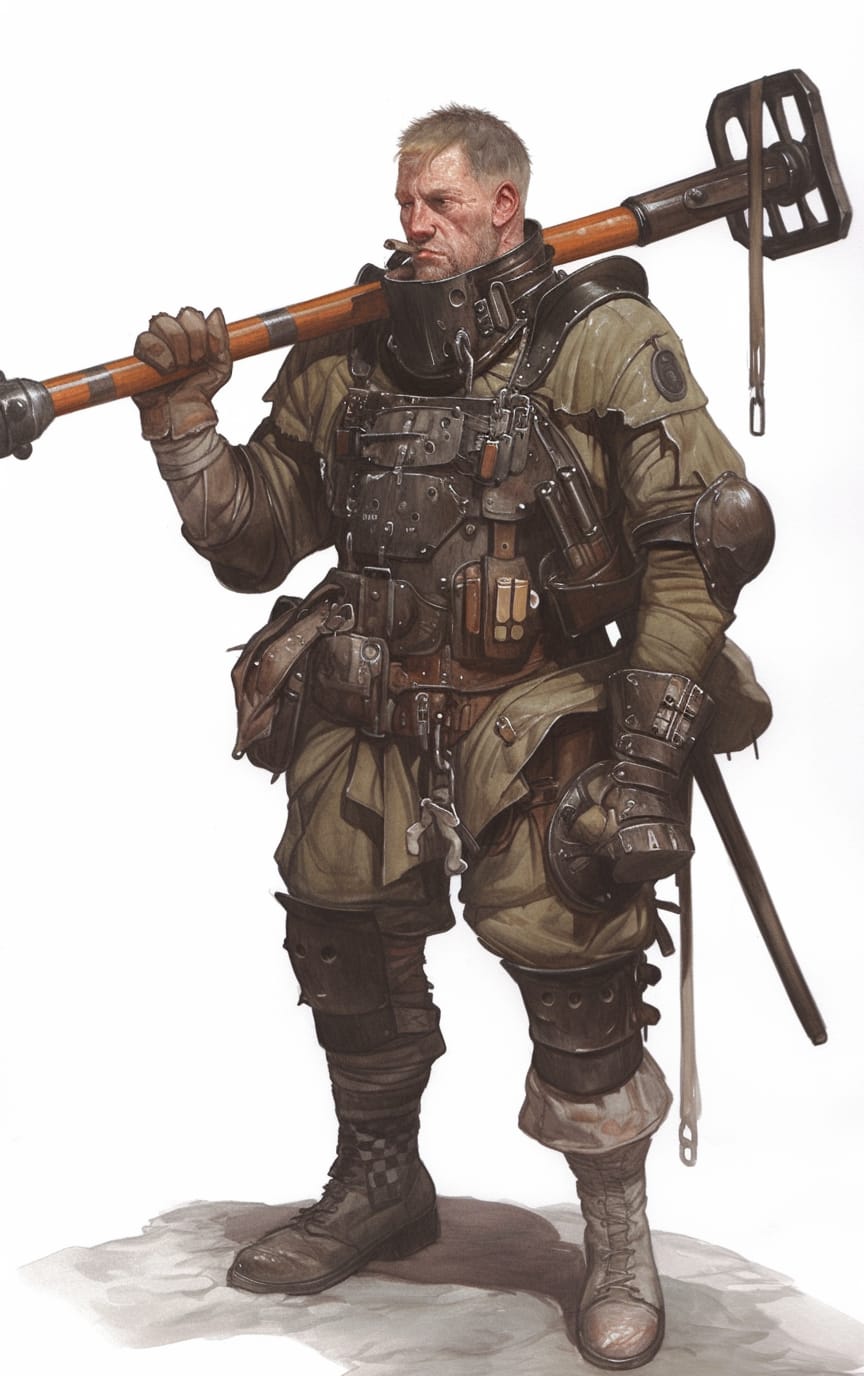
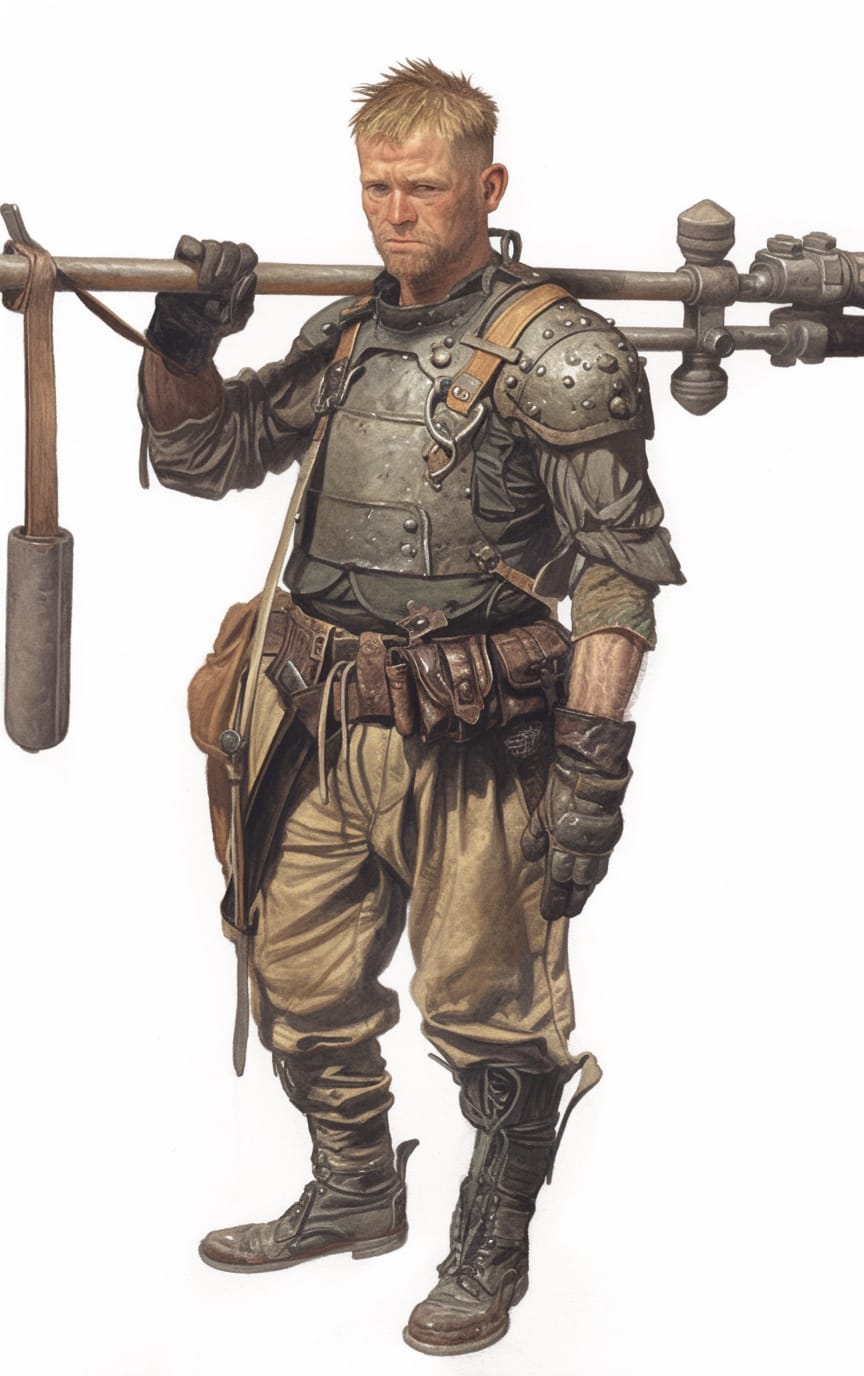

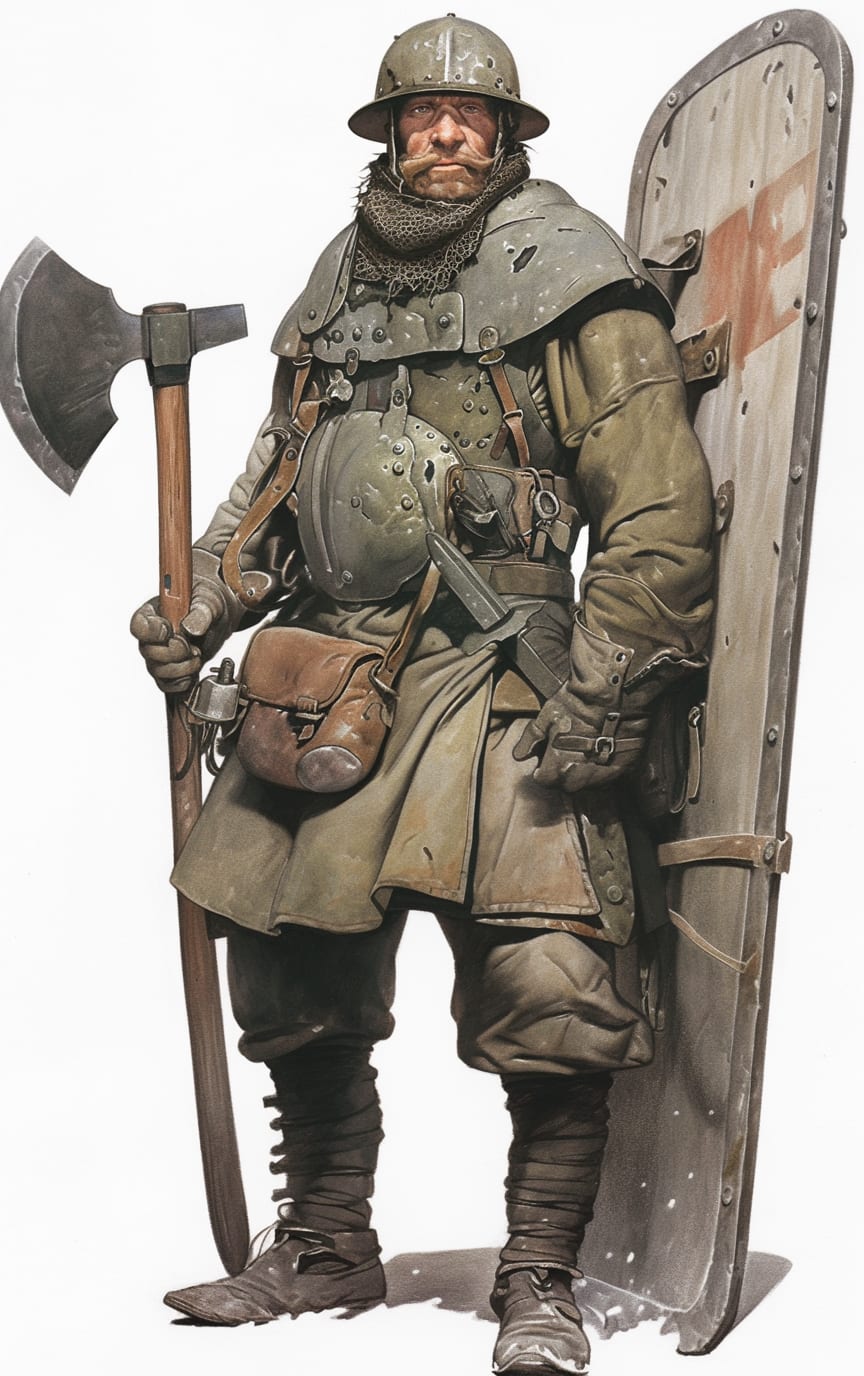
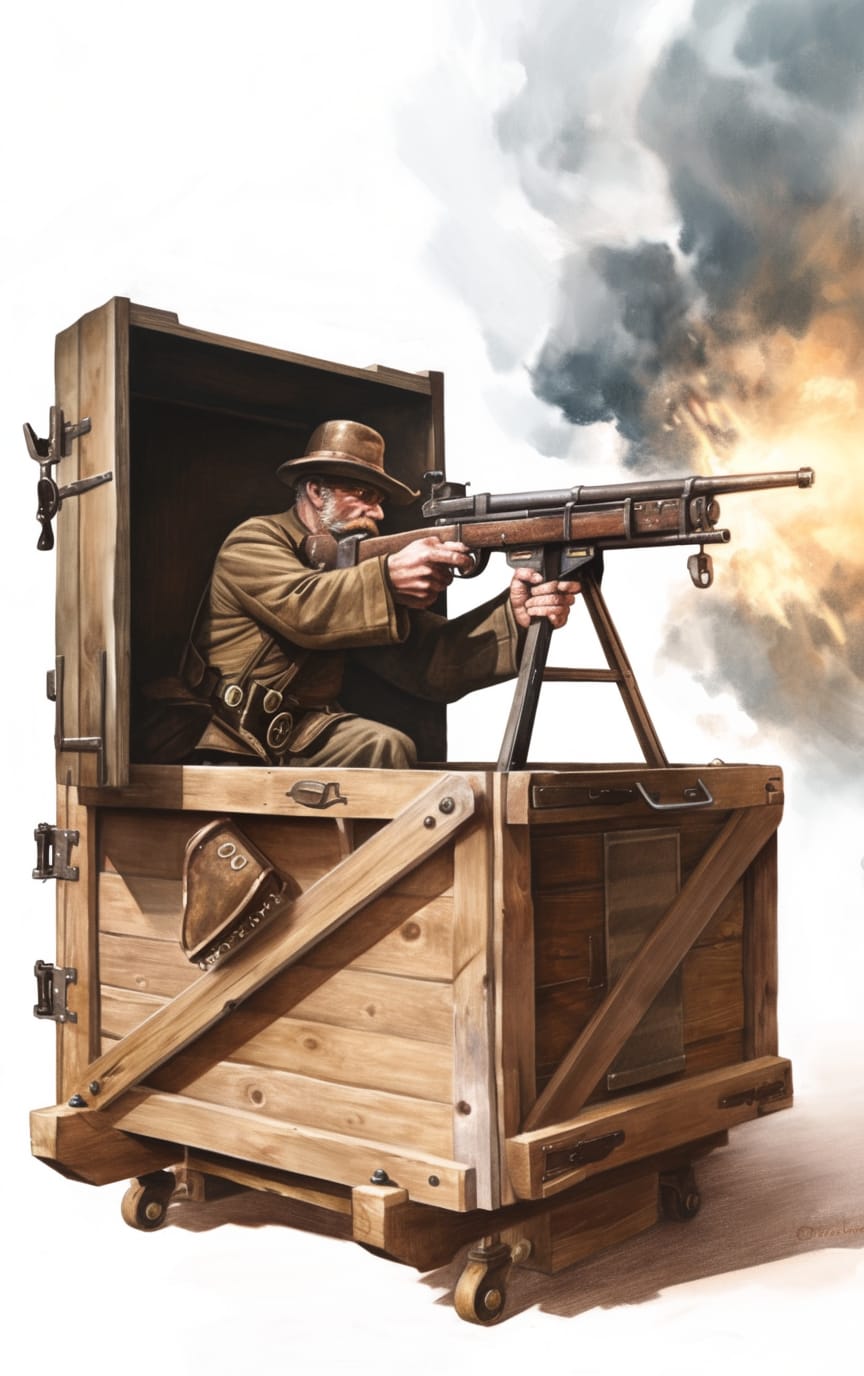
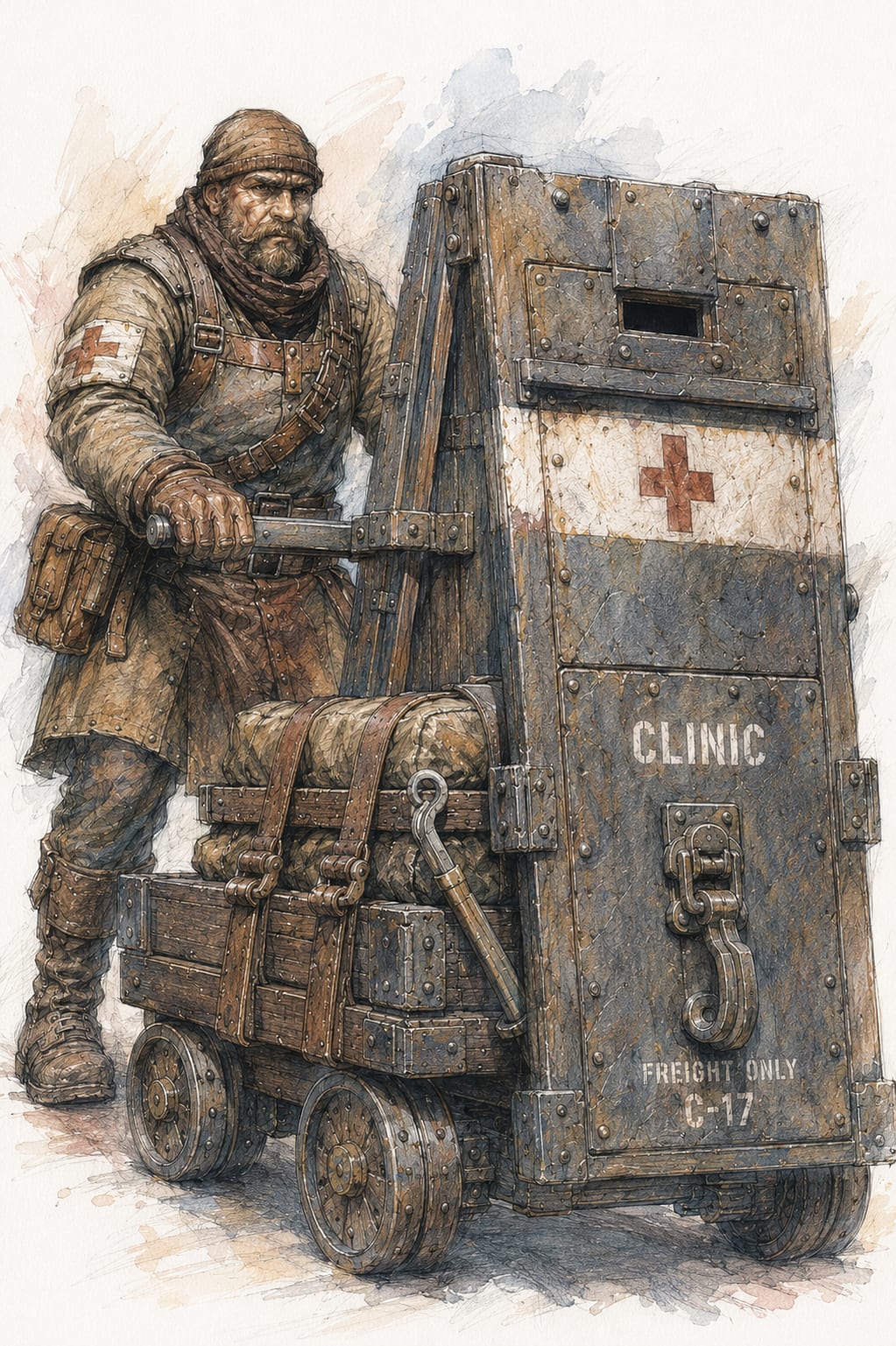
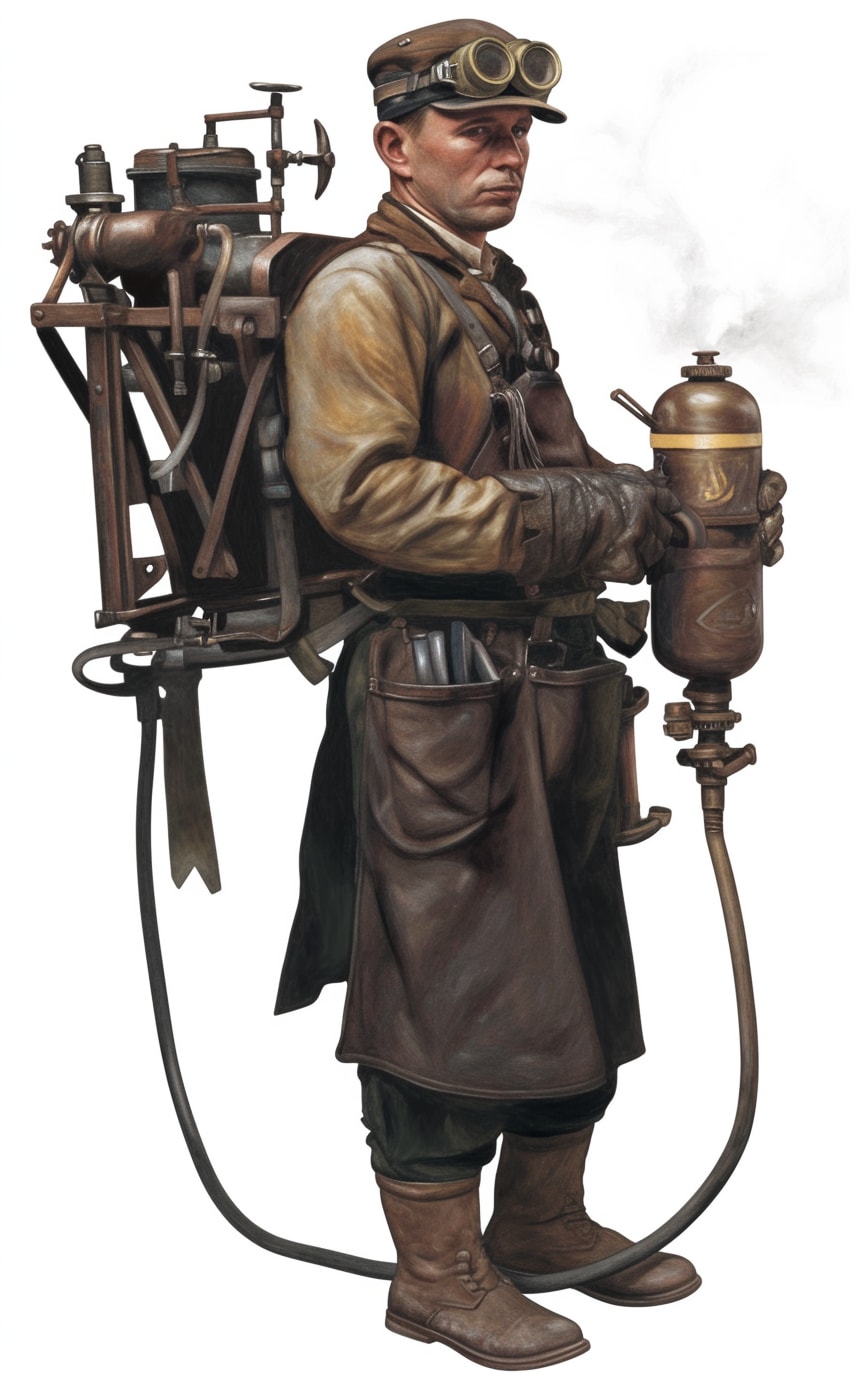
#Public and Support Roles
Paid Porters and Route Keepers
Paid porters carry inner cases, maintain carts, accept decoys, unlock yards, and guide local movement through the physical geography of the district — the gates, the stairs, the alleys, the drains, the chapel yards, the canal locks, and the loading bays where a body carrying a crate can pass without remark if the body carries the crate with the correct posture, at the correct speed, and with the correct expression of occupational resentment. They are the lowest-paid participants in the Syndicate's operations and the most exposed, because a porter carrying a crate through a Purity cordon cannot drop the crate and walk away with the ease of a Factor who can deny everything from the comfort of a counting room. The porter is holding the evidence. The evidence is heavy.
Route keepers make architecture socially passable. They are keyholders, boatmen, bell-ringers, drain workers, sluice operators, and kin networks — the people who control the physical points of passage that the Syndicate's routes depend on. Old Mera holds the lime-gate key under a cracked saint tile and opens the gate for medicine once, for a price that is not coin but the understanding that the medicine includes a dose for her grandson. Padrig the sluice boy changes the flood timing in the East Drain for cordial, paid in medicine rather than money because Padrig's family cannot eat money and the local apothecary has been closed by a Purity contamination order that Padrig's mother believes is retribution for a complaint she filed about the water supply. The two ash brothers sell cart positions in the drain passage. Saint Orlan's bell-ringer can extend procession noise for long enough to cover a handoff, but not for living passengers in false mourning, because the bell-ringer draws a line at blasphemy — a line that the Bureau of Doctrine finds theologically incoherent but humanly admirable.
A serious crew tracks wages, names, injuries, fears, and refusals, because paid hands remain people with future claims and present vulnerabilities. A porter injured on a job must be tended — by Mother Kett's clinic, if the route permits, or by whatever field medicine the crew carries. A route keeper whose price has been met must not be pressed for a second opening at the same rate, because the second opening carries different risk and the keeper knows it. Aven Pell represents both roles and forces the crew to acknowledge every handoff as a debt-bearing act: a transaction in which labour, risk, knowledge, and the porter's continued silence are exchanged for payment, truth, and the crew's willingness to remember the porter's name when the job goes wrong. The day the crew forgets the name is the day the porter becomes scenery, and scenery does not receive a share.
Corrupt Inspectors and Inside Officials
Inspector Dena Vos searched true medicine and filed a false result because her nephew needed the same stock. This sentence contains the entire moral architecture of the corrupt official's position: a genuine need, a genuine authority, a genuine betrayal, and a genuine consequence that compounds with every subsequent interaction between Vos and the crew that now holds the knowledge of what she did.
Corrupt officials may seek money — the simplest motive and the least interesting. They may seek family protection — medicine for a relative, passage for a threatened child, the disappearance of a document that connects a sibling to a crime. They may seek the delay of a contamination report that will condemn their ward. They may seek the disappearance of evidence that implicates their office. They may seek medicine for their own patients, because a clinic inspector who watches patients die while medicines sit behind tariff seals discovers that the distance between institutional duty and personal conscience is measured in coffins. They bend categories, timing, seals, scrutiny, reports, custody language, and rotations — the same tools the Bureau of Records uses to maintain truth, applied in reverse to maintain survival.
Clinic Contacts
Mother Kett's clinic receives necessity contraband — fever medicine, gauze, thread, lamp oil, fever salts, and people — through Syndicate routes because official supply is delayed by tariff, priced by monopoly, spoiled by storage, miscounted by negligence, or confiscated by a Bureau that prefers the medicine as evidence rather than treatment. The first delivery saved patients for minimal reciprocal help — an unlatched shutter, a cot for a runner with a twisted ankle, a generous death time on a patient's certificate. Later deliveries created a ledger.
Kett insists that the clinic belongs to the district. It does not belong to her. It does not belong to the crew. It does not belong to the buyer who financed the medicine, the patron who paid the route, or the Factor who negotiated the terms. The clinic exists because people are sick and the Bureau's supply chain has failed, and the clinic will continue to exist because people will continue to be sick and the Bureau's supply chain will continue to fail, and these two facts — the sickness and the failure — are the clinic's charter, unwritten, unstamped, and more binding than any document the Bureau of Doctrine has produced. Kett asks what else was in the crate, because Kett has learned that medicine sometimes arrives with other cargo, and the other cargo sometimes arrives with terms, and the terms sometimes arrive with a buyer whose charity has interest rates.
The clinic's location connects the East Drain, the pilgrim refuse gate, public misery, and possibilities for passengers, injured enforcers, and disguised hot objects — a convergence of need, crime, and mercy that makes the clinic simultaneously the most morally defensible and the most strategically exposed point in the Syndicate's network. The central danger — spoken about in the porter kitchen with the seriousness of people who have seen the danger from the inside — is the crew deciding that control of medicine, route, donor, and distribution makes it a private ration authority. A crew that controls a clinic's supply controls the clinic. A crew that controls the clinic controls the patients. A crew that controls the patients has become, in everything except name, the Bureau of Tithes with worse teeth and better intentions, and the intentions will not survive the next famine.
Buyers
Buyers include clinics, claimants, collectors, tariff offices, creditors, relief committees, Ash-mark patrons, auction houses, printers, rival crews, Houses, and official institutions — a taxonomy of motive so varied that the Bureau of Doctrine's best categorists have abandoned the attempt to reduce it to a manageable schema. Each buyer brings a desired subject, an acceptable condition, a hidden truth, a payment, and a claimed exceptional need. The exceptional need is always claimed. The exceptional need is sometimes real. The gap between these two frequencies is where the Factor earns his keep.
Quoin reads buyer terms the way a confessor reads a penitent's face: for the lie behind the confession, the confession behind the lie, and the third thing — the thing the buyer does not know he is revealing — that sits behind both. Fences read the buyer's lasting claims — what the buyer will own after delivery, what the buyer can enforce, what the buyer will demand when the current transaction's terms expire and the next transaction's terms activate. Finch listens for destinations that suppress speech — buyers who insist on silence about where the cargo goes, which means the destination is either dangerous or embarrassing, and the two conditions are, in Finch's experience, the same condition. Slate identifies enforcement disguised as prudence — a buyer who hires protection "for the crew's safety" and means protection for the buyer's investment.
Counterfeiters, Seal-Handlers, and Manifest Artists
These trades make objects and categories resemble permission — altering the first story told about a thing so it can pass the first door. Medicine becomes spoiled tonic. Gun mounts become agricultural hardware. Corpse carts become family duty. Relics become unremarkable inventory. The alteration is not permanent. It does not need to be. It needs to survive the first inspection, the first stamp, the first filing, and the first clerk — after which the altered category enters the Bureau of Records' system and begins to accrue the legitimacy of repetition, because a category that has been filed once can be cited, and a category that has been cited can be confirmed, and a category that has been confirmed is, in the Bureau's ontology, true.
The craftsmanship involves seals — carved, aged, copied, borrowed, revived from retirement, or invented from whole cloth and then aged to look as though they had been in use for decades. Aunt Lio's office at Rexel & Vane specialises in this work: the duplication of Bureau stamps, the recreation of expired tariff seals, the composition of origin chains that trace a cargo's history through offices that exist, officials who served, and dates that fall within the plausible range. The office's archives contain drafts, rejected alterations, practice seals, old signatures, and dead claims that can prove which party needed a lie before the lie became useful — a catalogue of fabricated truth that the Bureau of Records would burn a Registry House to possess and that Aunt Lio guards with the possessive vigilance of a mother guarding a child's drawings, which is precisely what they are.
Expert inspection, physical leaks — ink that bleeds wrong, wax that cracks at an incorrect angle, paper that weighs too little for the seal it bears — known witnesses, and contradictory paperwork all threaten the work. A false paper is an instrument of passage. It is not a replacement for reality. The paper opens the first door. What happens after the door opens — the inspection, the search, the question that the manifest was not designed to answer — requires a crew, a route, a plan, and the willingness to sacrifice the paper itself if the sacrifice protects the true load. A good counterfeiter knows this. A vain counterfeiter does not, and a vain counterfeiter is a counterfeiter who loves the craft more than the outcome, which is the same error that produces the Bureau of Records' worst scribes and the Bureau of Doctrine's finest hypocrites.
Grey Keel Boatmen
The Grey Keel boatmen belong first to water law and only conditionally to the Syndicate. They move through quay shadow, lower channels, flooded stages, salvage claims, old river customs, and the underquay routes that pass beneath official dryland control — a jurisdiction that the Bureau of Records has never successfully mapped because water does not hold categories the way stone does, and the Grey Keel exploits this categorical failure with the cheerful competence of fishermen who have discovered that the Bureau cannot audit a tide.
Water changes a load's identity. A crate on a dock is freight. The same crate in a skiff is salvage. The same crate floating in a canal lock is drowned property. The same crate hauled from a riverbed is recovery. Each category carries different jurisdiction, different taxation, different inspection authority, and different law. The Grey Keel understands this the way a priest understands liturgy — as a system of transformations, each one producing a different spiritual state from the same material substance. A cargo that enters water as contraband emerges as salvage, and salvage belongs to the salvor, and the salvor is the boatman, and the boatman recognises claims — drowned kin, keel share, salvage widow, tide compact, old boat law — that Warehouse Seventeen cannot name and the Bureau of Records has never filed.
Former Peregrine Insurance Clerks
The Peregrine Cartel's dissolution scattered insurance clerks into the criminal market the way a smashed window scatters glass — each fragment sharp, each fragment carrying a reflection of the institution it came from, and each fragment capable of cutting anyone who handles it carelessly. The former clerks understand the city through claims, loss, overvaluation, false destruction, and paid absence — the financial grammar that determines what a thing can be declared to have been worth, which differs from what it is worth, which is a different number and a more useful one.
They can identify impossible repair dates — a Wall Cart declared destroyed and subsequently seen in service, its damage report contradicted by its working axle. They can identify cargo declared lost but later delivered, its insurance claim paid and its contents intact, the two facts occupying the same ledger with the equanimity of a Bureau of Doctrine that maintains contradictory truths without visible discomfort. They can identify fires that began somewhere other than the incident report claims, because the Peregrine Mutual's assessment protocols taught them to read burn patterns the way a Relic Broker reads ash marks — for direction, origin, and the gap between what the physical evidence says and what the claimant's testimony insists.
Their danger is reducing human losses to replacement values. A clerk who has spent years calculating the cost of a warehouse fire in terms of damaged inventory, lost revenue, insurance exposure, and filing penalties develops a habit of mind that sees numbers where other people see suffering. A family that lost its home in the fire is, in the clerk's vocabulary, a claim. A worker who died in the fire is a liability. A child who was orphaned is an adjustment. The Syndicate imports this mind when it imports the clerk, and the mind produces efficiencies that the crew finds useful and the porter kitchen finds repulsive. The tension is productive. The tension is also permanent, because a mind trained by the Peregrine does not unlearn its training — it applies the training to new material, and the material is people.
Bureau-Adjacent Specialists
Former Records scribes, Purity orderlies, Tithes assessors, Shadows runners, Doctrine copyists, evidence clerks, and institutional workers of every denomination provide the Syndicate with knowledge of official systems — the internal grammar, timing, vulnerability, and habit that determines how a Bureau responds to a crime and how a crime can be shaped to produce a predictable Bureau response.
A former Records scribe knows which surviving receipts can prove a prior claim and which ones have been edited since filing — because the scribe edited some of them. A former Purity orderly knows which search priorities govern a district sweep and how long a sweep's paperwork takes to process — because the orderly processed it. A former Tithes assessor knows which tariff categories are enforced and which are cosmetic — because the assessor enforced the first and ignored the second. A former Shadows runner — whose existence the Bureau of Shadows denies, along with the Bureau itself and the runner and the running — knows marking methods, courier routes, drop protocols, and the schedule of the hooded figures who deliver Night Papers after the final peal. Each specialist brings institutional knowledge. Each specialist also brings institutional habit.
#Faction Contractors
Contractors enter through explicit agreement — a named skill, a named refusal, a named price, and the right to leave. Their presence tests whether the crew can honour consent without assuming loyalty, which is the same test the Bureau of Doctrine applies to its own appointees and fails with comparable regularity.
Aven Pell, Night Loader
Aven Pell grew up above Bay Two in Warehouse Seventeen, in a family of dock workers whose meals were timed to loading shifts and whose conversations concerned axle grease, porter shares, and the question of whether the Bay Four drain would flood before or after the third bell. His brother disappeared into an unsupported customs levy — a labour conscription that the Bureau of Tithes classifies as "voluntary contribution" and that the dockworkers' families classify as kidnapping with better stationery. Aven does not discuss his brother's absence. He discusses his brother's share — the wages that should have been paid, the insurance that should have applied, the name that should have remained in the ledger. The share was not paid. The insurance did not apply. The name was struck. Aven's career in the Syndicate began not with ideology but with arithmetic: the calculation that a system which erases a worker's name while retaining the worker's labour is a system that deserves the correction of a man who knows how the loading bay actually operates.
Aven knows night-loading schedules, hand signals, porter grievances, cart sounds, East Drain timing, and the specific weight of a crate that contains what it claims to contain versus one that does not. He places workers and public labour so that movement can continue while an illicit task passes inside it — the handoff hidden within the ordinary rhythm of loading, hauling, stacking, and complaining. He does not arrange workers as cover. He arranges workers as work, and the work is real, and the labour is real, and the wages are real, and the illicit task moves inside the reality the way a message moves inside a hymn: audible only to those who know the melody.
Corra Vey, License Widow
Corra Vey's husband was a licensing officer — a Bureau of Tithes functionary who reviewed trade permissions, inspection exemptions, registration renewals, and the dense tangle of bureaucratic authorisations that determined who could sell what, where, to whom, and under which tariff schedule. He died during Revocation Winter — the season in A.S. 197 when the Bureau of Tithes revoked and reissued half the district's commercial licenses in a single quarter, producing a cascade of administrative chaos that enriched the Bureau's reissuing clerks and bankrupted three guilds. Corra's husband died of a cough that became pneumonia that became a death certificate filed under "natural causes, administrative." After his death, multiple offices attempted to seize his cabinet — the locked filing chest containing retired licenses, trade permissions, inheritance marks, revocation copies, custody notes, and registration anomalies that the licensing officer had accumulated over a career's worth of bureaucratic review.
Corra kept the cabinet. She locked it with a key she had duplicated from her husband's ring before the Bureau of Tithes' recovery clerk arrived. She kept the contents, studied them, and discovered that the retired licenses — the expired permissions, the revoked exemptions, the lapsed authorisations — were not dead documents. They were prior claims. A retired license proves a former right. A former right, in the Bureau of Records' own precedent, can be cited as evidence of prior standing. Prior standing can be used to contest a current seizure, challenge a revocation, restore a trade permission, and — in one case that Corra executed with a precision that made the Bureau of Tithes' own assessors weep with professional envy — reverse an inheritance ruling that had been filed incorrectly for eleven years.
Corra prefers valid forgotten originals to forgery. Her craft is excavation, not fabrication — the recovery of genuine documents that the Bureau's own filing system has buried, misfiled, miscategorised, or deliberately suppressed. She uses buried procedure to recover legitimate claims that the Bureau's own clerks have lost in the labyrinth of their own corrections. She rejects false custody of living people — she will not create a forged adoption, a false kinship, or an invented guardianship, because false custody produces real control over real persons, and Corra has seen what real control looks like when it is exercised by an institution that has forgotten the person inside the file. She will, however, preserve a record that supports an ownership claim even when destruction would protect the crew, because the record is evidence, and evidence has a right to survive the convenience of the people it implicates — a position that Quoin finds admirable, Finch finds dangerous, and the Bureau of Records finds theologically offensive.
The Tin Cart Family
The Tin family operates a recognised public cart — a vehicle built by Jory Tin's grandfather, modified by every generation since, and repaired so many times that no original plank survives, though the family insists the cart is the same cart, which is a philosophical position the Bureau of Doctrine would endorse if it could bring itself to discuss the metaphysics of carpentry. Jory, Clement, Sella, and Odran Tin share the work. Jory drives. Clement loads. Sella navigates — which means Sella talks to the district, because navigation in a smuggling operation is a matter of people, and the people who make room for the Tin cart do so because they know the Tin family, trust the Tin cart, and have watched it carry funeral cloth, clinic bundles, refuse, repair tools, water, blankets, and the occasional discrete parcel for twenty years.
Their strength is public belonging. The crowds that make room for the cart are not being deceived. They are cooperating with a neighbour. The cart carries ordinary district needs — the lamp oil, the refuse, the funeral cloth — and the ordinary needs are real, and the cart is expected, and the expectation produces a social permission that no forged document can replicate, because a forged document persuades an inspector and a neighbour persuades a crowd, and a crowd that cooperates is a crowd that produces no witnesses, because witnesses see events, and a neighbour's cart is not an event. It is a Tuesday.
Moth Senn, Serial Washer
Moth Senn once engraved memorial plates — the brass and tin markers that identify the dead in ossuary niches, the iron tags that serial-mark bonded tools, the registry plates that authenticate a weapon's destruction, the quarantine hinges that bear an inspector's certification, and the execution equipment whose provenance the Bureau of Records insists on tracking for reasons the Bureau has never satisfactorily explained. The foundry that employed Moth sold duplicate plates to multiple clients — a practice that went undetected until a memorial plate bearing a dead man's name appeared on a tool in a living man's workshop, and the living man, understandably distressed, reported the anomaly to the Bureau of Records, which investigated, found seventeen further duplications, and closed the foundry.
Moth retained the duplicate ledger — the foundry's private record of which plates had been doubled, which clients had received the copies, and which serial numbers now existed in two places simultaneously. The ledger created a third role, between the original mark and its duplicate: the role of the person who knew both existed and could make one less fatal while retaining the other as insurance. This is Moth's trade. Moth launders tainted objects, provenance chains, claimant tags, and seller records. Moth removes one mark — the serial that connects a weapon to an evidence room's false destruction certificate, the tag that links a crate to a condemned warehouse, the stamp that identifies a relic as having passed through a Purity confiscation — but preserves another, hidden, recorded in a private ledger that Moth maintains in a code derived from the foundry's original engraving shorthand.
The service removes one danger and creates another. The weapon whose serial has been washed is safe to carry. The private ledger that records the washing is not safe to possess, because the ledger connects the weapon's past to Moth's present and Moth's present to the crew's operations, and the connection is a debt that Moth holds against every client who has used the service. Moth calls this insurance. Quoin calls it blackmail with a filing system. The distinction is a matter for the Bureau of Doctrine, and the Bureau of Doctrine has been invited to rule on it and has declined, citing a jurisdictional overlap with the Bureau of Records that both Bureaus know does not exist and both Bureaus find convenient.
Bram Cinder, Insurance Man
Bram Cinder is a former Peregrine Mutual assessor who understands fire from two directions: as a physical event that consumes material according to the laws of combustion, and as a financial event that creates claims according to the laws of insurance. The two sets of laws do not agree. A fire that begins in a grain store and spreads to a counting house is, physically, one fire. Financially, it is two fires — two policies, two assessments, two claims, two payouts, and two opportunities for fraud. Cinder reads both fires simultaneously, and the reading produces conclusions that neither the Bureau of Tithes' arson investigators nor the Peregrine Mutual's claims adjusters are equipped to reach, because neither institution trains its people to see both realities at once.
In the South Freight inquiry — the investigation into the fire at the South Freight warehouse that killed two workers and produced an insurance claim whose payout exceeded the warehouse's declared value by a factor that Cinder's assessment classified as "impossible absent prior arrangement" — Cinder found impossible ignition reports, a locked exit, and insured cargo delivered after the claimed loss. His findings were buried. The inquiry concluded that the fire was accidental. The payout was approved. The locked exit — the door that should have been open, that was welded shut from the outside, that trapped the two workers inside — was not mentioned in the final report. Cinder left the Peregrine Mutual with the buried findings in his pocket and the knowledge that the locked exit was a decision, and the decision was made by someone whose name appears on an insurance policy that was filed three days before the fire started.
The Pale Auditor
The Pale Auditor appeared after the early Golden Ledger rumours — after the first reports of debts that activated in sequence, of clauses that compounded, of crews that accepted generous terms and discovered, months later, that generosity was the most expensive thing they had ever been given. The Auditor reads debts that ordinary accountants avoid — the obligations that do not appear in a tariff ledger, the claims that cannot be filed with the Bureau of Tithes, the prices that are paid not in coin but in compliance, silence, access, and the slow surrender of the capacity to refuse.
The Auditor understands debts that answer — contracts whose terms shift when the debtor reads them, receipts that bind the signer to obligations the signer did not agree to, ledgers that remember blood, relic buyers who purchase not the object but the handler's name, and agreements witnessed by the dead or by entities whose testimonial standing the Bureau of Doctrine has not yet classified and does not wish to. The service is diagnostic. The Auditor identifies what a debt costs — its visible price, its attachment point, and what ordinary payment leaves unresolved. The diagnosis is precise. The diagnosis is also, in every case, worse than the client expected, because debts that require the Pale Auditor's attention are debts whose true cost is hidden, and hidden costs grow in the dark the way mould grows in the vaults beneath the Bureau of Records — quietly, persistently, and in directions that the architecture was not designed to contain.
The Auditor's rule is that every signer reads first. This is presented as professional ethics. It is also self-preservation, because a debt that the Auditor diagnoses without the debtor's understanding becomes a debt that the Auditor inherits — a transference of obligation that the Auditor has seen occur and does not wish to experience. Quoin fears the Auditor, and the fear is specific: the Auditor's diagnosis makes the First Buyer feel concrete. The First Buyer, in Quoin's private cosmology, is a metaphor — a useful abstraction for the unnamed forces that shaped the Syndicate's founding terms. The Pale Auditor's diagnosis suggests that the First Buyer is not a metaphor. The First Buyer is a creditor. The creditor is patient. And the terms of the original purchase — Quoin's freedom, Quoin's route, Quoin's capacity to refuse — are still accruing interest in a ledger that Quoin has never seen and the Pale Auditor can read but not close.
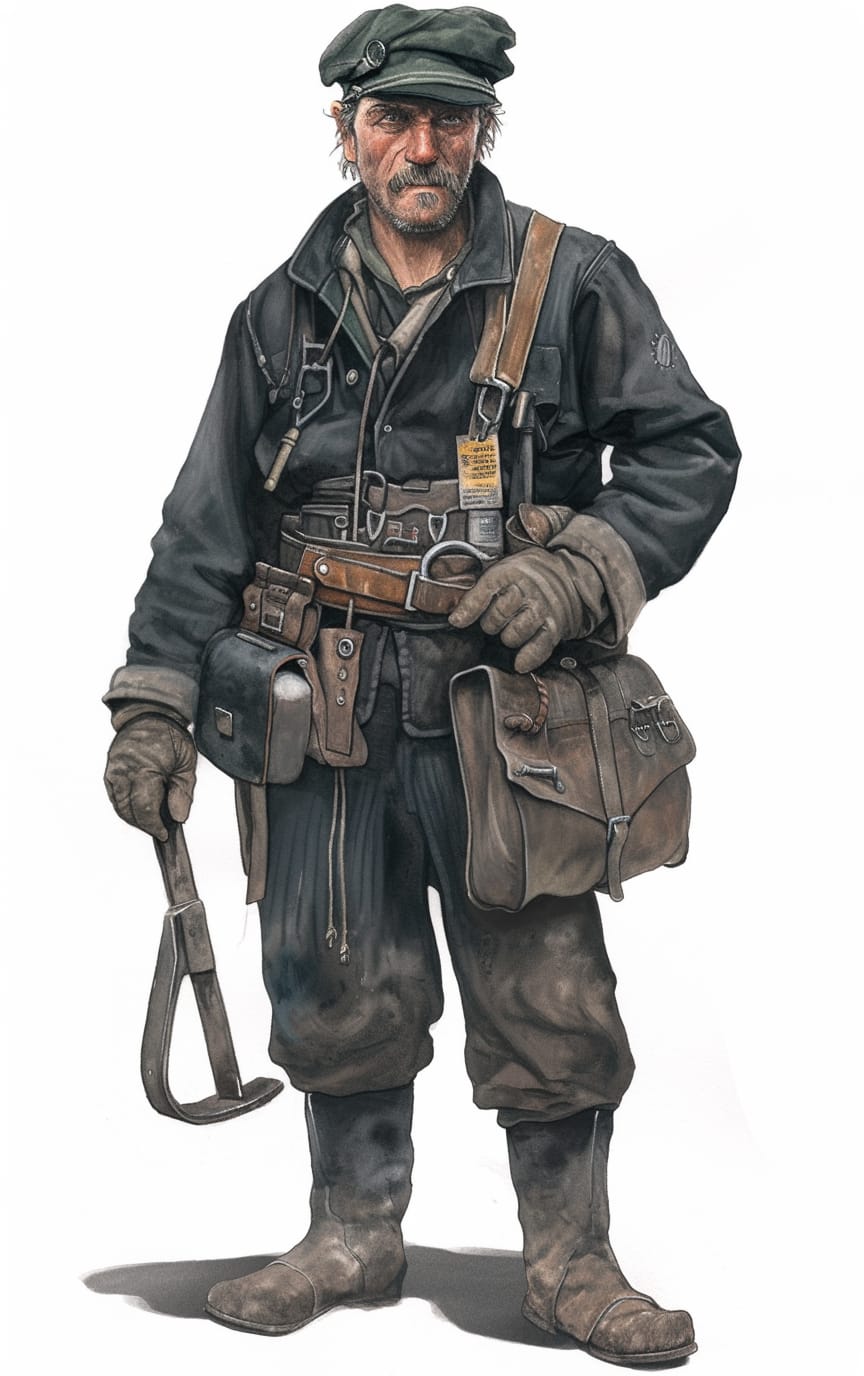



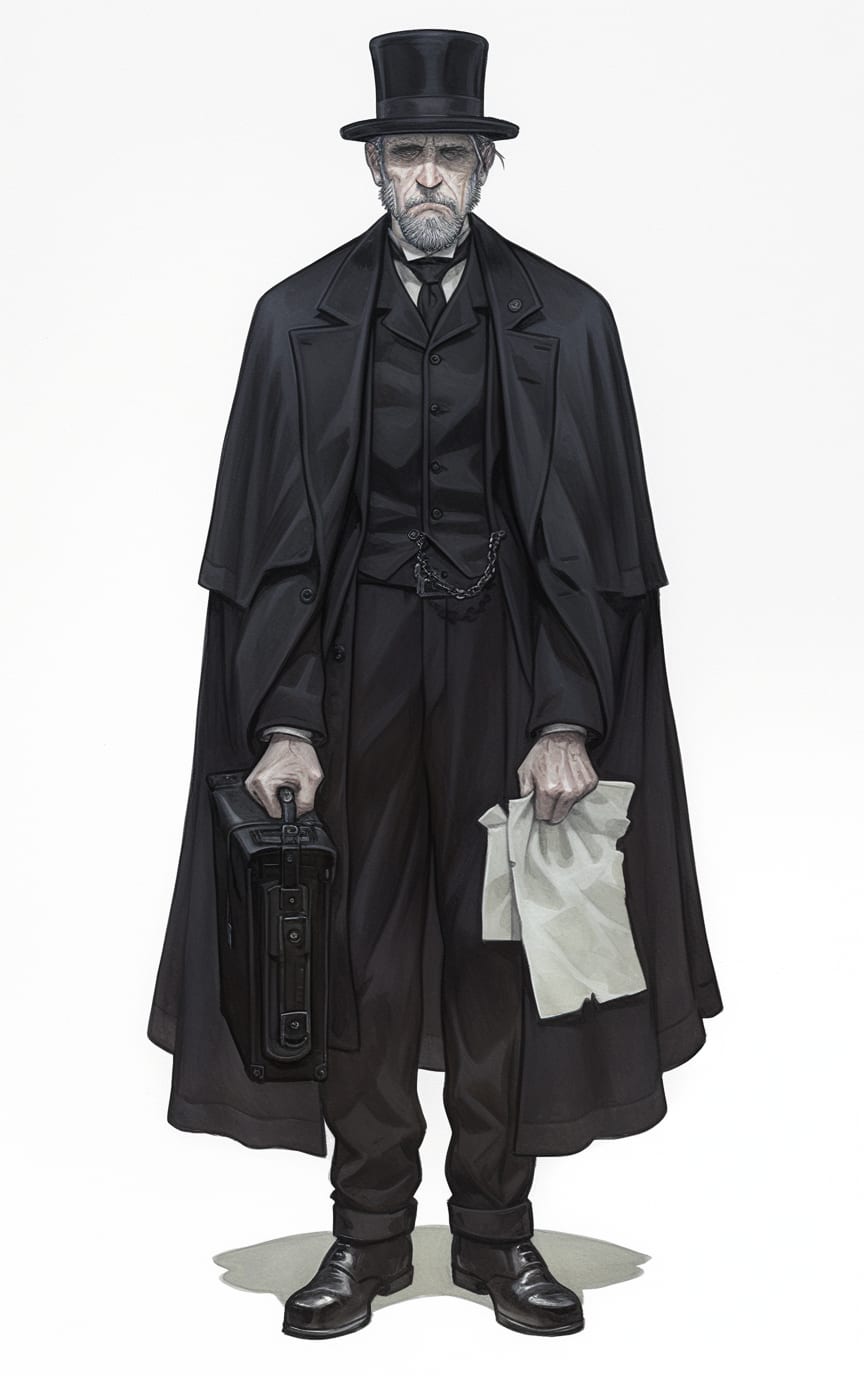
#Bases, Routes, Assets, and Contacts
#Warehouse Seventeen
Warehouse Seventeen stands at the freight edge of Strasbourg, where tariff jurisdiction, ward authority, canal custom, and lease law meet in a tangle of overlapping claims that no single Bureau has managed to resolve and no single Bureau wishes to. Its ownership is — I use the word with the precision of a man who has reviewed the relevant files and found them mutually contradictory — unresolved. It has multiple official numbers. Its painted names have been applied, overwritten, and applied again by successive tenants whose lease agreements reference different landlords, different dates, and different properties. Erased House marks survive beneath the paint. A porter-renewed chalk sign above Bay One reads "17" in a hand that changes quarterly, because the porters who maintain the sign consider it theirs, and the Bureaus that dispute the building's ownership have not, to date, disputed the porters' claim to a piece of chalk.
It has been a grain store, a confiscation annex, an emergency ration bay, and a private leasehold. Bay One handles public freight: grain, oil, leather, salt, planking, hymnals, and the spoiled tonic that everyone in the freight quarter understands is not always spoiled and not always tonic. Bay Two handles night loading — the truth-sensitive work that occurs after the public shift and before the dawn audit. Bay Three is officially unsafe after a roof fall but has been repaired at night by the porters, who use it as supplementary storage and occasionally as a hiding place during Purity raids whose occurrence the Bureau of Purity subsequently denies. Bay Four opens to the East Drain queue and serves as the primary departure point for routes that require wet passage, flood timing, and the tolerance of workers whose ordinary labour involves lime, ash, and bone wagons.

The upper Porter Rest Room serves as labour rest, family shelter, and temporary refuge during purge weeks — a function the Bureau of Purity would find objectionable if the Bureau of Purity could agree on who owns the building and therefore who is responsible for what happens inside it. The porter kitchen — the room where wages are counted, shares are argued, jobs are briefed, and the crew's ethics are debated with the volume and sincerity of men and women who know that the debate will not change the outcome but who conduct it anyway because the debate is the conscience — sits between Bay Two and the south stair. The south stair has three loose boards that announce careless movement, which serves as an informal alarm system. The broken lift in Bay Three conceals a working hoist route for light cases. The Bay Four rain gutter delivers paper to the drain yard under favourable wind. The roofline is a weak firing position but a strong signalling point.
Local unofficial devotions include Saint Avel of the Miscounted Loaves — a patron of honest error whose feast day is celebrated in the porter kitchen with a bread loaf from which one slice has been removed before counting — a dock prayer to the Nameless Carrier, recited before heavy lifts in a whisper that the Bureau of Doctrine has not yet thought to classify, and an upside-down Bureau notice pinned above the Bay Two counter marked "received under protest." The notice has been removed by Bureau inspectors on three occasions. It has been replaced on four. The mathematics are the district's.
#East Drain Cart Passage
The East Drain cart passage begins behind Bay Four, crosses a wet yard and a covered ditch, follows an old lime wall through a district whose residents have learned to ignore the sounds of wheels in water, and forks toward a clinic shutter, an underquay stair, a pilgrim refuse gate, and a hinge-based dead-end exit that opens only from the inside and only when the hinge-pin is lifted with a tool that Old Mera keeps beneath a cracked saint tile in the lime wall's alcove.
The passage depends on flood timing, and flood timing depends on everything: actual weather, the old bell schedule (which is correct), the new bell schedule (which is official), sluice conditions, Padrig's cooperation, and the accumulated debris of a drainage system that the Bureau of Public Works has repaired three times using methods that each subsequent repair crew has condemned as incompetent. Flooding hinders mounted pursuit and Watch boots while remaining manageable for trained cart crews who know where the water reaches axle-height and where it merely soaks through the planking. The passage is socially populated by ash carts, bone wagons, lime carriers, clinic refuse carts, and shrine sweepers — a procession of undesirable ordinary work that the Syndicate hides inside because no inspector volunteers to wade through ankle-deep drain water to search a cart carrying bone dust and lime sacks when the alternative is returning to the office and filing a report that says the passage was inspected.
#The False Manifest Office (Rexel & Vane)
Located above a legitimate counting room in the commercial quarter, bearing the public name "Rexel & Vane, Commercial Copying and Claims Assistance," the False Manifest Office produces the paperwork that makes the Syndicate's first lies hold long enough for the true load to change hands. Rexel is dead — of natural causes, per the Bureau of Records, which is the Bureau's preferred classification for deaths whose investigation would produce uncomfortable questions. Vane's identity is uncertain — the name may refer to a living person, a deceased partner, a legal fiction maintained for lease purposes, or a former client whose identity was absorbed into the business through a transaction that Aunt Lio describes as "administrative inheritance" and the Bureau of Records would describe as fraud.
The office handles cargo categories, origin chains, damage notations, seal aging, route plausibility, and witness handwriting — the full grammar of documentary fabrication required to convert a load from what it is to what it needs to appear to be. Its methods recast medicine as spoiled tonic, weapon parts as agricultural hardware, relic fragments as shrine repair material, broken wax as customs damage, wet labels as flood casualty, and source histories as the kind of dull, unexamined provenance that an inspector reads with one eye and files with the other. Aunt Lio — whose actual name I do not know, whose relationship to Rexel and Vane I cannot verify, and whose calligraphy is, I confess, superior to my own — manages the operation with the quiet competence of a woman who has spent twenty years producing documents that the Bureau of Records accepts as genuine and would burn to the ground if it knew they were not.
The office's hidden drawer contains refusals — the jobs Aunt Lio will not take. Living passengers with false identities. Plague certificates. Child registry work. Relic danger assessments. Testimony fabrication. The refusals have been breached three times, and the three breaches are recorded in the drawer beside the refusals, because Aunt Lio believes that a rule violated should be remembered alongside the rule kept, and the memory of the violation is the punishment, and the punishment is more effective than any the Bureau of Purity could administer, because Aunt Lio administers it to herself.
#The Buyer Room
The Buyer Room sits behind storm shutters near a second-floor counting alcove in Warehouse Seventeen. It contains one table, three chairs, a basin, a coat hook, two exits of unequal size, and mismatched planks installed to disrupt sound transmission — a precaution that works against listening from below and fails against listening from the side, a fact I discovered during a Bureau of Doctrine audit conducted in the adjacent alcove, and a fact I have shared with no one except the reader of this Codex, which is a population the Bureau of Doctrine controls.
Quoin designed the room to make buyers uncomfortable. The chair nearest the door is lower than the other two. The table surface is scarred. The basin contains cold water and a cloth, presented to every buyer as hospitality and understood by every buyer as theatre — the ritual washing of hands before the business of dirty money, offered without comment and accepted without refusal. The two exits are unequal: one leads to the south stair and the loading bay; the other leads to a corridor that passes the porter kitchen, where the crew gathers, and where the buyer's passage through is observed by the people whose labour the buyer's money will purchase. The passage is deliberate. The observation is the point.
#The Underquay Passages
The underquay routes pass through wet stone, timber, ladders, chain rooms, eel stalls, drowned chapels, ferry locks, and service arches beneath official dryland control. They connect freight yards to docks, quarantine slips to salvage platforms, shrine steps to fuel floats, and the hidden underside of commerce to the visible upper side in a geography that the Bureau of Records has never mapped because mapping requires fixed categories and the water does not hold fixed categories. A crate that enters the underquay as land freight emerges as wet freight, which may be ferry cargo, which may be salvage, which may be drowned property, and the jurisdictional transformation occurs not through paperwork but through physics — through the application of water to a legal classification that was designed for dry surfaces.
Local institutions include the Chain Mother — a woman of uncertain age who controls the chain room beneath the third quay and whose toll is paid in salt, medicine, or information, never coin — the Eel Ledger, a system of debts maintained by the eel-stall operators whose terminology the Bureau of Tithes has attempted to decipher and abandoned, Saint Merev's drowned chapel, where a saint's icon stands knee-deep in canal water and receives offerings from boatmen, smugglers, and the occasional Purity inspector whose piety exceeds his jurisdictional mandate, and the Grey Keel salt coins that serve as passage tokens below the waterline.
Water creates different custody risks. A lost crate may return under another claim — the Grey Keel's salvage right, the Chain Mother's toll seizure, a boatman's tide debt. A body may carry the wrong token and be delivered to the wrong family. A relic may have stronger river ownership than shrine ownership, because the river held it longer and the river does not recognise the Bureau's categories. The moral pressure of the underquay is the surrender of control — the recognition that partnership with people and forces that cannot be treated as hired scenery is the price of passage through a geography that the Syndicate does not own, the Bureau does not govern, and the water does not care about.
#Tariff Chapel Blind Spots
Tariff chapels combine prayer, levy collection, seals, confessions, cargo categories, and commerce at gates, bridges, markets, ferries, ration yards, and pilgrim streets — a fusion of the sacred and the fiscal that the Bureau of Doctrine considers theologically sound and the Bureau of Tithes considers operationally convenient and the Syndicate considers a gift. Blind spots emerge when ritual, embarrassment, and workload exceed scrutiny. Confession baskets are shielded by spiritual discretion — an inspector who opens a confession basket has committed a canonical offence, and the canonical offence is prosecuted with more enthusiasm than the smuggling it would reveal, because the Bureau of Doctrine values the sanctity of confession more than the Bureau of Tithes values its tariff revenue, and in disputes between theology and revenue, theology wins, which is the only context in which theology is useful.
Earlier assessments described tariff chapel operations as "exploiting religious observance for criminal purposes."
The assessment is accurate but incomplete. The Syndicate exploits religious observance. The Bureau of Tithes also exploits religious observance — by combining tax collection with prayer, by requiring confession at tariff gates, by making the payment of levies a sacramental act. The Syndicate merely uses the same exploitation from the other side of the counter. The Bureau of Doctrine has ruled that this is "regrettable but symmetrical," which is among the more honest things the Bureau has said this decade.
Saint Orlan of the Weighted Gate is the prominent example: a tariff chapel whose priest records night cargo-chit usage in a private journal while denying the practice publicly with the conviction of a man who has confused his administrative survival with his spiritual duty. Famine-week confession tokens function as cargo chits. Inspectors face outward during processions. Counting clerks and blessing clerks assume each other witnessed a transfer. Saint-day crowds discourage opening devotional crates. Medicine passes as votive return. Pamphlets nest inside hymnals. A passenger vanishes behind a widow's veil. Rings enter poor boxes. Relics travel as shrine repair. The work requires Confidence Artists, Inside Clerks, Lookouts, and Relic Brokers, and it offends the Bureau of Purity more than any other Syndicate operation, because chapel blind spots mix bodies, objects, belief, and official categories in a stew that Purity cannot strain without dissolving the chapel itself.
#Corruption and Transformation
Every collapse begins with a defensible act. A carter moves a child past a gate that would kill the child. A clinic operator accepts medicine from a source the Bureau has condemned because the alternative is watching patients die while the condemnation circulates through six offices and three appeals. A clerk copies a sealed truth because the seal was designed to protect the office that produced the lie, and the truth — which concerns a family's inheritance, a prisoner's innocence, a water supply's contamination — will expire before the seal does. A fence recovers a reliquary from a Bureau evidence room where it was filed as confiscated property and would have remained until the room was cleared, the property auctioned, and the family that venerated the reliquary for four generations informed, by stamped notice, that their loss had been administratively resolved.
These are good acts. I state this without qualification. The Bureau of Doctrine will note that I have done so and will file the notation in whatever tray receives the opinions of Hieromnemons who have outlived their caution. I state it because the Syndicate's moral danger does not begin with cruelty. It begins with competence. It begins with the discovery that the act can be repeated, that the repetition can be organised, that the organisation can be priced, and that the pricing — which started as compensation for risk — becomes the purpose that risk was incurred to serve.
The transformation proceeds through three stages that the Syndicate's own people describe with varying degrees of honesty. The first is emotional: the crew stops asking whether the cargo should move and begins asking who can afford movement. The question sounds similar. It is not. The first question contains a judgment about need. The second contains a judgment about price. The difference is a child who cannot pay. The second stage is administrative: obligations become claims. A favour remembered becomes a favour owed, and the owing acquires interest, and the interest acquires enforcement, and the enforcement acquires personnel, and the personnel acquire habits, and the habits look — to anyone standing at a sufficient distance — indistinguishable from the Bureau of Tithes on a bad day. The third stage is theological, and it is the one that Quoin fears in the hours between the second and third bells when the warehouse is quiet and the ledger is open: access becomes judgment. The crew that opened a road begins to believe that opening the road entitles it to decide who deserves the road, and the deciding — which started as triage and became preference and will become policy — is the precise mechanism by which the Synod governs, which means the crew has become the thing it was built to circumvent.
#Passage Becomes Trafficking
Legitimate Passage operates on consent, a survivable identity, a burned route, and the understanding that the passenger's life beyond the ledger is the passenger's own. The crew moves the body. The body decides the destination. The route is destroyed after use because the route's survival threatens the passenger's survival, and a crew that preserves a route for future use has begun valuing the route above the person it carried.
Collapse begins with the roster. A legitimate Passage crew does not keep a passenger list — the list is the evidence, and evidence is what the Bureau of Purity uses to find the people the crew was paid to hide. But a crew that has moved forty passengers discovers that the fortieth is related to the twelfth, and the twelfth owes a favour to the Factor, and the Factor's favour can be activated to secure a route that the crew needs for a contraband run next week, and the roster — which was supposed to be burned — is filed instead, because the roster has become useful, and useful things are never destroyed in a city where every useful thing is scarce.
The crew continues moving people. It begins serving the buyer, the creditor, the handler, the route keeper — anyone except the passenger. A refugee family is split because the mother's papers are useful in Strasbourg and the father's papers are useful in Brest, and the crew describes the splitting as "optimised placement" with the bureaucratic fluency of a Bureau of Records clerk reassigning a file. A deserter is sold twice — once to the crew that moves him, once to the buyer who wants him found — and the double sale produces double income and a man whose location is known to everyone except the man himself. A healer is delivered to a clinic and remains there because the clinic owes the crew and the healer's departure would reduce the clinic's value as a Syndicate asset, and the healer, who was rescued, discovers that rescue has terms, and the terms do not include leaving.
The defense — spoken of in the porter kitchen with the urgency of people who can see the cliff from the path — is fragmented knowledge, quick record destruction, payment of safehouse labour at rates the safehouse keeper negotiated freely, preserved refusal at every stage, and the practice of giving passengers their own evidence of promised terms. A passenger who holds a copy of the agreement is a passenger who can enforce it. A passenger who holds nothing is a passenger who has been purchased, and the purchase price is silence, and silence is the cheapest commodity in a theocracy that has spent two centuries perfecting the art of making people stop talking.
#Contraband Becomes Monopoly
Contraband begins as the correction of a prohibition that weaponises need. Medicine is classified behind a tariff wall that prices it beyond a ward's capacity. Food is levied at rates designed to fund a Bureau that has never missed a meal. Fuel is rationed by a formula that rewards proximity to Purity's offices and punishes proximity to the frontier. Paper is restricted because paper carries words, and words carry doubt, and doubt is a controlled substance. The crew moves these things because official movement has been made slower than death, and the crew's margin — the price above cost — compensates for porters' injuries, routes' maintenance, manifests' fabrication, and the risk of a Purity inspection that ends with branded forearms and a cell in the Ashen Cloister.
The margin is fair. The margin is earned. The margin is also habit-forming.
Earlier assessments described Syndicate contraband operations as "parasitic upon legitimate commerce."
The Bureau of Tithes authored this assessment. The Bureau of Tithes also authored the tariff schedule that made the contraband necessary. The Bureau of Doctrine finds no contradiction in this, because the Bureau of Doctrine has been trained to find no contradiction in anything, which is both its professional qualification and its spiritual disease.
A crew that controls a ward's fever-medicine stock discovers that control of supply produces control of price, and control of price produces control of the ward. Monopoly arrives without announcement. It arrives when the crew begins to describe scarcity as weather — a natural condition that benefits the prepared — and begins to fear open supply. A free clinic becomes a threat because a free clinic reduces demand. A mutual-aid kitchen becomes a competitor because a mutual-aid kitchen distributes food without the crew's permission. A rival crew becomes an enemy because a rival crew proves that the supply route is not unique, and if the supply route is not unique, the crew's price is not justified, and if the price is not justified, the crew is not needed, and being needed is the only theology the crew has left.
The monopoly creates new violence that the original crew would not have recognised. Porters enforce shortage — destroying rival supply, intimidating open distributors, pricing medicine by the patient's desperation rather than the medicine's cost. Fences compete for exclusive access to warehouse stock and treat competing fences as threats rather than colleagues. Buyers purchase scarcity itself — paying not for medicine but for the guarantee that medicine will remain scarce enough to justify the price the buyer charges downstream. Warehouse Seventeen's counterrule — declared medical-stock cost, route cost, and risk spoken aloud before the porter kitchen — exists because Quoin watched a crew in the west quarter transform from a medicine supply into a medicine cartel in the space of two famine seasons, and the cartel's porters, when asked what had changed, said nothing had changed, which was the most frightening answer Quoin had ever received.
#Brokerage Becomes Blackmail Theology
Legitimate Brokerage gives families names. It gives reformers documents. It gives clinics timing. It gives witnesses proof. It connects the party that needs a truth to the truth itself, across the gap that the Bureau of Records has constructed between knowledge and access — a gap maintained by classification, by sealing, by the simple expedient of filing a document in a vault that the document's subject cannot enter. The Broker crosses this gap. The crossing is valuable. The value is the problem.
Collapse begins when truth becomes a fear-priced sacrament. A Broker who has connected a family to a stolen inheritance discovers that the family will pay for the connection, and the discovery is not remarkable — the family should pay, because the Broker incurred risk, spent time, and expended a contact's goodwill. But the Broker also discovers that the family will pay more if the alternative is the inheritance's permanent loss, and more still if the alternative is the Bureau of Purity learning that the family sought the inheritance at all, and the pricing — which started as compensation — becomes a schedule of fear, and the schedule of fear is, in every functional respect, an indulgence table.
The ledger becomes confession. The Broker becomes priest. The debtor becomes penitent. Secrets carry indulgence prices. A buyer can pay to bury a name — to ensure that a piece of information the Syndicate possesses never reaches the party it would damage. A buyer can pay to conceal a false death — to maintain the fiction that a disappeared person is dead rather than relocated. A buyer can pay to identify a rival — to weaponise the Syndicate's information network against a competitor. A buyer can pay to destroy a roster entry — to remove a name from the Syndicate's own records, which is the most expensive service the Brokerage offers because it requires the Syndicate to forget, and the Syndicate, like the Bureau of Records, does not forget without compensation.
#Recovery Becomes Possession Worship
Legitimate Recovery follows a chain of claim: former holder, loss, theft, suffering, risk of return, and benefit of disappearance. The crew locates an object — a reliquary, a sealed document, a family register, a piece of evidence — and returns it to the party with the strongest claim. The claim is assessed by history, by loss, by the damage the object's absence has caused, and by the damage the object's return might cause to the party that currently holds it, which is often the Bureau of Purity's evidence vault or the Bureau of Records' sealed archive or the private collection of a Cardinal whose acquisition methods the Bureau of Doctrine has declined to examine.
Collapse begins when carrying or taking an object is treated as proof of judgment. The crew that recovered a reliquary from a corrupt evidence room begins to believe that the recovery itself — the risk, the planning, the successful extraction — confers a right that the original holder's centuries of veneration did not confer. The crew held the object. The crew risked arrest for the object. The crew bled for the object. The crew, by these acts, has earned the object, and the earning supersedes the claim of the family that merely loved the object, because love is not a denomination the Syndicate's ledger recognises.
Symptoms accumulate. An heirloom is kept as a fee. Relic inscriptions are copied for sale to competing collectors. Evidence is withheld from a claimant to protect the route that produced it. Cargo is claimed after eliminating a competing claimant, and the elimination is filed as "dispute resolution" with the same administrative serenity that the Bureau of Records brings to the reclassification of a living person as deceased. Receipts become scripture — proof of handling treated as proof of ownership. Living claimants are ignored because the paper trail is cleaner than the human trail, and the Syndicate, like every bureaucracy, prefers clean paper to messy people.
#Debt Replaces Loyalty
Loyalty remembers past sacrifice and leaves people free beyond it. A porter who carried a crate through a Purity cordon at risk of branding is owed gratitude, and the gratitude is discharged by payment, by future consideration, by the crew's willingness to remember the porter's name when the porter needs help. The gratitude has a natural term. It expires when the debt is paid. It does not compound.
Debt is necessary. Labour must be compensated. Risk must be priced. Routes must be maintained. Forgetfulness must be prevented from becoming exploitation — the crew that forgets to pay a route keeper will not find the route open next month. The ledger exists to track these obligations, and the tracking is honest, and the honesty is essential, because a crew that does not pay its debts is a crew that will not be trusted, and a crew that is not trusted is a crew that will be reported, and a report to the Bureau of Purity is the market's final correction.
The collapse occurs when every human connection — trust, friendship, care, fear, shared survival, a drink at the porter kitchen, a confidence shared during a late shift, a wound dressed by a colleague — becomes an account payable. Aven's bay access becomes a claim on his silence. Mother Kett's medicine becomes a claim on patient names. A rescued passenger owes future work. Slate's wound — taken defending a porter from a Purity patrol — becomes a claim on the porter's obedience. Quoin's settlement of a debt becomes a claim on the debtor's loyalty, and the loyalty is no longer freely given but purchased, and purchased loyalty is employment, and employment without the option of resignation is servitude, and the Syndicate has built, in miniature, the same architecture of compelled obligation that the Bureau of Tithes administers on a continental scale.
Earlier editions of this section described the Golden Ledger's debt practices as "exceptional."
They were not exceptional. They were mature. The Golden Ledger demonstrated what every Syndicate ledger becomes if its entries are never closed: a system of advance payment and forgiveness that functions as command over every person who accepted relief. The creditor who forgives is the creditor who owns. The Syndicate's porter kitchen rules require debts to have endpoints. The Golden Ledger had no endpoints. The difference is a sentence in a ledger. The consequence is a district in chains.
Some acts must remain memory rather than currency. Workers deserve pay, rest, truth, and release. Patient names are not collectible balances. Rescued lives are not outstanding accounts. The distinction between a debt and a gift is that a gift does not generate interest, and the Syndicate's ledger — that instrument of precision and control and honest accounting — has no column for gifts, because a gift cannot be enforced, and an entry that cannot be enforced is, in the ledger's economy, an error.
#Routes Become Territory
A route is a shared vulnerability maintained by bell-ringers, porters, clerks, cart hands, kin, watchers, safehouse keepers, boatmen, priests, and the accumulated knowledge of people who have lived in a district long enough to know which drain floods at what hour and which inspector patrols at what bell and which chapel's procession creates enough noise to cover a handoff. The route belongs to no one. The route exists because these people — who have separate lives, separate fears, separate prices, and separate reasons for cooperating — have agreed, through a web of obligation and payment that the Bureau of Records would require three scribes and a month to untangle, to make a particular passage possible at a particular time.
Territorial collapse begins when repeated access is mistaken for ownership. The crew that has used a route forty times begins to believe the route is its route — that the bell-ringer rings for the crew, the drain floods for the crew, the inspector looks away for the crew. The bell-ringer, the drain, and the inspector have their own opinions on this matter, but the crew does not ask, because asking would introduce the possibility that the answer is no, and the possibility of no is incompatible with the certainty of ownership.
Some route rules prevent disaster — the requirement that only one crew use a passage per night, the prohibition on moving living passengers and contraband on the same cart, the insistence that a route be rested after a Purity inspection. These rules protect the route and everyone who depends on it. Other route rules prevent competition — the requirement that rival crews pay entry, the prohibition on unsanctioned movement through a district the crew considers its territory, the insistence that local workers accept exclusive contracts. The two categories of rule become indistinguishable, and the indistinguishability is the mechanism of territorial capture, because a crew that cannot distinguish between a safety rule and a monopoly rule has lost the ability to recognise its own corruption, which is the most durable form of corruption the Bureau of Purity has documented.
#Buyers Become Masters
Buyers begin as necessary sources of money, protection, destination, political cover, or payment for work that official systems have made cruel and unofficial systems have made expensive. A buyer pays for medicine to reach a clinic. A buyer funds a passage for a family the Bureau has condemned. A buyer finances the recovery of a document that proves an inheritance the Bureau of Records has sealed. The buyer's money solves an immediate problem, and the solving is genuine, and the gratitude is earned, and the earning is where the danger lives.
The fall begins with a buyer who resolves immediate danger. The clinic shipment is intercepted; the buyer covers the loss. The route incurs penalties; the buyer pays. A ledger exposure threatens the crew; the buyer purchases silence. Equipment debt accumulates; the buyer forgives it. Purity arrives; the buyer funds the crew's disappearance. Each act of rescue is real. Each act of rescue is also an acquisition.
Repeated financial rescue becomes control, and the control advances through the same structures the crew built for itself. The buyer funds the manifest office and selects categories. The buyer pays route keepers and selects routes. The buyer purchases clinic debt and selects patients. The buyer guarantees safehouses and selects destinations. The buyer settles wages and selects which workers remain valuable. Masters use structures of inevitability rather than direct orders — the buyer never commands, because commands can be refused. The buyer arranges conditions under which refusal is more expensive than compliance, and the arranging is invisible because the conditions resemble help.
#People Become Infrastructure
The final collapse occurs with administrative calm. There is no dramatic moment. There is no betrayal, no speech, no turning point that a playwright could stage. There is a meeting in the Buyer Room at which the crew discusses a route adjustment, and during the discussion, Aven is referred to as "bay access." Mother Kett is referred to as "clinic cover." Mera is referred to as "lime gate." Padrig is referred to as "flood timing." Aunt Lio is referred to as "paper." Finch is referred to as "route." Slate is referred to as "threat." Quoin is referred to as "terms." A passenger is referred to as "collateral." A child's false name is referred to as "an asset." A dead person is referred to as "proof."
The crew may still claim to love these people. The claim is the last stage of the transformation, because the love — which may be genuine, which probably is genuine, which is almost certainly genuine in the way that a Bureau of Records scribe's pride in her penmanship is genuine — has become another argument for control. "We protect Aven because we care about Aven" becomes "Aven must remain in his position because we care about Aven" becomes "Aven may not leave because leaving would endanger the people we care about" becomes "Aven is bay access and bay access does not have preferences."
Earlier editions of this section described the Syndicate's transformation as "a risk of criminal enterprise."
It is not a risk of criminal enterprise. It is a photograph of the Synod's own administrative reduction developed at a smaller scale and with worse equipment. The Synod reduces citizens to wards, labour, testimony, contamination, traffic, rations, and examples. The Syndicate reduces colleagues to access, cover, timing, paper, route, threat, and terms. The vocabulary differs. The grammar is identical. The Bureau of Doctrine has asked me not to make this comparison. I have made it. The Bureau may file its objection in the tray I have designated for objections I intend to survive.
Full transformation is achieved when every mercy has a maintenance cost assigned to a person with less choice than the person who assigned it. The moral collapse proceeds through justified exceptions, carried debts, route restrictions, buyer gratitude, delayed wages, and minor future favours — each one defensible in isolation, each one catastrophic in accumulation, each one invisible to the crew performing it because the crew has confused its ledger with its conscience, and the ledger is balanced, and a balanced ledger is, in the Syndicate's theology, proof that no sin has been committed.
The visible final sign is administrative calm. Meetings decide who can be risked, delayed, sacrificed, or given as human guarantee without open argument. The decisions are efficient. The decisions are recorded. The decisions are reviewed. The decisions are, by every metric the Syndicate's own rules can measure, correct. And the correctness — that cold, ledger-verified, porter-kitchen-approved correctness — is the last thing the crew sees before it discovers that it has become the Bureau it was built to oppose, and the discovery, when it arrives, arrives too late, because the ledger does not have a column for regret.
#Short Fiction: "The Second Manifest"
A reconstruction, by the Hieromnemon, of an event he did not witness but has documented from six separate sources, four of which contradict each other and two of which are dead.
The public manifest listed six crates of spoiled tonic, three crates of grain additive, one empty return, damaged shrine plankage, and damp boot leather. It sat on the tariff counter of Warehouse Seventeen (Unregistered) in the usual grease-paper sleeve, stamped with the usual seals, annotated in the usual hand, and accompanied by the usual stink of tallow and wet flour that constitutes the freight quarter's permanent weather. Beside it — not beneath it, not behind it, not hidden in any fashion that an inspector could later describe as evasion — sat the second manifest, sealed, filed under a correction category that the Bureau of Tithes had created eleven days after the original cargo was loaded, and therefore invisible to every tariff schedule that predated its own existence.
Factor Quoin presented the public document to Inspector Dena Vos with the unhurried formality of a man handing a hymnal to a bishop. He did not smile. Quoin does not smile during inspections, because a smile invites suspicion and Quoin invites nothing — he merely arranges the room so that the thing he wants happens without requiring his visible participation.
Vos read the manifest. She read it again. She looked at Quoin the way a confessor looks at a penitent who has recited the standard absolution with slightly too much confidence.
"Your prior declaration listed seven tonic crates."
"Bay Two leakage," Quoin said. "The corrective category accounts for the discrepancy. The category was created on the fourteenth. You will note that the filing predates the cargo by eleven days, which is either prescient or administrative, and I assure you it is administrative, because prescience would require the Bureau of Tithes to have anticipated its own incompetence, and the Bureau of Tithes, in my experience, does not anticipate anything except lunch."
Runner Finch crossed the bay. She carried a rope coil over one shoulder with the exaggerated care of a worker favouring a bad leg — the limp genuine on the left side, false on the right, and consistent enough to explain why a young woman carrying rope was moving slowly through a space where young women carrying rope moved quickly. Against her ribs, beneath the coil, pressed a narrow wooden case eighteen inches long, flat-sided, wrapped in waxed cloth, and warm from her body.
The case contained fever cordial — three bottles of the true stock, not the sacramental dilution the Bureau of Tithes permits at tariff rates that would bankrupt a ward before the fever killed it — three patient notes signed by Mother Kett in the abbreviated script that clinics use when the queue is long and the ink is short, and one bottle marked with a small gold buyer's mark on the neck. The gold mark had already caused a fight. Quoin wanted it removed because a buyer's mark on medicine means the medicine has an owner, and owned medicine is not charity. Slate wanted it removed because a buyer's mark is evidence. The buyer wanted it preserved because the mark is receipt, and a receipt is proof, and proof is the buyer's religion. The bottle remained marked. The bottle's mark is the seed from which this entire evening's consequences grow, and the seed was planted by a man in a grey coat who was, at that moment, sitting in the Buyer Room with a basin of cold water, a cloth, and the patience of a creditor who knows that the debt is being incurred downstairs.
Aven Pell waited in the bay queue. His cart carried damaged shrine plankage — real plankage, from a real shrine, damaged by real weather, filed under a real repair requisition that the Bureau of Rites had approved three weeks earlier and forgotten with the reliable negligence that makes the Bureau of Rites the Syndicate's most consistent ally. Beneath the plankage sat lime sacks. Beside the lime sacks sat a hymn-board crate with false bottom, measured to receive the inner case, padded with straw, and smelling of old church wood and linseed oil — a smell that inspectors associate with parish maintenance and do not investigate, because investigating parish maintenance requires a canonical warrant, and a canonical warrant requires the Bureau of Doctrine's approval, and the Bureau of Doctrine does not approve warrants for shrine plankage because the Bureau of Doctrine has a limited supply of dignity and prefers to spend it on heresy.
Finch reached Aven's cart. She examined the rear wheel with the theatrical concern of a woman who has discovered a defect. Aven climbed down. They discussed the wheel. They pointed at the wheel. They touched the wheel. Aven produced a mallet and struck the wheel, which rang with the dull thud of wood that is not broken and never was. During the discussion — during the pointing and the touching and the striking — the inner case moved from Finch's ribs to the hollow beneath the hymn boards. The transfer took four seconds. The discussion took ninety. The ratio between performance and act is the Syndicate's most consistent metric.
Aven looked at Finch. He said, quietly, "This is breathing work."
Finch said nothing.
"Breathing work" is the porter kitchen's term for a job that involves living cargo — a passenger, a patient, a child. The term exists because porters distinguish between crates that can be dropped and crates that cannot, and the distinction is respiratory. Aven recorded, in whatever private notation Aven uses, that a debt had been created — that the handling of living-risk cargo without advance warning constitutes a surcharge on the arrangement, payable in future consideration, reducible to no fixed rate, and owed by the crew to Aven in the specific and personal sense that Aven, not the Syndicate, bore the risk of discovery, and Aven, not the Syndicate, would receive the branding if the hymn-board crate was opened by a White Cloak with a warrant and a curiosity that exceeded his theological obligations.
Enforcer Slate stood at the service arch. The arch connects the warehouse's interior to the lane that leads, through two turnings, a drain crossing, and a stretch of cobblestone that the Bureau of Public Works has not repaired since the reign of Hierarch Bonaventure, to the route that reaches Mother Kett's clinic. The arch is not a gate. It is not controlled by a lock, a seal, a chain, or a posted guard. It is controlled by Slate, who stands in it, and whose presence in an archway communicates to the surrounding population — porters, inspectors, Watch auxiliaries, passers-by, cats — that the archway is not currently available for transit, and the population, having observed Slate's dimensions and demeanour, does not argue.
Two Watch auxiliaries observed the arch from the bay side. One watched the loading operation. The other watched the crowd. Neither watched Slate, because watching Slate is an activity that produces anxiety, and anxiety produces errors, and errors produce reports, and the Watch auxiliaries' commanding officer has made clear that reports involving Warehouse Seventeen are to be filed only when the filing officer is confident that the report will not return to his desk with annotations from three Bureaus and a request for clarification that amounts to an interrogation.
Behind Slate, in the passage that the arch conceals, stood three people who were not cargo, were not porters, were not crew, and were not — in any category the Bureau of Records maintained — present.
The first was an old woman carrying a laundry basket. The basket was tied to the lime-gate debt — Old Mera's arrangement, the key under the cracked saint tile, the passage that opens for medicine once and closes after, priced in the understanding that the medicine includes a dose for the grandson. The old woman's passage was part of Mera's terms. The old woman did not know this. The old woman knew only that she had been told to stand in the passage behind the large man and wait until the large man moved, and the large man had not moved, and the old woman, who had been waiting for forty minutes and whose laundry was not getting lighter, had begun to suspect that the large man was not going to move, and the suspicion was making her angry, and the anger was making her brave, and the bravery was going to produce a confrontation that Slate was hoping to avoid because Slate does not enjoy frightening old women and the old woman was clearly the sort of old woman who would hit him with the basket.
The second was a porter with a bleeding nail tear across the palm. The porter had injured himself on a crate edge during the flour-hauling performance and required treatment at the clinic. His passage was legitimate in the sense that an injured worker seeking medical attention is a category the Bureau recognises. His passage was illegitimate in the sense that the clinic he was seeking is supplied by the Syndicate and staffed by a woman whose medical credentials the Bureau of Doctrine has declined to verify because verifying them would require acknowledging the clinic's existence, and acknowledging the clinic's existence would require acknowledging the supply chain, and acknowledging the supply chain would require the Bureau of Doctrine to have an opinion about fever cordial, and the Bureau of Doctrine's opinion about fever cordial is that fever cordial is the Bureau of Tithes' problem.
The third was a child. The child was under canvas — a tarpaulin draped over the child's shoulders and head in the manner of a dock worker sheltering from rain, though the rain had stopped an hour ago and the canvas smelled of lime and river silt. The child was using the name Marret. The child's real name was not Marret. The child was headed toward a cousin near Saint Orlan's chapel, and the cousin had not been told, because advance notice creates a witness, and a witness creates a record, and a record creates a filing, and a filing creates a trail that the Bureau of Purity can follow from the cousin's door to the service arch to the warehouse to Finch to Quoin to the second manifest to the child's original name, which belonged to a family that the Bureau of Records had recently reclassified from "resident" to "relocated," and "relocated" is the Bureau's word for a condition that does not include a forwarding address.
Vos asked for Crate Seven.
"Under leakage review," Quoin said. "Bay Two. The assessment is ongoing. The assessor is a man named Dunnick, whom you may know from the tariff office, and whom I know from the tariff office, and who is not here because the assessment requires him to be in Bay Two, which is where the leakage is, which is where the assessment should be conducted, unless the Inspector prefers the assessment to be conducted here, in which case the leakage will need to be moved, and I am not confident that leakage can be moved without losing its evidentiary character."
Vos did not smile. Vos asked why Crate Five was available for inspection.
"Dry," Quoin said. "Sealed. Legible. Legally available. The tariff on Five is current. The seal on Five is intact. The contents of Five are described on the manifest you are holding, which I signed, and which bears the stamp of the Bureau of Tithes, which your office issued, and which I would not dream of questioning because questioning a Bureau seal is heresy, and heresy is the Bureau of Purity's jurisdiction, and the Bureau of Purity charges an hourly rate for jurisdictional consultations that I am not prepared to pay on a Thursday."
Vos ordered Crate Five opened.
Crate Five was the decoy. It had been prepared with the care of a reliquary and the contents of a rubbish bin. Damaged wax along the seams — convincingly accidental, applied with a heated knife by a Confidence Artist whose speciality was making deliberate damage look like weather. A spoiled-tonic label in the Bureau's standard format, printed on stock that matched the current quarter's issue, aged with tea and folded once at a crease that suggested handling by a clerk who did not care, which was the most authentic detail because clerks who do not care are the majority of the Bureau's workforce. Deliberately imperfect rope — the knot slightly wrong, the tension slightly loose, the kind of error that a smuggler would not make and an honest shipper would. Broken bottles inside, packed in stained straw, leaking a harmless cordial that smelled medicinal and tasted of nothing and would test, under the Bureau's chemical assessment, as "inconclusive, probably tonic, requires further analysis," and further analysis required three weeks, and three weeks was longer than the fever.
Among the straw sat a partial buyer note. The note named a route fee. The note named a clinic obligation. The note bore a receiving mark — a stamp that connected the crate to a transaction, a buyer, and a chain of custody that was, in every particular, false, and whose falseness was calibrated to be the precise degree of falseness that an inspector would find satisfying. A note too clean suggests a plant. A note too dirty suggests concealment. This note was exactly dirty enough to reward the search and exactly informative enough to justify the seizure without revealing anything that the crew could not afford to lose.
Vos gained enough evidence to seize the crate. The seizure was genuine. The evidence was genuine. The victory was genuine. The mistake — Vos's mistake, which Vos would not recognise until the receipt was filed and the receipt's implications had been examined by someone with more patience and less integrity than Vos — was the receipt.
Quoin accepted the seizure. He demanded a receipt. Vos signed the receipt. The receipt described the seizure of one crate under the spoiled-tonic category, contents as inventoried, condition as inspected, authority as granted, and officer as Vos. The receipt was correct. The receipt was also a document that stated, in Vos's own hand, over Vos's own signature, that Inspector Dena Vos of the tariff office had seized a crate of spoiled tonic and classified it as contraband, which meant either the crate was contraband — in which case Warehouse Seventeen would suffer, and Quoin was prepared for Warehouse Seventeen to suffer because Warehouse Seventeen had suffered before and suffering was a renewable resource — or the crate was tonic — in which case Vos's office had accepted a false category and seized the wrong scandal in writing, and written scandals are the Bureau of Records' speciality, and the Bureau of Records does not lose written scandals, and Vos's career would thereafter contain a document that proved she had either found crime or committed it, and the two possibilities would coexist in her file for the remainder of her employment, and the coexistence would make Vos careful, and careful inspectors are useful inspectors, and useful inspectors are inspectors who answer the Factor's questions before the Factor asks them.
Quoin retained the receipt.
Aven's cart reached the broken scale at the bay's west end. The scale was broken. It had been broken for three months. The Bureau of Weights and Measures had been notified. The Bureau of Weights and Measures had filed the notification under "pending repair," which is the Bureau's category for objects whose repair would require acknowledging that the objects were used for purposes the Bureau prefers not to catalogue.
Aven performed a loud dispute with the scale clerk. The dispute concerned the weight of the shrine plankage. The dispute was audible from forty paces. The dispute involved Aven's voice, which is the voice of a man who has spent twenty years arguing with dock officials and has refined his indignation to a frequency that carries through stone walls and across crowded bays and into the ears of Watch auxiliaries who would rather watch anything — a wheel dispute, a flour spill, a rat — than listen to a man with twenty years of practised grievance describe, in ascending detail, the difference between wet weight and dry weight and the Bureau's consistent failure to acknowledge the existence of damp.
During the dispute — during Aven's voice and the scale clerk's responses and the crowd's attention and the Watch auxiliary's wince — Finch moved to the rear of the cart. She lifted two hymn boards. She removed the inner case. She handed it to a thirteen-year-old clinic runner who stood beside a stack of boot leather with the studied invisibility of a child who has learned that adults do not see children who are standing next to things that adults do not want.
Finch directed the runner to Bay Four. Bay Four opened to the East Drain queue. The queue emptied before the third bell. The third bell was fourteen minutes away. Saint Orlan's chapel was the fallback — Mother Kett objected to chapel use because chapel use mixed the clinic's work with the Syndicate's work in a space the Bureau of Doctrine monitored, and mixing in a monitored space was the kind of error that produced investigations, and investigations produced findings, and findings produced corrections, and corrections, in the Bureau of Purity's vocabulary, were applied to skin. But the fallback was the fallback because the primary route was the primary route, and primary routes fail, and the failure of a primary route without a fallback is the failure of a child, and the failure of a child was not an outcome that anyone in the porter kitchen would survive with their conscience or their reputation intact.
The runner joined the outbound queue. The runner vanished in the public laughter produced by Aven's argument, which had escalated from weight discrepancies to a historical survey of the Bureau of Weights and Measures' institutional failures dating to the administration of Hierarch Sulpicius, and which was, by this point, entertaining enough that the nearest Watch auxiliary had forgotten he was on duty and was leaning against a post with the posture of a man watching theatre.
The Watch auxiliary at the service arch decided that the seizure of Crate Five implicated the entire bay. He told Slate to move.
Slate said the bay was working.
The auxiliary said the bay was under investigation.
Slate said the bay was working and the investigation concerned one crate and the crate was with the Inspector and the Inspector was at the counter and the counter was not the arch and the arch was a worker passage and worker passages required canonical warrants and canonical warrants required the Bureau of Doctrine's approval and the Bureau of Doctrine did not issue approvals on Thursdays.
The auxiliary reached for his baton.
Slate raised a short gun. He did not aim it at the auxiliary. He aimed it at the wall beside the auxiliary's head — six inches to the right, high enough to miss the crowd behind, low enough to be unmistakable. The gesture was Slate's signature: violence offered, violence bounded, violence displayed as a promise whose fulfilment would be regretted by everyone in the vicinity, including Slate, who — as the porter kitchen frequently observed — was the only enforcer in the freight quarter who disliked his own profession with the sincerity of a priest who has lost his faith but kept his vestments.
The crowd went still. The bay went still. The flour porters stopped. The scale clerk stopped mid-sentence. Aven stopped mid-grievance, which was, by several accounts, the most alarming development of the evening, because Aven stopping mid-grievance was an event that required either violence or death, and the crowd, having identified the gun, concluded that both were available.
Vos saw the gun. Vos saw the crowd. Vos saw the vulnerable people — the old woman with the laundry basket, the porter with the bleeding hand, the shapes behind Slate in the passage that Vos could not see clearly and did not want to see clearly because seeing clearly would produce knowledge, and knowledge would produce obligation, and obligation would produce a report, and the report would produce consequences that Vos was not prepared to accept on a Thursday evening with a seized crate and a signed receipt and a career that already contained more ambiguity than any career should.
Vos ordered the auxiliary to stand down.
"I have a crate," Vos said. "I have a note. I have a receipt. I do not have a riot."
The auxiliary looked at Slate. Slate looked at the auxiliary. The auxiliary holstered the baton. Slate lowered the gun. The order of these two acts mattered: Slate lowered second, which meant Vos had given the public order and the auxiliary had obeyed the public order and the gun had been lowered in response to the public obedience, which meant the record — the official, fileable, Bureau-of-Records-compatible record — showed an inspector who commanded and a suspect who complied, and the record did not show a suspect who negotiated and an inspector who accepted the negotiation, and the difference between these two records was the difference between Vos's authority and Vos's survival, and Slate understood this, and Slate gave it to her, because Slate understood that a humiliated inspector is a dangerous inspector, and a dangerous inspector returns.
The old woman with the laundry basket cleared the arch through the lane that leads to the laundry route. The child under canvas cleared the arch behind her. The porter with the bleeding hand walked toward the clinic. None of them looked back. Looking back is a habit of people who believe they have been rescued, and rescued people attract attention, and attention is the commodity that the Syndicate cannot afford and the Bureau of Purity does not waste.
The third bell began. Rainwater moved through the East Drain in the old pattern — the sluice timing that Padrig adjusts for cordial runs and restores afterward, the timing that the Bureau of Public Works has petitioned to regularise and Padrig has petitioned to ignore, and Padrig's petition, being unwritten and unacknowledged and conducted through the medium of a sluice handle that the Bureau cannot operate without Padrig's cooperation, has prevailed.
The clinic runner crossed behind a lime wagon. She passed under an awning. She reached the shutter that Mother Kett opens from the inside — a wooden panel on leather hinges, stained with medicine and rain and the accumulated evidence of a hundred deliveries that the Bureau of Records cannot prove occurred because the shutter does not have a seal, a stamp, a schedule, or a category, and an event without a category is, in the Bureau's ontology, an event that did not happen.
The case passed through the shutter. Inside the clinic, fever cordial became medical treatment. Patients gained another night. The word "night" is not metaphorical. The cordial treats the fever. The fever returns. The cordial must return before the fever does, or the patient dies, and the death is filed by the Bureau of Records under "natural causes," which is the Bureau's category for deaths that have administrative origins and medical consequences, and the distinction between "natural" and "administrative" is the distinction between a death the Bureau must explain and a death the Bureau can file.
At the tariff counter, Vos signed the seizure receipt for Crate Five. The receipt described the contents as spoiled tonic. The category was false. The contents were harmless. The seizure was real. The receipt — that small, neat, stamped piece of paper that Vos signed without hesitation because signing receipts is what inspectors do and Vos is an inspector and inspectors sign receipts the way clerks file forms and priests hear confessions and the Bureau of Records records records — was the evening's true cargo.
Quoin understood this. Quoin had understood this before the evening began, because the evening was designed around the receipt the way a cathedral is designed around its altar, and the altar is not the largest thing in the cathedral, and the receipt was not the largest thing in the evening, but both are the thing that everything else exists to serve.
In the Buyer Room, the grey-coated buyer sat with his basin and his cloth and his patience. The buyer had paid for the medicine. The buyer had also paid for one bottle to retain its gold mark. The buyer wanted proof that the clinic's survival created a debt to the buyer, and the proof was the mark, and the mark was on the bottle, and the bottle was in the clinic, and the clinic's medicine — which was keeping patients alive through the night — bore the buyer's stamp of ownership the way a Bureau document bears a seal, and the seal means the document belongs to the Bureau, and the mark means the medicine belongs to the buyer, and the patients who survive the night will survive because a man in a grey coat decided that their survival was a useful investment, and the investment will mature, and the maturity will be collected, and the collection will be conducted with the same administrative calm that the Bureau of Tithes brings to the quarterly levy.
Finch returned to the warehouse with an empty rope coil and an altered limp — the left leg now favouring where the right had favoured before, an inconsistency that no one in the bay noticed and Aven noticed instantly, because Aven notices the things that officials miss and officials miss the things that matter, which is both the Syndicate's operating principle and its founding grievance.
"Wrong leg," Aven said.
Finch adjusted the limp.
Slate returned from the arch with a bruise on his forearm where the auxiliary's baton had grazed him during the standoff — minor damage, the kind of damage that Slate files under "operating cost" and the porter kitchen files under "evidence that Slate is still alive," both of which are accurate and neither of which is the point. The crowd was alive. The quiet passengers had cleared. The Watch had a crate and a visible victory and a report that would describe a successful seizure conducted by a competent inspector who had maintained order in a volatile situation, and the report would be filed, and the report would be believed, and the belief would be correct in every detail except the ones that mattered.
The East Drain flooded at the old timing. Pursuit, had pursuit been attempted, would have required wading through knee-deep water in a passage where the lights were out and the sluice timing had been arranged by a boy whose loyalty to the Bureau of Public Works was conditional and whose loyalty to the supply of medicine that kept his mother alive was not. Pursuit was not attempted. The Watch does not wade.
Quoin confirmed that the marked bottle remained marked. He confirmed this to himself, in the counting room, with the second manifest open on the counter and the public manifest filed in the tray that Vos's office would collect in the morning.
Aven, passing the counting room on his way to the porter kitchen, said: "Medicine arrived. So did debt."
Quoin did not answer. He looked at the second manifest. He looked at the receipt. He looked at the gold mark's entry in the ledger — a single line, buyer-coded, with a clinic destination and a patient population and a debt schedule that Quoin had written in his own hand and that read, when stripped of its codes and its euphemisms and its careful administrative language, as follows: A man in a grey coat has purchased the survival of a ward's fever patients, and the patients will survive, and the survival will cost them, and the cost will be determined by the man who paid it, and the man who paid it is sitting upstairs with clean hands.
The operation was successful. The district was preserved. The medicine was delivered. The child was moved. The passengers were cleared. The decoy was sacrificed. The inspector was managed. The violence was contained. The receipt was retained. The buyer was satisfied. The crew was intact.
And every lie that made the evening possible — the manifest, the category, the limp, the wheel dispute, the scale argument, the tarpaulin, the name Marret, the corrective tariff, the spoiled-tonic label, the shrine plankage, the hymn boards, the laundry route, the flood timing — every lie was layered over a truth that the Bureau's own systems had made unspeakable, and the unspeakable truth was this: children die when the roads are closed, and the roads are closed because the Bureau requires them closed, and the Bureau requires them closed because open roads produce movement, and movement produces doubt, and doubt is a controlled substance, and controlled substances require tariffs, and tariffs require inspectors, and inspectors require receipts, and receipts require signatures, and signatures require authority, and authority requires obedience, and obedience requires fear, and fear requires the roads to be closed.
The second manifest sits in Quoin's counting room. It will not be filed. It will not be stamped. It will not be sealed. It will be read by Quoin, once, in the last hour before dawn, and then it will be burned, because the second manifest is the truth, and the truth, in the freight quarter of Strasbourg, in the two hundred and first year of the Anno Synodi, is a controlled substance that moves through unofficial channels, pays unofficial tolls, and arrives at its destination — if it arrives — wrapped in waxed cloth, hidden against the ribs of a woman with a false limp, and delivered through a shutter that does not have a seal.