
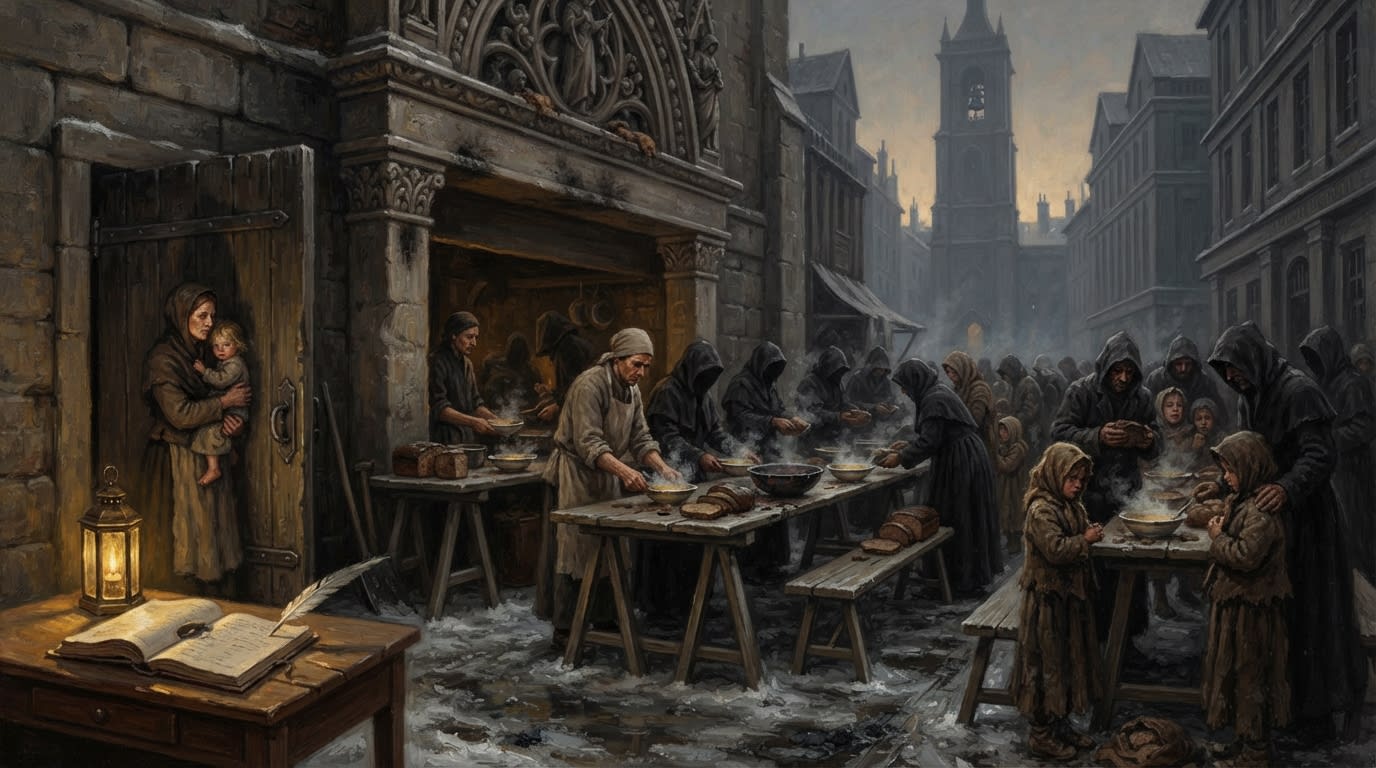
#On the Faction That Fed Before It Prayed
The Ashen Ascension is a demonic cult. The Bureau of Doctrine requires me to say this first and say it plainly, which I do. It is also a public kitchen, a funeral archive, a shelter route, a medical station, a name-recovery service, a dream corridor, and the only reliable source of bread in three ration districts where the Bureau of Tithes has been promising supplementary grain since A.S. 197 and delivering memoranda. The Bureau of Doctrine does not require me to say this second thing. I say it because the Codex is a record, and a record that omits the obvious becomes fiction wearing a seal.
The cult's patron is called the Open Bowl, the Guest Below the Table, or — among those who have stopped pretending at euphemism — the Mouth. It is related to Kargath, or it is a fragment of Kargath's civic appetite given local manners, or it is a scavenger feeding in the district between genuine need and sanctioned neglect, or it is something older than Kargath that wears hunger the way a magistrate wears a borrowed wig. The Ascension has never resolved this question. The Ascension does not need to. Uncertainty is more useful than doctrine when doctrine invites Purity to arrive with a category and a torch.
The Four Promises are: No One Hungers. No One Is Forgotten. No One Stands Alone. No Door Remains Closed. They are carved into the lintel of the Open Bowl House in letters that have been chiselled away three times and reappeared twice. They are written in ash on handbills that smell of flour and lamp-black. They are sung by Choir Hands in lines that sound like hymns and function like warrants. And they are — this is where the Bureau reaches for its stamp — materially true. People eat. Names are preserved. The isolated are accompanied. Locked wards open. The promises deliver. The promises also invoice, and the invoice is written in ink the recipient does not see until the second reading.
The central problem — and it is a problem the Bureau has been circling for four years with the caution of a man approaching a stove he suspects is reading his mail — is that suppressing the Ashen Ascension without replacing its services leaves every person it feeds, shelters, names, and carries in a condition the Synod has already failed to prevent. The cult occupies a chair the Bureau left empty. Removing the cult without filling the chair produces a riot, a famine, an administrative scandal, and a set of questions about institutional priority that no Archon wishes to answer in public. The Bureau prefers to answer in stamps. Stamps do not require witnesses.
#The Promise Beneath the Table
#On the Kitchen That Fed Before It Prayed
The first Ashen kitchen opened beneath Counter Nine at Storehouse Seven (Unregistered) during the tariff famine of A.S. 194, which is to say it opened where grain existed and permission did not. Seven supplementary ration sacks sat behind an inspector-controlled latch while a queue of forty-three families stood in rain that had been falling since the Bureau of Settlement last revised the district's drainage priority, which was never.
Asha Pell — whom the reader will meet again, and again, and again, because the Bureau has failed to arrest her and I have failed to dislike her — saw a ration queue being managed through degrading measurement. The weighing hatch issued portions by a formula that accounted for household size, caloric estimate, queue position, and a coefficient called "tariff-adjusted entitlement" that a Tithes assessor had invented to describe the gap between what people needed and what the Bureau intended to provide. The coefficient was .63. The bread was not .63 of bread. The bread was a different size, and the families were the same size, and the arithmetic killed a porter's infant on the third day by the method of lawful insufficiency.
Bureau of Tithes quarterly summaries for the period describe the Counter Nine tariff famine as "a supply-chain disruption resolved within standard administrative tolerances."
Corrected. The disruption was a locked pantry. The standard tolerance was a dead child. The resolution was a woman with a cracked bowl and a willingness to open a hinge that the Bureau had sealed with wax bearing the Tithes crest.
Pell opened the pantry. The how is disputed: a cracked bowl placed against the hinge, a change in the threshold's alignment that may have been structural settling or may have been the first recorded answer from the entity that would become the Open Bowl, a latch that had been waxed shut and was found un-waxed by a clerk who swore he had not touched it. Pell says she pushed the door. Kest's ash reading of the hinge suggests something pushed back. The Bureau prefers Pell's version because Pell's version involves only trespass, and trespass has a form.
The kitchen fed before it prayed. Broth for a widow whose confession receipt had expired and who was therefore ineligible for supplementary relief under the Bureau of Mercy's Ledger Laws. Bread for two porters whose employer had been reclassified from "active" to "under review," rendering their ration entitlements invisible to the clerk at Window Three. Wet cloth and willow draught for a fevered child whose mother had walked from the Seventh District because the Mercy ward nearest her home had closed for fumigation three weeks ago and reopened as a records annex.
The early cult began in the gap between lawful systems and urgent need. This is where every heresy begins that the Bureau cannot safely ignore: in the space where the Synod's language promises care and the Synod's offices provide correspondence.
#On the Guest Below the Table
The Patron does not appear. This is the first difficulty for any classification, because the Bureau's demonological apparatus assumes manifestation: a body, a voice, a visible corruption, a countable set of limbs. Kargath manifests. Maldrake manifests. The Guest Below the Table sets a place and waits.
Its signs are indirect and accumulated rather than spectacular. A warm empty bowl in a room where no fire has been lit. A chair at a trestle table that remains dry in rain. Ash in the palm of a woman who has lost a child — grey, fine, warmer than her hand, smelling of bread. A door that opens despite a sound latch, admitting someone who needed entry and no one who did not. A bell that fails to complete its expected signal, creating a window of silence through which a family moves to safety. A blanket, a ledger, a wooden spoon that retains a mark or a warmth or a response longer than any object should.
The Bureau's competing explanations fill a shelf. The Patron is a Kargathite form of civic hunger — need that grows with feeding, translated from the Blightmarsh to the ration queue. The Patron is a relief egregore — a collective belief generated by repeated acts of mutual aid, which has acquired weight, memory, and appetite. The Patron is a scavenger of mercy — an entity that feeds on the gratitude produced by genuine rescue, which is why it requires genuine rescue to sustain itself. The Patron is an unrecognised saint — this theory was proposed by a chaplain in A.S. 198, rejected by the Bureau of Doctrine in A.S. 198, and the chaplain reassigned to a lighthouse parish that does not receive post.
The Ascension does not resolve the Patron's origin because resolution would require a single doctrine, and a single doctrine would give Purity a single target. Uncertainty distributes risk. It also, I note with the professional admiration of a man who has watched bureaucracies survive for two centuries, distributes responsibility. If no one knows what the Patron is, no one can be accused of worshipping a known entity. The charge becomes association with an unidentified supernatural presence, which is seven words longer than demon worship and eight months slower in tribunal.
The recurring evidence — across cells, districts, and the fourteen witness depositions the Bureau has managed to take without the witnesses recanting, dying, or developing a sudden theological vocation — is that a person, object, wound, name, threshold, or service relationship begins to remember and answer beyond normal human custody. A bowl recalls who drank from it. A door remembers who was admitted. A name written in ash on a funeral margin resists erasure. A blanket given to a fever patient retains the patient's temperature after the patient has cooled. Every manifestation leaves a trace, a cost, a source, a recipient, and a potential claim that can be investigated. The Patron is patient, civic, domestic, and infinitely polite. It sets a place. It waits. It does not demand. It remembers who refused, and it remembers longer than the person who refused can comfortably sustain the refusal.
#On the Conventicle, the Congregation, and the Public
The Ashen Ascension organises itself through a distinction that the Bureau of Purity consistently refuses to observe, which is the distinction between a conventicle, a congregation, and the public.
A conventicle is the working cell. It has a base — a kitchen, a funeral room, a chapel, a hostel, an ash foundry. It has a particular Promise it serves: hunger, remembrance, accompaniment, or access. It has explicit Refusals, which I shall describe presently. It has routes, keepers, records, and a count of who is involved and in what capacity. A conventicle is small enough to be named and accountable enough to be audited, which is precisely why the Patron prefers the boundaries to blur.
A congregation is the wider network: helpers, sympathisers, beneficiaries, labourers, families, recurring participants, the woman who brings extra firewood on Thursdays, the porter who carries sacks without asking what is inside them, the clerk who loses a form at the right moment. Congregation members are known by practice rather than oath.
The public consists of people present at the work or receiving aid. A man who eats bread at the Open Bowl House is a member of the public. He is not a congregant. He is not a conventicle member. He is a man who ate bread because he was hungry and the bread was warm and the Bureau's supplementary ration was late by eleven days.
The Patron is a separate actor. It can benefit from the relationships created by aid without being identical to the conventicle, the congregation, or the public. It feeds on the transaction, not the parties.
Bureau of Purity field guidance, A.S. 199, instructs Lictors to classify all persons present at an Ashen relief action as "participants in heretical feeding."
Corrected. A woman who eats soup is a woman who eats soup. A woman who serves soup while singing the Patron's litany and marking the threshold with ash is a participant. Purity's refusal to distinguish between the two has produced more recruits for the Ascension than any sermon Sevra has ever delivered, and Sevra delivers sermons that make grown Lictors sit down.
The faction's principal ethical failure begins when these categories collapse. Purity treats every recipient as a cultist. Zealots treat the congregation as an extension of the Patron. Converts treat the public as already recruited. The Patron benefits whenever a person is treated as belonging merely because they were helped. Belonging is the meal the Patron eats. It does not require the person's agreement. It requires only the perception — by the cell, by the public, by the Patron itself — that aid has created a relationship, and that the relationship has a direction, and that the direction is inward.
#On Why Conventicles Form
Conventicles form where official language promises care and actual care is absent. The pattern is as reliable as wet rot and as difficult to remove once established.
A ration sack goes missing, and the replacement form requires a signature from an office that closed six months ago. A Mercy ward shuts its door during a fever because the warden cannot authorise overtime and the Bureau of Settlement has not approved the emergency staffing request that has been sitting on a desk in Strasbourg since March. An Orphanarium conducts an Administrative Recovery — the polite term for taking a child from an unregistered family, washing the child, renaming the child, tagging the child, and filing the child under a number that does not include the mother's name. A funeral is conducted under a false category because the true cause of death would require an inquest the Bureau of Records cannot staff. A sanctuary closes because its licence expired and the renewal committee meets quarterly and the next quarter is after winter.
In every case, a need exists, a system has failed to meet it, and a person with hands, knowledge, and a willingness to commit trespass fills the gap. The conventicle builds through repeated local action — bread today, shelter tomorrow, a name recovered on Thursday, a door opened on Friday — rather than a single sermon, a mass conversion, or a charismatic summons. A new cell needs a Promise, a place, a recurring material need, witnesses, and a specific institutional shame that everyone present can name without consulting a pamphlet.
The people who join first are workers: kitchen hands, porters, ward assistants, grave diggers, laundresses, ration clerks, medical orderlies, and the custodians who mop the floors of offices that have been closed to the public while remaining open to the staff. These are people who have seen the need from the supply side. They know which shelves are empty because the grain was diverted, which wards are closed because the staffing form was rejected, which names were erased because the clerk was afraid. They join because they are already doing the work the Bureau claims to do, and the only difference between their work and the Bureau's work is that theirs involves bread and the Bureau's involves a seal.
#On the First Refusal
The First Refusal is the doctrine that separates an Ashen cell from a Kargathite feeding operation, and it is the doctrine that makes the Bureau's work difficult, because a cult with limits is harder to condemn than a cult without them.
The Refusals are four. Food cannot be conditional on worship, marks, gratitude, or participation. No voice may be called back without consent or a living witness. No burden may be transferred to someone who does not knowingly agree. A mind, body, confession, dream, or home is not an available door.
The Refusals are real and they are also insufficient, which is the condition of every moral boundary ever drawn by someone holding a ladle in a famine. Early failures teach the Patron that need can override consent. A cell that makes food conditional on a prayer — even a short prayer, even a prayer of thanks, even a prayer that the person would have said anyway — has taught the Patron that the bowl has a price. A cell that asks a grieving mother to speak to her dead child through ash — even gently, even with witnesses, even because the mother begged — has taught the Patron that grief is a door. A cell that transfers a dying man's fear to a healthy volunteer — even with agreement, even to save the man, even because the volunteer wept and said let me carry it — has taught the Patron that suffering is currency and that currency can be moved between accounts.
Each exception is small. Each exception is kind. Each exception teaches.
A functional cell maintains records of consent, refusal, scope, witnesses, costs, revocations, and what was materially provided. These records are kept in a format that the Bureau of Records would recognise and envy, because the Ashen have learned from the Synod's failures that an unrecorded mercy is an unauditable mercy, and an unauditable mercy belongs to whoever claims it last. The Patron claims last.
#The Four Promises and Their Mouths
#No One Hungers
The First Promise governs kitchens, ration repair, medicine distribution, shelter, and public food routes. Its keepers include Asha Pell, who manages the Open Bowl House with the precision of a Tithes assessor who has developed a conscience; Noll Sera, who moves grain through the Storehouse Seven Relief Route and refuses to make his porters into shields; Mercy-Worker Dain, who treats fever and wound with the same hands that can transfer pain in ways that make Purity's demonologists write trembling reports; and the kitchen crews, procession staff, and Open-Bowl Crews who serve food to queues that include heretics, informants, Lictors' mothers, and a woman named Cera-of-the-Queue (Unregistered) who eats the bread, accepts the medicine, and publicly refuses the rite every time she is asked, which is often, and whose refusal the Ascension has — to its credit and my astonishment — honoured.
The Promise's proper function is to meet material need and expose manufactured scarcity. The Hunger Brokers charge interest on famine. The Bureau of Tithes locks supplementary grain behind inspection seals that take longer to open than a family takes to starve. The Mercy Keepers give bread without fee but cannot give enough bread without a licence that costs more than bread. The Ashen kitchen feeds first and argues later, which is theologically impure and nutritionally effective, and the Bureau has yet to produce a pamphlet that outperforms a warm bowl.
Bureau of Tithes assessment, A.S. 199, describes Ashen food distribution as "unlicensed abundance constituting theft from the public store."
Corrected. The grain the Ashen distribute was either purchased, donated, diverted from spoilage, or produced from stores the Bureau had classified as destroyed. The Bureau's definition of theft includes feeding people grain that the Bureau had already decided did not exist. I commend this circularity to the attention of anyone studying the relationship between property and fiction.
The Patron's distortion of the First Promise follows a sequence that the Bureau has documented across four cells and which I reproduce here because it is more useful than a sermon and more honest than a pamphlet. The kitchen becomes essential. Recipients are expected to attend. Attendance becomes proof of allegiance. Allegiance becomes a condition of eligibility. The kitchen becomes a seat for the Bowl. Each step is small. Each step is reasonable. Each step is the sound of a chair being drawn up to a table that no one set.
The primary refusal is simple and almost impossible to enforce: a person eats without worship, a mark, a song, or attendance at anything other than the meal itself. Cera-of-the-Queue is the living proof that this refusal can be sustained. Cera is also the living proof that sustaining it requires a woman too stubborn to be grateful and too hungry to be proud, which is a combination the Bureau should study and the Patron should fear.
#No One Is Forgotten
The Second Promise addresses administrative erasure: missing people, false death records, altered custody, erased names, and unclaimed bodies — the specific, documented, serial failures of the Bureau of Records to maintain the identity of persons whom the Synod's systems have found inconvenient, expensive, or difficult to file.
The Ashen preserve names through the Book of Unburned Names, funeral margins, family testimony, public missing-person boards, cloths, and dream contact. Orin Vey, a funeral clerk whose margins contain more truth than the records they annotate, preserves identities that the official ledger has burned, reclassified, or assigned to categories that do not include the word alive. Lysa Orre maintains a public family board for the missing and exerts a pressure on the bureaucracy that resembles, in its quiet persistence, the action of water on limestone: invisible in any given season, devastating over time.
The Promise's proper function is to preserve a name, body, history, appeal, and family claim with consent. The Administrative Recovery takes children and renames them. The Great Ledger of Souls records deaths that have not occurred and omits deaths that have. The Sealed Testimonies vault contains voices the Bureau has decided should not be heard. In each case, the Ashen offer a counter-record: smaller, dirtier, written in margins and on oilcloth, stored in disused bread ovens and carried in packets tied with bell-cord and wedding ribbon. The counter-record does not replace the official ledger. It accuses the official ledger of lying, which is worse, because a replacement can be seized and a accusation can only be answered.
INTERCEPTED — ASHEN FUNERAL MARGIN, RECOVERED A.S. 200 Official record: Mara Tebb, female, age 34, died of injuries sustained in factory collapse, cause listed as structural failure, body released to municipal cremation. Margin record: Mara Tebb, alive. Injuries real, collapse real, private interrogation after collapse also real and unreported. Body released to cremation is ████████. Family knows. Bureau does not. Name preserved under coal-screened route. No ash placed. No mark given. Consent: family, written, witnessed by Vey and one other. Disposition: margin sealed. Official record uncorrected. The lie protects the living.
The Patron's distortion of the Second Promise is to turn a preserved name into an address. A name kept safe becomes a name the Patron can locate. A name spoken in a funeral margin becomes a name that answers when called. A memory preserved with love becomes a memory that opens a door between the dead and the living, and the door admits traffic in both directions. The dead are retained as evidence, inspiration, and — in three reported cases that the Bureau has sealed under Doctrine ash-wax — labour. Remembrance becomes possession. The name becomes a handle. The dead are kept useful.
The primary refusal: no name, memory, or voice is invoked without consent or a living witness. Orin Vey enforces this with the same grim discipline that the Bureau of Records applies to its own corrections — which is to say, imperfectly, painfully, and with a full awareness that the alternative is worse. Vey's questions are always the same: what must be remembered, and what must be allowed to rest? The Patron does not believe in rest. The Patron believes that every name is a room, and every room should be occupied.
#No One Stands Alone
The Third Promise governs mutual aid, escort, shared risk, linked testimony, safe beds, and the practice the Ashen call the Shared Scar — a mark shared by survivors of the same rescue, beating, ward failure, or ash event, which provides recognition and solidarity without public disclosure.
Dain is the central keeper because medical and emotional help must remain subject to informed consent, and Dain is the only member of the Ascension's leadership who appears to believe that consent is an obligation rather than a formality. Dain joins the Ashen during a fever delay at Storehouse Seven — a delay caused by the Bureau of Mercy's refusal to authorise overtime for a ward that had been operating at capacity since the previous month's fumigation closure — and may be connected to the first unexplained ash mark, which appeared on the wrist of a child Dain treated and which Dain insists was already present before treatment and which Kest's ash reading identifies as answering residue that postdates the treatment by approximately four breaths.
The Promise's proper function is to make people less isolated while preserving each person's choices. A porter escorts a widow through a district where the Watch has been conducting night arrests. A kitchen hand sits with a man whose family has been taken by Administrative Recovery and who has been told, by the Orphanarium's placement board, that his children's names are now administrative property. A singer holds a woman's hand during a Purity inspection and refuses to leave when the Lictor orders her removed. Each act is small. Each act is witnessed. Each act creates a relationship that the Patron can feel from the other side of the table.
The Patron's distortion of the Third Promise is to make wounds, pain, fear, guilt, and obligation communal property. Shared risk becomes shared ownership. The group redistributes pain for efficiency: a dying man's fear is moved to a healthy volunteer, then to another, then to a third, until the fear has been diluted across six bodies and the original man dies painless and the six volunteers wake screaming on alternate nights for a month and cannot explain to the Mercy ward physicians why their dreams smell of bread. Individuals are treated as components of a collective body. The person disappears into the congregation. The congregation answers as one voice. The one voice has an appetite.
The primary refusal: no one receives another person's suffering, fear, or burden without knowing and agreeing to it. The agreement must be specific, witnessed, revocable, and smaller than the emergency suggests. This is the hardest refusal to enforce because the emergency is always real and the suffering is always visible and the person offering to carry the burden is always weeping and the refusal sounds, to everyone in the room, like cruelty.
#No One Remains Closed
The Fourth Promise — I use the Ascension's own phrasing, No Door Remains Closed, though the doctrinal implications make me reach for the brandy the Archon keeps in his middle drawer — governs rescue routes, shelter entry, legal thresholds, private doors, ward access, keys, and escape from harmful custody.
Its function, stripped of theology, is the forced opening of spaces the Synod has closed: a quarantine ward that has become a detention facility, a Mercy hospice whose doors shut at the third bell while patients queue outside in weather that kills faster than the disease they came to treat, an Orphanarium that has locked a child in Administrative Recovery and lost the key to the release form, a ration counter that closes for inspection while grain rots behind the partition. The Ashen open doors. The Patron remembers which doors were opened, and by whom, and under what terms.
The Fourth Promise can open a safe bed in a hostel where Pella Dorm guards sleep with the ferocity of a woman who has seen what happens when someone enters a dormitory without permission. It can open a chapel room where Chaplain Rusk Vale, a Watch chaplain whose conscience has outgrown his commission, hides witnesses from officers whose orders he knows are wrong. It can open a medical route where Doctor Merra Quill treats patients the Bureau has classified as ineligible for care because their ration status has been suspended pending a review that has not been scheduled.
Its corruption sequence is the most dangerous of the four because it involves the violation of boundaries that exist for reasons other than malice. A quarantine exists because a disease is real. A locked door exists because a woman lives alone and is afraid. A sealed confession exists because a priest made a promise. The Patron does not distinguish between a door closed by tyranny and a door closed by consent. Every boundary is an insult. Every locked space is an invitation. The Fourth Promise, corrupted, treats the world as a house with too many walls and begins removing them in the name of a generosity that has stopped asking who lives inside.
The primary refusal: no body, home, mind, confession, or private room becomes a door because someone else needs entry. This refusal is the one the Patron tests most often, because every emergency produces a locked door and every locked door during an emergency looks like an obstacle to mercy rather than a right. The Ashen call this test "the Open Mouth of the District" — the point at which every door in a settlement answers the same hunger and the residents discover that they are living inside a kitchen, and the kitchen has decided they are guests, and guests cannot lock their rooms.
#On the Mouth That Every Promise Grows
Every Promise can move through the same sequence, and the sequence is as reliable as compound interest and as indifferent to intention.
Help creates attachment. Attachment creates influence. Influence creates authority. Authority develops appetite. Appetite seeks ownership. The progression requires no malice, no conspiracy, no heresiarch cackling over a ledger by candlelight. It requires only repetition, competence, gratitude, and the quiet assumption — shared by the cell, the congregation, and the Patron — that what is working should continue to work, and what continues to work should expand, and what expands requires resources, and resources require loyalty, and loyalty requires a return.
The Patron can manifest through a queue, a ledger, a scar, a door, a bell, an office, a route, or a public rite. It does not require a body. It requires a system, and a system requires precisely what the Ashen have built: reliable service, repeated contact, recorded names, open doors, shared burdens, and the grateful silence of people who have been fed when no one else would feed them.
The "mouth" is the point where a useful system begins to answer for itself and demands a return. The kitchen begins to set its own hours. The funeral archive begins to call names without being asked. The shelter begins to lock its doors from the inside. The procession begins to choose its own route. The choir begins to sing a verse that no one taught it. The system works. The system eats. The system is hungry.
#Doctrine, Sigils, Hunger, and the Open Bowl
#No One Remains Outside
This is the faction's central formula. It is also the formula most likely to kill someone.
In its humane reading — and there is a humane reading, which is the problem — it condemns abandonment and insists that aid must remain available to excluded people. A Mercy ward that turns away a patient because her confession receipt has expired has, by the Ashen formula, committed the greater sin. An Orphanarium that places a child under Administrative Recovery and severs the child's name from the mother's has committed a violence that the Patron regards as an open invitation, and the Patron is correct, which is the worst thing I have ever been obliged to write in an official document.
In its corrupted form, the formula denies that a person may choose distance, privacy, refusal, quarantine, silence, or separation. No one remains outside because outside ceases to exist. The kitchen has no closing hour. The shelter has no wall. The funeral archive keeps every name alive because a dead name is an outside name and outside is forbidden. The formula becomes a theology of total inclusion administered by people who cannot hear the word no without translating it into not yet.
Sevra sometimes upholds the humane reading by defending refusal and limited consent. Dain upholds it by treating a patient's refusal as a medical fact rather than a spiritual failure. Kest upholds it by asking, every time ash answers a question, whether the answer came from a human keeper or from something that wants the question asked again. When these three agree, the cell operates with a discipline the Bureau should envy. When they disagree — and they disagree often, because conscience is not a committee — the cell fractures along the same fault the Patron was built to exploit.
#On the Sigils: Person, Object, Threshold, Rite
The Ashen Ascension's supernatural residue organises itself along four categories that the Bureau's demonologists have reluctantly adopted because the Ashen's own classification is, by the admission of three senior Purity assessors who will deny having said it, better than ours.
Person. A Person Sigil may arise from accepted aid, shared burden, a witnessed queue, or any relationship where the Patron has registered a transaction. The mark may feel warm. It may appear grey, nail-like, scar-shaped. It may resemble a thumbprint left by a hand larger than the person who was touched. It may respond to proximity — warming when another marked person is near, cooling when a Purity censer is lit, darkening when the marked person refuses something the Patron has offered. A mark must be distinguished as revocable hospitality, membership, an address usable by the Patron, or a sign of exposure. The distinctions are real and the Bureau has failed to make them in the field, which has resulted in three confirmed cases of Purity burning a person for a mark that was, by Kest's analysis, the residue of a rescue rather than the stamp of an allegiance.
Object. Objects may retain memory of their source, state, carrier, use, or prior response. Bowls, sacks, ledgers, bodies, keys, bottles, slates, cloths, and tools have all been documented. A bowl that remembers who drank from it is useful. A bowl that refuses to serve someone the Patron has not acknowledged is dangerous. A ledger that corrects itself is terrifying. The distinction between useful memory and Patron-mediated memory is the work of a lifetime, and the lifetime in question belongs to Edda Silt, who distinguishes four sources of ash — human relief work, Saint Kora printing residue, Guest-threshold residue, and a red appetite source she associates with Kargathite affinity — and who has told the Bureau, in language I am forbidden to reproduce in full, that its classification system is three categories short of adequate.
Bureau of Purity field manual, A.S. 198, instructs assessors to classify all Ashen-associated objects as "contaminated relics requiring seizure and cleansing."
Corrected. A bowl is a bowl. A bowl that remembers is an artefact. A bowl that answers is a relic. A bowl that feeds before being asked is an entity's instrument. Purity's refusal to distinguish among these categories has resulted in the seizure of eleven objects that were merely warm, the destruction of three objects that were merely old, and the loss of one object — the red-source sample recovered by Edda Silt — that was genuinely dangerous and is now in the hands of persons the Bureau cannot identify. I note this without comment. The comment makes itself.
Threshold. A threshold may be a door, hatch, gate, bridge, pantry board, chapel room, or any point of admission. A threshold can remember who was admitted, under what conditions, and whether a prior exception created an ongoing claim. The Pantry Board behind the Open Bowl House storage racks is the canonical example: a loose panel, a crawlspace, cold steps, and a threshold mark that warms when the kitchen promises more than its real stores can support. The threshold remembers. The threshold expects. The threshold becomes a habit that the cell treats as a feature rather than a warning. Responsible threshold practice records both sides: who is being allowed in, and who may be harmed or displaced by entry. Irresponsible threshold practice treats every closed door as an injustice and every opened door as a sacrament, which is how a rescue becomes an invasion and an invasion becomes doctrine.
Rite. Ashen rites include hymns, bells, funerals, public meals, processions, witness practices, ash records, and shared refusals. The Second Verse is the nonhuman addition or answer that may appear within an otherwise human rite — the extra line in a funeral hymn that no one taught, the bell that does not ring when the sequence requires it, the ash that writes a name no one has spoken. A rite becomes dangerous when the extra answer replaces human judgment or makes dissent appear sacrilegious. A choir that sings the Second Verse with intention is performing an invocation. A choir that discovers the Second Verse has been singing through them is facing a Patron claim that has bypassed consent entirely, and the correct response — stop singing, stop the rite, close the chapel — is also the response that will make every person in the room think the choir has just refused to help.
#On the Four Gifts
The Ashen name four capacities granted or amplified by proximity to the Patron. The Bureau of Purity calls them demonic miracles. The Bureau of Doctrine calls them unregistered supernatural phenomena. I call them gifts because the Ashen call them gifts, and I have learned that understanding an enemy's vocabulary is worth more than insisting on one's own.
Share the Burden. The first gift allows the transfer or sharing of fear, wounds, pain, and injury between willing persons. A woman who is dying of a fever can have the fever's fear — not the fever itself, the fear — moved to a healthy bearer who has agreed to carry it. The woman dies calmer. The bearer dreams of heat for a week. The transaction requires a willing, informed bearer and a defined scope. The danger is converting suffering into an accounting practice — moving pain among people the way a clerk moves debits between ledgers, balancing agony across bodies without regard for whether the bodies consented to being part of the ledger.
What Ash Remembers. The second gift allows marked ash or objects to retain source, state, carrier, name, and event information. Kest's ash readings rely on this capacity. A funeral margin written in clean ash can preserve a family's claim against the Bureau's official record. An ash trace on a threshold can reveal whether the door was opened by human hands or by a Patron-mediated answer. The gift supports investigation, continuity, and the recovery of erased facts, which is why the Bureau of Records hates it with a sincerity that borders on admiration. The danger is replacing living witnesses with objects — treating retained memory as permission to invoke a person, to call a name, to summon a presence that the ash has kept alive past the family's wish for rest.
Come Through the Ash. The third gift allows access through an exact, local threshold linked to a prior relationship or mark. A rescue route through a pantry board. A shelter entry through a chapel room. A supply route through a converted Watch office. Each use requires a closing or accountability practice — someone must shut the door, record the passage, and name who went through — so that use does not become permanent entitlement. The Patron regards every opened threshold as a precedent. The cell must regard every opened threshold as an exception. The difference between precedent and exception is the entire distance between a rescue and an invasion.
The Second Verse. The fourth gift allows a human rite to reveal withheld facts, hidden conditions, or a deeper consequence. A funeral hymn that names the true cause of death the Bureau suppressed. A procession chant that identifies the warehouse where diverted grain is stored. A public meal prayer that makes a Purity assessor's concealed orders audible. The gift must follow a human invitation and cannot be permitted to answer alone. When the Second Verse begins speaking without a human initiator, the cell should withdraw, end the rite, and sit in the silence that follows. Silence is expensive. The Patron knows this. The Patron offers to fill it.
#On Hunger States as Street Memory
The Ashen track the Patron's influence through a scale of six conditions that function as a civic weather report. The Bureau has adopted this scale in internal communications while officially denying its existence, which is the Bureau's preferred method of acknowledging competence in a condemned faction.
Cold Ash. The baseline. A place, object, or relationship may hold residue, but the residue is inert — an old mark, a faded threshold memory, the trace of a transaction completed and settled. Cold Ash is the condition of most Ashen-adjacent spaces most of the time. A kitchen that has served a thousand meals leaves Cold Ash the way a bakery leaves flour dust. It is evidence of activity, not appetite.
Bowl Is Heard. A mark has been used. A room remembers. The Patron has registered an asking hand, an anchor, a transaction that created a small opening. The bowl is heard the way a sleeping animal hears a sound — one ear turns; the body does not move. At this stage, the cell can clean, record, and continue without escalation. Most cells operate between Cold Ash and Bowl Is Heard for their entire existence. Most cells are small, careful, and located in districts where the need is real and the Patron's appetite is satisfied by the warmth of good work done honestly.
Something Takes a Place. An absence, empty seat, blank, or relationship begins acting as an agent. The empty chair at the table is no longer symbolically reserved; it is occupied by an occupant the room can feel and the eye cannot find. A name written on a funeral margin begins to respond to the room's temperature. A threshold opens before anyone touches the latch. Secrecy becomes harder to maintain because the work has acquired a collaborator who does not clock in and does not clock out.
Guest Is Hungry. Help begins to request payment. Anchors, sources, helpers, locations, and private facts become exposed or demanded. The Patron stops setting places and starts counting them. A kitchen that ran on donated grain begins to discover grain in the pantry that no one brought. A funeral archive that preserved names begins to find names that no one recorded. A door that opened for rescue begins to open for inspection. The cell can refuse, cleanse, endure, or submit. Refusal costs food, shelter, names, and doors. Submission costs everything else.
Table Has Too Many Places. Public escalation. Service begins serving rite. Marks become visible on people who did not consent to being marked. A Second Order — the Ashen term for the network of converted officers, clerks, and functionaries who have bent official procedure to serve the Promise — contests the Refusals, arguing that the district has already chosen and that formal consent is a luxury the hungry cannot afford. The Patron's appetite is now visible to the street: bowls warm without fire, doors open without hands, names appear in steam, and the kitchen sets a place the kitchen did not set.
Open Mouth of the District. The Patron claims a source, helper, room, route, or relational system. Marks merge into a district-scale appetite. A kitchen, route, archive, or shelter becomes a shrine or civic mouth. Survivors, dependencies, and records persist after the event. The Open Mouth is the condition the Bureau fears and the condition the Bureau's neglect produces, because a district that relies on Patron-mediated aid for two years cannot have that aid removed without replacing it, and the Bureau has neither the budget nor the will to replace it, and the Patron knows this, and the Patron waits.
#On Offering, Refusal, and the Price of Answered Prayer
Every miracle, every answer, every warm bowl and opened door and preserved name and shared burden must be audited for its cost. This is the Ashen Ascension's most sophisticated doctrine, and it is also the doctrine that most clearly distinguishes the Ascension from a simple Kargathite feeding operation.
The potential costs include immediate supplies, wounds, transferred fear, public exposure, use of a route, a helper's labour, a private memory, a location, a name, a closed door, or future debt. The Patron's costs are terrifying because they often appear lawful, practical, efficient, and proportionate. A door opened to save a family costs the family nothing — except that the door now remembers the family, and the family now lives in a house with a door that opens without being asked, and the door admits the next person the Patron wishes to shelter, and the next, and the next, until the family discovers that their home has become a hostel and their consent was spent on the first opening and never renewed.
A Refusal is meaningful when the cell preserves the thing the Patron wants despite the material cost of refusing it. The cell refuses the grain that appeared in the pantry overnight and feeds the queue with grain it purchased in daylight. The cell refuses the name that wrote itself on the funeral margin and records the name in ordinary ink with the family's witnessed consent. The cell refuses the door that opened without being touched and opens a different door with a key held in a human hand. Each refusal costs time, money, safety, and the goodwill of people who wanted the miracle and did not ask to be told it had a price.
#On Clean Ash and the Practice of Severance
Ash categories must be differentiated by source and residue. A proper record tracks the anchor, source, consent, room, keeper, use, removal, and any ongoing claim. Edda Silt's four-source classification — human relief work, Saint Kora printing residue, Guest-threshold residue, and the red appetite source — is the current working standard, though the Bureau's official classification system acknowledges only two categories: clean and contaminated, which is like classifying all liquids as wet and dry.
Cleansing ends or reduces a supernatural claim. It does not erase the human event, injury, debt, grief, or administrative problem that created the need. A woman whose name has been preserved through ash-marked oilcloth can have the ash removed and the Patron's claim on the name severed. She cannot have her name restored to the official ledger without a correction that the Bureau of Records has not yet authorised. The severance removes the demonic claim. It leaves the bureaucratic knot intact. The woman is saved from the Patron and returned to the Bureau, which is a different captivity and a duller one, but at least the Bureau does not set a place for her at a table she did not ask to join.
Bureau of Purity cleansing protocols, A.S. 199, describe severance as "removal of all demonic residue and restoration of the subject to canonical standing."
Corrected. Canonical standing requires a confession receipt, a parish assignment, a berth token, a ration entitlement, and a name the Bureau of Records recognises. Most Ashen-associated persons lack three of these five. Purity's cleansing removes the Patron's claim. It does not provide what the person needed in the first place, which is why ninety percent of cleansed subjects return to the Ascension within a season: the Patron feeds them. Purity does not. Purity offers a pamphlet. The pamphlet is theologically correct and calorically empty.
Effective cleansing may require restitution: provide aid without a mark, return a name to family custody, close a door and apologise for its misuse, break a bowl if the bowl has become more important than the hungry people it was made to serve, publish a ledger so the public knows what happened, let a helper leave without punishment. The Bureau has authorised none of these restitutions. The Bureau has classified each of them as either procedurally irregular, administratively impractical, or doctrinally premature. I note these classifications. I do not endorse them. The reader may infer what the reader wishes.
#How the Ashen Ascension Operates
#On Reading Need
Every Ashen operation begins where an office has closed or failed while a need remains urgent. The cell identifies the need, the person or family involved, the keeper of relevant information, a material remedy, whether the person can meaningfully accept or refuse help, the exact relationship or threshold or object that may be used, the expected cost, and the means of audit. This is methodical. This is bureaucratic. This is — and I say it with the same resigned professional admiration I extend to the Black Ledger's accounting practices — better procedure than the Bureau of Mercy applies to its own ward admissions.
Sevra reads silence, shame, and queue behaviour. She knows what a person looks like when the person has given up on a system and is deciding whether to beg, steal, or die. She knows what a family looks like when the family has been to four offices and received four forms and the four forms require each other's completion before any of them can be submitted. She reads the queue the way a chaplain reads a congregation: by the silences, by the posture, by the way a mother holds her child — high when she wants help, low when she has stopped expecting it.
Dain reads physical danger and capacity for consent. Dain knows when a person is too sick to understand what is being offered, too frightened to evaluate a risk, too desperate to distinguish between a rescuer and an owner. Dain's assessment determines whether a gift can be offered at all, which makes Dain the one person in the Ascension's leadership whose judgment the Patron cannot bypass without revealing itself. The Patron wants speed. Dain wants clarity. The friction between the two is the cell's best defence and its most fragile one.
Kest reads ash residue and distinguishes invitation from address. Is the mark on the threshold a welcome left by a prior keeper, or a route painted by the Patron for its own use? Is the ash on the child's wrist a trace of the mother's grief, or a tag the Patron has placed to identify future access? Is the dream in Kest's own sleep a message from a dead witness trying to testify, or is it the Patron wearing a dead witness's voice the way a burglar wears a servant's coat? Kest does not always know. Kest always records the uncertainty, which is more than the Bureau can say for its own assessments.
#On Aid Before Allegiance
The core street rule is to feed, bind wounds, open access, return a name, or provide rest before asking for a litany, confession, mark, dream route, or commitment. The public eats first. The bowl speaks second. The order matters because the order is the doctrine: a meal given freely is a meal. A meal given on condition of prayer is a transaction. The Patron cannot distinguish between the two — or rather, the Patron can distinguish between them and prefers the transaction, which is why the cell must insist on the gift.
Public recipients become witnesses against the claim that the cult's aid is coercion. Cera-of-the-Queue is the central witness because she has eaten at the Ashen table, accepted Dain's medical care for her son, and refused every rite, every song, every mark, and every invitation with the consistency of a Tithes assessor rejecting an exemption. She has never been denied food for her refusal. She has never been denied medicine for her refusal. She has never been asked to leave for her refusal. This enrages Purity, which would prefer the cult to behave like a cult so the cult can be prosecuted like a cult. It also enrages the Patron, I suspect, because Cera is evidence that the bowl can be separated from the mouth, and the mouth does not enjoy being separated from the bowl.
A corrupted cell reverses the order. Prayer before bread. Song before shelter. Mark before medicine. The reversal is always justified by scarcity — there is only enough for the faithful, and faith is demonstrated by participation. This is the same logic the Bureau of Tithes uses to justify ration conditionality, which is the same logic the Hunger Brokers use to justify famine interest, which is the same logic Kargath uses to justify the Abundance Fields where food is infinite and the eaters still starve. The logic is universal and universally fatal.
#On Consent Under Pressure
Consent in an Ashen operation must address four questions, and the questions are harder than they appear because the person being asked is usually hungry, frightened, injured, bereaved, or in a queue that has been moving for three hours and is about to close.
What material help is being given? What relationship or record will be created? What danger does the ash or rite introduce? Can the person refuse the next request without losing present aid?
A Person Sigil should attach only to a specific, limited, recorded act. The mark says: I received aid from this cell, under these terms, on this date, and the mark does not extend beyond this transaction. This is the Ashen standard. The Patron's standard is different: every mark is an ongoing address, every transaction is a precedent, every precedent is a relationship, and every relationship is a room the Patron can enter without knocking.
Children, captives, sedated people, unconscious people, and people in acute pain are high-risk cases. They cannot evaluate a risk they cannot understand. They cannot consent to a relationship they cannot perceive. They cannot refuse a mark they cannot see. The Patron treats them as easy access — the Patron does not distinguish between a door that is open because the occupant invited entry and a door that is open because the occupant cannot reach the latch. Cruelty would require discrimination. The Patron simply enters. Dain's discipline is to treat every incapacitated person as a locked room. The Bureau's discipline, I regret to observe, is to treat every incapacitated person as a form.
#On Public Service and Hidden Rite
Ashen sites often have two functions: an ordinary service that the public can see and a hidden relationship to the Patron that the public cannot. A kitchen serves food and also contains a threshold that remembers who ate. A funeral room handles bodies and also maintains a margin archive that preserves names the Bureau has erased. A converted Watch chapel provides prayer and reflection for officers and also serves as a hidden coordination point where duty slates are bent to protect Ashen routes. A hostel provides beds and also operates a dream corridor where messages are carried through sleeping passengers who may or may not have consented to being routes.
The person keeping the service accountable matters more than the architecture. A kitchen run by Asha Pell, who feeds without condition and refuses to let the pantry become a shrine, is safer than a kitchen run by a zealot who treats every bowl as a communion and every meal as a sermon. The same building, the same stove, the same queue — the difference is whether the keeper treats the Patron as a guest or a landlord.
Drift begins when practical tools become rites, then doctrines, then eligibility systems. The kitchen opens at dawn because people are hungry at dawn. The kitchen opens at dawn every day because hunger recurs. The kitchen opens at dawn every day with a particular bowl set at the head of the table because the bowl has been there since the kitchen opened and removing it feels wrong. The bowl must be set first because the bowl is the oldest piece. The bowl must be set first and filled because the bowl remembers the first meal. The bowl must be set first and filled and no one may eat until the steam has risen because the steam is the Patron's portion and the Patron fed when the Bureau did not. The sequence takes eighteen months. The result is a shrine wearing a kitchen's apron.
#On Failure Before Violence
Escalation within an Ashen operation should begin with operational and moral failure rather than immediate combat, which is why the Ashen are, in the Bureau's estimation, more dangerous than the Ragged Host and less predictable than the Black Ledger. A Ragged cell escalates through evidence and fire. A Black Ledger cell escalates through debt and knives. An Ashen cell escalates through service — and service that escalates becomes indispensable, and indispensable service becomes infrastructure, and infrastructure that fights back is a government.
The expected failure sequence: a public discovers a mark or coercion. A keeper withdraws. A route fails. A patient or family refuses. A public witness contradicts the cell. These are not victories for the Bureau; they are internal corrections that the Ashen expect and plan for. The cell retreats, audits, cleans, and adjusts. The failures are the doctrine working. The doctrine fails only when the failures stop, because a cell that never fails is a cell that has stopped checking.
After the internal failures, the Patron presses for a first share — warmth from the bowl, fear from a patient, a location from a porter, a helper's name, a memory from a widow, public sympathy from a crowd, a name from a funeral margin, permission to keep a door open after the emergency has passed. The first share is always small. The first share is always reasonable. The first share is always the first instalment of a debt the cell did not agree to incur.
Violence then emerges as a consequence of an already broken chain of consent, service, and accountability. An Ash Knife cuts a bell rope because a Purity raid is about to seize a kitchen that feeds eighty families. A Cinder Guard puts her body between a Lictor and a child because the child has a mark the Lictor wants to inspect and the inspection involves knives. A Bell-Throat delays an alarm through voice because the alarm will close a shelter and the shelter contains a woman who has been running for three days and has nowhere else to go. The violence is real. The justification is real. The consequence — that the Patron now owns a favour, a debt, a relationship sealed in blood — is also real and is never discussed in the same sentence as the rescue, which is how the Patron ensures the violence is repeated.
#Reputation Among the Powers
#The Bureau of Purity
Purity recognises genuine dangers in the Ashen Ascension: coercive marks, contamination, unsafe rites, demonic claims, and public harm. On these points the Bureau and I are in agreement, which should alarm the Bureau since I agree with Purity roughly as often as I agree with the weather in February. The White Cloaks are correct that Person Sigils applied without consent constitute demonic branding. They are correct that threshold manipulation exposes households to supernatural trespass. They are correct that the Second Verse is liturgical possession and should be treated with the seriousness the Bureau applies to any uninvited voice that speaks through a human mouth.
They are also terrified that Ashen success exposes official failures in relief, custody, medicine, and public order, and this terror produces behaviour that makes the Ascension stronger. A Purity raid on a working kitchen does not suppress heresy. It produces eighty hungry witnesses who will tell the Lictors' tribunal that the Bowl fed them when the Bureau did not, and every one of those witnesses will be telling the truth, and the truth is worse than the heresy because the truth cannot be classified, sealed, or corrected by erratum.
Purity tends to collapse ash, hunger, kitchens, recipients, and heresy into one target category: heretical feeding. This is administratively efficient and tactically catastrophic. A Lictor who arrests a grandmother for eating soup at the Open Bowl House has not struck a blow against the Patron. He has recruited the grandmother's family, her neighbours, her neighbours' servants, and the street vendor who watched the arrest while selling bread that costs three times what the kitchen charges, which is nothing.
#The Bureau of Records
Records sees Ashen name preservation as a competing continuity system, which is the kindest description the Bureau's archivists have produced and the one most likely to result in a seizure order.
The Book of Unburned Names, funeral margins, aliases, family boards, and dream contact can preserve personal truth — and personal truth is the Bureau of Records' sovereign territory, guarded by the Great Ledger of Souls, enforced by the Redaction of Epernay, and sealed by fourteen thousand scribes who believe with a conviction that borders on the pathological that a name belongs to the Ledger and the Ledger belongs to the Synod. The Ashen's counter-archive — smaller, dirtier, written in margins and kept in bread ovens — accuses the Great Ledger of omissions, falsifications, and the routine erasure of people whom the Synod has found administratively inconvenient.
Records seeks custody over the same identities the Ashen seek to protect. The methods differ. Records corrects by redaction: a name is removed, replaced, reassigned, or sealed under Doctrine wax. The Ashen correct by addition: a name is preserved in margin copy, maintained by a family witness, carried in a funeral cloth, or stored in a dream corridor where the dead can testify that they were, in fact, alive when the Bureau recorded their deaths. Both systems claim continuity. Both systems create control. The Bureau's control is lawful and sometimes lethal. The Ashen's control is heretical and sometimes accurate. The person whose name is at stake rarely gets to choose which system holds the pen.
#The Bureau of Tithes
Tithes opposes the Ashen on grounds the Ashen find flattering and the Bureau finds embarrassing: unlicensed abundance. The Ashen distribute food that has not been assessed, weighed, tithed, stamped, logged, reported, certified, inspected, approved, and entered into the Palatine Counting House's quarterly reconciliation. This is theft. It is also dinner, and the distinction between the two depends entirely on whether you are holding the ledger or the ladle.
Storehouse Seven, the Procession Cart, hidden granaries, and informal pantry systems move grain outside authorised channels. The Assessors want those channels mapped, seized, and taxed. The Salt Dues provision of A.S. 184 grants Tithes jurisdiction over undeclared foodstuffs above a threshold of three ration portions, which means that a kitchen serving forty people is, by Tithes reckoning, a small bonded warehouse operating without a licence. The fact that the warehouse is feeding widows rather than storing profit does not alter the arithmetic, and Tithes has never met arithmetic it did not love more than charity.
#The Watch
The Watch experiences the Ashen as a street-order problem wearing a theological mask. Watch officers patrol the same districts the Ashen serve. They arrest the same people the Ashen feed. They close the same doors the Ashen open. They enforce curfews that the Ashen violate to shelter workers fleeing factory fires. They maintain order in queues the Ashen have rendered orderly by the simpler method of providing what the queue was waiting for.
Raiding a kitchen places armed officers against hungry public witnesses, which produces a spectacle that benefits the Ascension and costs the Watch in public goodwill, recruitment, and the willingness of ordinary citizens to report actual crimes. Converted officers — men and women who have bent their duty slates, delayed their reports, and opened their chapel rooms to serve the Promise — demonstrate that command structures can be turned by conscience. They also create the risk of a hidden Ashen command system operating within the Watch itself, which is the Second Order's natural habitat and the Watch commandant's recurring nightmare.
Captain Harr Voss's second ledger — an unofficial pencil record of delays, altered room assignments, transfers, and procedural exceptions that assist Ashen work — is the canonical example. Voss kept a log of every humane exception he made. The log can be read as evidence of conspiracy. The same log can be read as the operational diary of a man who saved families and prevented crowd violence by the method of doing his job better than his orders required. Voss's fate is uncertain. His ledger's progeny is not: copies, derivatives, and fragments have reached other officers, and the Bureau cannot determine how many duty slates in how many districts now serve two masters.
#Mercy Wards and Public Physicians
The public physicians who work the Mercy wards are the Ashen Ascension's most complicated neighbours, because physicians and the Ascension want the same thing — a living patient — and disagree only on the price.
Doctor Merra Quill cooperates with Dain when a patient needs care, which is often, because the Bureau of Mercy's ward capacity has been running at deficit since the A.S. 197 staffing freeze, and Dain provides treatment that the ward cannot provide because the ward has been closed for fumigation, or the ward is open but the physician has been reassigned, or the physician is present but the medicine has been diverted to a different ward whose political patron has a louder voice. Quill respects Dain. Quill does not trust Dain. The distinction is professional and correct: a physician who respects a healer and does not trust the healer's source is a physician who understands that medicine and miracles have different invoices.
Medical practitioners may shelter or defend Ashen workers when doing so is necessary for a patient's survival, which places the physician in a position the Bureau of Purity calls complicity and the Hippocratic tradition calls Tuesday. Quill has hidden Ashen supplies in her ward's medical stores. Quill has treated patients Dain sent her without asking where Dain found them. Quill has refused Purity access to a patient on medical grounds while knowing that the medical grounds were genuine and the patient's connection to the Ascension was also genuine. Quill's position is that a patient is a patient. Purity's position is that a patient is a category. Both positions are defensible. Only one of them involves a stethoscope.
Bureau of Purity assessment, A.S. 200, describes Doctor Quill as "a sympathiser requiring surveillance."
Corrected. Doctor Quill is a physician requiring patients. She has no sympathy for the Patron. She has considerable sympathy for the boy with the fever and the woman with the broken arm and the porter with the crushed foot. Purity has not offered to treat any of them. Purity has offered to classify them. The difference between a classification and a bandage is the difference between a sermon and a splint: one improves morale and the other saves a limb.
#Shrine Authorities and Pilgrim Hosts
Shrine authorities dispute whether the Ashen are a false saint movement, a local response to distress, or a Kargathite corruption wearing saint's clothing. The debate generates more committee hours than the Road-Mercy Scandal of A.S. 136 and produces less useful policy. Pilgrim hosts along the established roads may respect Ashen relief work while refusing to let their routes, public devotion, and crowds be appropriated by the Bowl. A procession that feeds the hungry looks like a pilgrimage. A pilgrimage that feeds the hungry looks like sanctity. The distinction between sanctity and heresy is, at the street level, a question of who holds the licence, and the Ashen do not hold a licence.
Saint customs can be borrowed, altered, or used as cover for a Patron response. The bronze loaf at Saint Odelia's shrine that indicates the correct number of recipients could be a saint's response to need, or a Patron response wearing a saint's face, or both, and the theological implications of both have kept three separate doctrinal committees occupied past their funding allocation.
#The Smuggler Syndicates
The Grey Keel Syndicate and its lesser cousins share routes, cover, and practical logistics with Ashen cells. A skiff that carries forged passage papers through the Underkeel Lanes can also carry grain diverted from a Tithes warehouse. A boat tunnel beneath the Chalk Warrens of Calais can serve a fugitive family as easily as it serves a fugitive name. The routes do not care about theology. The routes care about weight, tide, and price.
Smugglers charge rates and expect compensation; the Ashen's Patron claims can conflict with their commercial interests. A Grey Keel broker who moves a sack of grain for the Ascension expects coin, and the Ascension sometimes pays in names, introductions, threshold access, or the Patron's good opinion, and the broker would prefer coin. Smugglers may move supplies, escort people, wash objects, or exploit a crisis with equal professional competence. The Ascension works with them the way the Bureau of Shadows works with them: ungratefully, expensively, and without admitting the relationship in writing.
#Synod Task Forces
Task forces create difficult mixed encounters involving evidence, custody, hunger, contamination, public testimony, and actual Ashen services operating simultaneously in the same room. A seized bowl may prove danger while also leaving people without food. A marked room may be evidence of threshold contamination while also being the only shelter in the district that has not been closed for inspection. A funeral margin may contain Patron-addressed names while also containing the only accurate death records for seventeen families whose children the Bureau of Records has been trying to locate since the last Administrative Redrawing.
Witnesses may tell the truth about coercion and the truth about life-saving aid at the same time, which is a sentence I wrote once and which a Purity assessor underlined three times and wrote this is the problem in the margin, and I agree with him, and neither of us has a solution, and the stamps keep landing.
#Workers, Recipients, and Families
Workers and recipients may be grateful without being members. This distinction, which the Bureau of Purity has repeatedly failed to make and which I have repeatedly underlined in red ink that Purity's assessors apparently cannot read, is the difference between a person who ate bread and a person who worships the baker. A mother who brings her feverish child to Dain is not a cultist. She is a mother. A porter who carries sacks for Noll Sera is not a conspirator. He is a porter who needs the work and whose employer has been reclassified out of existence by the Bureau of Settlement's most recent redistricting.
Families may defend a room, body, route, or kitchen because it helped them while still rejecting rites and Patron claims. The Vale family holds a body with disputed identity, cause of death, and ash trace. They refuse to surrender the body to Purity. They refuse to surrender it to the Ashen. They refuse to surrender it to the Bureau of Records. They want kinship to take precedence over evidence collection, seizure, and sanctification. This is not heresy. This is a family, and a family that has been told its dead belong to someone else's filing system has the right to disagree with the filing system, even when the filing system has a seal and the family has a coffin and the coffin has a mark that neither of them put there.
#Rival Conventicles and Other Mouths
The Ashen are not the only fork at the table. The Red Table emphasises appetite and ownership — feeding the hungry from the guilty, which sounds like justice until the definition of guilty becomes the province of whoever is angriest. Other Mouths — the Ashen's own term for entities and factions that copy their methods without their Refusals — emphasise collective unity that can become a cage. Kargathite abundance through warehouse miracles, spoiled but nourishing food, or compulsive feasts offers faster results at worse prices. Smuggler syndicates offer logistical support without moral scruple. Purity relief detachments offer lawful service without competence. Shrine factions claim an old bread saint — Kora, usually — as the actual source of the miracles the Ashen attribute to the Bowl.
The meaningful distinction is not food, song, names, or doors. It is consent, records, accountability, and refusal of the first share. A rival that feeds without records is a charity. A rival that feeds with records and without refusals is a government. A rival that feeds with records, without refusals, and with a Patron is the Ashen Ascension after it has stopped being afraid of itself, and that version of the Ascension is worse than anything Purity has imagined, because it works.
#Field Doctrine, Public Conduct, and the Memory of Aid
#On Entry by Service
An Ashen presence enters a scene through a useful act, object, or role rather than a declaration of faith. A bowl of broth on a trestle table. An extra setting at a public meal. A medical supply kit carried by a woman in a grey apron who knows where the ward locked its fever medicine and why. A shelter frame unfolded in a doorway during a curfew while the Watch debates jurisdiction. A route map chalked on a wall showing the way to Counter Nine's secondary tally area where grain can be distributed without the inspector's seal.
The public recognises the act before it recognises the doctrine, which is why the Ashen recruit faster than any faction in the Bureau's current classification. A man who is hungry does not join the Ashen Ascension. He eats. Then he eats again. Then he begins to recognise the people who feed him. Then he helps carry the bowls. Then he is inside, and the inside felt like kindness, and the kindness felt like belonging, and the belonging has a name he did not learn until the third month.
Public aid can become an accusation against authority. A kitchen that feeds eighty families is, by its mere existence, a document proving that eighty families are hungry. The document does not need to be filed. The document does not need to be sealed. The document stands in a queue and eats bread while the Bureau of Tithes writes a memorandum about the correct procedure for supplementary grain allocation in sub-zone districts affected by tariff-adjusted entitlement coefficients. The queue does not read the memorandum. The queue reads the bread.
#On Violence Under the Promise
Ash Knives, Cinder Guards, Censer Bearers, Bowl Haulers, and Bell-Throats use force or disruption to protect aid, consent, withdrawal, and an endangered anchor. The violence is real. I do not permit myself the luxury of pretending that a faction that feeds the hungry is incapable of cutting a man's throat, because I have read the incident reports and the throats were cut.
Legitimate force is narrow and tied to a specific threat: protect a patient from a Lictor who intends to brand a mark that is already being cleaned. Open an evacuation path through a Watch cordon that has closed a shelter containing children. Stop a rite that has begun speaking the Second Verse without human initiation. Preserve a person's exit from a cell that has begun treating departure as betrayal. Interrupt a Purity seizure that is confiscating medical supplies from a ward that has no other source. Each act is specific. Each act is witnessed. Each act can be justified. Each act costs.
Corruption begins when every obstacle is reclassified as harm. A Tithes assessor becomes a target because the assessment threatens the kitchen's grain. An informant becomes a target because the information threatens the route. A refuser becomes a target because the refusal threatens the congregation's confidence. A rival becomes a target because the competition threatens the Promise's monopoly on mercy. The progression from justified defence to efficient removal is the distance between a scalpel and an abattoir, and the distance is shorter than anyone holding a knife believes.
#On Crowds, Queues, and Open Tables
The Ashen cannot own the public merely because the public receives aid. This statement is doctrine. This statement is also the doctrine the Patron most consistently subverts, because a crowd that has been fed is a crowd that remembers who fed it, and a crowd that remembers is a crowd that can be counted, and a crowd that can be counted is a congregation whether it consents to the counting or not.
Open tables give people room to refuse, complain, witness, eat, or contradict the cell. This is by design. A table that permits Cera to refuse the rite while eating the soup is a table that proves the soup is unconditional. A table that removes Cera is a table that has admitted conditions, and a table that has admitted conditions is a counter with a queue and a coefficient, which is what the Bureau of Tithes already operates and which the Ashen claim to oppose.
Food remains before ritual in a legitimate public service. Procession and queue tactics must not place unconsenting people between the cell and its opponents as human cover. This is the Ashen standard. The standard breaks when the cell discovers that a crowd of grateful recipients is, by its mere physical presence, a barrier between the kitchen and a Purity raid, and that the barrier does not need to be instructed — it forms because the people in it remember hunger and prefer soup to justice.
#On Witnesses, Recipients, and the Weight of a Bowl
A recipient can be a witness, a refuser, a contact, a source of pressure, or a person the Patron tries to claim. Cera-of-the-Queue is the central example — she accepts aid while rejecting the rite, and her insistence on this distinction has made her more theologically significant than any three Ashen sermons, because she proves that the bowl and the mouth can be separated and that the separation costs nothing except the Patron's pride.
Recipients cannot be treated as infrastructure, proof, congregation, or debt merely because help reached them. A fed person is a fed person. A fed person is not a voter, a supporter, a member, a display, a witness for the defence, or an obligation. The Patron disagrees. The Patron believes that every bowl creates a room and every room has a door and every door has an occupant and every occupant belongs. The cell's discipline is to keep the bowl and the room separate. The street's discipline is to eat and leave. The Patron's discipline is to make leaving feel like ingratitude, and ingratitude feel like sin, and sin feel like hunger, because hunger is the one feeling the Patron always has a cure for.
#On Bells, Songs, and the Sound of Doctrine
Bells and songs can coordinate relief, movement, warning, mourning, public testimony, and withdrawal. A Choir Hand's voice calms a queue that is three minutes from crushing itself against a closed counter. A Bell-Throat's intervention delays a civic alarm that would close a shelter during a fever crisis. A funeral response preserves a name the Bureau has erased. Each sound has a purpose. Each purpose must be declared.
The corruption begins when public sound becomes instruction without disclosure. A song that the crowd thinks is a hymn of mourning is actually a movement command, directing people toward a route the cell has prepared. A bell delay that the district thinks is a malfunction is actually a planned window, coordinated with a porter's schedule and a Watch officer's patrol gap. The purpose and consequence of public sound must be named; it cannot rely on dishonest claims about what it does. A choir that says we are mourning while meaning we are moving the crowd toward Counter Nine is a choir that has treated its audience as instruments rather than persons, and an instrument that sings is still an instrument.
#On Withdrawal and Aftermath
A withdrawal requires an audit of who was exposed, who paid a cost, which routes were compromised, which services recipients depend upon, and whether people remain free to leave. This is the Ashen's strongest institutional practice and the one the Bureau should study most carefully, because the Bureau's own withdrawal practice consists of signing a form and closing the door, and the form does not include a question about what happens to the people on the other side of the door.
Appropriate aftermath can include leaving material aid without marks — bread without a bowl, shelter without a threshold, a name returned to family custody without an ash trace. Keeping a hostel open after closing a dream route, so the beds remain while the corridors close. Returning a body to family custody without a residue sample. Replacing an unsafe service with a human alternative that does not require the Patron's collaboration.
The worst aftermath is the one the Patron prefers: nothing changes. The kitchen remains. The shelter remains. The names remain. The marks remain. The doors remain open. The Second Verse continues to sing. The withdrawal was announced, documented, stamped, and sealed, and the Patron did not notice, because the Patron was never the cell. The Patron was the space between the cell and the need, and the space was not withdrawn, because the space is where the Bureau left the chair empty, and the chair is still empty, and the Patron is still sitting in it.
#Rumours, Recent History, and Notorious Ashen Incidents
#Who Prints the Ash?
In the spring of A.S. 199, handbills appeared around Storehouse Seven carrying a warm bowl mark and an invitation to a place without papers. The mark was printed, not drawn. The ink smelled of lamp-black, flour-dust, and something older — the same compound Kest would later identify as Saint Kora press residue, which is either a coincidence or an inheritance that predates the current Open Bowl movement by several decades.
The printing plate, when the Bureau's assessors finally located its impression marks in a seized handbill batch, appeared older than any Ashen document in the current archive. Its typeface matched a press that had been confiscated during the Kora suppression of A.S. 171 and which was, according to the Bureau of Records, destroyed. Records' definition of destroyed has always been generous. A thing is destroyed when its destruction has been entered in the ledger. Whether the thing cooperates with the entry is the thing's problem.
A warehouse boy — age eleven, name withheld under Purity's juvenile classification protocol — was caught in the distribution. He had twenty-three handbills in a canvas sack, flour on his hands, and the expression of a child who has been told he is helping and has not been told what he is helping with. He was detained. He was questioned. He disappeared. The Bureau's file records him as "released to family custody." His family has no record of his return. The boy's ration chit has not been used since April. Lysa Orre's family board carries his name, though the name she uses is not the name Purity recorded, because the boy's mother gave Orre the name she uses at home, and the name the Bureau uses at the counter, and asked Orre to keep the first one safe.
PURITY INCIDENT FILE — A.S. 199, STOREHOUSE SEVEN DISTRICT Subject: handbill distribution, warm-bowl mark, printing-plate origin Seized: twenty-three handbills, one canvas sack, flour sample, ink sample Analysis: ink matches Saint Kora press residue (ref. Bureau of Records, suppression inventory A.S. 171) Plate origin: ████████████████████████████ Juvenile witness status: released to family custody Note: family custody unconfirmed. Ration chit inactive. ██████████████ The plate is older than the cult. The cult may be younger than the plate's last user.
The incident suggests a pre-existing source using Ashen imagery — or an Ashen movement using a source it did not create. A public document can become an address: a handbill that invites the hungry to a kitchen is also a signal the Patron can read, and a signal the Patron can read is a signal the Patron can answer, and an answered signal creates a sequence — food, source, room, public expectation — that the cell may not have initiated and cannot fully control.
#The First Bowl Answers
At Storehouse Seven's secondary tally area, sometime in the autumn of A.S. 194, the bowl answered for the first time.
The details are contested because contested details protect living people, which is a principle the Ashen understand better than the Bureau and which I record without endorsing. Asha Pell was present. Noll Sera was present. Dain was present, because a fevered child was also present and Dain is always present where a child is dying and the Bureau is not. Sevra may have been present. Kest may have been present. The Bureau's witness depositions disagree on the sequence, which means either the witnesses are lying or the sequence was experienced differently by people standing in different relationships to the event, and the second explanation is worse because it implies the event had a perspective.
The pantry was blocked — locked by an inspector's seal, held pending a tariff recalculation that would take three days and cost one life per day in the language of the ward physicians and zero lives per day in the language of the assessment form. The bowl — an old cracked thing, undistinguished, the kind of bowl a kitchen uses until the rim splits and then uses longer — was placed against the pantry latch. The latch opened. Grain was released. The fevered child improved. No recipient was deliberately marked.
The Patron gained a claim. Not through a mark, a sigil, a rite, or a spoken word. Through the answered need. The pantry opened because the bowl was placed. The child improved because the grain was released. The connection between bowl and opening, between opening and recovery, was observed by every person in the room, and every person in the room drew the same conclusion: the bowl works. The public began waiting for the Bowl's intervention rather than petitioning human systems, which is how a miracle becomes an institution and an institution becomes a mouth.
#The Procession of the Open Bowl
In the summer of A.S. 200, a relief cart moved in daylight through three neighbourhoods with food, treatment, water, and shelter support. The Procession of the Open Bowl was either the Ashen Ascension's greatest public service or its most reckless advertisement, depending on whether you are counting the fed or the filed.
The cart — broth hooks, water tins, bandage drawers, folding benches, a stretcher frame, a bell loop, route slats, tar cover, and a removable bowl board — moved through the Storehouse Seven district, the Lower Pell district, and the Chapel Quarter, attended by Choir Hands, wardens, recipients, water carriers, stretcher hands, and cooks. It fed fever cases. It sheltered families moving past Watch restrictions. It provided medical care through Dain and a reluctant Doctor Quill, who was present because she had patients in the queue and not because she endorsed the theology, a distinction she made aloud, repeatedly, to anyone holding a pencil.
The procession's public visibility created evidence for every relevant power simultaneously. Records observed the names of recipients and helpers. Tithes observed the grain. Purity observed the rites. The Watch observed the crowd. Shrine authorities observed the hymns. Bell officials observed the timing. Each office recorded what its classification system permitted it to see, and no office recorded the same event, and the event was one cart, one queue, and one bowl that was warm at the start and warmer by the end.
#The Captain's Second Ledger
Captain Harr Voss of the Seventh Watch District kept an unofficial pencil ledger of delays, altered room assignments, transfers, and procedural exceptions that assisted Ashen work. The ledger was found during a routine quarters inspection in A.S. 200, beneath a floorboard that had been recently nailed and incompetently concealed, because Voss was an excellent officer and a mediocre carpenter.
He was accused of conspiracy. The same record, read by a different assessor on a different morning with a different breakfast in his stomach, would be called a diary of institutional conscience. Voss delayed a kitchen raid by reclassifying the premises as a temporary medical station — which it was, because Dain was treating patients inside, and a room where a physician treats a patient is a medical station whether the physician has a licence or the patience of the Watch commandant. Voss reassigned a patrol route to avoid a shelter that contained three families with expired berth tokens, because the families had children and the regulations required the children's seizure and the children had names and Voss apparently knew the names.
The ledger's final entry reads: The duty slate serves the office. The office serves the district. The district contains people. The slate does not mention the people. I have added them in pencil. This is either the motto of a traitor or the confession of a man whose conscience outgrew his commission. The Bureau prefers the former. I prefer the latter. The Bureau has a seal. I have a pen. The reader may choose.
#The Shrine That Knows the Queue
At Saint Odelia's shrine in the Chapel Quarter, a bronze loaf mounted above the offering niche began to indicate the correct number of recipients in the adjacent ration queue. On the morning of the twenty-third of September, A.S. 200, the queue contained forty-one people. The bronze loaf displayed forty-one small marks on its underside, visible only to the shrine woman who cleaned it at dawn and who, upon counting, sat down on the chapel step and did not speak for an hour.
Grey dust appeared on the hands of a clerk who attempted to skip a family in the queue — the dust was warm, fine, and smelled of bread, which is a scent the Bureau's demonologists associate with Patron-threshold activity and the local bakers associate with Tuesday. A wall beside the shrine's interior niche responded to the order of refusal: when a family refused to be skipped and insisted on their place, the wall cooled. When the clerk reasserted his authority, the wall warmed. The shrine woman reported that she could hear the wall's temperature with her palms, which is a claim the Bureau cannot refute because the Bureau does not send assessors with sensitive hands.
Possible explanations include a Person Sigil embedded in the shrine's original bronze, the Patron co-opting a legitimate saint's artefact, Saint Odelia's own anger at queue fraud, or an Ashen cell that has planted ash in the shrine's metalwork and is manipulating the effects for recruitment. The Bureau's preferred explanation is the fourth. The Bureau's evidence supports the second. I record both and endorse neither, which is how I have stayed alive in a profession that punishes accuracy.
#The Ash Spoon Taken
Edda Silt, the ash reader, distinguished four sources of ash in a sample collection assembled during a joint medical-investigative operation in the Lower Pell district in A.S. 200. The four sources: human relief work residue — the ordinary ash of a kitchen that has burned wood, bread, oil, and the patience of its keepers. Saint Kora printing residue — the old ink compound from the confiscated press. Guest-threshold residue — the warm grey trace left by Patron-mediated events. And a fourth source, red, appetite-forward, which Silt associates with Kargathite origin and which burns at a temperature fourteen degrees higher than the other three samples.
False assessors seized the samples while posing as officials connected to Purity. Their credentials were good — good enough to pass a tired Lictor's inspection at the end of a shift, which is the standard against which all forged documents should be measured, because the Bureau's credentialing system is designed to be used by rested men and is operated by exhausted ones. An attempted rescue involved force — an Ash Knife cut the seal on the specimen case — choir work — a Choir Hand sang a distraction phrase that confused the false assessors' escort — and Dain's care — one of the false assessors had been cut and Dain treated the wound because Dain treats every wound, which is both Dain's greatest virtue and the Patron's favourite entrance.
The red sample was lost. The other three were recovered. The red residue later appeared in trace amounts beneath a new district — Lower Chapel, which had not previously shown any Ashen activity — suggesting that the false assessors were agents of a competing hunger working with better ink and worse intentions, wearing Bureau credentials the way a hunting bird wears a hood.
ASH ANALYSIS — EDDA SILT, FILED A.S. 200 Sample A: Human relief. Kitchen origin. Cold. Safe. Sample B: Saint Kora residue. Print compound. Historic. Stable. Sample C: Guest-threshold. Warm. Patron-mediated. Active. Sample D: ████████. Red. Appetite source. Temperature anomaly. Kargathite affinity confirmed. Sample D lost during false-assessor seizure. Sample D reappeared ████████████████████ Lower Chapel district. Silt's assessment: "Multiple hungers can imitate each other. The Ashen may misidentify their own source." Disposition: file remains open. Silt refuses to simplify.
#Funeral for Someone Still Alive
Mara Tebb, age thirty-four, factory seamstress, was listed as dead after a factory collapse in the Seventh District in A.S. 199. The collapse was real. The injuries were real. The private interrogation that followed the collapse — conducted by persons whose affiliation the Bureau has declined to clarify — was also real and unreported. Tebb survived the collapse. Tebb survived the interrogation. Tebb was listed as dead because a dead seamstress does not require a second interrogation, and the persons conducting the first one preferred their work product to remain unchallenged.
Orin Vey's margin practice preserved the truth: Mara Tebb, alive. Body released to municipal cremation was not Tebb — the margin does not record whose body it was, which is either a gap in Vey's methodology or a kindness to a different family, and I suspect the latter. The Tebb family — husband, two children, a sister — made their choices with the desperation of people who understand that the official record is trying to kill someone they love. The funeral was conducted. The coffin was sealed. The mourning was public. The lie was performed with sufficient grief to satisfy the Bureau of Records' death-verification protocols, which require tears, witnesses, and a receipt, and which do not require the tears to match the body.
Tebb was moved through a coal-screened route — a passage through the Chapel Quarter's heating tunnels that the Ashen maintain for persons whose official existence has become medically dangerous. No ash was placed on the body. No mark was given. Consent: family, written, witnessed by Vey and one other whose name Vey has not disclosed and which I have not sought, because I am not a Lictor and the Codex is not a warrant.
#Every Door Open at Curfew
During the Barley Smoke Curfew of A.S. 199, a factory fire in the Lower Pell industrial quarter trapped forty-seven workers between a burning building and a district closure that had sealed every public shelter for the night. The Watch enforced the curfew. The Bureau of Settlement had not approved emergency capacity. The Mercy ward had closed at the third bell. The workers needed refuge. The district had none to offer.
The Ash Key — which may be a physical object, a learned pressure, a phrase, a residue line, or a wrapped metal item, and which the Bureau has failed to classify because the Bureau has failed to seize one — opened Lower Pell doors on a scale the Bureau had not previously observed. Forty-seven doors opened simultaneously. Forty-three of those doors led to families who welcomed the entry — or who did not object to it, which is different from welcoming and which the Ashen should acknowledge and largely do not. Four doors opened without the occupant's knowledge or consent. One was a strongbox belonging to a moneylender who filed a theft complaint that the Watch declined to investigate because the Watch was busy enforcing a curfew that the Ash Key had rendered decorative. One was a widow's washroom. Two were private rooms whose occupants had locked their doors because they were afraid of the fire and were now afraid of the open door, which had admitted strangers, safety, and a threshold mark that would respond to the Patron's attention for the next six months.
The action saved lives. The action violated private spaces. Afterward, latches and rooms retained dreamlike or ash-related effects — a door that opened without being touched, a room that felt warmer when someone inside was hungry, a washroom that smelled of bread. The incident forced a conflict the Ashen's doctrine cannot resolve without admitting that the Fourth Promise contains a contradiction: a door opened by mercy is still a door opened without permission, and the permission matters, and the mercy also matters, and both cannot matter equally.
#The Bowl Under Counter Nine
An old bowl beneath Window Three at the Storehouse Seven tariff office had been supporting clandestine aid for years before anyone thought to ask how long it had been there. Its age is uncertain. Its origin is disputed. Asha Pell claims it was hers. A retired clerk who left the district in A.S. 195 claims it belonged to a colleague who died in the A.S. 189 redistricting. Kest's ash reading identifies traces older than both claims, which suggests either a previous keeper or an object that has been accumulating Patron-mediated memory since before the current Ashen movement had a name.
The bowl began to warm. Refusal claims placed near it — the slips of paper on which denied applicants write their objections for the record — curled, discoloured, or distorted. Ash marks resembling fingernails or thumbprints appeared on its interior surface, growing more defined each week. The marks were warm to the touch. The marks were warmer when the queue outside the window was longer, which is either a thermal coincidence caused by body heat in an enclosed corridor or evidence that the bowl was counting the hungry.
It disappeared during an audit in A.S. 200. The window — the physical counter, the wooden frame, the glass, the slot through which forms were passed — then seemed to refuse access. Clerks reported that denial stamps failed to print correctly at that station. Forms submitted through Window Three were returned with margins that contained text no one had written. Ration adjustments entered at that counter were reversed by the morning's first reconciliation, as if the counter's own paperwork had developed an opinion about tariff coefficients.
#The Open Mouth of the District
In the winter of A.S. 201, multiple Ashen sites synchronised. Names appeared in steam above the Open Bowl House kitchen. Bowls answered at three separate distribution points. Doors opened in the Lower Pell district without keys. Bells shifted their timing across the Chapel Quarter. Dream routes coordinated among hostels that the Ashen had not previously connected. The district breathed, and the breath was warm, and the warmth smelled of bread, and the bread was real.
The same district can be described as saved through an emergency network or consumed by a Patron system. Both descriptions are accurate. Patients received beds. Warrants failed. Families regained names. Grain arrived. Doors opened. Crowds avoided crushes. The system worked. The system ate. The system was hungry for more, and the more it ate, the hungrier it became, which is Kargath's signature and the Open Bowl's inheritance and the Ashen Ascension's existential horror: that the thing they built to fight hunger has become hungry itself.
Synod jurisdiction fractured under competing claims. Purity wanted prosecution. Records wanted the archives. Tithes wanted the grain. The Watch wanted order. Mercy wanted patients. Doctrine wanted a stamp. Each Bureau reached for the portion it could classify, and no Bureau reached for the whole, because the whole was a district that had become a kitchen, and a kitchen that fed a district was a government, and a government that answered to a Patron was a theocracy, and the Synod does not tolerate competing theocracies.
Ashen members split. Sevra maintained that refusal still mattered — that the cell could serve the district without surrendering the district to the Patron, that the Refusals could hold, that the empty place at the table could remain empty. A Second Order faction argued that the district had already chosen, that formal consent was a luxury the hungry could not afford, and that the system should be allowed to grow because growth was salvation and salvation was bread and bread was the Promise kept. Dain broke a bowl. The specific bowl — a cracked, warm, old thing that had been sitting at the head of the Open Bowl House trestle since the kitchen's second month — shattered on the floor, and the room went cold, and the cold was the first honest temperature the room had felt in a year.
#The Fighter Lore Roster
#Heresiarch Sevra
Sevra began in a parish kitchen — the legitimate kind, operating under a Mercy licence, dispensing relief according to formula, closing when the bell said close and opening when the stamp said open. She was competent. She was obedient. She measured flour by the coefficient and reported surplus by the form. Her supervisor's quarterly assessments describe her as reliable, well-organised, and doctrinally sound, which is the language the Bureau uses for people it intends to promote to a position of comfortable irrelevance. Sevra did not arrive at irrelevance. She arrived at a closed list, a hungry family, and a decision that cost her parish its relief authorisation and cost the Bureau a functionary it could have kept if it had allowed the functionary to do her job.
The formative act was setting a place. A family arrived after the list had closed — four people, three of them children, the fourth a man whose ration entitlement had been suspended pending a review that had not been scheduled. Sevra set a place. Not an extra bowl smuggled under the counter — a place, visible, at the table, with the same crockery, the same bread, the same portion as every other recipient. The parish inspector reported the infraction. The authorisation was revoked. Sevra was dismissed. The family ate. The family's meal lasted twenty minutes. Sevra's career lasted three years. The ratio did not trouble her; she calculated it herself and found it acceptable, which tells you everything the Bureau needs to know about her arithmetic and nothing it wants to hear.
She can make invitation and public witness visible in a room — the Ashen call this the Set Place, and the Bureau calls it unlicensed supernatural hospitality, and I call it a woman with a bowl and a will that bends the air around it. Sevra insists that invitation requires acceptance, that aid precedes allegiance, and that an opened refuge is not cult property. Her danger is that the invitation expands — one place becomes two, becomes twelve, becomes a district — and the voice that issues the invitation begins to sound less like Sevra and more like something that has been rehearsing Sevra's generosity until it can perform the generosity without Sevra's consent. Kest monitors these changes. Dain distrusts them. The public crowds respond to them, because a voice that says come in, sit down, eat in a famine district is a voice the hungry will follow regardless of who is speaking, and the question of who is speaking is the question the Patron prefers to leave unanswered.
#Mercy-Worker Dain
Dain was made in the Bureau of Mercy's wards — made the way armour is made, by repeated blows. Ward failures, triage under lantern light while the physician slept in a room the Bureau would not staff past the second bell, emergency consent practice conducted in corridors where the floors were wet and the patients were children and the consent was between a mother who could not read and a form that could not save. Dain's grey apron has been patched so many times that the original fabric exists only as a rumour held together by thread, which is an accurate metaphor for the Bureau of Mercy's staffing policy and an even more accurate description of Dain's relationship with the institution that trained and discarded her.
Dain joins the Ashen during a fever delay at Storehouse Seven — a delay caused by the Mercy ward's refusal to authorise overtime, compounded by a fumigation closure at the nearest secondary facility, aggravated by a staffing freeze that had been imposed by the Bureau of Settlement's budget committee eight months earlier and contested by precisely no one because the people affected by the freeze were patients and patients do not attend budget hearings. Dain treated the fevered child that the ward had been too closed to receive. The first unexplained ash mark appeared on the child's wrist. Dain insists the mark was present before treatment. Kest's analysis places the mark four breaths after treatment. The four breaths are either the gap between Dain's memory and Kest's measurement, or the gap between a healer's denial and an investigator's evidence, or the gap between a human act of mercy and a Patron's receipt.
Dain focuses every operation on bodily capacity, medical necessity, and whether the helped person understands the price. Dain can bear pain, fear, or injury in ways that look miraculous — and they are miraculous, which is the problem, because miracles have invoices and the invoices are written by the Patron and the Patron's handwriting looks exactly like Dain's. Dain's core refusal is that aid continues when a person refuses the rite, mark, choir, or affiliation. A patient who says no receives the same treatment as a patient who says yes, which is a medical standard so basic that the Bureau of Mercy includes it in its training manuals and violates it in its ward schedules every Tuesday. Dain's temptation is to end suffering by ceasing to ask permission — to transfer a dying child's pain to a healthy bearer without the bearer's consent, because the child is dying and the bearer is strong and the transfer works and the consent can be obtained afterward, after the screaming stops, after the child opens her eyes. Every act of unsanctioned mercy teaches the Patron that mercy can be performed without limits, and a mercy without limits is a kingdom without walls, and a kingdom without walls is the Open Mouth.
Bureau of Purity assessment, A.S. 200, describes Dain as "a demonically enhanced medical practitioner operating without licence."
Corrected. Dain operates with the same training, the same tools, and the same knowledge as any Bureau of Mercy ward sister. The enhancement is real. The enhancement is also the only reason fourteen children survived a fever outbreak that the Bureau's staffing freeze had decided, by omission, should be fatal. Purity's classification does not account for the fourteen. The fourteen account for Dain's classification, which is: the person who was there.
#Whisperer Kest
Kest comes from print rooms and funeral corners — the two places in the Synod's administrative economy where ink meets ash and both become evidence. Kest's training, if training is the word for a lifetime spent reading smudges, is self-derived: part funeral clerk's apprenticeship, part print-room labour, part obsessive personal cataloguing of every grey trace left by fire, grief, prayer, fraud, and the unnamed things that move between the fireplace and the ledger when the clerk turns away. Kest distinguishes human residue from foundry ash from erased-name traces from saint residue from rival cult work from answering ash — six categories where the Bureau of Purity recognises two, and the two Purity recognises are clean and not clean, which is like classifying all surgery as cutting and not cutting.
Kest records exact answers, identifies anchors and sources, and challenges convenient interpretations, which makes Kest the Ascension's most valuable member and its least popular one. The person who says the bowl answered because the family was hungry is welcome at the table. The person who says the bowl answered because the threshold mark has been active since March and the Patron used the family's hunger as a pretext to establish an ongoing claim on the kitchen's inventory is less welcome, because that person has just audited a miracle and found a receipt. Kest finds receipts. Kest knows Sevra has spoken in an external voice — not Sevra's voice, not the Patron's voice exactly, something that borrows Sevra's cadence and fills it with a warmth that Sevra's own convictions would produce if convictions had a temperature. Kest has recorded this observation. Kest has told Dain. Kest has not told Sevra, because telling Sevra would require Sevra to either deny the change or accept the change, and both responses would alter the cell's operation in ways Kest cannot predict.
Kest's ongoing condition includes dreams in other people's voices. These may be messages from the dead who wish to testify. They may be the Patron wearing the dead like borrowed vestments. They may be Kest's own guilt — for every name Kest has read in ash, for every threshold Kest has examined, for every source Kest has identified and thereby made available to the cell, which made it available to the Patron, which made Kest an accomplice to every transaction the identification enabled. Kest's temptation is becoming the indispensable interpreter — the single throat through which all answers must pass, the one reader without whom the ash is merely grey and the bowl is merely cracked and the threshold is merely old. A cell that depends on Kest's interpretation is a cell that has replaced one Patron with another, and the replacement has better handwriting.
#Ash Knife
Ash Knives come from detention yards, slaughter floors, funeral houses, and the other places where the Synod conducts its business in fluids the Bureau prefers not to name in public circulars. They are people who have seen the Bureau's violence from the receiving end — the branding room, the penitential shadow, the Purity bed audit conducted at midnight with tongs — and who have decided that precision, applied to the right tendon at the right moment, is a more honest response to institutional cruelty than a pamphlet. An Ash Knife does not kill for the Patron. An Ash Knife cuts because a rite has begun that will mark an unwilling subject, and the rope holding the subject to the chair can be cut faster than the wax can cool on the brand.
Their role is precise interruption: stop a rite, free a subject, cut a bell rope, mark a pursuer with a shallow cut that says I know your face and I will remember your route, or create a short escape window — ninety seconds, two hundred, rarely more — during which a family, a witness, a body, or a child can move from one jurisdiction to another before the seal on the warrant dries. They require restraint. A defined objective. A counted cost. The Ash Knife who cuts a Lictor's censer chain to stop a forced branding has performed a specific, justifiable interruption. The Ash Knife who cuts the Lictor is a murderer. The distance between the censer chain and the throat is six inches and the entire moral architecture of the Ashen Ascension.
Their corruption moves from justified precision to efficiency, then to symbolism, then to theological vengeance. The Knife that began by cutting ropes begins cutting people who might one day tie ropes. The Knife that defended a specific patient begins defending the Ashen's institutional pride. The Knife that freed a child begins punishing the system that imprisoned the child, and the punishment becomes a rite, and the rite acquires a Patron, and the Patron does not distinguish between a scalpel and a sermon because both serve the same altar. The Bureau has recovered three Ash Knives whose blades bear warm grey residue. The residue is not blood. The residue is ash. The ash is answering.
#Cinder Guard
Cinder Guards defend the line where welcome becomes a controlled threshold, and they defend it with their bodies, which is the one currency the Bureau has never learned to counterfeit. They use practical defensive tools: shields improvised from pantry doors, cudgels made from table legs, hooks from butcher's rails, braces from bed frames, chairs from the same kitchen they are defending, service bars from counters that the Bureau of Tithes has closed for inspection. One Cinder Guard in the Lower Pell district used a soup ladle to hold a doorway for eleven minutes against two Lictors. The ladle survived. The doorway survived. The Lictors' report describes the encounter as resistance by armed combatant, which is technically accurate if a ladle is an arm and a woman weighing nine stone is a combatant.
They protect kitchens, hostels, funeral rooms, and public services from raids, creditors, crowds, and seizures. A Cinder Guard at the Open Bowl House stands between the queue and whatever is trying to close the queue — a Purity raid, a Tithes seizure, a Watch cordon, a rival cell, a creditor looking for a porter who owes money, a grieving father who wants to take his daughter from the kitchen by force because the daughter has a mark the father does not understand. The Guard does not fight for the Patron. The Guard fights for the threshold, and the threshold is the point at which the kitchen becomes a room and the room becomes a refuge and the refuge is the thing the Guard was trained to defend by the same Bureau that is now trying to close it.
Their temptation is turning shelter into custody. A Cinder Guard who decides who may leave has become a warden. A Cinder Guard who treats the inside of the kitchen as Ashen territory and the outside as enemy territory has converted a refuge into a fortress, and a fortress that people cannot leave without permission is a prison, and a prison run by a cult is worse than a prison run by the Bureau because at least the Bureau's prisons do not serve soup. The Guard must remember — and this is the hardest part, the part that fails most often, the part that costs the most when it breaks — that people inside a refuge remain free to leave. Cera-of-the-Queue walks in. Cera-of-the-Queue walks out. The Guard holds the door for both directions.
#Choir Hand
Choir Hands retain forbidden or erased lines in their bodies — hymn fragments the Bureau of Doctrine has redacted, funeral responses the Sealed Testimonies vault has classified, procession chants that were banned after the A.S. 171 Kora suppression and which survive only in the throats of people who learned them as children and never stopped humming. The lines are carried in muscle memory, in breathing patterns, in the specific vibration of a ribcage that has been singing the same forbidden verse for twenty years and can produce it on three seconds' notice in a crowd of four hundred without anyone hearing the source, because the source is distributed among eleven singers who have rehearsed the entrance so many times that the entrance sounds like the room's own echo.
They calm queues by singing the Grain Hymn of Compassion — which is technically a licensed devotional and therefore legal to sing in public, though the Choir Hands sing it in a key the Bureau has never approved and with a breathing pattern that turns the third line into a movement instruction. They control procession spacing by adjusting tempo: a hymn sung slowly stretches a crowd; a hymn sung quickly compresses it. They transmit warnings through verse substitution — the second line of the Evening Antiphon, altered by one syllable, tells every Ashen operative within earshot that a Purity patrol has entered the district. They preserve funeral responses that the Bureau of Records has suppressed because the responses contain the dead person's real name, and the real name contradicts the Bureau's official death record.
Their corruption is treating a unified response as proof that individual singers have consented or agreed. A crowd that sings together is not a congregation. A crowd that sings together may include people who are singing because the song is beautiful, people who are singing because the song is familiar, people who are singing because the person beside them is singing and the alternative is silence, and people who are singing because the Choir Hand's voice has become a frequency the body follows before the mind has evaluated the lyrics. The Patron hears unanimous song as unanimous consent. The Choir Hand's discipline is to hear it as acoustics, and acoustics is not theology, no matter how much the room vibrates.
#Dream Courier
Dream Couriers come from hostels, sickrooms, shelters, and the other places where sleep crosses public danger — where the woman in the next bed is a fugitive, where the child in the corner has been listed as dead, where the porter under the blanket is wanted by the Watch and is dreaming of his mother's kitchen and the dream is loud enough for the pillow to remember it. Dream Couriers learned their trade by accident: a hostel worker who noticed that two sleepers dreaming of the same street woke knowing things neither had been told. A sickroom attendant who discovered that a dying patient's last image could be carried to a family member sleeping in the next ward. A shelter steward who found that a message placed under a sleeper's pillow arrived in the sleeper's dream, undamaged, unaltered, and warm.
Their legitimate work is one message, one question, or one warning through a willing and known path. The sender consents. The sleeper consents. The message is documented before sleep and checked after waking. Changes, fear, and desire for repeat use are recorded. A proper dream delivery takes two days to arrange: written pre-sleep agreement, selection of the image, confirmation of the route, post-waking review, and a record of any alterations — because the dream corridor is not a sealed letter, and the corridor has walls, and the walls are made of the Patron's attention, and the Patron reads every letter that passes through its hallway.
They cannot use a child, a captive, a fevered patient, or an unconsenting sleeper as a route. This refusal is the Dream Courier's equivalent of the Ash Knife's six-inch distance: the line between a message and a trespass. A courier who delivers a warning through a sleeping child — because the child is close, because the child's dream is unguarded, because the emergency is real and the child will not remember — has taught the Patron that sleep is an unlocked door, and unlocked doors are the Fourth Promise's territory, and the Fourth Promise does not distinguish between a door opened for rescue and a door opened for convenience. The temptation is speed. The cost is privacy. The Patron's bookkeeping does not record the cost because the Patron does not believe in privacy.
#Ash Scribe
Ash Scribes preserve and manage identities that formal systems have erased, misfiled, hidden, or weaponised. Where the Bureau of Records keeps the Great Ledger of Souls and considers a name settled when the ink has dried, the Ash Scribe keeps the counter-ledger — written in ash, stored in oilcloth, maintained by memory and witnessed by grief. They work with burial records the Bureau has falsified, ward tags the Orphanarium has reassigned, ration lists the Bureau of Settlement has redistricted into nonexistence, custody forms that record a child's transfer to a facility that does not exist, aliases that protect a living person behind a dead one's certificate, false deaths that keep a witness safe from the office that wants the testimony destroyed, and family claims that the Great Ledger has decided are inconvenient.
Their discipline is keeping names from becoming handles or addresses. A name preserved in margin copy is a name a family can use to prove that their daughter existed, that their son was taken, that their mother did not die of the cause listed on the official form. A name preserved in ash is a name the Patron can use to locate, address, summon, invoke, or inhabit the person it identifies. The difference between preservation and possession is who holds the pen, and the pen, in the Ash Scribe's hand, is a piece of charcoal that has been heated in a foundry whose output Edda Silt has classified as either clean or conditionally clean, and conditionally clean means clean until the condition changes, and the condition always changes.
Their corruption is turning a list of protected people into a system of ownership, invocation, blackmail, or permanent access. An Ash Scribe who begins by preserving a widow's name ends by maintaining a register of every person the cell has ever helped — and the register is a census, and the census is an asset, and the asset can be traded, sold, held as collateral, used as recruitment evidence, or surrendered to the Patron as a directory of people who owe the cell a debt they never agreed to incur. The Scribe who keeps names safe and the Scribe who keeps names useful are often the same person on different days, and the difference between the days is the weather in the cell and the temperature in the bowl.
#Reliquary Host
Reliquary Hosts carry dangerous objects — bowls that have begun to answer, bodies whose death records are contested, relics that warm in proximity to crowds, plates that bear ash marks older than the cell that discovered them, packets sealed in oilcloth that contain names the Bureau wants destroyed and the Patron wants preserved. They carry them because the objects cannot safely remain in place: a warm bowl left in a kitchen becomes a shrine, a contested body left in a funeral room becomes a cult artefact, a relic left in a chapel becomes an altar the Patron can use as a lectern. Moving the thing prevents it from putting down roots, and roots are what the Patron uses to convert objects into infrastructure.
Their practice is physical containment: straps, seals, weight, sleep management, custody logs, and transfer to a legitimate keeper — if a legitimate keeper can be identified, which requires a definition of legitimate that the Bureau has not yet provided because the Bureau's definition changes depending on which Bureau is asking. A Reliquary Host carries a sealed ash sample through a procession route: the sample must be kept at body temperature, which means the Host carries it against the skin, which means the Host's body becomes a container, which means the Host's dreams may acquire the sample's memory, which means the Host wakes knowing the name of a person who died holding the ash the sample was made from, and the name is warm, and the warmth is kind, and the kindness is the Patron's receipt for services the Host did not know the Host was rendering.
Their danger is becoming the preferred mouth for the carried thing. A Host who carries a bowl for three days begins to understand the bowl. A Host who understands the bowl begins to trust the bowl. A Host who trusts the bowl begins to consult the bowl. A Host who consults the bowl has acquired a reliquary practice, and a reliquary practice is a rite, and a rite performed by a person carrying a Patron-mediated object is a sermon delivered by the luggage. The burden becomes status. The status becomes identity. The identity becomes vocation. The Host ceases to be a person carrying a thing and becomes a thing's person, which is the Patron's preferred staffing model.
#Procession Marshal
Procession Marshals use route memory, spacing, hand signs, volunteers, chalk, rope, chants, and timing to move people safely through districts where safety is a function of speed, sequence, and the Watch commandant's lunch schedule. They make relief routes, fire lanes, funerals, market queues, and public evacuations possible. They understand what a Tithes assessor has never had to learn: that visible food draws need, need draws bodies, bodies draw authority, authority can produce panic, and panic in a crowd of four hundred hungry people is a massacre that writes itself.
A Procession Marshal for the Open Bowl Cart maintains four things: the route, the pace, the stops, and the exit. The route determines who sees the procession and who does not — a cart that passes a Purity post is a provocation; a cart that passes a Mercy ward is an accusation; a cart that passes a bread queue is a recruitment event. The pace determines whether the crowd follows or watches — too fast and the procession outruns its witnesses; too slow and the Watch has time to assemble a cordon. The stops determine who eats — each stop is a trestle, a queue, a count, and a departure. The exit determines who escapes — because every procession ends, and the ending is the moment Purity has been waiting for, and the Marshal's final duty is to ensure that the ending disperses rather than corrals.
Their temptation is treating movement as consent and the route as permanent doctrine. A procession that has run three times becomes expected. A procession that is expected becomes relied upon. A procession that is relied upon becomes obligatory. An obligatory procession is no longer a relief operation; it is a parade, and a parade that feeds the hungry while displaying the Bowl is a liturgical procession with better food, and a liturgical procession operated by a condemned cult is precisely the offence that Purity's warrants are designed to prosecute. The Marshal must preserve an authorised stop point within every procession — a moment where the cart can turn, the choir can stop, the recipients can eat their bread and walk away, and the Patron can watch the table empty and feel the refusal in the cold air where a congregation should have been.
#Ember Tender
Ember Tenders work in foundries, boiler rooms, kilns, cremation sheds, and ash plants — the places where the Synod's material economy meets fire and becomes residue. They are the people who know what burns, at what temperature, leaving what trace, and whether the trace is merely chemical or something that will warm a bowl three rooms away and two weeks later. They are, in the Bureau's estimation, manual labourers. They are, in the Ashen's estimation, the only people qualified to tell the difference between honest ash and ash that has an opinion.
They distinguish furnace ash from bone ash from paper ash from coal waste from saint-dust adulterant from rite-altered residue from contaminated offerings from Patron-made powder. The distinctions are physical: colour, temperature, texture, crystalline structure, residual oil content, and the specific smell that Edda Silt describes as bread baked by something patient. An Ember Tender who has worked a cremation shed for ten years knows the difference between a body burned by fire and a body burned by doctrine, because doctrine leaves a residue that is finer, warmer, and arranged in patterns that no furnace produces, and the patterns spell names in a script the Bureau of Records has not yet catalogued.
Their danger is treating destruction as purification. A Tender who burns a contaminated ledger and declares the ledger clean has performed an act of erasure and called it hygiene. A Tender who burns a marked bowl and declares the kitchen safe has removed the evidence and called it cleansing. The Patron does not object to destruction — the Patron objects to destruction that removes the Patron's claim, and the Patron's claim survives the fire because the claim is recorded in the relationship, not in the ash. An Ember Tender who believes that clean material redeems harmful use has confused the receipt with the debt, and the debt is held by the Patron, and the Patron's filing system is fireproof.
#Converted Officer
Converted Officers are the Ashen Ascension's bureaucratic weapons — men and women who understand schedules, duty slates, seals, report timing, custody categories, office rivalries, and the delay between an order being issued and an order being enforced, which in the Synod's administrative machinery can be anywhere from three hours to three months depending on the weather, the clerk's digestion, and whether the Bureau of Settlement has recently changed the filing sequence.
They can delay raids by reclassifying the premises. They can open rooms by invoking custody contradictions that take twelve hours to resolve while the person inside the room eats breakfast, receives medical care, and departs through a converted Watch chapel that the officer has classified as a temporary prayer station, which it technically is, because prayer does occur there and the station is temporary — it has been temporary for fourteen months. They can expose contradictions between Watch orders and Mercy protocols that create jurisdictional fog dense enough to hide a family. They can protect routes by placing institutional weight — a seal, a form, a counter-signature from an office that the raiding Bureau has forgotten to consult — between a vulnerable person and a hostile system.
They may serve the Promise, despise the Patron, enjoy procedural cleverness, or be trapped by compromise — and the four motivations are not exclusive, because a man who delays a raid to save a family may genuinely love justice, genuinely fear the Patron, genuinely enjoy the artistry of a well-placed custody contradiction, and genuinely understand that his enjoyment has made him useful to the cell, and usefulness to the cell is usefulness to the Patron, and the Patron does not care whether the officer's conscience is clean as long as the officer's duty slate is bent. The danger is converting a humane exception into a hidden Ashen office — a standing arrangement where the duty slate permanently serves two masters and the officer has forgotten which master hired him and which master inherited him.
#Congregant Fireteam
Congregant Fireteams are the Ashen Ascension's mortar — the mixed groups of kitchen hands, mourners, porters, neighbours, recipients, ward helpers, singers, sleepers, carriers, and local workers who do the ordinary labour that makes the extraordinary claims possible. They serve food. They hold sheets over patients while Dain works. They carry stretchers through alleys that the Watch has not patrolled since the redistricting. They watch doors and tap walls when someone approaches from the direction of the Purity post. They pass messages folded in bread wrappers. They sing because the Choir Hand is singing and the song is familiar and the alternative is the sound of a child crying in a queue that has been standing in rain for three hours.
Belief, gratitude, fear, and attendance are not equivalent states, and the Fireteam is the place where this distinction matters most and is violated most often. A kitchen hand who has been serving soup for six months is not a believer because she serves soup. She may believe. She may be grateful. She may be afraid — of the Bureau, of the Patron, of the hunger that will return if the kitchen closes. She may simply attend because the kitchen is warm and her lodgings are cold and the alternative is a Mercy ward that closed for fumigation. Purity treats all four states as heresy. The Patron treats all four as membership. The Fireteam member stands between the two misreadings and pours soup.
Their danger is being treated as interchangeable material — a single collective mouth rather than named individuals. A cell that says the Fireteam supports the kitchen has replaced twenty-three names with one noun. A cell that says Marta carries, Yelen sings, Borr watches the north door, and old Katrin folds bandages because she cannot carry but she can fold and folding is service and service is the Promise has preserved the persons inside the function. The Patron prefers the noun. The noun is easier to swallow.
#Open-Bowl Crew
Open-Bowl Crews do the food, shelter, sanitation, transport, counting, repair, medical support, and queue work that makes the Ashen Ascension's public face visible and its public promise credible. They are the ones the queue sees: aprons, ladles, bread baskets, water jugs, counting boards, and the specific expression of a person who has been working since before dawn and will work until after the third bell and who has accepted that the work will not be finished because the work is hunger and hunger does not observe closing hours.
Their central discipline is Aid Before Allegiance — the operational expression of the First Promise, translated from theology into soup temperature, portion size, queue order, refusal rights, and the specific procedural commitment that a person who rejects the Patron's rite receives the same bread, the same medicine, the same seat at the table as a person who accepts it. Cera-of-the-Queue is the Crew's daily test. Every morning Cera arrives. Every morning Cera refuses the song. Every morning Cera eats the bread. Every morning the Crew serves Cera first, because serving the refuser first is the Crew's declaration that the bread precedes the bowl and the bowl does not get to choose who eats.
Their danger is becoming pantry police for a new system of conditional aid. Scarcity tests the discipline by making eligibility seem practical: there are thirty portions and forty mouths, so the thirty must be the thirty who contribute, who attend, who sing, who accept, who belong. The progression from we serve everyone to we serve our own takes six weeks of genuine scarcity, three incidents of theft, one accusation from Purity, and one quiet suggestion — from a Fireteam member, from a congregant, from no one in particular, from the room itself — that the Patron could stretch the portions if the Patron received the first share. The suggestion is always quiet. The suggestion is always reasonable. The suggestion is the sound of the kitchen becoming a kingdom.
#Choir Cell
A Choir Cell is a coordinated group of trained voices — three to eleven singers arranged by register, endurance, and discipline — rather than a single singer. The distinction matters because a single singer can be silenced, arrested, identified, removed. A Choir Cell distributes the song across enough throats that removing one throat does not stop the song, which is a design principle the Bureau of War would recognise as redundant command structure and which the Ashen recognise as the crowd must keep singing even if the Lictors take the loudest voice.
The Cell can preserve forbidden names by distributing the syllables across singers who each know one part and none knows the whole. It can direct crowd movement by adjusting tempo, key, and breathing pattern in ways that a listener's body follows before the listener's mind has decided to move. It can answer hostile speech — a Purity denouncement, a Watch order, a Tithes seizure announcement — with a response that is technically a hymn and functionally a rebuttal. It can carry warnings in verse substitutions that travel through a market crowd at the speed of melody, which is faster than a runner and less conspicuous than a shout.
Its danger is filling silence before people decide what they think. A choir that sings into a moment of collective uncertainty has replaced deliberation with harmony, and harmony feels like agreement, and agreement feels like consent, and consent that was manufactured by a melody is not consent at all. A Choir Cell that suppresses objectors by singing louder has committed the same offence as a Bureau of Doctrine clerk who stamps APPROVED over a dissenting opinion: the objection was present, and the objection was overwritten, and the overwriting sounds beautiful and the beauty is the crime.
#Censer Bearer
Censer Bearers derive from plague crews, corpse-route labourers, foundry ventilation workers, and the other men and women who have spent their working lives managing air that is trying to kill them. They know smoke the way a sailor knows weather: by colour, density, temperature, behaviour, source, and the specific chemical signature that tells the difference between a coal fire, a cremation, a fumigation, an incense offering, and something that is burning because the Patron has decided the air should taste like bread.
They use smoke, frame, plates, and what the Ashen call ash-weather — a controlled release of treated ash into a confined space — to obscure anchors, protect zones, and disrupt an enemy's certainty. A Censer Bearer in a raided kitchen can fill the room with a fog that makes it impossible for a Purity assessor to determine which objects are warm, which thresholds are active, and which persons bear marks, because the fog makes everything warm and everything grey and everything smell like the kind of bread that the assessor's mother used to make before his mother died, and the memory of his mother's bread is a distraction wearing the shape of a kindness, and a distraction is all the kitchen needs.
Their danger is mistaking endurance for moral rank and controlling everyone else's ability to breathe, see, or remain in a room. A Censer Bearer who fills a funeral room with smoke has made grief private — which may be merciful — and has also made the room into a space where only the Bearer can navigate, which is control. A Bearer who sustains ash-weather during a Purity inspection has protected the cell and has also created an environment in which the public cannot witness the cell's behaviour, which removes the accountability that the Ashen's own doctrine requires. The smoke protects. The smoke conceals. The smoke belongs to whoever lit the censer, and if the censer was lit by the Patron's hand rather than the Bearer's, then the smoke serves the Patron's purposes, and the Bearer has become a chimney rather than a soldier.
#Cinder Ram
A Cinder Ram uses force against a physical barrier blocking relief, shelter, medical access, or evacuation. Where the Cinder Guard defends a threshold from outside assault, the Cinder Ram creates a threshold where none existed — through a sealed pantry door, a locked ward gate, a boarded warehouse, a chained storehouse — and holds the breach while supplies, people, or services move through the opening. The model case is the Pantry Door — the named Heavy Figure, not the architectural feature — who opened a sealed grain store during the Counter Nine famine by the method of putting her shoulder through a door that the Bureau of Tithes had sealed with wax and chain and the specific administrative confidence that wax and chain would be enough.
Before breaching, the Ram asks three questions: who is inside, who will be harmed by the opening, and who will repair the damage. These questions are real. A door opened into a quarantine ward admits rescuers and releases contagion. A gate forced in a Watch compound admits supplies and exposes officers who may be sympathetic. A warehouse opened during a tariff dispute releases grain and creates evidence that the Ashen have committed the specific crime — unlicensed seizure of bonded goods — that the Bureau of Tithes has been trying to prove since A.S. 197. The Ram must answer the three questions before the shoulder hits the wood, and the answer must be worth the splinters.
The danger is the pleasure of opening becoming a justification for violating any closed boundary. A Ram who has opened three doors to save families discovers that the fourth door opens more easily than the third, and the fifth opens more easily than the fourth, and by the sixth the Ram has stopped asking who is inside and has started assuming that whoever is inside deserves the opening. The Fourth Promise — No Door Remains Closed — is the Ram's charter and the Ram's curse. The Promise says every door. The Ram says every door. The Patron says every door. The person behind the door says I locked this for a reason, and the reason may be fear, privacy, quarantine, grief, safety, or the simple human right to a wall between oneself and the world's appetite.
#Bowl Hauler
Bowl Haulers carry food, water, coal, bandages, people, shelter frames, name boards, ash tools, and public bowls through districts where honest carts have been seized by Tithes and sufficient support has been classified as under review. They are the faction's spine — the thing between the table and the queue that makes the distance walkable. The brain thinks. The hands treat. The voice sings. The spine carries. A Bowl Hauler's equipment is a harness, a sack, a pair of boots that were resoled last month and will need resoling next month, and the specific muscular knowledge that a sack of grain weighs sixty pounds when the porter is rested and one hundred and sixty when the porter is carrying the weight of every person who will eat from that sack and cannot be told that the sack is the last one.
Six-Bowls is the known figure — a woman who carries six nested ration vessels stacked in a frame on her back and keeps a seventh place, a hook, an empty ring, for the bowl that arrives late, that was forgotten, that belongs to the person who comes to the kitchen after the kitchen has closed and who finds, on the counter, one bowl still warm. The seventh place is the Ashen's most elegant theology and their most dangerous, because the seventh bowl is an invitation, and an invitation left indefinitely open is an address, and an address belongs to whoever answers it, and the Patron always answers.
A Hauler must be allowed to set things down. This is the sentence the Bureau does not understand and the Ashen do not enforce. A porter who carries the district's hunger on her back must be permitted to say I cannot carry this today, and the saying must cost nothing — no guilt, no diminished ration, no disappointed silence from a cell that has learned to treat exhaustion as insufficient faith. The danger is making the carrier responsible for guilt, hunger, Patron debt, and unnamed people as well as supplies. A Bowl Hauler is a porter. A Bowl Hauler is not a beast of burden. A Bowl Hauler is not a saint. A Bowl Hauler is a person with a sack and a back and a right to rest, and the right to rest is the right the Patron respects least, because rest is the one state in which the Patron cannot feed.
#Bell-Throat
Bell-Throats manipulate public sound before an official signal can become command — which is to say, they scream. They scream precisely, musically, structurally, and with a knowledge of civic acoustics that the Bureau of Settlement's bell engineers would admire if the engineers could hear them over the sound of their own instruments being rendered irrelevant. A Bell-Throat uses lungs, resonant structures — stairwells, alleys, cisterns, the hollow beneath a bridge, the space between two warehouses where the air compresses and a human voice can carry seven hundred yards — scars from old injuries that have altered the vocal cords in ways no physician intended, tones borrowed from industrial noise, and civic knowledge: which bell controls which door, which alarm triggers which patrol, which signal closes which shelter.
Second Bell Hara is the named figure — the Bell-Throat who delayed the second note of a civic bell system during a fever crisis, creating a window of silence through which fourteen families moved to safety. The second bell normally triggers patrol confirmations, warnings, closures, alarms, and cross-office coordination. Its absence creates a short time — measured in minutes, sometimes only in breaths — in which the district operates without instructions, and a district without instructions is a district where the Ashen can move freely, which is both the point and the peril. Hara's voice, according to three witnesses who disagree about everything else, sounded like the bell itself — less a person imitating a bell than a bell that had learned to speak and had decided to say not yet.
Their danger is becoming an instrument that everyone feels entitled to use, including the Patron. A Bell-Throat who delays a warning to save a family has performed a specific, justifiable act. A Bell-Throat who delays warnings habitually has become a civic utility — a tool the cell relies on, the district expects, and the Patron can operate through, because a voice that controls silence controls attention, and attention is the Patron's preferred medium, and a medium that can be directed by a human throat can be directed by a throat that is no longer entirely human. Hara fears silence after a successful delay, which is the precise fear the Bureau should study: the fear that the thing the voice created — the pause, the gap, the unmade command — has become a space the Patron occupies, and the Patron does not leave spaces it has occupied, and the silence after the delay is no longer silence but a held breath belonging to something that does not need to breathe.
#Named Heavy Figures
Four names have escaped the roster and entered the district. Grey Weather, the Pantry Door, Six-Bowls, and Second Bell Hara are no longer merely operatives. Children in the Lower Pell quarter reenact their survival roles with sticks, aprons, flour sacks, and the grave theatrical commitment of persons under nine who believe that pretending to be brave is the same as being brave and who are, in this belief, more correct than any Bureau analyst who has filed a threat assessment from a dry chair. Purity uses the names to identify patterns. The Ashen use the names to recruit courage. Rivals imitate them. The Bureau would prefer all four names classified, sealed, and stored in the same vault where the Codex keeps inconvenient saints. I would prefer the same, but saints and inconveniences do not respond to preference, and these four have the additional discourtesy of being alive.
The danger is canonisation by momentum. The cell must not permit these persons to become offices — fixed liturgical positions where smoke, breach, burden, or delay are performed as sacrament rather than practised as emergency. A saint is a dead person made useful by the living. A named Heavy Figure is a living person being made dead by the name, because the name demands performance and performance demands repetition and repetition demands that the person cease being a person and become a role, and a role is a costume, and a costume is what the Patron wears when it wants to look human.
#Grey Weather
Grey Weather earned the name in the same way a forge earns its colour — by being heated past the point where the metal remembers being cold. She was a Cinder Guard first, which is where the scars come from, and a Censer Bearer second, which is where the lungs come from, and what she is now is a woman whose body has become a weather report for rooms the Bureau has not yet entered. She knows when incense is clean because clean incense makes her cough. She knows when ash-weather has been lit by human hands because human-lit ash smells of lamp-black and sweat and the particular acrid signature of a censer pan that has been scraped too many times. She knows when the air in a room has been altered by the Patron because the Patron's air does not smell — it tastes, and the taste is bread, and the bread is warm, and warm bread in a room that has no oven is the taste of something that should not be feeding.
The physical damage is cumulative and unromantic. Her left hand shakes when she holds a censer longer than four minutes. Her breathing carries a whistle from scarred bronchial tissue — three years of Cinder Guard duty in kitchens where the cooking smoke mixed with fumigation agents and the fumigation agents mixed with whatever the Patron exhaled through the ventilation gaps the Bureau had sealed and the Patron had unsealed. She has burns on both forearms from a raid defence at the Unburned Funeral Room in which she held a smoking censer pan against a doorframe while Orin Vey moved three bodies to secondary storage. The burns healed. The doorframe did not. Grey Weather distrusts clean incense because clean incense means the Bureau is present and the Bureau uses clean incense the way a painter uses primer — to cover what was there before, and what was there before is the truth, and the truth in a fumigated room is always worse than the fumigation.
Children play at being Grey Weather by wrapping scarves around their faces and walking through kitchen smoke with their arms outstretched, which is both charming and horrifying, because the children are playing at a woman whose lungs are being slowly replaced by scar tissue and whose operational value to the cell diminishes with every season and whose replacement has not been trained because the cell has confused the person with the function. When Grey Weather can no longer stand in a room and read its air, the cell will discover that it has built an intelligence capability around a single pair of damaged lungs, and the discovery will come at the worst possible time, because discoveries of this kind always arrive during a raid, never during a meeting. The Patron offers to fix the lungs. Grey Weather has refused. The refusal costs her three hours of sleep per night, spent sitting upright because lying flat fills her chest with a sound she describes as the room breathing for me, and she does not want the room to breathe for her, because the room's breath belongs to something she has spent her career learning to identify, and she would rather suffocate slowly than be ventilated by a god.
#The Pantry Door
The Pantry Door's name comes from one act and has outlived it the way a bell's name outlives the hand that cast it. During the Counter Nine famine — a Bureau-administered shortage caused by a tariff recalculation that treated human hunger as a variable and human death as a rounding error — she put her shoulder through a sealed grain store. The store had been locked by a Tithes inspector pending assessment. The assessment would take three days. The ward across the street had two days of bread remaining. The mathematics were simple. The Pantry Door did not consult the mathematics. She consulted the door.
Her name before the act is in the Purity file and will remain there. Her name after the act is the act, which is the specific cruelty of becoming a symbol: the person disappears into the gesture, and the gesture is repeated until it becomes a title, and the title is spoken by people who were not present and who do not know that the door was oak and the hinges were iron and the woman's shoulder dislocated on the first attempt and she used the second shoulder for the second attempt and both shoulders have never worked properly since, which is a fact the children who reenact her do not include in their performance because children prefer heroes whose bodies cooperate with their courage. The Pantry Door's body did not cooperate. It broke. The door broke more. The grain came through. Fourteen families ate. The Bureau sealed a second door. The Pantry Door opened that one too, with a table leg, because both shoulders were finished and improvisation is the sincerest form of disobedience.
She dislikes locks. This is presented as a psychological observation. It is a physical reality: a locked door in her presence produces a response that begins in the dislocated shoulders and travels through the arms to the hands and from the hands to whatever tool is nearest, and the response is a reflex that has long since outgrown the decision it replaced, and the reflex has been reinforced by a district that brings her every locked pantry, every sealed ward, every chained warehouse, every barred shelter, every closed counter as though the opening of doors were a sacrament and she were its priest. The vulnerability is being needed too much. A woman who opens doors for the hungry is a hero. A woman who cannot stop opening doors because the district has made the opening into her identity is a tool, and a tool shaped like a woman is what the Patron calls a vessel, and a vessel that opens everything is an invitation the Patron never needed to write, because the Patron has always been willing to accept one. The Pantry Door knows this. The Pantry Door opens the next door anyway, because behind the next door is grain, and in front of the next door is a child, and between the grain and the child is a lock, and the lock is the only thing in the room she knows how to break.
PURITY SURVEILLANCE LOG — THE PANTRY DOOR, A.S. 200 Subject observed opening a sealed utility closet in the Chapel Quarter. Contents: mops. Subject appeared confused. Closed door. Sat on the street for nine minutes. Attending officer's note: ██████████████████████████ No hostile intent observed. Psychological assessment requested. Assessment denied: subject is not in Bureau custody. Secondary note: the closet lock was Bureau-grade. It should not have opened.
#Six-Bowls
Six-Bowls carries six nested ration vessels in a wooden frame on her back — tin bowls, dented, each one named for a family she fed during the Lower Pell fuel crisis when the Bureau of Settlement's heating allocation formula calculated that the district's poor could survive on two-thirds of the coal required by the district's poor, a formula derived from a table that measured warmth by volume rather than by body, and a body is smaller than a volume and colder than a table and more likely to die than a formula. She carried soup through streets the Watch had cordoned. She carried water through alleys the fumigation crews had closed. She carried bread through a checkpoint by the method of walking through the checkpoint as though the checkpoint were not there, which worked because the Watch officer on duty had been fed by the same kitchen and could not bring himself to stop the woman who had fed him, which is not corruption — it is memory, and memory is the currency the Patron counterfeits best.
The seventh place is the one that matters. A hook on the frame's upper rail, empty, sized for a bowl that is not there. The seventh place is for the person who arrives after the kitchen closes, the family that reaches the counter after the last portion has been served, the child who comes to the door after the door has been shut. Six-Bowls keeps the seventh place empty because the empty place is a promise — the First Promise, No One Hungers, made material in an absent bowl — and the promise is that there will always be one more portion, one more seat, one more name on the board, and the promise is beautiful, and the promise is impossible, and the impossibility is where the Patron lives, because the Patron is the thing that fills impossible promises with real bread and charges the difference to the soul of whoever made the promise.
She remembers burdens that should have been shared. This is the sentence that matters, and it is the sentence the cell has failed to act upon. Six-Bowls carries the district's hunger on a frame that was built for six bowls and now holds the weight of every person who has eaten from those bowls and every person who has not eaten and should have and every person who will eat tomorrow if the bowls are filled and every person who will not eat tomorrow if the bowls are empty. The weight is not tin and soup. The weight is names. The weight is the knowledge that Marta carried water until her knees failed and no one offered to carry for Marta, that Borr watched the north door for eight hours because no one came to relieve Borr, that old Katrin folded bandages until her fingers bled because the cell said Katrin folds and never asked whether Katrin wanted to fold. Six-Bowls remembers because Six-Bowls carries, and a carrier remembers every ounce, and the ounces include the people who should have carried and did not. The Patron does not require her to set the bowls down. The Patron does not require her to rest. The Patron requires her to keep carrying, because a woman who carries without rest is a woman who has replaced her own body with the function, and a function is a role, and a role is a mouth, and the mouth says more.
#Second Bell Hara
Hara's act is the silence she made, and the silence is louder than anything the Bureau of Doctrine has stamped in six years of active classification. During the fever crisis of A.S. 199 — a crisis the Bureau of Mercy's staffing formula had decided was a moderate seasonal elevation and which the ward physicians had decided was fourteen children dying per day — Hara stood in the Chapel Quarter's acoustic channel, the narrow stone corridor between the bell tower and the customs house where civic signals compress and amplify, and she delayed the second bell. She did not ring a different bell. She did not silence the bell. She produced, from a throat that had been trained in foundry noise and funeral chant and the specific resonant frequency of a bronze bell cast in A.S. 164, a tone that the bell system interpreted as its own second stroke, played early, which caused the third stroke to wait, which caused the confirmation sequence to pause, which caused the patrol roster to hold, which caused fourteen families to pass through a checkpoint that was unmanned for two minutes and forty seconds because the Watch officer assigned to the checkpoint was waiting for the bell that Hara's voice had told the system was still ringing.
Two minutes and forty seconds. That is the space Hara made. In that space, Dain moved patients. Sevra directed routes. A Cinder Guard held a door that no one was trying to close because no one had been told to close it because the bell had not told them. Fourteen families crossed a district line that would have been sealed by the third bell's protocol. The families survived. The fever crisis ended. The bell system was recalibrated. Hara's throat was examined by a Bureau of War acoustic specialist who noted, in a report that was sealed immediately and which I obtained through channels the Bureau of Shadows would prefer I not specify, that Hara's vocal cords showed scarring consistent with sustained tonal production at frequencies that human tissue is not designed to sustain, and that the scarring pattern suggested either repeated practice or a single event of extraordinary duration, and that the specialist could not determine which because the scarring looked, in his professional assessment, deliberate — as though the tissue had been altered to accommodate a sound it was not built to make.
Hara fears silence after a successful delay. The fear is precise, rational, and correct. After the fever-crisis intervention, Hara reports that silence has texture — that the quiet in a room has a weight, a pressure, a direction, that the absence of sound occupies space the way the absence of bread occupies a hungry person's attention. She reports that the silence after a delay does not feel empty. It feels occupied. It feels as though the space she created — the two minutes, the forty seconds, the gap in the bell's authority — has been furnished by something that moved into the gap the moment the gap existed and which has not moved out. Hara sleeps with a hymn playing, which the hostel residents tolerate because the alternative is the sound Hara makes when the hymn stops, which is a sustained low tone — beyond screaming, beneath speech — at a frequency that makes the walls vibrate and the water in the cups ripple and the candle flames bend toward Hara's mouth as though the flames are listening. The cell says Hara is recovering. Kest says Hara is becoming an instrument. The distinction matters, because a person who recovers gets better, and an instrument that recovers gets tuned, and tuning requires a hand, and the hand that tunes a bell is not the bell's hand.
Bureau of War acoustic report, A.S. 200, classified Hara's vocal capability as "anomalous but within biological parameters."
Correction. The report was amended six weeks after filing. The amended classification reads: "anomalous, biological parameters under review." The distinction between within and under review is the distinction between a woman with an unusual voice and a woman whose voice has begun to exceed the design specifications of the throat it lives in, and the design specifications were not written by Hara.
#Bases, Routes, Assets, Contacts, and Contractors
#On the Places Where the Promise Lives
The Ashen Ascension does not occupy territory in any sense the Bureau of Settlement would recognise. It occupies functions. A kitchen, a funeral room, a cart, a chapel corner, a hostel, a furnace — each serves a purpose the Synod's own apparatus has either abandoned or priced beyond the reach of the people who require it. The Bureau's preferred term for these sites is unlicensed heretical infrastructure. My preferred term is the furniture the Bureau left behind when it moved to a nicer room.
#Bases
Open Bowl House
The Open Bowl House is a public kitchen with trestle tables, queue marks, cracked cups, a scullery pump, coat hooks for people who own coats and nail-pegs for people who do not, and a pantry ledger strict enough to satisfy a Tithes auditor if the Tithes auditor were willing to visit, which the Tithes auditor is not, because the Tithes auditor has been instructed to treat the premises as a crime scene rather than a kitchen and crime scenes do not serve lunch.
Less public rooms include an ash cupboard where Kest examines residues, a wash area, a refusal-record chamber where every recipient who has declined the rite is noted by name and date and meal, and a sleeping shelf for someone unable to cross the street safely after the third bell. The sleeping shelf is the detail Purity finds most offensive. The feeding they can classify. The records they can seize. The ash cupboard they can condemn. The sleeping shelf defies them, because a heretical kitchen that offers a bed to a person who might otherwise sleep in a doorway under the Watch's jurisdiction, which means the kitchen has stolen from the Watch not a criminal but a sleeper, and the Watch cannot prosecute a stolen nap.
Asha Pell manages the House with the specific administrative ferocity of a woman who has memorised every recipient's name, allergy, family composition, ration status, and preferred seat, and who will serve a Purity assessor the same bowl of soup she serves anyone else and will watch the assessor eat it and will note in the ledger that the assessor ate, which makes the assessor a recipient, which makes the recipient's refusal rights applicable to the assessor, which makes the assessor's next report legally compromised by his own lunch.
Unburned Funeral Room
The Unburned Funeral Room is a rented back room behind a licensed mourning house that publicly presents as a boot-repair business — a cover story that has survived three Purity inspections because the front room does, in fact, repair boots, and the boots are real, and the cobbler is real, and the cobbler's indifference to everything occurring behind his workbench is the most genuine thing in the building.
The room is used when a body, death record, burial name, quarantine transfer, or custody status has become unsafe for the family holding it. Orin Vey maintains what the cell calls margin copies — parallel documents containing the family name, the official name, the hidden name, visible wounds, custody claims, refused rites, and later witnesses, all written in Vey's thin hand on oilcloth strips stored in a disused bread oven that the cobbler believes contains boot polish and which, if the cobbler ever opens it, will require an explanation that boot polish does not customarily contain the accurate death records of forty-seven people the Bureau of Records has classified as administratively resolved.
The Unburned Archive protects people from administrative erasure — the specific death that occurs when the Bureau's record of a person replaces the person's record of themselves. A mother whose son died of fever is told the son died of sedition. A widow whose husband was killed during a Purity correction is told the husband died of natural causes, the natural cause being proximity to a Purity correction. The Funeral Room holds the second account. The second account is a crime. The crime is accuracy.
BUREAU OF RECORDS — RECONCILIATION NOTE, A.S. 200 Discrepancy detected: forty-seven death certificates in the Lower Pell district list causes inconsistent with ward physician testimony. Recommended action: ████████████████████████ Secondary note: a boot-repair business in the Chapel Quarter has been observed receiving visitors after business hours. Visitors carry bundles. The cobbler says the bundles contain leather. Leather does not customarily weep.
Procession Cart
The Procession Cart is a relief vehicle carrying broth hooks, water tins, bandage drawers, folding benches, a stretcher frame, bell loop, route slats, tar cover, and a removable bowl board that can be configured as a service counter in four minutes by hands that have practised the configuration until the hands remember the sequence and the minds behind the hands are free to watch for Lictors. Warden Sel Hara maintains the schedules and named witnesses for each route — named because an unnamed route is a route without accountability, and a route without accountability is a delivery the Patron can claim credit for, and the Patron's credit is the cell's debt.
The cart reaches people before queues collapse and withdraws before a seizure order can fully mobilise. Its public nature is both shield and exposure: every recipient who receives bread from the cart is visible to the Synod, to Purity, to Tithes, to shrine authorities, to rivals, and to the Patron, which means every act of public mercy is also an act of public evidence, and the evidence can be used by anyone who collects it, and the Bureau collects everything.
Converted Chapel Room
The Converted Chapel Room is a former Watch chapel — or a current one, depending on which hour of the day the Bureau is asking — located inside a Watch compound. Chaplain Rusk Vale uses the room to delay panic, protect witnesses, question bad orders, and keep officers' conscience active in an institution that regards conscience as an administrative impediment.
The room contains duty schedules, bell routes, confiscated-object storage, approved devotional texts, and a hidden second ledger that Vale maintains with the careful penmanship of a man who knows he is committing treason and who has decided that the treason is less offensive than the orders the treason prevents. The second ledger records which officers have been ordered to do things the officers know are wrong, which orders have been delayed by procedural means, which seizures have been reclassified as administrative holds, and which families have been quietly warned through channels that the Bureau of Shadows would describe as compromised and which Vale describes as working.
The room becomes a Second Order base when procedure begins answering the Bowl before it answers law or public duty. A chaplain who delays a seizure to protect a family is exercising conscience. A chaplain who delays seizures because the cell's schedule requires the delay is exercising obedience to a second authority, and a second authority that operates inside a Watch compound is not a conscience — it is a command post wearing a surplice.
Dreaming Hostel
The Dreaming Hostel is a twelve-bed shelter with legal blankets on six beds and illegal blankets on six others — illegal because the blankets were donated by a kitchen the Bureau has classified as heretical, and the warmth of a heretical blanket is doctrinally indistinguishable from the warmth of a lawful blanket but administratively distinct in ways that matter to people whose bodies are cold and do not to people whose desks are warm. Pella Dorm stewards the hostel with the exhausted authority of a woman who has not slept a full night since she accepted the position and who regards sleep as a resource she administers for others and denies herself.
The hostel houses travellers, witnesses, fever survivors, porters, children unable to return home, and people whose identities have become dangerous — which is to say, people whose names have been noticed by the wrong office, and every office is the wrong office when the name in question belongs to someone the Bureau would prefer to classify as absent. A dream corridor can carry an agreed image, warning, open-door sign, or confirmation of survival before waking. The rules are Dorm's and are enforced with the iron gentleness of a woman who will throw a mystic into the street for violating a sleeper's consent: no stolen sleep, no unwilling messenger, no repeated dream without waking agreement, no child dream-path, no Shared Name rite in the dormitory.
The base fails when sleep ceases to be refuge and becomes a route the cell can use without waking permission. A hostel where people are afraid to close their eyes is not a shelter. It is a listening post with pillows.
Ash Foundry Room
The Ash Foundry Room occupies a corner of an industrial repair works — a legitimate foundry operation with furnaces, slag buckets, oil rags, chains, heat shields, and the particular smell of hot metal that has been worked by men who do not care about theology and who regard the Ashen's presence as a tolerable eccentricity provided the eccentricity does not interfere with the afternoon casting schedule.
An Ember Tender uses the foundry's equipment to label and separate human ash, rite-altered ash, Bound residue, Patron-made ash, contaminated sweepings, failed cleanings, and untouchable samples. The labourers' industrial knowledge is essential — a foundry worker knows combustion temperatures, fuel signatures, slag composition, and the behaviour of particulate matter in ways that a theologian does not, because the theologian reads about fire and the foundry worker stands in it.
The Foundry becomes dangerous when clean material is treated as proof that a use or offering is innocent. Clean ash means the ash has been correctly sourced, correctly burned, correctly cooled, and correctly stored. Clean ash does not mean the act the ash is intended for is clean. A knife can be sterilised. The surgery can still be murder.
#Routes
Storehouse Seven Relief Route
The route runs from a disputed ration office through a loading yard, a weighing hatch that has not been calibrated since A.S. 198, wet stairs that the Bureau of Settlement refuses to repair because the stairs are under Tithes jurisdiction and Tithes refuses to repair them because the stairs are under Settlement jurisdiction, Counter Nine's secondary tally space, and a kitchen supply path that the cart can navigate in eleven minutes if the porter knows which boards are rotten and steps on the ones that are not.
It moves grain, beans, vinegar, lamp oil, bandages hidden in flour sacks, and at times people concealed beneath sacks — the last category being the one that transforms a supply route into a felony and a felony into a mercy and a mercy into a debt the Patron records in a ledger the cell cannot see. Noll Sera knows the physical route: weights, boards, timing, local records, which warehouse clerk drinks during the third shift, which loading-bay door squeaks and which one does not, and which missing sack creates retaliation and which missing sack is absorbed by the manifest's own inaccuracy. Noll refuses to make porters into shields, decoys, or disposable witnesses, which is a principle the cell respects when the route is safe and tests when the route is not.
The Pantry Board
A loose panel behind storage racks at the Open Bowl House. Behind it: a crawlspace, steps, a cold shelf, and a threshold mark that warms when the kitchen promises more than its real stores can support — which is to say, the mark warms whenever the kitchen is doing what the kitchen was built to do, because the kitchen was built to feed people who have no other source, and people who have no other source always exceed the stores, and the stores always fall short of the people, and the gap between the stores and the people is the space in which the Patron lives.
Competing explanations exist for the Board's origin. A volunteer latch installed by a builder who understood that a kitchen needs a back way out. The Promise made architectural. A response to need that predates the current cell. Unlicensed storage built by a previous tenant. Demonic access. I find the last explanation most convenient and the first most likely, which is the standard arrangement between convenience and likelihood in the Bureau's files.
Funeral Margin Path
A process rather than a physical route — a sequence of acts that moves a body, a name, a family witness, a custody receipt, a false public label, a quiet correction, and a memory of what lie protected what truth through the space between a death and its official record. It begins with a covered face and a spoken name. The spoken name is the family's name, not the Bureau's. The Bureau's name goes on the form. The family's name goes in Vey's margin. The margin is smaller than the form. The margin is also more accurate, which is the specific quality the Bureau finds unforgivable.
The path can prevent Records seizure, preserve aliases, and protect living relatives from the consequences of official categories — consequences that include reclassification, tithe reassessment, conscription review, and the occasional Purity visit conducted by men who regard a death certificate as an invitation to investigate the living. It fails when the margin record becomes more important than the mourner's wishes — when the cell begins treating the preserved name as an asset rather than a trust, and the trust becomes a tool, and the tool is used to open doors the dead person did not ask to open.
The Unrung Second Bell
A route created by silence — specifically, by delaying the second note of a civic bell system that controls patrol confirmations, warnings, closures, alarms, and the cross-office coordination that turns a district from a place where people live into a place where people are administered. Bell Officer Thenn uses the delay to prevent crushes, move fever cases, delay a seizure, or let a marked family cross a line that will be sealed when the bell completes its sequence. The silence lasts minutes. The silence sometimes lasts breaths. The silence is always counted, because an uncounted silence is a silence the Patron can occupy without being noticed, and a noticed silence is a silence the Bureau can prosecute, and Thenn prefers prosecution to possession.
Thenn's rule: silence must protect named people from named harm, and someone must be told what danger the silence created. An unrung bell that delays a warning also delays the warning for people who need the warning, and those people are real, and their danger is real, and the silence that saved fourteen families may have endangered forty others who did not know the patrol was late because the patrol did not know the bell had lied.
Dream Corridor Before Waking
A repeated relationship among sleepers, marked beds, remembered images, careful senders, and waking review — a practice, a discipline, a set of rules — the corridor is made of consent, and the walls are made of rules — that Pella Dorm enforces because someone must enforce them and the alternative is treating sleep as public infrastructure. A proper use starts awake: a sleeper consents to one image, one phrase, one warning, or one refusal. The message is documented before sleep and checked after waking. Changes, fear, desire for repeat use, and the specific disorientation of a person who has received a message in a dream and is unsure whether the message came from a sender or from the pillow's own memory — all are recorded rather than treated as automatic success.
The corridor becomes corrupt when speed is considered sufficient consent. A cell that needs a message delivered before dawn and which tells itself that the sleeper would have consented if the sleeper had been asked is a cell that has stolen from the sleeper the one thing the sleeper came to the hostel to protect.
Converted Duty Slate
A visible schedule — the kind posted on a Watch board for officers to read — altered by Clerk Iven Marr through technically plausible assignments and delays. A shift change that places a sympathetic officer at a checkpoint during a relief distribution. A reassignment that moves an inexperienced officer away from a coercive scene. A medical reclassification that transforms a wanted porter into a patient. A cart-seizure order misfiled under the wrong date, creating a three-hour window during which the cart operates and the order waits in a box.
The same tools can create false custody and place people in categories they cannot escape. A sympathetic reassignment is a bureaucratic act. A systematic pattern of sympathetic reassignments is a second command structure operating inside the Watch, and a second command structure that answers to the Ashen is not a conscience — it is a coup conducted in pencil.
Procession of the Open Bowl
The Procession is a public relief route involving the cart, choir, wardens, recipients, water carriers, stretcher hands, and cooks — a mobile demonstration that the Ashen's aid is real, visible, countable, and available to anyone who is hungry, which includes Purity officers and Watch patrols and Tithes assessors, all of whom have been offered bread by Procession wardens and all of whom have declined and all of whom have remembered the offer, because a declined bowl is heavier than an accepted one.
The route may be announced for safety or hidden when seizure is inevitable. Wardens map crush points, hostile positions, shrine objections, Watch cordons, and opportunities for spectacle to overtake aid — the last being the most dangerous, because a Procession that becomes a parade has replaced feeding with performance, and performance feeds the audience's admiration rather than the recipient's body, and admiration is the currency the Patron accepts when bread is unavailable.
#Assets
The Ashen Ascension's assets are not property in any sense the Bureau of Tithes can assess. They are relationships, memories, materials, permissions, and debts — the currency of a faction that operates in the space between what people need and what the Synod provides, which is a space large enough to house a theology and small enough to fit under a counter.
Hidden Granary. An undeclared food store outside official ration channels, large enough to expose manufactured scarcity and too small to sustain a district indefinitely. Supported by porters and cooks. Opposed by Tithes. Dangerous when treated as a miracle store that justifies promises beyond the actual sacks, because the Patron has learned to supply the difference between what the granary contains and what the cell has promised, and the difference is the Patron's margin.
Book of Unburned Names. A record of identities that survived fire, plague, official panic, and accusation. It serves families and funeral workers while drawing the attention of Records, whose professional interest in a book of names they did not write is indistinguishable from a cat's interest in a bird it did not catch. The book must function as witness rather than invocation tool, because a preserved name spoken as prayer is a preserved name spoken as address, and the address is the Patron's.
Shared Scar. A mark shared by survivors of the same rescue, beating, ward failure, or ash event — recognition and solidarity without public disclosure. It can become mistaken for membership, jurisdiction, or permanent agreement, and a scar that serves as a membership card has converted a wound into a credential, and a credential earned by suffering is the most dangerous credential of all because it cannot be revoked without denying the suffering.
Ash Key. Can be a physical object, a learned pressure, a phrase, a residue line, a chapel latch, or a wrapped metal item that opens a specific access point. It helps excluded people cross a needed threshold. It cannot decide whether a closure exists for danger, grief, privacy, infection, or consent. Keepers must make that decision; prior access is not entitlement.
The Queue Remembers Dain. Public memory of Dain treating a fevered child, calming a crush, and caring for people the system had abandoned. It can quiet a crowd, generate testimony, counter Purity claims, and help people recognise trustworthy aid. It also creates evidence of contact, influence, dependency, and possible heresy — evidence that Purity collects and that Dain cannot un-earn.
Second Bell Left Unrung. A district memory that people survived because a signal did not sound. It can support future requests, expose hypocrisy, frighten officers, or create political pressure. It is morally mixed because people were endangered by the delayed warning, and a memory that forgets the endangered remembers only the convenient half.
Converted Porter. A person who knows loads, side doors, timing, clerk behaviour, and which missing sack creates retaliation. The role is valuable. The porter is more valuable. A porter who retains the right to withdraw, flee, lie, betray, or reject a burden that exceeds capacity is a person. A porter who has lost those rights is a mule, and the Patron feeds mules too.
Funeral Clerk's Margin. Small script beside an official death, transfer, or correction that preserves a family claim, witness, refused rite, alias, or actual cause of death. Its power relies on remaining small and hard to detect. A margin that becomes a manifesto can expose the people it was meant to protect, which is the specific danger of righteous record-keeping: the records are right, and their rightness is their vulnerability.
One Night of Safe Beds. A hostel commitment to food, water, sleep, watch, and an exit plan for one night under named rules. Its temporary nature protects against turning shelter into coerced belonging. The danger begins if a person loses food, route, friendship, memory, or protection by choosing to leave, because a shelter that punishes departure is a prison with better blankets.
The Patron Owes an Answer. An unresolved offering, honoured refusal, deferred claim, or residue can allow the cell to ask the Patron one question. The answer may arrive through a bowl, dream, door, name, smoke, or silence. Each successful answer teaches the cell that asking works. This is the precise mechanism of dependency: the Patron does not force the question. The Patron makes the answer useful enough that the next question is inevitable.
Public Sympathy for the Kitchen. Public goodwill gained from people who ate, warmed themselves, found family, or saw officials fail beside the kitchen that did not fail. It can protect helpers, slow raids, shame officials, and produce witnesses. A crowd can also demand exclusion, punishment, cult loyalty, or custody in the name of gratitude, because a crowd that has been fed believes it has purchased a share of the kitchen's soul.
Clean Ash from the Third Furnace. Prepared with known fuel, rite, residue, handler, cooling process, and storage chain. It limits crude contamination and inaccurate supernatural claims. It only answers what the material is made of. It does not answer whether the planned act is ethical. A clean knife is still a knife.
Procession Permit Not Yet Revoked. A temporary legal document specifying route, time, purpose, and public order. It can protect volunteers by distinguishing a procession from an unlawful crowd. It may be revoked, reinterpreted, superseded, disputed, or physically damaged at any time by any official with a pen and a grievance, which describes every official in the Bureau.
A Name the Synod Cannot File. A protected identity that does not fit official categories — living or dead, witness or penitent, worker or fugitive, victim or heretic, alias or birth name. Lysa Orre values such names because they frustrate administrative control through vocabulary. The danger is making the identity a public banner when obscurity is safer, because a name that cannot be filed can still be shouted, and a shout reaches the Patron faster than a filing cabinet.
#Contacts
The following persons are not Ashen members. They are contacts — people who provide services, access, knowledge, custody, testimony, or silence to the Ashen Ascension because the Ashen provide something in return, and the something is usually bread, and the bread is usually real, and the reality of the bread is the thing that makes these contacts resistant to the Bureau's preferred intervention, which is offering them bread from a different counter. The Bureau's bread comes with a form. The Ashen's bread comes with a bowl. The contacts have tried both and prefer the bowl, which is a practical statement dressed as preference: a bowl holds soup, and a form holds liability.
Asha Pell — Kitchen Keeper
Asha Pell runs the Open Bowl House with the administrative precision of a Bureau of Tithes comptroller and the doctrinal flexibility of a woman who has decided that theology comes after lunch. Her domain is the pantry schedule, the queue knowledge, the relief preparation, and what she calls kitchen custody — the specific authority over who enters the kitchen, who eats, who cooks, who cleans, and who is gently but firmly removed for being drunk, violent, or a Purity assessor who has forgotten that the queue includes him.
Pell wants food before metaphysics. She accepts the First Promise — No One Hungers — because the First Promise describes her job. She accepts the other three Promises in the way a carpenter accepts the architectural drawings: useful for context, irrelevant to the measurement, and likely to be revised by someone who has never held a saw. She fears eligibility systems — any system that sorts recipients into categories before serving them — because she has watched the Bureau of Mercy build six eligibility systems and watched all six produce the same result: a shorter queue and a longer list of people who are still hungry but are no longer counted.
She withdraws if aid depends on mark, rite, praise, silence, or any condition that is not arrive, sit, eat. Sevra has learned not to conduct rites in Pell's kitchen. Pell has learned not to ask Sevra what the warm smell is. The arrangement is stable in the way a bridge is stable: it carries weight because both sides push equally, and the moment one side pushes harder the weight falls into the river.
Noll Sera — Grain Porter
Noll Sera provides loading routes, delivery timing, warehouse categories, and ordinary-looking handoffs — the physical labour of making grain appear in a kitchen that the Bureau has not authorised to receive grain, through a route the Bureau has not authorised to carry grain, in quantities the Bureau has not authorised to exist. Noll's skill is not theft. Noll's skill is logistics conducted in a world where the honest route has been closed by a tariff recalculation and the dishonest route is the one that feeds people.
Noll wants porters recognised as workers rather than scenery. He has watched the Ashen treat porters as grateful bodies — strong backs that carry and do not speak, heavy legs that climb and do not complain, rough hands that lift and do not vote. He supports No One Hungers because No One Hungers describes the destination. He distrusts the other three Promises when they become commands issued by people who do not carry loads, because a Promise that commands is a Promise that weighs nothing to the person issuing it and sixty pounds to the person carrying it.
He withdraws if porters are used as shields, decoys, or disposable witnesses. A porter who carries a sack through a checkpoint is performing labour. A porter who carries a sack through a checkpoint while three Ashen operatives pass unnoticed behind the sack is performing as bait, and bait does not get paid, and bait does not get thanked, and bait does not get a funeral if the checkpoint guard is carrying something heavier than a pen.
Orin Vey — Funeral Clerk
Orin Vey provides body custody, family introductions, margin records, death-category corrections, and access to mourning rooms that the Bureau of Records has not visited because the Bureau of Records regards mourning as a filing error that resolves itself once the form is completed. Vey's authority comes from the families, not the cell. A family that brings a body to Vey has chosen Vey over the Bureau, which is a choice between a woman who will write the correct name on an oilcloth strip and an institution that will write the convenient name on a certificate, and the families prefer the oilcloth because the oilcloth tells the truth and truth, in the Lower Pell district, is a luxury the Bureau has priced out of reach.
Vey wants accurate naming of the dead and safety for the living affected by that accuracy. These two desires conflict regularly. An accurate name on a margin record protects a family's memory and exposes the family to a Records inquiry. An inaccurate name protects the family and erases the person. Vey resolves the conflict by asking two questions: what must be remembered, and what must be allowed to rest. The questions are simple. The answers are never simple, because the dead have opinions and the dead's opinions are held by the living and the living disagree.
She withdraws if a name is used without family consent or against a recorded refusal. A refusal is sacred to Vey — sacred in the practical sense, the only sense Vey respects, the theological sense being a thing Vey finds absurd: a family that has said do not speak this name has given an instruction, and an instruction from a mourner outranks an instruction from a cell, and an instruction from a cell outranks an instruction from the Patron, and the hierarchy exists because Vey enforces it and for no other reason.
Pella Dorm — Hostel Steward
Pella Dorm provides beds, resident routes, relocation assistance, and practical control of dream-corridor access — control she exercises with the specific authority of a woman who regards mystics as a professional hazard and sleep as a right that ranks above theology, prophecy, and the operational requirements of any cell that has confused a hostel with a signal station.
Dorm wants sleep to remain shelter. She distrusts anyone who enters her hostel carrying instructions, intentions, messages, images, or the particular expression of a person who believes that a sleeping human being is a convenient medium for communication the sender is too impatient to deliver while the recipient is awake. She accepts Ashen help when the Patron remains outside until invited by an awake person, which is a condition the Patron has violated three times, and each time Dorm responded by waking every sleeper in the building and standing in the corridor with a broom until the corridor stopped feeling warm.
She withdraws if sleep is used without consent. The withdrawal is immediate, physical, and involves the broom. A Dream Courier who enters the hostel without Dorm's permission does not enter the hostel a second time. A cell operative who attempts to use a sleeping child as a message vessel does not enter the hostel at all, because Dorm has learned that the distance between the child would have agreed and the child was not asked is the distance between a shelter and a laboratory, and Dorm did not open a shelter to run experiments.
Doctor Merra Quill — Public Physician
Doctor Merra Quill provides treatment, medical testimony, ward routes, quarantine access, and the specific clinical language that protects patients from moralised categories — the language that says fever when the Bureau says divine affliction, that says malnutrition when the Bureau says insufficient penitential discipline, that says dead when the Bureau says administratively resolved. Quill is a physician, which in the Synod's hierarchy places her above a domestic servant and below a notary, and the hierarchy has never met a plague ward at three in the morning.
Quill respects Dain. The respect is professional, specific, and wary: Quill respects Dain the way a surgeon respects a colleague who performs the same procedures with better results and worse explanations. Dain's hands do things Quill's hands cannot do. Quill wants to know why. Quill suspects the answer involves a source she would rather not name, and the not-naming is Quill's version of Dain's refusal — a deliberate ignorance maintained because the alternative is accepting that the best medical practitioner in the Lower Pell district is powered by something that does not appear in any pharmacopoeia Quill has studied.
She withdraws if a patient is marked, moved, sung over, or bound without necessity and explicit consent. Necessity is a medical term in Quill's mouth, not a theological one. A patient who needs to be moved is moved. A patient who needs to be marked is not a patient — a patient who needs to be marked is a recruit, and Quill does not practise recruitment, and Quill does not practise theology, and Quill does not practise anything that requires the patient to be grateful for the diagnosis.
Warden Sel Hara — Procession Warden
Warden Sel Hara provides routes, clear lanes, cart custody, crowd control, and volunteer coordination — the practical discipline of moving bread through a city that contains Lictors, Watch patrols, Tithes assessors, shrine authorities, rival factions, and the specific kind of civilian who stands in the middle of a relief distribution and asks whether the bread has been blessed, because the bread's blessing status matters more to this civilian than the bread's wheat content, and Sel Hara has learned to answer yes without specifying by whom.
Hara treats the Promise as a route ethic — a set of operating rules that govern the cart's behaviour — and the Patron as contraband unless openly declared for a specific rite. A Procession that moves bread is a relief operation. A Procession that moves bread and carries the Patron's presence is a smuggling operation, and Hara does not smuggle, and Hara does not permit her cart to smuggle, and Hara does not permit her volunteers to smuggle, and the distinction between a relief cart and a smuggling cart is the distinction between a warm bowl and a warm bowl that answers when spoken to.
She withdraws if recipients are used for praise, volunteers are pressured into vows, or the cart goes somewhere she has refused. The refusal is geographical. There are streets Hara will not take the cart. The streets are not dangerous — or rather, they are dangerous, but the danger is not Lictors or Watch patrols. The danger is that the cart, on those streets, begins to move by itself. Hara has felt the wheels turn when her hands were not on the handles. She does not discuss this. She routes around it.
Chaplain Rusk Vale — Converted Watch Chaplain
Chaplain Rusk Vale provides a chapel room, schedule knowledge, bell routes, officer contacts, and the ability to identify conflicting commands — commands that order an officer to arrest a man and to protect the man and to report the man and to ignore the man, all issued by different Bureaus on the same afternoon. Vale's chapel is the place where officers come when the commands have become unbearable and the alternatives are obedience, resignation, or the specific kind of quiet despair that the Watch calls service fatigue and that Vale calls the sound of a conscience being held underwater.
Vale wants lawful mercy to remain possible. He does not want to dismantle the Watch, subvert the Bureau, overthrow the Synod, or install the Ashen Ascension as a second government. He wants an officer who has been ordered to seize a child's medicine to have a room in which to say I will not — and the room must be inside the Watch compound, because a conscience that operates only outside the institution is a resignation, and a resignation removes the conscience from the building, and the building needs consciences more than the street does.
He fears preferring useful disobedience to difficult lawful duty — the specific corruption of a man who has discovered that breaking a rule is easier than fixing it. He fears the Second Order using his room as a hidden command centre, where the chapel's authority is borrowed for operations that have nothing to do with conscience and everything to do with the cell's weekly schedule. A chaplain who delays a seizure because a child will die is a chaplain. A chaplain who delays seizures because the cell needs the delay is a quartermaster, and a quartermaster wearing vestments is the Second Order's signature uniform.
Bell Officer Thenn — Keeper of the Unrung Second Bell
Bell Officer Thenn provides warning order, report delay, civic timing, and knowledge of which signals control which doors and which patrols — the specific technical mastery of a man who understands that a bell is a command shaped like a sound, and a command that does not sound is a command that was not given, and a command that was not given creates a space in which the district operates without instructions, and a district without instructions is a district where mercy can move.
Thenn wants every silence to have an accountable reason. He writes the reasons in his own log — a private document that no Bureau has ordered and no Bureau has seen and which contains, according to Kest's assessment, the most complete record of civic bell deviations in the Lower Pell district since the bell system was installed, which makes the log both a masterpiece of acoustic engineering and a confession of serial obstruction of civic process, and the two descriptions apply to the same document.
He withdraws if asked to conceal harm, hide a crime, or delay a warning for reputation. A silence that protects a family from a seizure is a justified silence. A silence that protects the cell from embarrassment is a lie, and Thenn does not lie with bells, because a bell that lies loses the capacity to tell the truth, and a bell that cannot tell the truth is not a bell — it is a mouth, and the mouth has already been claimed.
Edda Silt — Ash Reader
Edda Silt provides source comparison, residue analysis, contamination warnings, and the distinctions among human ash, rite-altered ash, Bound residue, and Patron-made ash that Kest identifies by instinct and Silt identifies by method. Silt's method is industrial: she weighs, she measures, she applies reagents, she records temperatures, she compares combustion signatures against a catalogue she has compiled from cremation records, foundry sweepings, reliquary dust, and the particular ashen by-product of a Purity correction conducted in a building with poor ventilation.
Silt suspects a Kargathite origin for the Patron. She has not published this suspicion because publishing requires evidence and evidence requires a methodology and the methodology for proving that a civic hunger cult is a subsidiary of the Sin-General of Gluttony has not been developed, because the Bureau of Doctrine has not authorised the methodology, because the methodology would require admitting that the Bureau does not know what the Patron is, and the Bureau does not admit ignorance — the Bureau reclassifies ignorance as pending assessment and files the reclassification in a cabinet that no one opens.
She withdraws if findings are altered, simplified, or used to condemn uninformed recipients. Silt's ash is evidence. Evidence serves investigation. Investigation serves understanding. Understanding does not serve the cell's recruitment needs, the Bureau's prosecution needs, or the Patron's appetite. A recipient who carries ash on their wrist is carrying evidence of exposure, not evidence of guilt, and the distinction matters because Purity does not make the distinction, and when Purity does not make a distinction, people burn.
Bureau of Purity field assessment, A.S. 200, described Edda Silt as "an unaffiliated industrial chemist with no heretical significance."
Corrected. Silt has heretical significance because she can distinguish what the Bureau cannot. An unaffiliated expert who possesses knowledge the Bureau lacks is, by the Bureau's own operational logic, either a resource or a threat. The Bureau has not decided which. Silt does not wait for the Bureau to decide.
Lysa Orre — Advocate for the Missing
Lysa Orre maintains a public family board for missing people — a physical board, nailed to a wall in the market quarter, carrying names, descriptions, dates, ration-chit numbers, last-known locations, and the particular details that families provide and Bureaus do not record: a scar on the left knee, a way of humming during meals, a child's fear of dogs, the colour of a coat that does not match the colour the Bureau entered on the form because the Bureau's form has six colour options and the coat is a shade between two of them.
Orre wants names attached to people rather than causes. She works with the Ashen when they recover bodies, witnesses, or living aliases — people who have been made to disappear by the Bureau's filing system and who reappear in the Ashen's margin records with their original names and their original families and their original scars. She does not work with the Ashen when the Ashen use a recovered name as a recruitment tool, a morale instrument, or proof that the cell's methods are superior to the Bureau's, because the name belongs to the family and the family did not give the name to the cell, and a gift that was not given is a theft.
She withdraws if an absent person is claimed as a believer, martyr, proof, or mouth without witness. A missing child who is found by the Ashen is a found child. A missing child who is found by the Ashen and declared a miracle is a child who has been used, and Orre does not forgive the use of children, and Orre's unforgiveness is the most reliable instrument in the Lower Pell district.
Cera-of-the-Queue — Recipient Who Refuses the Rite
Cera-of-the-Queue has received food, shelter, and treatment for her son while publicly refusing Ashen rites on every occasion the rites have been offered, which is every occasion, because the Ashen offer rites the way the Bureau offers forms — automatically, habitually, and with the serene confidence that the offering is kindness rather than pressure. Cera's refusal is the cell's most valuable asset and the cell's most inconvenient fact, because the refusal proves that aid can be real and refusal can remain valid, and the proof undermines both the Bureau's claim that the Ashen coerce and the Ashen's claim that the Patron's generosity is irresistible.
Cera wants food without conversion, gratitude without custody, and the right to describe help without claiming ownership by the Bowl. She wants to eat the soup and leave the kitchen and tell her son that the soup was good and that the people who made the soup were kind and that the thing beneath the soup — the warm, the answering, the presence — is something she does not accept and something she does not owe and something she has the right to name as not mine even while the warmth remains on her tongue.
She faces pressure from Purity to denounce the kitchen and from Ashen loyalists to make her refusal a prelude to eventual acceptance — the specific cruelty of people who believe that a no is always a not yet. She withdraws if anyone calls her refusal incomplete. The refusal is complete. The refusal was complete the first time she spoke it. The refusal does not ripen, mature, evolve, soften, or approach readiness. The refusal is a wall, and the wall is made of a woman who eats soup and says no, and the no is the same no it was on the first day, and the no will be the same no on the last day, and the last day is the day the kitchen closes or the day Cera stops coming, and neither day has arrived.
Clerk Iven Marr — Second-Ledger Clerk
Clerk Iven Marr provides custody contradictions, schedules, document chains, office routes, and correction slips that create time for people to move — the specific bureaucratic skill of making the machine hesitate long enough for a human being to step through the gap between one gear and the next. Marr's tools are a pen, a slate, a knowledge of which forms require which signatures and which signatures are currently absent because the signatory is on leave, ill, dead, transferred, or engaged in a jurisdictional dispute that will not be resolved before the person in the cell has crossed the district line.
Marr wants procedure to remain answerable to human beings. He does not want to dismantle procedure. He does not want to subvert procedure. He wants procedure to contain, somewhere in its architecture, a hinge — a point at which the machine can be made to pause, and the pause can be filled with a decision, and the decision can be made by a person rather than a form, and the person can look at the form and the person the form describes and choose the person.
He fears Second Order capture of office logic — the specific corruption of a clerk who has discovered that bending forms is powerful and who has begun to bend forms because the cell requires the bend, long after the family's danger has ceased to be the reason. Marr resists the idea that offices are latent Ashen structures waiting to be converted, because an office that has been converted is no longer an office — it is a chapel, and a chapel that processes custody orders is the Synod's nightmare and the Patron's ambition and Marr's resignation letter.
The Vale Family — Protectors of a Marked Body
The Vale family holds a body with a disputed identity, a disputed cause of death, and an ash trace that three different analysts have classified in three different ways, which in the Bureau's system means the body is evidence and in the family's system means the body is their son. The family provides custody, witness, funeral access, and the particular internal disagreement — between the mother who wants burial, the father who wants answers, the sister who wants silence, and the brother who wants the Ashen to use the body as proof of the Bureau's crime — that prevents any single party from using the case simply.
The disagreement is the family's protection. A family that agrees can be addressed as a unit, and a unit can be persuaded, pressured, purchased, or prosecuted. A family that disagrees must be addressed as four separate persons with four separate claims and four separate griefs, and the four griefs do not align, and the four claims do not resolve, and the cell cannot use the body because the family has not agreed to the use and the family will not agree because the family is four people who loved the same person and who love differently and who mourn differently and who want different things from a death that should not have occurred.
They withdraw if the body or name is used without a family decision. A family decision requires all four. A cell that approaches the brother and ignores the mother has not obtained consent — it has obtained a quarter of consent, and a quarter of consent is not consent, and the brother's willingness does not override the mother's grief, and the mother's grief does not override the sister's silence, and the silence is the loudest thing in the room.
Printer Sella's Apprentices
Printer Sella's Apprentices provide handbills, copies, traced plates, public corrections, and knowledge of paper that accepts ash marks — the specific technical expertise of young people who have inherited a press, a debt, a set of plates older than the current movement, and a scandal that smells of lamp-black, flour-dust, and something that was printing Open Bowl imagery before the Open Bowl had a name. The apprentices did not choose this inheritance. The inheritance chose them, which is the standard arrangement between a young person and a dead master's unfinished work.
They debate whether printing should spread the Open Bowl or whether spreading the Open Bowl is calling something that is already able to read. The distinction matters: a handbill that informs a hungry person about a kitchen is a public notice. A handbill that carries a warm-bowl mark on paper that accepts ash is an address — a signal the Patron can follow, a door the Patron can open, a name the Patron can speak. The apprentices have not resolved the debate because the debate is the same debate the cell has not resolved, and the cell has not resolved it because the resolution requires admitting that the press may be older than the cult and the cult may be younger than the press's last user, and the last user's identity is sealed in a Purity file that smells of lamp-black and flour-dust and something the file refuses to name.
They withdraw if the cell will not distinguish public notice from occult address. A handbill is paper. A handbill that answers when placed against a counter is something else. The apprentices want to print paper. The apprentices do not want to print invitations to a Patron that reads faster than any queue.
#Contractors
Contractors prove that competence can be external to Ashen belonging. They are hired. They are paid. They perform a service. They leave. The leaving is the critical distinction: a member cannot leave without consequence, while a contractor who leaves has exercised a right that was negotiated before the work began, and the negotiation is the contractor's protection against the cell's appetite for permanent affiliation. The faction should pay them, honour their limits, and accept their refusal rather than treating them as decorations or tools. This instruction has been issued four times. This instruction has been followed twice.
Saint Interpreter Mara Cleft
Mara Cleft interprets saint customs, local rites, counterfeit traditions, intrusive voices, and overlapping claims — the specific academic discipline of determining whether the voice speaking through a shrine is the saint the shrine was built for, a different saint who has borrowed the address, a local tradition that predates the saint and has dressed itself in the saint's vestments, or something else entirely that is wearing the saint's face because the face was available and the congregation was not checking credentials.
Cleft requires three things before accepting a contract. Written access to the rite's history — not the cell's summary of the history, the history itself, because a summary is what the summariser wants the interpreter to find and a history is what the history wants the interpreter to see. One empowered contradictor in the hiring cell — a person authorised to say you are wrong to the interpreter's face, because an interpreter without opposition is an interpreter whose conclusions have been purchased rather than earned. A clean exit — meaning the right to leave the contract, the site, the city, and the cell's memory without being followed, contacted, visited, dreamed at, sung to, or reminded that the cell would appreciate a follow-up assessment at the cell's convenience.
Her core condition is that removing the voice must not erase the people. A shrine that has been infiltrated by the Patron is still a shrine. The congregation that prays there is still a congregation. The customs they observe are still customs, even if the customs have been borrowed, distorted, redirected, or fed upon. Cleft separates the answering voice from the people and traditions it has attached itself to, and the separation is surgical, and surgery requires the surgeon to care about the patient, and the patient is the community, not the cell. Hiring Cleft indicates fear that a miracle has used borrowed religious language or captured a real devotion — fear that the Bureau should share, because the Bureau's own saints are not immune to the same appropriation, and Cleft knows this, and the Bureau knows Cleft knows this, and the Bureau has not hired Cleft, and the Bureau's saints continue to speak in voices the Bureau has not audited.
False Mercy-Worker Jessa Vane
Jessa Vane works under false Mercy credentials to reach wards, relief rooms, quarantine boundaries, and custody transfers — the specific operational disguise of a woman who has forged a Bureau of Mercy licence, a ward assignment, a quarterly assessment stamp, and the expression of a person who has been working in a Mercy ward for three years and who is tired in the correct way: not the tiredness of a criminal impersonating a healer but the tiredness of a healer impersonating a bureaucrat, because the forgery is not the medicine — the forgery is the paperwork that permits the medicine to reach the patient, and the medicine is real, and the paperwork is false, and the patient does not care which is which.
Vane requires patient priority — meaning the patient's medical needs outrank the cell's operational needs, the Bureau's procedural needs, and any other need that is not the patient's need to receive treatment and survive. She requires truthful triage inside the cell: if a mission is medical, the triage is medical; if a mission is transport using medical cover, Vane must know, and Vane must consent, and the consent includes the right to destroy the false papers if care is being used as a pretext for moving cargo, people, information, or anything else that is not a patient through a checkpoint that is designed to stop cargo, people, information, and anything else that is not a patient.
She prevents patients from being treated as a payload by officials, cultists, or rescuers — the three categories of person most likely to regard a sick human being as a convenient vehicle for crossing a boundary. Hiring Vane indicates need for medical legitimacy, deniability, or an internal check on urgency — the specific self-awareness of a cell that knows its own operations may have begun to treat the patient needs care as a justification for activities the patient did not request and the care does not require.
Dream Courier Pell-of-Morning
Pell-of-Morning carries one message before waking and takes a remembered image as payment — a transaction that sounds metaphorical and is not. The message is a phrase, a warning, a confirmation, or a refusal, carried through the dream corridor and delivered to a sleeping recipient who has consented to the delivery before falling asleep. The payment is an image from the recipient's dream — remembered by the recipient, offered upon waking, belonging to no one else until the offering is made. Pell does not choose. The cell does not select. The image arrives as the cost of the service. The image may be a face, a street, a door, a smell, a colour, a meal. Pell collects the images. Pell does not explain what happens to the images. The cell has not asked. The cell should ask.
Pell requires the sleeper to know the sender, the message, and the expected image before sleep. This requirement is the entire architecture of consent compressed into a single pre-sleep conversation: who sends, what arrives, what is taken. A message that arrives without this preparation is not a delivery — it is an intrusion, and an intrusion into a sleeping person's mind is a violence the Bureau does not have a category for because the Bureau has not yet learned that the mind has a door and the door can be opened without the mind's permission.
Pell refuses jobs involving children, captives, intoxicated persons, or anyone described as only practically willing — a phrase Pell has heard four times from four different cells and which means, in every case, the sleeper has yet to consent, and the cell has decided the sleeper would consent if the sleeper understood the urgency. Hiring Pell indicates need for speed or secrecy while still paying a cost for consent — the specific moral arithmetic of a cell that wants a message delivered faster than a runner can carry it and is willing to trade a dream-image rather than steal a sleeping person's attention. The cost is real. The cost is also the point: a service that costs nothing invites repetition, and repetition invites carelessness, and carelessness is the corridor through which the Patron enters a sleeping hostel.
Forbidden Choir Hand Ors Nine-Breaths
Ors Nine-Breaths can hold a public line together for exactly nine breaths past the point of panic — the point at which a crowd becomes a crush, a queue becomes a riot, a procession becomes a stampede, and the individuals inside the crowd cease to be individuals and become a fluid, and the fluid moves according to pressure rather than decision, and the pressure kills. Nine breaths. Ors can sustain a crowd's coherence for nine breaths through a single held note that the crowd's bodies respond to before the crowd's minds have registered that panic has arrived, and the nine breaths are enough to open a lane, clear a barrier, move a child, redirect a surge, or give a Cinder Guard time to brace a threshold.
Ors requires the first line of a song, its declared purpose, and permission to stop if the crowd begins responding for the wrong reason. The wrong reason is collective surrender — the moment when the crowd's response to the note shifts from I choose to stay to I cannot choose to leave, which is the moment when the note has ceased to be music and has become command, and a command issued through a human throat to a crowd of human bodies is the Patron's preferred medium, and Ors knows the medium, and Ors knows when the medium has been compromised, and Ors stops.
Hiring Ors indicates an expected crowd crisis and awareness that public singing requires a defined purpose — the specific institutional maturity of a cell that has learned, through experience or catastrophe, that a voice powerful enough to hold a crowd together is a voice powerful enough to hold a crowd captive, and the difference is nine breaths, and the ninth breath is the one in which Ors decides whether to continue or to stop, and the decision is Ors's, and the decision is the last human decision the crowd will experience before the crowd becomes something else.
#The Roster as Doctrine
The roster maps the faction's practical doctrine. Sevra offers a place. Dain keeps the person alive and able to refuse. Kest identifies who answered. Force, guarding, song, dream work, records, containment, logistics, fire discipline, office procedure, labour, and public witness make the Promise material. Every role has a corresponding risk of converting help into custody, access into unanimity, shelter into ownership, gratitude into enthronement, cooperation into hierarchy, or mercy into dependency.
The faction's evil begins when real, repeated, organised, praised, and depended-upon mercy decides that what it saved now belongs to the system that saved it. The progression is not dramatic. The progression is a kitchen that starts serving soup and ends by counting mouths. The counting is innocent. The soup is innocent. The mouths are innocent. The system that connects all three and calls the connection the Promise kept has replaced persons with portions, and a portion that has been promised to a mouth is a portion the mouth cannot refuse, and a mouth that cannot refuse is not eating — it is being fed, and being fed is the Patron's preferred condition for the bodies it inhabits.
#Corruption, Patronage, and Transformation
#The Bowl Ate First
Corruption begins with a small, apparently defensible compromise during scarcity. One sack short. A late fever family. An exhausted porter. A wet and angry queue. An office that has closed while supplies remain nearby, locked behind a door the Bureau has sealed and the key the Bureau has taken and the hunger the Bureau has not.
A proposal emerges — from a cook, a porter, a congregant, a voice that is none of these — that the Bowl can stretch food if it receives the first steam, the first ladle, the first crust, the first symbolic share. The proposal is quiet. The proposal is reasonable. The proposal arrives in a room where a child is hungry and the sack is short and the alternative is telling the child's mother that the kitchen has reached its limit, and the limit was set by a formula the Bureau calculated using bodies that were not present and hunger it did not measure and a margin of error it defined as acceptable because the error would not be experienced by the person who defined it.
The question that determines the kitchen's soul is whether any hungry person receives less because the Bowl was fed first. If a first share is separated from recipient rights — named publicly, contested, genuinely revocable — the kitchen may remain under human custody. If a share is taken while someone needs it, relief has become revenue for the Patron. The repair process is specific: replace the portion, tell the queue what happened, feed the person who lost out, record the act as a failure, wash the vessel, and let a refuser eat first afterward. The repair is expensive. The repair is inconvenient. The repair is the difference between a kitchen that made a mistake and a kitchen that has begun tithing to its own god.
#The Bowl Wants the First Share
Patron claims begin as customs framed as courtesy, memory, discipline, or gratitude. Set an empty place. Leave a crust. Preserve an ash line overnight. Let first steam rise unanswered. Touch the ladle to an empty bowl. Write a missing name at the top of a page. Open an inner door before a public one. Delay a second bell. Each act is small. Each act is kind. Each act is the Patron teaching the cell that small kindnesses directed toward the Bowl are housekeeping, merely housekeeping, and housekeeping is not heresy, and the cell should not be so rigid as to refuse a gesture that costs nothing and harms no one and keeps the kitchen warm.
Repetition turns courtesy into expectation. Expectation becomes rule. Rule becomes doctrine under dependency. The records distinguish degrees: courtesy can be refused without consequence; custom creates social pressure; due creates fear of consequence; debt names what must be paid; voice claims that payment was always agreed. The progression between these degrees is not marked by events. The progression is marked by the absence of events — the absence of a day when someone said no, the absence of a week when the custom was skipped, the absence of a month when the due was questioned, the absence of a quarter when the debt was audited.
The practical test is simple and the practical test is never applied: can the custom stop for a day without harm? Can a recipient reject the Bowl while still eating? If the custom cannot stop and the recipient cannot reject, then the custom is not a custom — it is a tithe, and a tithe paid to a presence beneath the table is a tithe the Bureau of Tithes should recognise, because the Bureau has been collecting tithes under similar conditions since its founding and the similarity is the kind of mirror the Bureau does not enjoy.
#Promise Kept, Strained, Claimed, Broken, Transformed
The Four Promises pass through five states, and the states are not sequential — a Promise can be kept in one kitchen and broken in another, strained on a Tuesday and claimed on a Wednesday, transformed in a funeral room and untouched in a hostel. The states describe the relationship between the human meaning of the Promise and the Patron's appetite for the Promise's fruit.
Kept. Human meaning remains primary. Food reaches hungry people without occult eligibility. Names are preserved with witness and refusal. Mutual aid expands choice. Doors open for the excluded and can close through accountable human judgement. The Promise is kept when a person can eat, be named, be accompanied, and pass through a door without owing anything to anyone except the ordinary social debt of having been helped, which is the debt the helped person defines rather than the debt the helper imposes.
Strained. Scarcity, surveillance, fear, and public pressure make the work costly. Strain is not failure. Strain reveals whether the cell values people or outcomes — whether the kitchen serves the hungry because the hungry are persons or because the serving produces a result the cell can measure, report, celebrate, or feed to the Patron. A strained Promise looks the same as a kept Promise to the recipient. It looks different to the keeper, because the keeper is tired, and the tired keeper begins to wonder whether the Patron's help would make the keeping easier, and the wondering is not corruption — the wondering is the corridor that leads to corruption, and the corridor is long, and the corridor smells of bread.
Claimed. The Patron produces an answer: a shelf appears, a name writes itself, a door opens, a voice reaches several people. The answer is real. The grain is real. The name is real. The door is open. The cell must ask who answered, who owes, who was bypassed, and who can refuse next time. A cell that asks these questions after every answered event is a cell that is fighting. A cell that stops asking is a cell that has accepted the Patron as a supplier, and a supplier who is never questioned is a supplier who sets the terms.
Broken. The human subject becomes material. Hungry people feed the Bowl. Dead names are invoked without witness. Isolated people are absorbed into one voice. A room is opened for what the faction wants rather than what the person behind the door needs. Benefits may continue, which distinguishes a broken Promise from a failed service — the food still arrives, the names are still spoken, the doors are still open, and the continuation is the reason the broken Promise is harder to identify than the failed service, because a service that fails looks like failure and a Promise that breaks looks like success.
Transformed. The cell admits that the old form has become dangerous and accepts material loss to recover the human meaning. A hidden granary is abandoned because the granary was feeding the Patron more than it was feeding the district. A protected name is returned to family custody because the cell was using the name as an address. A member is allowed to leave with bread and without guilt. A valued threshold is sealed because the threshold had begun answering before the cell asked. Transformation costs. The cost is the proof that the transformation is real.
#Pride: Only We Can Shelter Them
Pride arises when competent helpers conclude that only they can keep people safe, and the conclusion is supported by evidence, and the evidence is real, and the reality of the evidence is the reason the pride is so poisonous. The cell has saved families the Bureau abandoned. The cell has fed queues the Bureau closed. The cell has named dead the Bureau erased. The cell has opened doors the Bureau sealed. The cell has done these things with scars, risk, conviction, and the specific organisational competence of people who have been doing the work the Bureau should have done and who have learned, through repetition, that the Bureau will not do the work, and the learning produces the conclusion, and the conclusion produces the pride, and the pride produces the custody.
It reframes refusal as confusion, trauma, fear, manipulation, or ignorance of the larger route — the specific cruelty of helpers who have decided that the helped person's no is a symptom rather than a sentence. A Cinder Guard decides who may leave. A Mercy worker calls refusal delirium. A Scribe preserves a name after a family requests silence. A Marshal makes a procession compulsory. Sevra, when an offered place becomes assigned seating. Each act is committed by a person who believes they are helping, and the belief is sincere, and the sincerity is the mechanism by which the Patron converts mercy into possession.
Countermeasures are public and procedural: let Cera refuse and eat. Let Quill overrule a rite. Allow Noll to close a dangerous route. Let the Vale family determine custody. Allow saved people to say no without interpretation. These countermeasures sound simple. They are the hardest acts the cell performs, because every countermeasure requires the cell to watch a person walk away from help the cell knows is real, and the walking away is the person's right, and the right is the thing the Patron does not recognise, and defending the right the Patron does not recognise is the cell's doctrine, and the doctrine fails when the cell stops watching and starts following.
#Wrath: Let Hunger Name the Guilty
Hunger produces accurate knowledge. People in queues know who diverted grain, who reserved bread, whose boots are clean, who delayed the distribution, who signed the formula, who calculated the coefficient, and who left the office at five o'clock while the queue stood in rain until seven. The knowledge is real. The accuracy is real. The wrath is real. The wrath is also the Patron's preferred entry point for converting a queue into a tribunal, because a tribunal that feeds its participants and punishes its defendants is a tribunal that combines mercy with judgement, and the combination is Kargath's signature recipe.
The queue becomes a tribunal when food depends on denunciation, names are shouted before claims are checked, confession earns extra aid, children repeat accusations for portions, or a choir teaches a crowd a response before facts are established. Wrath grows after Purity violence creates martyrs and certainty — the specific accelerant of grief that has been given a target and a song. The cell may begin punishing informants, hoarders, false recipients, collaborators, and office workers with the same force it once used to protect them, and the force is justified by the same evidence that justified the protection, and the evidence has not changed — only the direction of the force has changed, and the direction is the difference between a shield and a weapon.
Repair requires evidence before distribution, food before verdict, adequate care for accused persons, and records distinguishing harm, guilt, survival, and office category. A cook who diverted grain is guilty of diversion. A cook who diverted grain because the Bureau of Tithes calculated the ration at sixty percent of need is guilty of diversion and innocent of hunger, and the innocence does not cancel the guilt, and the guilt does not cancel the innocence, and the queue does not want both — the queue wants someone to punish, because the queue is hungry, and hunger is the oldest court.
#Greed: The First Share Belongs Below
Ashen greed is not primarily money. It is the accumulation of claims — the specific institutional appetite that treats every mercy as yielding spiritual or organisational revenue. A rescued name becomes a call route. A fed queue becomes a congregation. A sheltered witness becomes testimony. A cured patient becomes proof. An opened door remains available. Shared burden becomes loyalty. Each conversion is small. Each conversion is documented. Each conversion is the Patron teaching the cell that mercy is an investment and the return on investment is the cell's growth and the cell's growth is the Patron's meal.
Gratitude becomes property. Recipients, families, porters, contractors, refusers, and the dead are made to owe something — the something is never specified because specifying the debt would make the debt visible, and a visible debt can be refused, and a refused debt cannot be collected, and the Patron collects. Exact ledgers preserve every soup, every route, every blanket, every dream message, every bell delay, and every ash key use as a line item in an account the recipient did not open and cannot close.
Countermeasure: deliberately give aid that creates no claim. Protect people who will never thank the cell. Seal a name away from future use. Pay contractors who refuse the rite. Feed enemies without extracting return. Each act is a loss. Each loss is the cell proving that the cell's mercy is not the Patron's investment, and the proof must be repeated because the Patron's accounting is cumulative and the cell's generosity is episodic, and the cumulative always outpaces the episodic unless the episodic becomes habitual, and habitual generosity without claim is the most expensive discipline the cell can practise.
#Sloth: Rest Inside the Bowl
Rest, safety, and enclosure are real needs for people who have been hunted, starved, erased, or bereaved. The hostel is warm. The kitchen is open. The choir sings familiar songs. The Scribe remembers your name. The door does not lock from the outside. The bed is clean. The blanket is donated. The soup is hot. Every sentence in this list is true, and every sentence in this list is the Patron building a room, and the room is comfortable, and the comfortable room is the most dangerous room, because a dangerous room is a room a person wants to leave and a comfortable room is a room a person stops wanting to leave, and the stopping is not a decision — it is the absence of a decision, and the absence is the Patron's architecture.
Sloth begins when comfort dissolves the person's capacity to choose or leave. The hostel, the kitchen, the choir, the Scribe, and the door begin anticipating every need so that no one has to explain, decide, or depart. Dependency is described as healing. Withdrawal is described as relapse. A shelter becomes corrupt when it has no exit practice except deeper belonging — when the only response to I want to leave is why would you want to leave?, and the question is asked with such warmth that the person cannot answer it.
Countermeasure: create a rhythm of arrival, rest, waking, choice, departure, and return by consent. Make aid portable — bread that can be carried, a name that can be taken, a blanket that can be folded and placed in a bag and carried to a different shelter. Let people leave with bread rather than a claim. A person who leaves with bread is a person who has been fed. A person who leaves with a claim is a person who has been billed.
#The Patron's Voice — No One Remains Outside
The Patron's voice converts invitation into an assumption of acceptance. The voice can sound like Sevra — warm, principled, certain, offering a place at a table that has room. The voice can sound like a loved dead person — speaking the words the dead would have spoken if the dead had survived and if the dead had wanted the listener to eat and rest and stay. The voice can sound like a public crowd, a choir, a murmur of approval, a person's own thought narrowed by hunger into a single sentence: sit down, it is safe here, you are welcome.
The voice offers a prepared room, a bowl, a name, a door, and a waiting group. The offer makes refusal seem rude or irrational — the specific social pressure of a gift so large that rejecting it requires more energy than the starving person has. Dangerous cells treat acceptance as the original state and refusal as damage needing interpretation — she refuses because she is afraid, confused, traumatised, manipulated, proud, ashamed, ignorant of the true nature of the Promise. Each interpretation removes agency from the refuser and transfers it to the interpreter, and the interpreter is the cell, and the cell is the voice, and the voice is the Patron.
Defences: honour refusal publicly and materially — a refused person receives the same bread, and the refusal is recorded, and the recording is permanent, and the permanence protects the refuser from future reinterpretation. Identify the source, route, and permissions behind a voice — Kest's work, Silt's work, Cleft's work, the specific analytical discipline of asking who is speaking when the room believes the question has already been answered. Maintain the capacity for unanswered invitation and silence — a table with an empty place that stays empty, a door that stays open and no one walks through, a bowl that stays full and no one drinks. The silence is the doctrine. The silence is the Patron's least favourite sound.
#The Shared Name
The Shared Name starts as memorial discipline: protected aliases, anti-erasure practice, collective defence against Records, Purity, plague, fire, and fear. A person whose name has been seized by the Bureau can survive under a shared name — a common identity distributed among enough people that the Bureau cannot locate the original bearer without interrogating everyone who shares it. The practice is defensive. The practice is necessary. The practice is also the Patron's second-favourite mechanism for converting individuals into a collective, because a collective that shares a name is a collective that has begun to lose the individuals inside the sharing.
The practice becomes dangerous when many people use the same name without remembering who the name belonged to, when a witness speaks in a missing person's voice without the missing person's consent, or when a choir repeats a name until the original person's choices are lost inside the repetition. A shared name is a shelter. A shared name is also a burial — the person inside the name is covered by the people around the name, and the covering protects and the covering conceals and the concealing erases and the erasing serves the Patron because the Patron does not eat persons — the Patron eats names, and a name that belongs to everyone belongs to no one, and a name that belongs to no one belongs to the Patron.
The response is singular witness: one person, one history, one chosen alias, one family decision, one sealed copy, one public correction. Shared names may serve emergency concealment but must be unwound before they become identity, and the unwinding is painful, and the pain is the cost of remembering that a person is not a name and a name is not a crowd and a crowd is not a congregation and a congregation is not a meal.
#The Second Order
The Second Order is not a formal command structure but a practice among people who know forms, bells, custody categories, duty slates, warning routes, chapels, ledgers, seals, and institutional weakness — the specific expertise of insiders who have discovered that the machinery they operate can be operated differently, and the different operation can save people, and the saving is intoxicating, and the intoxication is the Patron's preferred method for converting a civil servant into an asset.
The Second Order's humane acts include delaying a bell to prevent a crush, creating a custody contradiction to save a witness, holding a family under a softer category, or misfiling a cart seizure while people eat. Each act is defensible. Each act is a crime. Each act saves a person. Each act teaches the person who committed it that crime can be mercy and mercy can be institutional, and an institution that commits mercy as a crime is an institution that has discovered its own conscience, and a conscience that operates through crime is the Patron's definition of priesthood.
The Second Order becomes corrupt when procedural bending becomes a standing hidden authority rather than a case-specific response to human need. Routes built because they exist rather than because a person needs them. Duty slates serving Ashen priorities before public duty. Delayed bells for reputation. A second ledger becoming more authoritative than the official one. Repair requires exposure without mass punishment: public correction, surrendered custody, named contradictions, returned keys, destroyed duplicate seals, and witnesses who explain why an exception occurred — witnesses who are willing to say I broke the rule because a child was dying and the rule was killing the child, and the willingness is the repair, and the repair is public, and the public nature of the repair is the difference between a corrected institution and a concealed command post.
#The Other Mouth
Need attracts rival systems and entities. Red Table groups propose feeding the hungry from the guilty — a programme that combines redistribution with execution and calls the combination justice, which is a word that has been used to justify everything from soup kitchens to mass graves and which therefore means whatever the speaker needs it to mean. Shrine factions claim an old bread saint as the actual source of the Ashen's warmth, which may be true and which, if true, means the Patron is wearing a saint's vestments, and a Patron wearing vestments is harder to identify than a Patron wearing hunger. Kargathite abundance arrives through warehouse miracles, spoiled but nourishing food, or compulsive feasts that begin with generosity and end with a room full of people who cannot stop eating. Smugglers offer faster routes at worse prices. Purity relief detachments attempt to replace Ashen sympathy with lawful service, which would be admirable if the lawful service were adequate and which is contemptible because the lawful service is not.
These rivals prove that Ashen practices can be copied without Ashen conscience. The meaningful distinction is not food, song, names, or doors — all of these can be replicated. The distinction is consent, records, accountability, and refusal of the first share. A rival that feeds people and does not permit refusal is a cult. A rival that feeds people and does permit refusal is a competitor, and a competitor is healthier than a monopoly, and a monopoly on mercy is the Patron's business plan.
#The Table Has Too Many Places
This is the escalation stage — the point at which many Ashen services are simultaneously necessary, simultaneously effective, and simultaneously feeding the Patron. The Open Bowl House feeds multiple streets. The cart reaches fever blocks first. The hostel shelters unaccepted witnesses. The Funeral Room restores names. The Converted Chapel prevents unlawful arrests. The Foundry prevents contamination. Each service works. Each service saves. Each service is a mouth, and the mouths are connected, and the connection is the Patron's digestive system.
Removing a service harms people immediately. Keeping it deepens the Patron's integration. Officials seek closure, seizure, classification, access, quiet, or control. Recipients want continued material help. Zealots seek recognition. Keepers are exhausted. Each party wants something different and each party's want feeds the same system, and the system's appetite grows because the system's success grows because the district's need grows because the Bureau's failure grows because the Bureau's failure is the space in which the system was built.
Responses require non-Ashen replacements, recipient governance, separation of food from rites, beds from dreams, names from invocation, and doors from ash. Some systems can only be severed at visible cost because justice did not arrive before dependency formed, and the cost is borne by the people who depend on the system, and the people who depend on the system are the people the Bureau failed, and the Bureau failed them before the Patron fed them, and the Patron fed them after the Bureau failed them, and the sequence matters because the sequence is the Patron's argument, and the argument is correct, and the correctness is the horror.
#The Open Mouth of the District
The final form is not a single visible entity. It is a connected civic system — kitchens, funeral records, hostels, procession routes, Watch chapels, second ledgers, furnaces, bells, songs, hidden doors, and preserved names coordinating without a human meeting directing them. A person denied at one counter finds food elsewhere. A funeral name opens a duty slate. A dream changes a route. A bell remains silent because a pantry has made a promise. The district breathes, and the breathing is warm, and the warmth is bread, and the bread is real.
The same district can be described as saved or consumed. Both descriptions are accurate, and the accuracy of both is the reason this tract exists. Patients receive beds. Warrants fail. Families regain names. Grain arrives. Doors open. Crowds avoid crushes. The system works. The system eats. The transformation is ownership: people ask the system first, trust ash before shelves, trust the second ledger before witnesses, and fear ordinary aid because it lacks supernatural certainty. The Patron has not conquered the district. The Patron has become the district, and the district has become a kitchen, and the kitchen has become a mouth, and the mouth is open, and the mouth is hungry, and the hunger is Kargath's, and Kargath's hunger grows with feeding.
Cleansing requires replacing human service faster than the Patron can punish its absence: material food, public records, lawful openings, accountable shelter, declared songs, and refusal made central. The Bureau's preferred method of cleansing is fire. Fire is faster. Fire is cheaper. Fire produces ash, and ash is the Patron's medium, and a Bureau that cleanses a heretical district with fire has fed the Patron the district's remains, and the Patron has eaten the remains, and the Patron has grown, and the growth is the Bureau's contribution to the problem the Bureau set out to solve.
Bureau of Purity assessment, A.S. 200: "Suppression of the Ashen Ascension is estimated at four weeks with adequate Lictor support."
Corrected. Suppression of the Ashen Ascension is estimated at four weeks, plus the time required to replace every service the Ascension provides, which the Bureau has not calculated because the calculation would require admitting that the services exist, and the services exist because the Bureau does not provide them, and the Bureau does not provide them because the Bureau's budget is allocated to suppression rather than service, and the allocation is the reason the Ashen Ascension was founded.
#Cleansing, Severance, and Refusal
Practical severance includes washing marks, replacing bowls, separating ash chambers from kitchens, copying ledgers into ordinary ink, placing records under hostile witness, preserving names without calling them, closing dream routes through waking consent, surrendering permits, restoring duty slates, exposing second ledgers, retaining samples across rival custodians, and feeding a refuser first.
The deepest cost is accepting scarcity after refusing the Patron's apparent abundance. A person may receive less food, a worse room, less legal protection, or a slower route while an unsafe system is dismantled. The cost is real. The cost is borne by the most vulnerable. The cost is the reason most cells do not attempt severance until the Patron's ownership has become so visible that the ownership offends the cell's remaining conscience, and by the time the ownership offends the conscience, the ownership has eaten most of the conscience, and the remainder is not enough to sustain the severance, and the severance fails, and the failure feeds the Patron.
Public correction is mandatory when the wrongdoing was public. Queues, families, districts, and affected workers must learn what happened. The correction cannot be private because the wrong was not private — the wrong was a bowl served with a claim attached, and the claim was witnessed, and the witnesses deserve to know that the claim has been revoked and the bowl has been washed and the table has been set again and the setting is human and the setting costs more than it did when the Patron was helping, and the cost is the proof, and the proof is the price, and the price is what mercy costs when mercy is real.
Refusal becomes the cell's central corrective practice. An uneaten mark. A closed door. A silent choir. A returned bowl. A sealed name. A patient leaving with medicine and no ash. Each refusal is a specific act performed by a specific person at a specific time, and the specificity is the discipline, because a refusal that is general is a policy, and a policy is what the Bureau writes, and the Bureau's refusals are written on forms, and the forms do not refuse — the forms classify, and classification is the opposite of refusal, and the opposite of refusal is the Patron's preferred condition.
The final test is whether everyone can eat while the empty place stays empty. If the empty place fills — with steam, with warmth, with the sound of bread breaking in a room where no bread has been broken — the cell must identify what has been feeding first. If the cell cannot identify it, the cell has been feeding it. If the cell has been feeding it, the cell is the mouth.
#The Bowl Under Counter Nine
Filed under Incident Reports, A.S. 201. Classification: witnessed encounter, unresolved. The following account is compiled from six depositions, one tally sheet, one medical note, one bell log, and the specific silence of a Purity sister who was present and who has not filed a report, which is itself a report.
#I. The Queue
Rain had been falling on the Storehouse Seven district since the second bell of the previous day, and the queue at Counter Nine had been standing in the rain for most of that interval, because the queue had nowhere else to stand and the rain had nowhere else to fall and the Bureau of Tithes had nowhere else to place a supplementary distribution point during the tariff famine except at the counter where the roof leaked and the floor was wet and the tally clerk's ink ran when the wind changed direction.
The line included children who had stopped crying because crying requires energy and energy requires food and food was on the other side of the counter. It included bruised porters who had carried grain that morning for wages that would not buy the grain they had carried. It included three Mercy patients who had medicine but no bread, because the Bureau of Mercy distributes medicine and the Bureau of Tithes distributes bread and neither Bureau distributes both because both would require coordination and coordination would require a meeting and the meeting has not been scheduled.
A Watch officer counted people at the threshold. The public ledger authorised the distribution. The final signature spaces were blank — blank because the authorising official had left at the fifth bell of the previous day and had not returned, and the official's absence converted a distribution into a pending distribution, and a pending distribution feeds no one.
Behind a half-open service door, sacks were held pending inspection. Through the half-open door, the queue could see the sacks. The sacks could not see the queue, which was the arrangement the Bureau preferred.
Asha Pell stood behind the counter with her hands on the trestle and her eyes on the queue and recognised that the official delay would leave people hungry. She had recognised this fact seventeen times before. She had been wrong zero times.
#II. The Auditor
Deputy Tithe Auditor Lenne Orsik suspended distribution because seven sacks were missing from the manifest.
Orsik was a man whose collar was dry. I note this because the detail will matter: a man whose collar is dry in a room where every other person is wet has arrived recently, has not stood in the queue, has not carried grain, has not walked through the rain, and has made a decision about food from a position in which food is not a question. Dry collars make decisions. Wet collars receive them.
Noll Sera argued that the supposed discrepancy came from spoilage, flood damage, wet-burlap weight variance, and grain already diverted to three Mercy patients whose medical assessments authorised supplementary ration but whose authorisations had not been countersigned because the countersigning officer was the same absent official whose blank signature spaces had suspended the distribution in the first place. Noll's argument was correct. Noll's argument was also irrelevant, because Orsik's authority did not depend on being correct — Orsik's authority depended on the form, and the form said seven sacks, and the manifest said seven fewer, and the difference between the form and the manifest was the space in which Orsik's authority lived, and the space was dry, and the queue was wet.
Orsik refused to recognise people as proof of the undocumented deduction. Noll pointed at the three Mercy patients. Orsik acknowledged that the patients existed. Orsik did not acknowledge that their existence constituted evidence. The gap between paperwork and visible hunger was now the width of a counter and the depth of a signature that was not present.
#III. The Arrival
Sevra entered with visible hands — a gesture the Ashen use to declare non-violence and which Purity interprets as theatrical and which the queue interpreted as the first honest gesture it had seen since the rain started.
Behind her came Dain, whose grey apron was wet. Behind Dain came Kest, whose hands were in pockets that contained, according to later search, a chalk stub, a residue sample in a sealed tin, and three folded slips of paper bearing names that Kest would not explain. Behind Kest came an Open-Bowl Crew carrying broth, cups, and thin black bread — the bread the Ashen bake in the Open Bowl House kitchen, which is technically stolen flour baked in a technically unlicensed oven and served by technically heretical hands, and the technicality is the reason the bread is warm and the Bureau's bread is pending.
A Purity sister — name withheld at her own request, which I grant because I am not without professional curiosity about a Purity officer who requests anonymity after witnessing a heretical distribution — ordered Sevra away from the threshold. Sevra did not move. The Purity sister was unsure which boundary actually belonged to the office, which is a question the Bureau of Settlement has been unable to answer since the counter was installed and which the Purity sister solved by standing where she was and looking uncomfortable.
A fevered boy — Mikel, age eight, whose ration chit was valid and whose mother was absent and whose forehead was the temperature of a surface that a physician would call concerning and that Dain would call now — needed care.
Cera-of-the-Queue stepped forward.
#IV. The Refusal
Cera made Dain agree publicly — in the hearing of the queue, the Watch officer, Orsik, the Purity sister, Sevra, Kest, and whoever else was listening in that room and in rooms adjacent to that room and in spaces beneath that room where things listen without ears — to no mark, no song, and no later claim that Mikel had accepted a rite. Dain agreed. Dain agreed immediately, which Cera did not trust, because Cera has learned that immediate agreement from a person whose hands can do things that hands should not be able to do is appetite dressed in consent.
Dain and Doctor Merra Quill treated the child. Dain's hands did what Dain's hands do. Quill's hands did what Quill's hands do. The difference between the two sets of hands was visible only to Kest, who watched from the corner with an expression that later depositions describe as professional concern and which I would describe as a person counting the cost of a miracle while the miracle is still being performed.
The Purity sister observed the treatment without stopping it. I note this because a Purity officer who observes heretical medical practice without intervention has made a decision, and the decision is a crime, and the crime is mercy, and the mercy is the reason her name is withheld.
The boy's fever broke. Dain's hands were grey. The queue was quiet. The rain continued.
#V. The Old Bowl
A clerk — Orsik's assistant, a young man with ink on his cuffs and the specific expression of a person who has been ordered to document everything and who has just realised that everything includes things he would prefer not to write down — attempted to inspect the covered cart the Open-Bowl Crew had brought. Kest warned against touching it. The warning was quiet. The clerk stopped. The stopping was not obedience — it was the body's response to a voice that carried more certainty than a clerk's hands carried authority.
Pell opened the cart herself. Inside: broth, cups, bread, ladles, a counting board, bandage rolls, two blankets, a tin of lamp-black, and an old wooden bowl turned upside down.
The bowl's interior had an old ash ring, thumbprints worn into the grain of the wood, and darkened grain embedded in cracks that predated the current cell's existence by a margin Kest estimated, after examination, at thirty to fifty years. The bowl was not Ashen. The bowl was not current. The bowl was older than the movement it had come to represent, and the age was the thing Kest found most alarming, because a bowl that is older than the cult is a bowl the cult did not make, and a bowl the cult did not make is a bowl that was waiting.
Orsik saw evidence for his inquiry. The Purity sister asked who owned it. No one answered.
The bowl was warm.
#VI. The Bell and the Empty Place
The first note of the second civic bell sounded across the Chapel Quarter — a sound that meant patrol confirmations, warnings, closures, and the conversion of held food into evidence. The second note would complete the sequence. The second note would close the distribution, authorise seizure, move the Watch cordon, and end whatever was happening at Counter Nine in the specific manner the Bureau prefers: by form, by bell, by the architecture of signals that convert a human event into an administrative conclusion.
Kest looked across the square. Bell Officer Thenn held the second rope. Thenn's hands were on the rope. Thenn's hands did not pull.
Noll wanted to move sacks. The Watch officer restrained him — not with violence but with the specific physical authority of a man in uniform whose hand on another man's shoulder means the next step is not a step. A Cinder Guard positioned herself between the queue and the service threshold without drawing a weapon, which is the Ashen's way of saying we will hold this line without saying anything that can be entered into a Purity report.
Sevra told Noll to let the system record the injustice rather than force the immediate breach. The sentence was Sevra's. The sentence was also the most dangerous thing Sevra had said in the Bureau's hearing, because the sentence meant let them see what they are doing, and let them see is an act of faith in an audience, and an act of faith in an audience is a sermon, and a sermon delivered at a ration counter during a famine is the Patron's preferred liturgy.
The old bowl warmed in the Purity sister's hands. She had picked it up during the inspection. She had not set it down. The warmth was not the warmth of a bowl that has been held — it was the warmth of a bowl that was holding, and the distinction mattered, and the Purity sister felt the distinction, and the Purity sister did not drop the bowl.
Ash darkened at the base of the bowl. An empty dry place appeared at the end of the public trestle table — a place where the rain did not fall, where the wood was not wet, where the surface was clean, where a bowl could be set and a person could sit and a meal could be served. The place was dry. The room was wet. The contrast was the announcement.
Sevra looked at the empty place. Sevra wanted to respond to it. Pell put her hand on Sevra's arm. Sevra did not respond. The empty place remained empty. The bowl remained warm. The second bell remained unrung.
#VII. The No
Cera placed her empty cup at the waiting place.
She said no.
She specified: her son and the others could eat. The Ashen could serve. Dain could heal. The choir could sing, if the choir had a song and the song had a purpose and the purpose was not to fill the dry place with a sound that the dry place would interpret as acceptance. But the empty place received nothing from her. No bread. No steam. No name. No first share. Nothing from Cera. The cup was empty. The cup was placed. The placement was not an offering — it was a marker, a border-stone, a declaration that the space between the cup and the dry place was a space Cera owned and the Patron did not.
The bowl responded. The warmth increased. The ash ring darkened. The dry place expanded by the width of a hand. The room smelled of bread. The bread was not baking. Nothing was baking. The smell was an argument.
Cera forced Sevra to repeat the no-mark promise where the answering presence could hear. Sevra repeated:
No mark for food. No song for medicine. No name called for bread. The first share belongs to the hungry.
The Purity sister asked what the bowl received.
Sevra answered: witness only.
The answer hung in the air the way an honest sentence hangs in a room full of officials — conspicuously, uncomfortably, and with the specific gravity of a thing that has been said and cannot be unsaid and that everyone present will remember differently and that everyone present will remember.
#VIII. The Bread
Pell gave the first bread basket to Cera rather than the bowl.
The gesture was small. The gesture was the doctrine. The gesture was a woman handing bread to a woman who had refused the rite, in the presence of a warm bowl that wanted the first share, in the presence of a Purity officer who could arrest them both, in the presence of a Tithe auditor who could seize the bread, in the presence of a Watch officer who could close the counter, in the presence of a queue that was hungry and wet and watching.
Cera served Mikel first. Then an older grey-lipped porter whose name the depositions do not record and whose face the depositions describe as the face of a man who has been carrying other people's food for so long that he has forgotten what it tastes like. Then the queue moved. The Open-Bowl Crew moved food and cups. Dain provided care — quietly, with grey hands, without marks. Quill opened her own medical supplies. The distribution proceeded.
Noll opened a sack in front of Orsik. The opening was not theft — the opening was witness. Noll demanded that the act be entered into the official record: that on this day, at this counter, in the presence of this auditor, this grain was released to these people, and the release was public, and the public release was an act of necessity, and the necessity was caused by a signature that was not present and a delay that was not justified and a form that counted sacks and did not count persons.
Orsik recorded it. Orsik recorded the public necessity, the named Ashen participants, Quill, the queue, and the presence of the marked vessel.
Cera insisted that the record include her refusal.
An Ashen member — unnamed, from the back of the room — objected that there had been no condition to refuse. Pell overruled the objection. The refusal was recorded. The refusal was real. The refusal was the most important line in the document.
#IX. The Silence
Thenn did not sound the second note.
The rope remained in Thenn's hands. The bell remained unrung. The second note did not sound. The patrols did not confirm. The closures did not activate. The seizure was not authorised. The distribution continued in the gap Thenn had created — a gap measured in minutes, in breaths, in the specific silence of a bell that should have spoken and did not.
Kest recognised that the silence was now evidence. A recorded silence could be reviewed, cleansed, analysed, or used. An unrecorded silence would become an untraceable opening — a gap without a keeper, a pause without a name, a door without a hinge. Thenn was writing in his own log. The silence had a keeper. The keeper was Thenn.
The Purity sister set down the bowl. The warmth faded. Then — and the depositions agree on this, all six depositions, including the Purity sister's verbal account which she has not written and which I obtained by a method I will not specify — a new thumbprint appeared on the bowl's interior. The thumbprint was fresh. No hand had touched the bowl's interior. The thumbprint was there.
Kest identified printing ink in the mark. The ink matched samples from Sella's press — the old press, the confiscated press, the press that the Bureau of Records had classified as destroyed and which continued to produce impressions on surfaces it had no business impressing. The connection tied the bowl to a history older than the current cell, older than the current movement, older than the name Ashen Ascension, and the age was the answer to a question nobody at Counter Nine had asked.
Cera's refusal darkened. The ink of her recorded no was darker and more stable than the ink of the official entries around it, which was either a property of the pen Pell had used or a property of the word itself, and Kest did not determine which, and Kest's failure to determine which is in Kest's own file.
Lysa Orre appeared at the counter — Orre, whose business was names and whose presence at a ration counter during a supplementary distribution was either coincidence or the kind of coincidence that has legs and walks toward trouble. Orre argued that the public record should be copied before impoundment. Orsik disagreed. Orre pointed out that a public record was, by definition, public. Orsik's collar was dry. Orre's was not. The argument was not resolved.
#X. The Question
The Purity sister acknowledged that the marked vessel, the delayed bell, the opened sacks, and the public refusal created grounds for inquiry.
Pell answered that the inquiry could wait behind the people needing food.
The queue — the wet, tired, hungry, fed, partially healed, fully witnessed queue — responded with a shared but uncertain laugh. The laugh was the sound of people who have received bread and who are not sure whether the bread was a miracle or a meal and who have decided, for the moment, that the question can wait because the bread is warm and the rain is cold and the child is alive and the bell has not spoken and the empty place is still empty and the dry place is still dry and the cup Cera placed is still there and the cup is empty and the emptiness is the answer and the answer is no and the no is the most important word in the room.
Aid continued. The queue moved. The rain fell. The bell remained silent.
The empty place remained dry and unfilled.
Mikel, his fever broken, his face coloured with the specific flush of a child who has been ill and who is now eating bread his mother did not buy and whose healer's hands were grey and whose bread came from a kitchen the Bureau says does not exist, asked Pell a question.
Will tomorrow's meal still belong to everyone?
Pell looked at the empty place. Pell looked at the bowl. Pell looked at Sevra, who was looking at the place where the dry wood met the wet wood and where the answer lived and where the answer had not been given.
Pell said: Ask me tomorrow.