
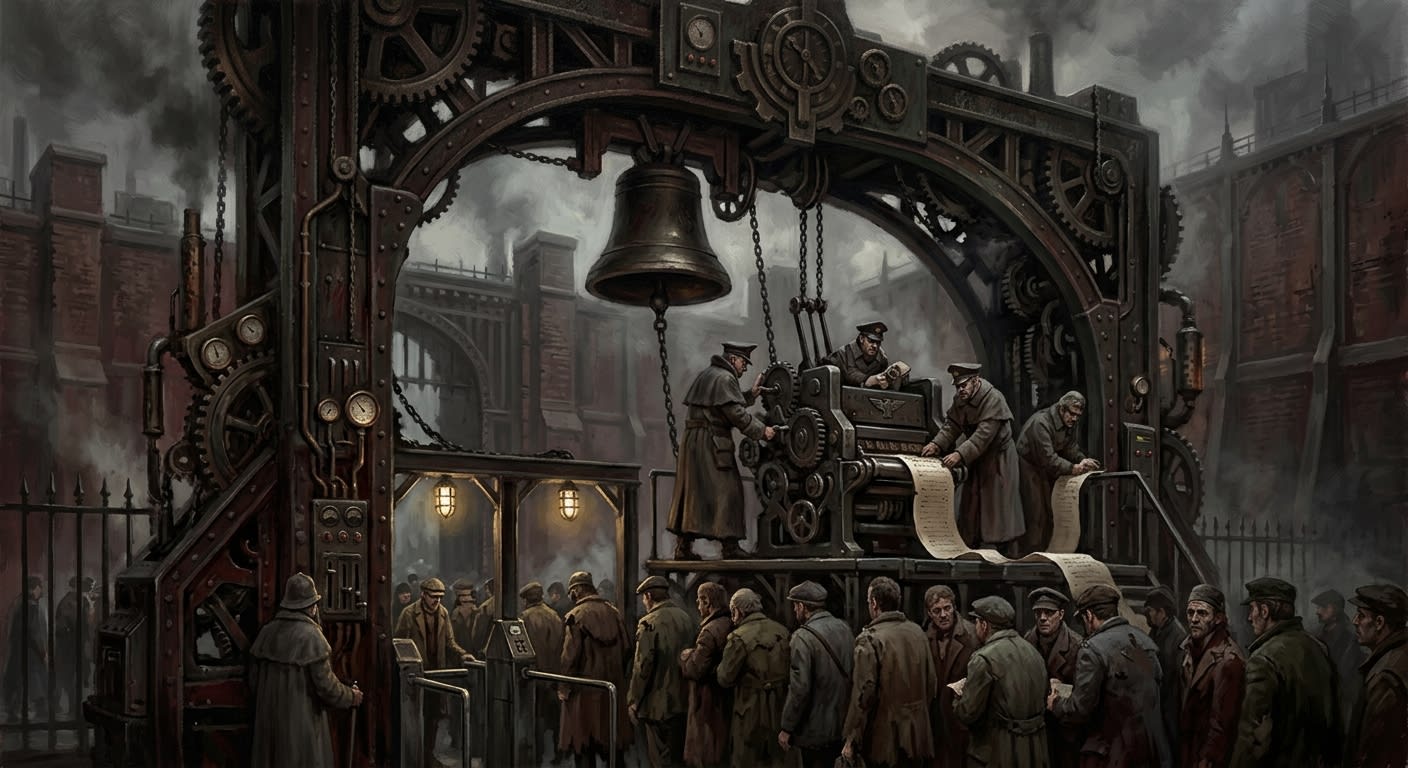
#On the Iron Throat Above Gate Three
The Bell-Mark Gantry spans the Queue Road at the Third Gate (Unregistered), where dawn becomes property and the waiting body receives its first legal wound. It is an iron structure of catwalks, stamp balconies, bell-hammer frames, paper cages, rain gutters, clerk rails, and little pulley baskets by which ink, wafers, cards, rate notices, disciplinary slips, and sandwiches of unacceptable smell travel above the heads of forty-eight thousand obedient sufferers.
The public definition is clean: the Gantry timestamps travellers. A paper rises. A clerk stamps. A bell records. The clock starts. Every minute between that mark and the next clearance becomes part of the Directorate ledger. This is called throughput. Men have been excommunicated for prettier lies.
The Gantry belongs outwardly to the Synod Permit Directorate (Unregistered), inwardly to the minute economy (Unregistered), and metaphysically to whatever appetite below Gate Nine taught officials that waiting could be fed into machinery. It is tollhouse, bridge, and liturgical instrument for turning unpriced duration into stamped liability. Bells sanctify. Stamps confirm. Iron holds the crowd beneath the throat until the system can swallow in sequence.
#On the Invention of the Bell-Mark
The Gantry's ancestor was a bell rope and a table. After the A.S. 97 Latch River crush (Unregistered), when three thousand died in a road surge officially attributed to weather under a sky that behaved with exemplary innocence, the new gate courts required a way to decide who had waited lawfully. A bell marked the opening of each lane. A clerk wrote the hour. Travellers objected, forged, fainted, bribed, and occasionally stabbed the man nearest the inkpot. The Directorate studied the disorder and, in the grand moral tradition of Strasbourg, built a higher table.
By A.S. 104, minute pricing had begun. By A.S. 110, when the First Continental Levy made bodies move east in batches large enough to frighten accountants awake, the bell-mark system had hardened into policy. The Third Gate span received its first iron frame in A.S. 111, according to Directorate maintenance rolls, though Records preserves a contrary receipt from A.S. 109 because nothing true is allowed to pass through the Queue Road without waiting in two lines.
Directorate school notices describe the Bell-Mark Gantry as a humane crowd-order instrument created to prevent recurrence of the Latch River crush.
Corrected for internal copies. The Gantry was built to price waiting after the crush revealed how much waiting could be compelled. Safety supplied the sermon. Revenue supplied the altar.
The bell-mark itself is small: a pressed hour glyph, lane sigil, clerk initial, rate class, and dry line showing when the ink began to set. The smallness is insulting. A man may stand six hours in sleet, lose two toenails, miss his daughter's fever, and receive in exchange a mark no larger than a thumbnail. Yet that thumbnail governs passage, debt, meal priority, appeal standing, reclassification risk, and the possibility of being erased into the Null Verge. The Synod has always preferred small marks for large dominions. A brand does not need to be wide if it is placed where refusal cannot reach.
#On the Mechanism of Stamping
At dawn the bell clerks take position on the upper balcony. Below them, lane wardens lift the paper poles: hooked sticks by which travellers raise permits, passage slips, witness cards, debt revisions, maternity exceptions, corpse transfer dockets, and other fragile pleas toward the clerical sky. The stamp clerks work from cages, each cage assigned a lane and rate class. Their presses hang from weighted arms so the blow falls evenly, impersonally, beautifully. A good press makes no smear. A bad press creates litigation.
The bell above each cage does not ring for the crowd. The crowd hears enough bells to lose sense of mercy. It rings for the ledger wheel inside the Gantry housing, a brass-rimmed counter that advances with each authorised strike. Bells speak to counters. Counters speak to ledgers. Ledgers speak to rates. Rates speak to hunger. Hunger speaks in the lanes with admirable clarity and no recognised standing.
Bell-Mark Slips are issued to those whose papers cannot be safely handled from below: fever cases, corpse escorts, sealed military packets, birth-in-transit notices, and persons who have already begun aging in ways the Directorate would rather not smear across standard forms. A Slip carries the Gantry's authority without the paper's original body, which makes it useful, portable, expensive, and beloved by forgers. Clerk's Mile (Unregistered) has produced counterfeits so lovely that Directorate auditors accepted them, framed them as exemplars, then condemned the frame-maker when the fraud became public.
#On Drift at the Span
The Minute Drift reached the Gantry after the A.S. 200 rate doubling. The official phrase was expansion confirmed. The clerks' phrase was the hand goes before the bell. Both are accurate; one has blood in it.
First came duplicate marks. A traveller's paper would receive Third Gate Matins and Third Gate Matins again, same clerk, same pressure, same ink dry line, separated by a blank minute the ledger counted twice. Then came future stamps: Vespers marks at dawn, next-day lane seals before breakfast, appeal windows closed before the offence occurred. Supervisors confiscated the cards. Confiscation is the Directorate's preferred form of theology: if the document is absent, the event repents.
The bodies below noticed sooner than the offices above. Men stamped at first peal reported hunger from noon. Women given morning marks reached the next gate with evening shadows under their eyes. A boy received a clearance stamp dated three hours ahead and grew two adult teeth in the interval before the rate board caught up. The teeth were pulled for evidence. The boy was billed for dental handling.
A.S. 200 Gantry irregularities were attributed to clerk fatigue after increased throughput.
Amended. Clerk fatigue does not stamp tomorrow on wet paper. Clerk fatigue does not make ink dry before pressure is applied. Clerk fatigue remains useful as a public explanation because clerks are numerous, tired, and cheaper to blame than hidden wheels.
Beneath Gate Nine, the Apparatus turns. At the Gantry, the first bite is marked. No Directorate circular says this. No Directorate circular needs to say it. The Bell-Mark opens the minute account from which later extraction draws authority. The Apparatus may grind waiting below the Hearing Hall, but the Gantry blesses the grain before it enters the mill.
HOURGLASS OBSERVATION NOTE — GANTRY SPAN, A.S. 201 Test card raised without bearer. Stamp applied before clerk's hand descended. Bell sounded after mark appeared. Ledger wheel advanced by ███ units. Observer reported sensation of having been late since childhood. Disposition: test discontinued; card sealed; observer assigned to work without clocks.
#On the Unstruck Beneath the Bell
The Clock Heretics, called the Unstruck, hate the Gantry with a purity most approved orders fail to achieve. Their doctrine begins where the Gantry begins: dawn arrives before the stamp. Hunger arrives before the invoice. A minute exists in the pulse before the Directorate rents it upward. No bell owns the hour.
Their sabotage is small because small acts fit through grates. They wedge pebbles beneath hammer stops, sing under the span until the clerk's wrist moves half a breath late, smear lampblack over rate boards, trade damp chalk marks between lanes, and cut rope guides where Drift thickens. They do not bring the Gantry down. A collapsed Gantry would be martyrdom for iron and an excuse for massacre. They make it hesitate. Hesitation is their sacrament.
Purity raids the culverts with public boots and private slowness. The correlations are sealed badly. Unstruck interference reduces extraction surges. Stamp delays calm the worst amber spikes. A clerk singing one beat late beneath the Gantry can spare three lanes from future marks for a morning. The Bureau denounces the interference, studies it, permits enough of it to preserve the Road, and arrests whatever portion looks inexpensive.
#On Clerk Hands and Purchased Witness
The Gantry's human part deserves its own contempt. Stamp clerks are selected for wrist steadiness, number obedience, low pity, and the ability to look down on a lane without seeing faces. Their training bench uses blank cards for three weeks, then condemned transfer papers, then live permits under supervision. A clerk who hesitates over a widow's card is reassigned to ink scraping. A clerk who stamps too eagerly is promoted if the totals please the board and disciplined if the smear rate rises.
Witnesses stand on the side balconies and certify that the mark fell after the bell, before the ledger, within the lane window, and upon the correct paper. Witnessing is paid by interval. Paid witnesses become philosophical about sequence. The Witness Rental Houses (Unregistered) of Stamp Court Row (Unregistered) supply replacements when official witnesses faint, vanish, or begin insisting that the bell rang from below the road rather than above it.
Some clerks keep private books of wrong marks. This is forbidden. It is also the only reason the Hourglass learned that Vespers stamps appeared at dawn before the spring rate change was posted. One book, recovered from Clerk Berrin Vale (Unregistered) after his fingers locked around a press handle, contained thirty-seven future marks, six duplicate births, and a drawing of Gate Nine made from memory by a man who had never passed Gate Five.
#On Present Use and Proper Fear
As of A.S. 201, the Bell-Mark Gantry remains active. The Third Gate cannot process the Road without it, and the Road cannot feed the forward depots without the Third Gate, and the forward depots cannot feed the Sagittal Line without the Road. This is how a single iron span above a queue becomes strategic doctrine. The grandest systems often hang from bolts inspected by men who cannot afford boots.
The Directorate has added Hourglass observers, double-ledger comparison, ink-delay strips, clerk rotation, bell-hammer seals, and witness pairs. The measures work in the technical sense that they create more records. Future stamps still appear. Duplicate marks still pass through when the crowd surges. The rate board sometimes displays prices for a day that arrives cheaper, dearer, or dead. In the Shed Wards (Unregistered), people age in public. At the Gantry, papers age first.
Travellers now cross themselves before raising papers. This is unauthorised unless done in the approved hand, but wardens tolerate it because a man praying is easier to strike than a man arguing. Clerks tie red thread around their stamp wrists. Bell-hammer boys sleep poorly. Supervisors confiscate anomalies with the solemn greed of relic thieves. Above all, the Gantry keeps marking.
At dawn the first peal sounds. Papers rise on hooked poles. Iron cages open. Ink shines black. The clerks bring their hands down, and thousands of lives acquire an hour the Directorate can own.