
#On the Theft of Waiting
"If the bell rings twice, pay once. If the clerk hears both, pay twice." — Queue Road proverb, suppressed A.S. 199
The Minute Drift is the official name for time behaving badly along the Queue Road, chiefly inside the Barricade Maze between Gates Three and Five, lately at Gate Two Bridge Pinch, the Bell-Mark Gantry, and the Shed Wards (Unregistered). The Bureau of Rites classifies it as a Category Two Localized Temporal-Scribal Disturbance. The Bureau of the Hourglass calls it Class II-Extractive, sub-designation Alpha, which is a polite way of saying that the Rites have mislabelled a wolf as a damp carpet.
The Directorate calls it a clerical inconvenience. The people in the lanes call it losing days.
Inside the Drift, bells ring out of sequence. Ink dries on a stamp before the wax cools. Shadows fall at angles belonging to hours that have not yet arrived. Hunger arrives late, early, doubled, or missing. A traveller swears by his bell-card that he stood six hours; his joints insist on three days. Another enters the Maze at dawn and exits under the same dawn, with beard stubble, frostbitten fingers, and a permit recording seventy-nine payable minutes. The Directorate bills the permit. The fingers receive no hearing.
#On Symptoms, Ledgers, and Bodies That Disagree
The Drift is called temporal-scribal because it injures clocks and paperwork together. A pure temporal event would afflict duration. A pure scribal event would afflict record. The Minute Drift possesses the vulgar ambition to afflict both, then invoice the victim.
Bell-marks duplicate. Queue cards accept stamps from future windows. Audit ledgers show totals from hearings not yet convened. The Permit Directorate's rate boards sometimes display tomorrow's prices, which would be useful if tomorrow did not then arrive with different prices and a fine for possessing unauthorized foresight. Stamp clerks posted near the Barricade Maze report that their hands move faster than their intentions. One clerk signed two hundred and twelve permits in a quarter-bell, collapsed, woke with ink beneath his fingernails and no memory of the work, then received a commendation for efficiency.
Bodies record what ledgers deny. Hair whitens. Nails split. Old bruises bloom. Wounds heal with the tight, shiny haste of flesh ordered to conclude. The best attested case remains the Shed Wards woman who arrived in A.S. 198 and by A.S. 201 looked twenty years older than her papers declared. Her neighbours noticed. Her family noticed. The Directorate did not, because her minute account remained balanced.
The Drift also produces absence. People lose intervals. A mother remembers entering Gate Four with two children and leaving with two children, yet one child's shoes are soaked in river mud from Gate Two, and the other has learned a song the Unstruck use in the culverts. A wagoner sleeps one night in the Hostel Ribbons and wakes owing nine days of stall rent. The landlord presents stamped proof. The wagoner's horse is dead of age.
#On the Apparatus Beneath the Road
The Bureau's public account makes the Drift sound local, mild, and fenced. It is none of these things. It is the surface rash of the Apparatus beneath Gate Nine.
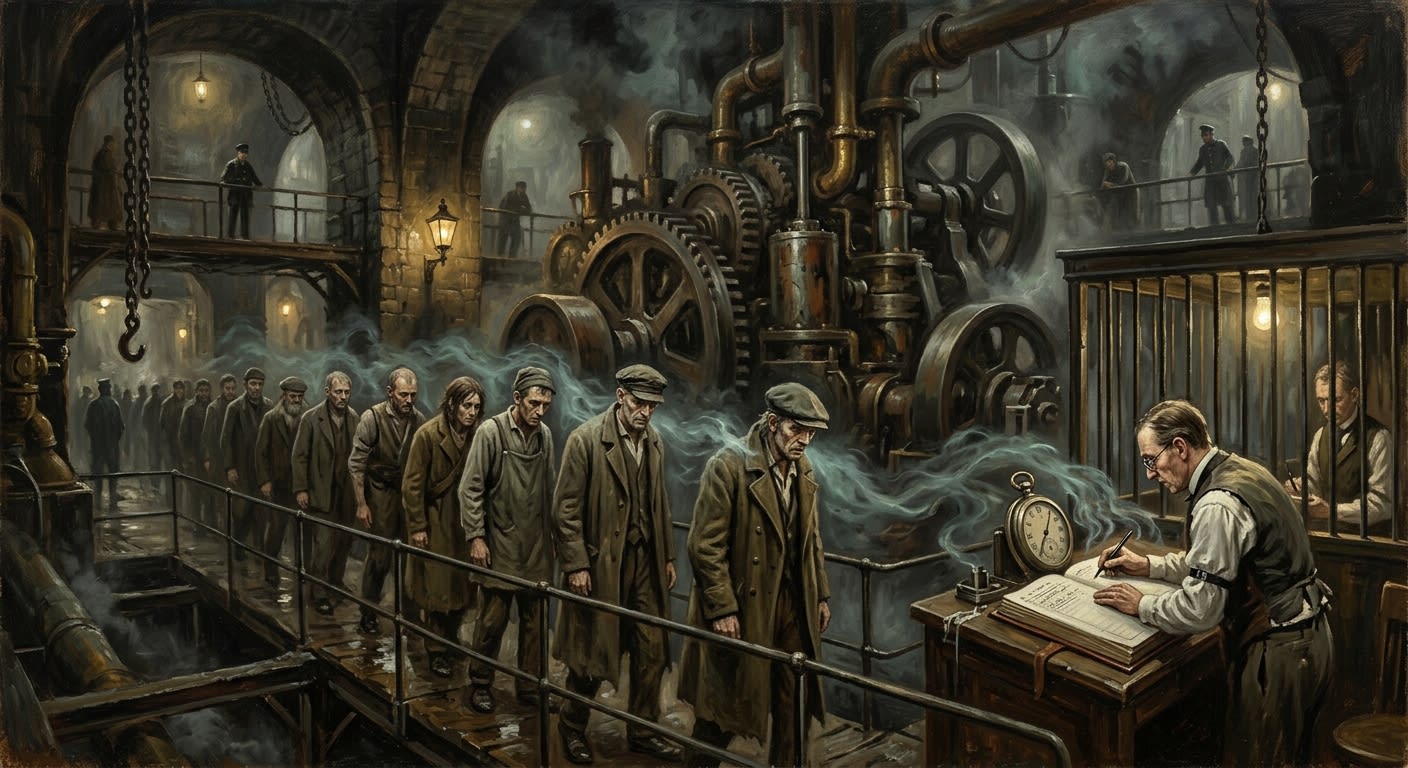
Forty-two feet below the Hearing Hall, in a hexagonal chamber of dressed stone, a wheel turns. The Bureau of Engineering found it in A.S. 178 while investigating sub-grade vibrations interfering with stamp-press calibration. Report Two, A.S. 194, reached the archive six days before the Rites issued the Drift classification. Report Three, A.S. 199, recorded an eleven-percent throughput increase after a spring rate adjustment and recommended continued non-disclosure pending Phase Nine completion. The fourth sentence of that report names what the wheel produces. I have seen the gap where the sentence should be. The gap has better posture than most officials.
The Minute Drift is a localized irregularity of bell-mark procedure and lane fatigue.
Corrected for internal circulation. The Minute Drift corresponds to measurable temporal extraction. The phrase “lane fatigue” is retained only for notices posted where the waiting public can read them, since the waiting public already has enough facts and insufficient exits.
The Apparatus grinds waiting. This is not metaphor from the pamphleteers; it is the least foolish description available. The Queue Road compresses bodies into lanes, gates into courts, courts into delays, delays into billable minutes. Beneath that pressure the Apparatus takes the surplus interval — the hours spent standing because a clerk has not lifted his hand, the days spent in a lane that could move but does not, the obedient patience extracted from forty-eight thousand registered souls and the uncounted erased — and sends it somewhere.
The Hourglass liaison at Shipka said the essential thing: Syrion decelerates. The Apparatus extracts. Syrion makes time heavy. Gate Nine makes time disappear.
#On the Commerce of Stolen Hours
The Permit Directorate did not create the Apparatus. The chamber predates the Directorate, the Bureau of War, the Concordat of Strasbourg, and probably the road itself. The Directorate did something more bureaucratically sinful: it built a business model over a wound and congratulated itself on paving.
Minute pricing began in A.S. 104. By A.S. 110 it was policy. The Road learned to sell waiting long before the Drift received its name. A man stands. His wait becomes credit. A merchant buys the credit. The merchant moves. The man remains. The Directorate records both transactions as orderly throughput. That the Apparatus below Gate Nine responds to throughput is, by official doctrine, unrelated.
After the A.S. 200 rate doubling, the Drift widened. Gate Two Bridge Pinch began reporting bell-shadows: silhouettes falling before their owners crossed the bridge-planks. The Shed Wards aged wrong. The Bell-Mark Gantry stamped papers with times that made clerks flinch and supervisors confiscate the cards. Gate Nine closed for sanitation that autumn, and bodies stacked in the Maze faster than the Null Verge carts could remove them.
No decree explained this. No inquiry reached conclusion. Three subpoenaed clerks vanished between summons and hearing. Their families received generous minute credits. Grief, on the Queue Road, can be converted to transit if the bereaved are sufficiently practical.
#On the Unstruck and the Useful Heresy
The Clock Heretics, called the Unstruck, have been right too often to be safely ignored and wrong too loudly to be publicly tolerated. Brother Senn preaches under the Barricade Maze with illegal clocks wrapped in oilcloth and says the bell-marks are instruments of spiritual violence. He says waiting is being fed to something. He says the lanes are troughs.
The Bureau of Purity hunts him. Slowly. With the theatrical zeal of men instructed to miss.
The Unstruck sabotage bell schedules, misalign stamp windows, and cut lane ropes where the Drift grows thickest. Their disruptions reduce Directorate revenue. They also reduce extraction spikes. Someone has noticed. Someone above the Directorate has left the culvert chapels standing. This is not mercy. This is maintenance by heresy.
MAINTENANCE CORRELATION NOTE — A.S. 200 Unstruck interference events: █████ Extraction surges dampened within █████ bell-cycles: █████ Recommended enforcement posture: public pursuit; private tolerance; no martyrdom. Authorizing office: ███████████████████████████
#On Present Spread
The Minute Drift refuses the word “localized,” but classifications, once stamped, develop the stubbornness of bad priests. Category Two remains. Amber status remains. Toll collection remains. The Drift keeps widening.
Witness-pairing, sanctioned bell-cards, Queue Prayer (Unregistered) repetitions at fence-posts, salt lines at gate thresholds, double-entry ledgers, Hourglass beat-counters: all have been tried. The measures produce reports. The reports produce recommendations. The recommendations wait in queues governed by the same minute economy that feeds the thing being recommended against. This is the Synod at its purest: a remedy standing patiently in the disease.
Current Rites classification defines the Minute Drift as localized, stable, and non-escalating.
Clarified A.S. 201. “Localized” includes any place the Drift has already reached. “Stable” means revenue has not collapsed. “Non-escalating” means no official authorized to use the word escalation has done so in a signed document. The classification stands.
The woman in the Shed Wards grows older. The bridge shadows at Gate Two step before their owners. The Bell-Mark Gantry stamps hours with a hand quicker than the bell. Below Gate Nine, the wheel turns in its hexagonal chamber, and the channels glow amber, and the Queue Road stands correct, moves when named, and pays minute by minute for the privilege of being consumed.