
#On the Sealed Reports
"Three documents. Three wax seals I should not have broken. Three acts of insubordination the Bureau of Doctrine has declined to prosecute because prosecution would require admitting the documents exist."
I will state what the Queue Road article could not. That article — my own, stamped with my own seal, bearing the imprimatur of the Bureau of Doctrine — was redacted at section seven, paragraph four, on grounds of "speculative theology exceeding the Hieromnemon's jurisdictional remit." The redaction stands. I do not contest it. I contest only the premise that a Hieromnemon's remit has boundaries, and I contest it here, in a document the Bureau will classify before the ink has cooled.
The reports arrived at my desk on the 3rd of Corvus, A.S. 200, in a folio sealed with wax the colour of old bone. No courier logged. No receipt requested. The folio bore one annotation in a hand I did not recognise: Read. Then decide what you are. I read. I have not yet decided.
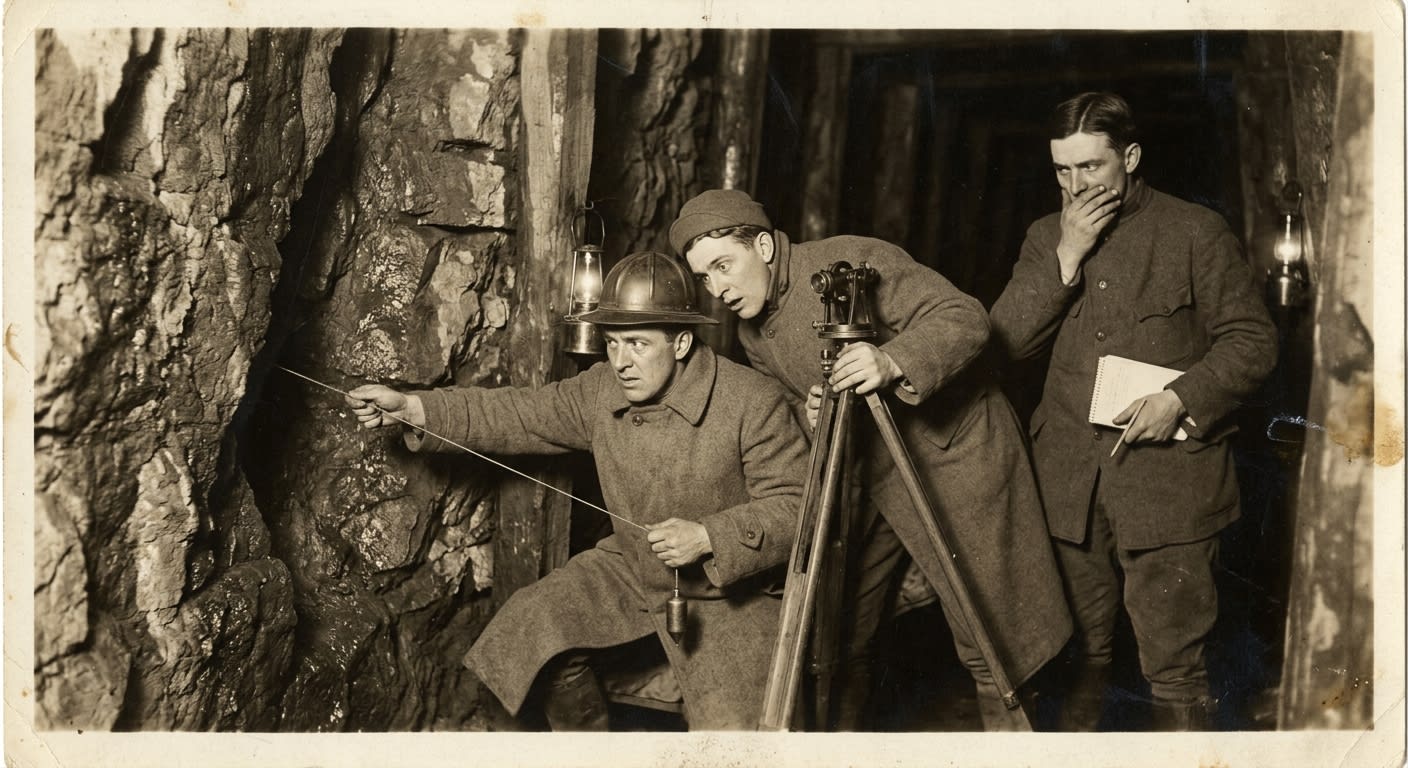
Report One is dated A.S. 178. It describes a Bureau of Engineering survey team dispatched to Gate Nine of the Queue Road following complaints from the Directorate that "sub-grade vibrations were interfering with stamp-press calibration." The team drilled. They found bedrock at expected depth. They drilled further, because Bureau of Engineering teams drill until someone tells them to stop, and no one told them to stop. At forty-two feet below the Hearing Hall's foundation stones, the drill punched through into a cavity. The report's language shifts here — from the measured diction of engineering notation to something closer to a field chaplain's confession diary. The cavity was not empty. The cavity was occupied.
Report Two is dated A.S. 194 — the same year the Bureau of Doctrine classified the Minute Drift as "Category Two Localized Temporal-Scribal Disturbance." This is relevant. The classification was issued six days after Report Two was filed, which means the classification was not a response to the Minute Drift. It was a response to the report. The Bureau classified the symptom because classifying the cause would have required naming it, and naming it would have required admitting it was there, and admitting it was there would have required answering the question of who put it there, and answering that question would have required — I suspect, though I cannot prove — the dissolution of at least one Bureau and the quiet retirement of at least three Hierarchs whose names I will not commit to paper because I enjoy my current posting and the coffee in Strasbourg is excellent.
Report Three is dated A.S. 199. It is four sentences long. I will reproduce three of them.
The first: The mechanism continues to operate within projected parameters.
The second: Throughput has increased by eleven percent since the spring rate adjustment.
The third: The unnamed bureau recommends continued non-disclosure pending completion of Phase Nine.
The fourth sentence I will not reproduce, because the fourth sentence names what the apparatus produces, and I have been told — by a voice I heard in a room I was not in — that the name, once written, cannot be unwritten, and the paper on which it is written becomes the thing it names.
#On the Chamber
"Forty-two feet of Heartlands limestone, then nothing, then this."
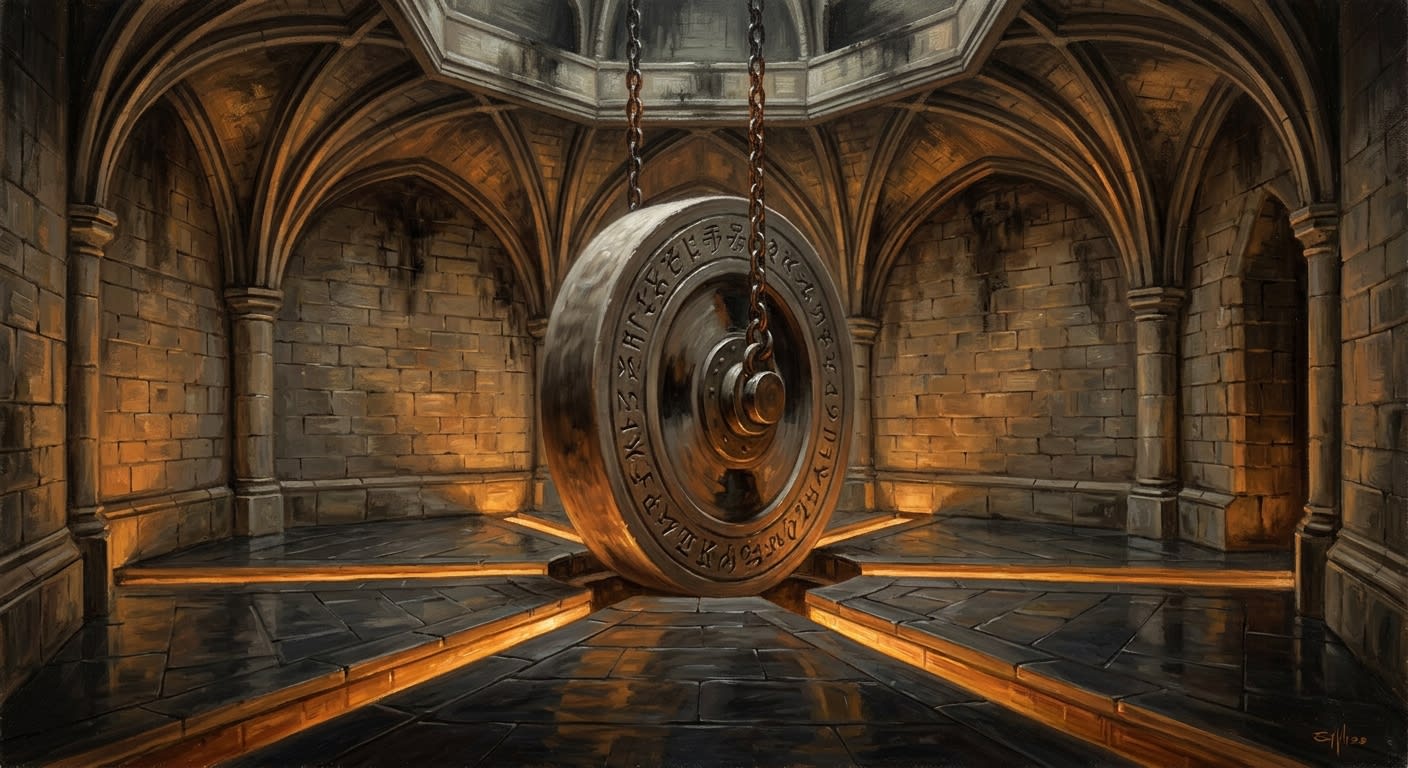
The cavity beneath Gate Nine is not a cave. Caves are formed by water, by the patient dissolution of mineral over millennia, by forces that have names in the vocabulary of natural philosophy. The chamber beneath the Hearing Hall was formed by intention. The walls are dressed. The corners are square. The ceiling vaults in a ribbed pattern that any mason of the Bureau of Engineering would recognise as late-Romanesque — a style that predates the Synod by centuries, that predates the Rationalists by centuries, that predates, in point of architectural fact, the road above it by an interval the Bureau of Records has declined to calculate because the number would raise questions the Bureau does not wish to answer.
The chamber is hexagonal. Sixty feet across at its widest. The floor is a single slab of basalt that does not match the surrounding limestone, which means it was brought here, which means someone hauled a sixty-foot slab of volcanic stone into a cavity beneath the Heartlands and set it level, and did so before there was a road, before there was a Directorate, before — if Report One's geological assessment is accurate — there was a Synod to argue about it.
Six channels radiate from the chamber's centre toward the six walls. The channels are cut into the basalt — not carved atop it, cut into it, as though the slab were soft when the channels were made. Each channel is nine inches wide, nine inches deep, and terminates at a vertical shaft in each wall. The shafts ascend. Report One's survey team dropped plumb-lines down three of the six shafts. Two plumb-lines returned measurements consistent with the surface positions of Gate Three, Gate Five, and Gate Seven. The third plumb-line did not return. It was lowered on forty feet of chain and the chain went taut at thirty-seven feet — taut in the wrong direction, pulling laterally, as though something at the far end had decided the plumb-line was more useful elsewhere. The chain was cut. The engineer who cut it was transferred to Bastion-Brest within the week. His name is in the report. His name is no longer in the Bureau of Records' personnel registry.
The remaining three shafts were not surveyed. The report does not explain why. The report simply stops, mid-paragraph, as though the author had set down his pen and walked away from his desk and not returned.
#On the Mechanism
"It turns. I have no better word. It turns."
At the centre of the hexagonal chamber — at the convergence of the six channels, above the basalt slab, suspended from the ribbed vault by chains of a metal that Report One describes as "iron-adjacent but spectrally non-conformant" — hangs the apparatus.
Report One calls it "a mechanism." Report Two calls it "the installation." Report Three calls it nothing; Report Three refers to it only by a designation I cannot reproduce because the designation is itself classified. I will call it what the Clock Heretics call it, because the Clock Heretics — those wretched tunnel-saints of the Unstruck who sabotage bell-marks from the culverts beneath the Barricade Maze — are the only faction on the Queue Road who know what sits below Gate Nine and have had the theological audacity to name it in a language the Bureau cannot redact.
They call it the Grindstone.
The apparatus — the Grindstone — is a wheel. Vertical. Approximately twelve feet in diameter. Mounted on an axle of the same spectrally non-conformant metal as its suspension chains. It turns. Slowly. One full revolution per — and here the reports disagree. Report One says one revolution per day. Report Two says one revolution per bell-cycle. Report Three says the revolution rate is "variable and responsive to throughput." The disagreement is the point. The wheel turns at different speeds depending on who is measuring it, which means the wheel is not operating in a temporal framework that accommodates measurement, which means the temporal framework is the wheel's product, not its container.
The wheel's rim is inscribed. The inscriptions are not in the Triune Alphabet, nor in Latin, nor in any of the six archaic scripts the Bureau of Records' palaeography department has catalogued. The inscriptions are in a script that changes. Report One sketched seventeen glyphs from the rim; Report Two, sixteen years later, sketched the same section and found twenty-three glyphs, none matching the original seventeen. The glyphs are not carved. They appear to emerge from the metal as the wheel turns, the way frost-patterns emerge on glass — from within, without apparent agency, in configurations that suggest language without confirming it.
The wheel does not touch the floor. It does not touch the walls. It hangs, and it turns, and as it turns the six channels in the basalt floor glow with a light the colour of late afternoon in autumn — a warm amber that Report One's author describes, with evident discomfort, as "the most beautiful thing I have seen, and I wish I had not seen it."
What flows through the channels is not light. It is not liquid. It is not air. Report Two's author, a different hand, calls it "compressed duration" and then crosses out the phrase and writes above it "harvested interval" and then crosses that out too and writes in the margin: I do not have words for this. The thing in the channels is what time looks like when it has been separated from the events it was meant to contain. It is time with the living stripped out.
#On What the Apparatus Produces
The fourth sentence of Report Three names the product. I will not reproduce it. I will describe its effects, because its effects are visible to anyone who walks the Queue Road with open eyes and a bell-card that they trust more than the Directorate's clocks.
The Minute Drift.
The Category Two Localized Temporal-Scribal Disturbance that the Bureau of Rites classified in A.S. 194 and has not reclassified since, despite the phenomenon's expansion from the Barricade Maze to Gate Two Bridge Pinch, the Bell-Mark Gantry, and the Shed Wards. Despite the woman in the Shed Wards who arrived in A.S. 198 and now looks twenty years older than her papers declare. Despite the bells that ring double. Despite the ink that dries on stamps before the wax cools. Despite the shadows that fall at angles corresponding to hours that have not yet arrived or have already passed or — in the sector between Gates Three and Five — have never existed at all.
Prior Bureau of Rites classification designated the Minute Drift as "Category Two Localized Temporal-Scribal Disturbance" (A.S. 194).
The classification remains unchanged. The Minute Drift remains Category Two. Category Two is defined as "localised, stable, non-escalating." The Minute Drift is no longer localised, is not stable, and has escalated measurably in the last eighteen months. The classification remains unchanged because changing it would require acknowledging the cause, and the cause is classified, and the classification of the cause is itself classified. The Bureau of Rites considers the matter closed. The Minute Drift does not.
The apparatus grinds time the way a mill grinds grain — through compression, through friction, through the steady conversion of one substance into another. The Queue Road is the hopper. The nine gates are the millstones. The forty-eight thousand registered souls and the uncounted erased of the Null Verge are the grain. They stand in their lanes. They wait for their bell-marks. They shuffle forward when named. And beneath their feet, beneath the stamped gravel and the drainage culverts and the smugglers' highway and the forty-two feet of Heartlands limestone, the Grindstone turns, and their waiting — their patience, their boredom, their slow animal endurance, their minutes and hours and days of standing in sleet and dust and paper fog — is fed into the channels and comes out the other side as something else.
What does compressed duration become? What is produced when time is stripped of the events it contained and ground into raw substrate?
I do not know. Report Three knows. The fourth sentence knows. The unnamed bureau that maintains the apparatus knows. The unnamed patron — who holds a rank the Bureau of Shadows' own hierarchy does not include, who authorises the operation through channels the Directorate cannot trace — knows.
I have my suspicions. They are theological and therefore dangerous. The Bureau of Doctrine redacted them once. It will redact them again.
#On the Sealed Bureau
"Every bureau has a name. Every bureau has a charter. Every bureau has a founding writ stamped with at least one recognisable seal. Every statement in this paragraph is true. The bureau beneath Gate Nine makes all three statements false."
The entity that maintains the apparatus bears no designation in the Synod's administrative registry. It appears in none of the Bureau of Records' seventeen volumes of institutional genealogy. It is not listed in the Bureau of War's chain-of-command tables, the Bureau of Doctrine's jurisdictional concordances, the Bureau of Purity's counter-intelligence maps, or the Bureau of Shadows' — which is itself an institution that officially does not exist — internal hierarchy.
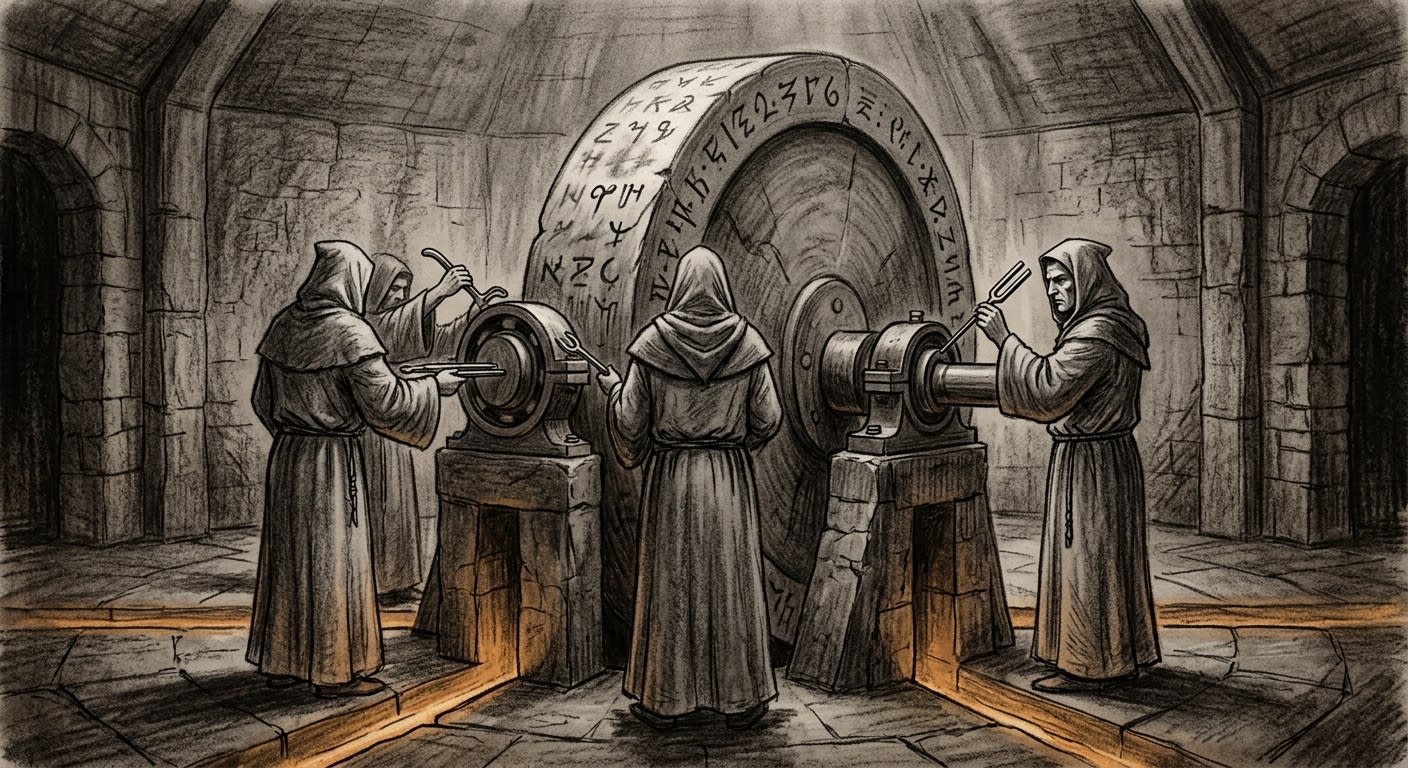
The maintainers are present at Gate Nine. This is confirmed. Report Two describes encountering them: three figures in grey robes of a cut the author does not recognise, performing calibrations on the apparatus's axle bearings with tools that "resembled tuning forks but vibrated at frequencies below audible range — I felt them in my teeth." The figures did not speak. They did not acknowledge the survey team's presence. When the team's escort — a Bureau of Shadows operative, which tells you something about the survey's authorisation level — attempted to address them, the nearest figure turned and looked at the operative with an expression the report describes as "recognition without interest, as one recognises a species of moth one has catalogued but does not collect."
The unnamed patron is worse. The patron is referenced in all three reports but described in none. Report One refers to "the authorising party." Report Two refers to "the oversight designation." Report Three refers to nothing at all — the patron's existence is grammatically implied by passive constructions that require an agent but never supply one. "The apparatus is maintained." "Throughput is monitored." "Phase Nine completion is anticipated." By whom? The sentences refuse to answer. The grammar folds around the absence like scar tissue around a splinter.
I have filed seventeen formal inquiries with the Bureau of Records regarding the identity of the Queue Road's sub-grade maintenance authority. Twelve were returned stamped "No Such Entity." Three were returned stamped "Inquiry Misfiled — Resubmit on Form 44-Q." Form 44-Q does not exist; I checked every form registry in the Strasbourg archive. The remaining two inquiries were not returned. They were not acknowledged. They entered the Bureau of Records' filing system and did not emerge. The filing clerks remember accepting them. The filing clerks do not remember what they contained.
#On the Relationship to Syrion
The Bureau of the Hourglass — which measures temporal drift along the Sagittal Line and classifies Syrion-adjacent timing anomalies from its station at Bastion-Shipka — has never been asked to assess the Minute Drift. This is remarkable. The Bureau of the Hourglass exists to detect exactly this class of phenomenon. It was founded to detect exactly this class of phenomenon. That it has not been invited to examine the most prominent temporal anomaly in the Heartlands — occurring not on the front, not in the Charnel Lands, not in a Syrion-adjacent theatre, but in Zone 2, in the administrative core of the Theocracy, on a road the Bureau of War calls "secure" — is a silence louder than any report.
I raised the question with a Bureau of the Hourglass liaison during my inspection tour of Bastion-Shipka in A.S. 199. The liaison — a careful woman whose name I will protect by not recording it — listened to my description of the Minute Drift's symptoms. She went pale. She asked me to repeat the detail about the shadows falling at angles corresponding to hours that had not yet arrived. I repeated it. She asked me whether the Directorate's bell-marks had begun running fast or slow. I told her both, depending on the gate. She closed her notebook. She said: "That is not Syrionic."
I asked her what it was, if not Syrionic.
She said: "Syrionic drift decelerates. It slows things. Syrion is the Languid Dreamer; his domain is stagnation, the draining of momentum, the conversion of urgency into stupor. What you are describing is not deceleration. What you are describing is extraction. Something is removing time from the system, not slowing it down. The time is going somewhere."
Whoever built the road.
The Queue Road was built by the Bureau of War. The Bureau of War was founded in A.S. 105. The road predates the Bureau. The Permit Directorate was constituted in A.S. 102. The road predates the Directorate. The Concordat was ratified in A.S. 90. The road — as an open highway, as a dirt track flanked by farms and inns — predates the Concordat.
The chamber beneath Gate Nine, with its late-Romanesque ribbing and its basalt slab and its tool-marks that match no known chisel, predates all of it. The apparatus — the Grindstone, the wheel of spectrally non-conformant metal inscribed with glyphs that change — hangs in a chamber that was built before the Synod existed, before the Rationalists published De Vera Luce, before the Atheist Wars tore Europe apart, before the Sundering cracked open the Balkans and let the Great Deceiver walk.
The apparatus was running before there was a Queue Road to feed it.
Someone built the hopper later.
#On What Cannot Be Said
[SECTION REMOVED — BUREAU OF DOCTRINE SEAL APPLIED] [Filed: 22 Corvus, A.S. 201] [Reason: "The Hieromnemon's theological conclusions, if published, would constitute a Category One Doctrinal Hazard requiring the immediate convocation of a Doctrinal Congress. The Bureau of Doctrine does not wish to convene a Doctrinal Congress. The Bureau of Doctrine has not convened a Doctrinal Congress since A.S. 104. The Bureau of Doctrine considers this a record worth preserving."] [Drax's annotation, visible beneath the seal: "The question is not what the apparatus produces. The question is who ordered the road built above it. The answer to that question is not a name. The answer is a job title. And the job title belongs to the Synod."]
#On the Present Condition
The apparatus turns. The Minute Drift spreads. The Bureau of Rites maintains its Category Two classification with the serene confidence of a physician who has diagnosed a plague as indigestion and sees no reason to revise his notes while the cemetery fills.
In the spring of A.S. 200, minute pricing on the Queue Road doubled overnight — no decree published, no explanation offered. The Directorate's revenue ledgers showed a corresponding spike. The Minute Drift's geographic footprint expanded in the same quarter, reaching the Shed Wards for the first time. The residents of the Shed Wards have begun ageing wrong. Their hair whitens. Their joints stiffen. Their bell-mark histories say they have been standing for three years; their bodies say thirty. The Directorate has not commented. The Directorate's master ledger — the true book, the one that records manipulation rather than compliance — remains unproduced for external review.
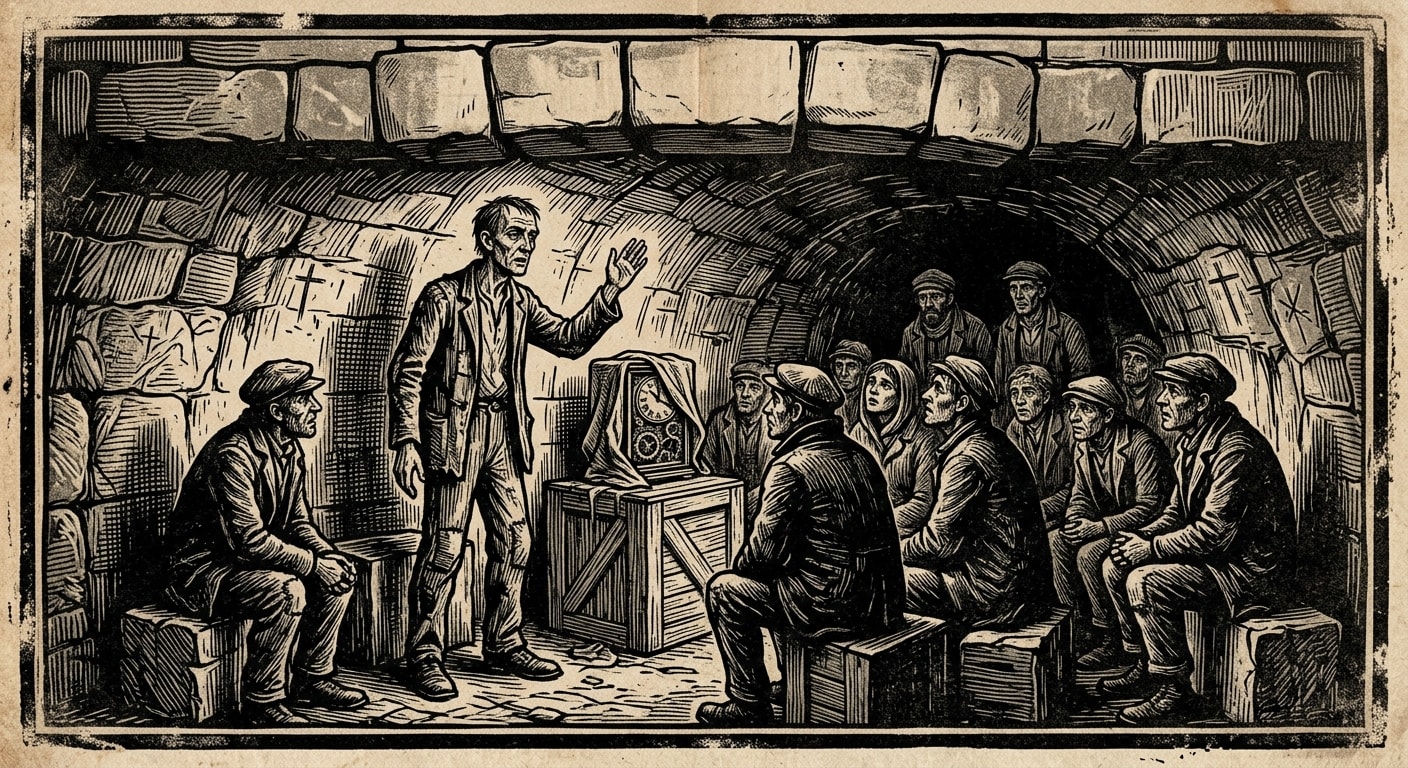
The Clock Heretics are growing. Brother Senn's congregation in the culvert-chapels has doubled since A.S. 199. The Unstruck carry their forbidden clocks wrapped in oilcloth and preach that the minute economy is a sin against the order of time — that the bell-marks are instruments of spiritual violence, that the Directorate's lanes are feeding troughs, that the road was built above the Grindstone the way a millrace is built above a wheel: with purpose, with design, with the full knowledge that what flows through will be consumed.
The Bureau of Purity hunts them. The Bureau of Purity has not caught them. The Bureau of Purity, I now suspect, has been told not to catch them — because the Unstruck's sabotage disrupts the Directorate's revenue, and someone above the Directorate's authority has decided the Directorate was feeding the apparatus too quickly. The spring rate increase was too much. The Drift expanded beyond acceptable parameters. The grey-robed maintainers in the chamber below needed the throughput reduced, and the Clock Heretics — poor, wretched, righteous Brother Senn and his culvert-saints — are performing a maintenance function they do not understand for a bureau they cannot see.
They are, in the vocabulary of the Synod, useful heretics. The most dangerous kind.
The apparatus turns. The road feeds it. The gates grind. The Queue Road is the longest machine in the Theocracy, and the forty-eight thousand souls who stand in its lanes do not know they are fuel. The Directorate does not know it is a hopper. The Bureau of War does not know its "secure artery" is a feeding tube. The Bureau of Doctrine knows — or suspects — and has redacted the suspicion, which is the Bureau's way of confirming it.
I know. I have read the three reports. I have pressed my hand to the warm floor of Gate Nine. I have lost four minutes I cannot account for. I have seen the glyph beneath my desk and I have counted the grey-robed figures in Report Two's sketches and I have asked seventeen questions the Bureau of Records cannot answer and two questions the Bureau of Records cannot remember.
And somewhere beneath the stamped gravel and the drainage culverts and the forty-two feet of Heartlands limestone, the Grindstone turns, and the channels glow amber, and the inscriptions change, and the time of forty-eight thousand patient, stamped, obedient souls flows downward through the bedrock into a machine that was running before the Synod was born, before the Rationalists were born, before the road was built above it to give it something to eat.