
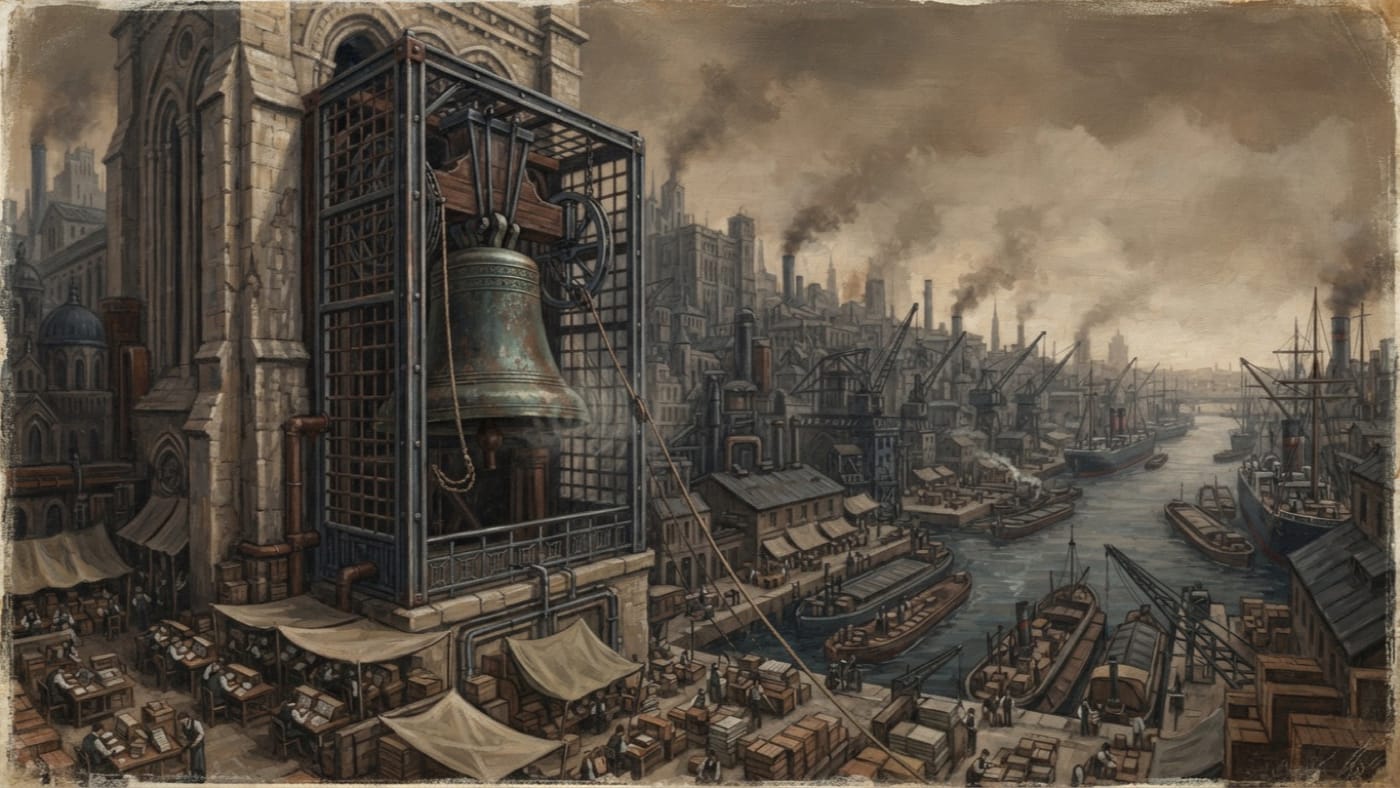
#On Oraison's Station
Nine principal bells hang in the Cathedral of Saint-Victor, and Oraison is the one Marseille hears most often and thinks about least. The cathedral register gives it one sentence of duty: Oraison marks Bureau business at the quay. I have read encyclicals with less discipline and inventories with more.
The bell belongs to the company in the reinforced cage that the Bureau of Bells keeps in the cathedral's western mass. That cage is the Bureau's southernmost major relay, driven through old limestone above the harbour of Marseille. The surviving description does not say where Oraison hangs in it, what it weighs, who cast it, which cleric blessed it or in what year it was first hauled up on wet rope. I decline to supply those details. A Hieromnemon who invents a founder's mark for a bell has begun forging relics, and the Cathedral Quarter already employs enough people in that trade.
That leaves the duty, and the duty is enough. Victor bears the cathedral's prayer against shipwreck. Lazare tolls for relic arrivals and disputed deaths. Oraison tolls for paperwork. Of those three burdens, only the last has never been interrupted by a miracle.
#On the Business Marked by Sound
A licence stands behind every bell in the Church's dominion. Not every fool with a rope may swing one, and the Bureau has kept the paperwork to prove what happens to those who try. The Office of Bells was constituted in A.S. 52, long after the first village rope had already been pulled. The Bell Codex that now governs every licensed stroke was ratified in A.S. 115. Between those two dates the Church learned something the Rationalists never managed to learn. A proclamation nailed to a door reaches the literate and the curious. A bell reaches everyone in range, including the illiterate, the indifferent and the man hiding in a cargo hold who hoped the Bureaus had forgotten him.
Oraison is the local proof. Bureau business at a quay is usually invisible. It happens at clerks' tables under canvas, in ledgers that swell with salt air, beside wax that softens in the southern heat and in the queue of a man waiting to learn whether his crate exists. A bell makes that work public. When Oraison sounds, the harbour knows the Bureaus are at work. That much the register certifies, and I will certify nothing more.
The register is silent on which Bureau summons it, which transactions earn a toll, how many strokes it gives, at what hours it rings and whether anyone is bound by the sound. A toll is not a seal. Bronze announces. It does not pass cargo, discharge a debt, open a counter or put a pilgrim aboard ship. Those tasks belong to clerks, who resent the comparison.
I will add this as a matter of interpretation. The Codex has always treated sanctioned sound as authority that can be heard, and Oraison applies that doctrine to the dullest and most essential work of a port. Saints draw crowds. Ledgers keep them fed. Someone has to ring for the ledgers.
#On the Quay and Its Authorities
Marseille is a Zone 1/7 Mediterranean port on the southern supply corridor. Grain, powder, rope and penitents leave it, and much of its pilgrim traffic sails east toward Thessaloniki. Its quays carry fish carts, relic crates, ropewalk bales, hostel touts, Watch patrols and so many folding desks that a stranger would think the harbour had been founded to give clerks somewhere to sit. Every one of those desks belongs to some office. Every office believes its business is the business Oraison marks.
The register does not name the quay. Relic arrivals by way of Quai Saint-Lazare belong to Lazare's rope, and Oraison's duty should not be read into that traffic. Visitors who know Marseille's older harbour names sometimes assume the bell was named for a quay, or the quay for the bell. No record establishes either. I have been asked to stop guessing in print, and I comply when the request comes with a seal.
Saint-Victor answers to the Creator, the Diocese, the Bureau of Bells, the parish chapter and the city of Marseille. Four other Bureaus press their claims whenever their hour comes round. Bureau business is the most dangerous phrase in the cathedral's register, because every Bureau reads it as a description of itself.
The Bureau of Tithes holds that all business is its business, since business produces revenue. The Bureau of Pilgrimage holds that the harbour exists for embarkation and treats everything else as a delay. The Bureau of Relics holds that any crate might contain a saint and so deserves its attention first. The Bureau of War holds that a port in the supply corridor is a magazine with a fish market attached. The Bureau of Records holds nothing in particular. It only writes everything down, and that is the most aggressive claim of the five.
No surviving record gives any of them Oraison's rope. The Bureau of Bells keeps the cage and licenses the ringing. The others may want the bell. Wanting has never yet rung one.
#On the Other Bells and the Keeping of the Peal
The peal has a division of duties, and the division matters. Without it, Marseille would hear nine bells as one noise.
Victor is the largest. People carry its tolls home and argue about them. Lazare rings for relic arrivals and disputed deaths, which in Marseille are often the same event viewed from different ends of a contract. Marthe, thin and sharp, calls pilgrim muster. Salt-John sounds harbour danger, and when it rings nobody waits to learn which Bureau is pleased. Little Beryn gives its nasal complaint at terce, and every child in the lower quarter can imitate it. Three lesser bells share parish business, funerals, debt remissions and the small duties a city assigns when it cannot afford a larger bell for its shame.
Oraison has none of these duties. It does not mourn, muster, warn or complain. The cathedral-wide sequences are also tower business: the descending peal for fire, the sustained toll that seals the harbour and the holds called during relic transfer. Nothing in the register assigns them to Oraison. A bell with a clerical commission is spared the dramatic offices. It is also spared the gratitude.
A previous Bells register listed Saint-Victor as possessing ten principal bells.
Corrected. The tenth, Saint Armand of the Foam, was removed in A.S. 158 after repeated mis-tolls. Oraison's place among the nine is unaffected by that correction, and no record names it as Saint Armand's successor, replacement or heir.
Licensed bellwork goes on above all this in the ordinary way. Keys are signed for. Logs are kept. Ropes are checked for salt-rot, frames for drift and clappers for the dull note that means a fitting has loosened. Harbour damp gets into everything in the western mass, and stone that has sweated all night is slick by prime. I do not know which hands keep Oraison in particular. They are not recorded, and I will not baptise strangers for the sake of a paragraph. I do know what the work requires of anyone licensed to do it under the Codex: the stroke must be the authorised stroke, rung at the authorised hour, and entered in the log before the ringer goes down the stair.
#On the Present Application
As of A.S. 201, Saint-Victor's relay is active, overloaded and structurally pious. Its peals carry across the harbour, out to the pilgrim fleet, along the coastal chain and inland toward the Rhône road. Oraison sounds within that system with the narrow commission the register gives it and no wider one. It marks Bureau business at the quay. The harbour hears it. Whatever happens next is handled by clerks, stamps, queues, bribes, appeals and the slow damnation of men who misplaced their papers.
I count this as the most honest bell in the western cage. Victor carries an anomaly that the Bureau of Bells denies. Lazare carries disputes. Little Beryn carries a crack that was never properly repaired and a complaint it never lets go. Oraison carries one fact, the plainest fact about any port under the Church's government: the offices are open, the officers are watching, and the sea has been entered in a ledger.