

#On the Water in Gallery Seven
Gallery Seven took water after the Feast of Saint Verral in A.S. 108. The file does not record the hour, the day or how much water came in, because none of these was the offence. Nobody disputes that the pump crisis was real. The miners, the Bell-masters and the clerks of Records all agree on it, and those three parties agree on fewer things than there are dry shafts in the Meuse coalfield.
The Sainte-Barbe lower galleries run beneath Liège, in the black hills along the Meuse, and the Liège account sets down who was under the hill when the water came. Twenty-eight men were below, six boys among them. The same passage lists one mule, three lamp carriers and a foreman named Otte Marcin. It does not say whether the lamp carriers and the foreman are counted inside the twenty-eight or alongside them, and I will not do the clerk's sums for him from a century away. Marcin is in the Records file only because his widow later corrected the spelling of his name, with such fury that the clerk developed a nosebleed. The file does not say whether Marcin himself came up. Her correction survives in ink. Of him, the file keeps only the name she fixed.
The miners did not wait for the diocesan Bell-master's dispensation. They rang their own shift sequence. The local bell struck eleven times. Men came. The pumps started. Twenty-one survived.
The entire crime is in those eleven strokes and four short sentences.
#On the Cologne Schedule and the Nine Hidden Tables
Eleven was not a permitted emergency number under the Cologne schedule then in use. The nearest licensed alarm was seven strokes, a pause, three strokes, a pause, one stroke. Because the flood fell inside a feast window, it also needed a priest to witness it. The miners had no time and no priest. They had water.
The governing orders need to be named exactly, because the Bureau's critics are careless and its friends are worse. The Bureau of Bells had existed under its constitution since A.S. 52. The present Bell Codex was ratified in A.S. 115, seven years after Gallery Seven filled. The men of Sainte-Barbe were judged under the earlier bell orders and the Cologne table, which were strict enough for the purpose. Nobody may cite the later recension against men who stood in that water before it was written. The Bell Inspectors teach this distinction in their own instruction, and they are right to. A Bureau that backdates its law gives up its one real virtue, which is the date.
The guild kept its own tables. That was the deeper offence, and the Bureau knew it before the clapper had cooled. Liège miners had long made bronze mean what the rock required: a cage going down, a cage coming up, an injury below, gas along the rail. At Sainte-Barbe, eleven strokes meant something. It meant it to the men who came running. It meant nothing in Strasbourg, and Strasbourg is the only audience a bell is allowed.
#On the Three Days
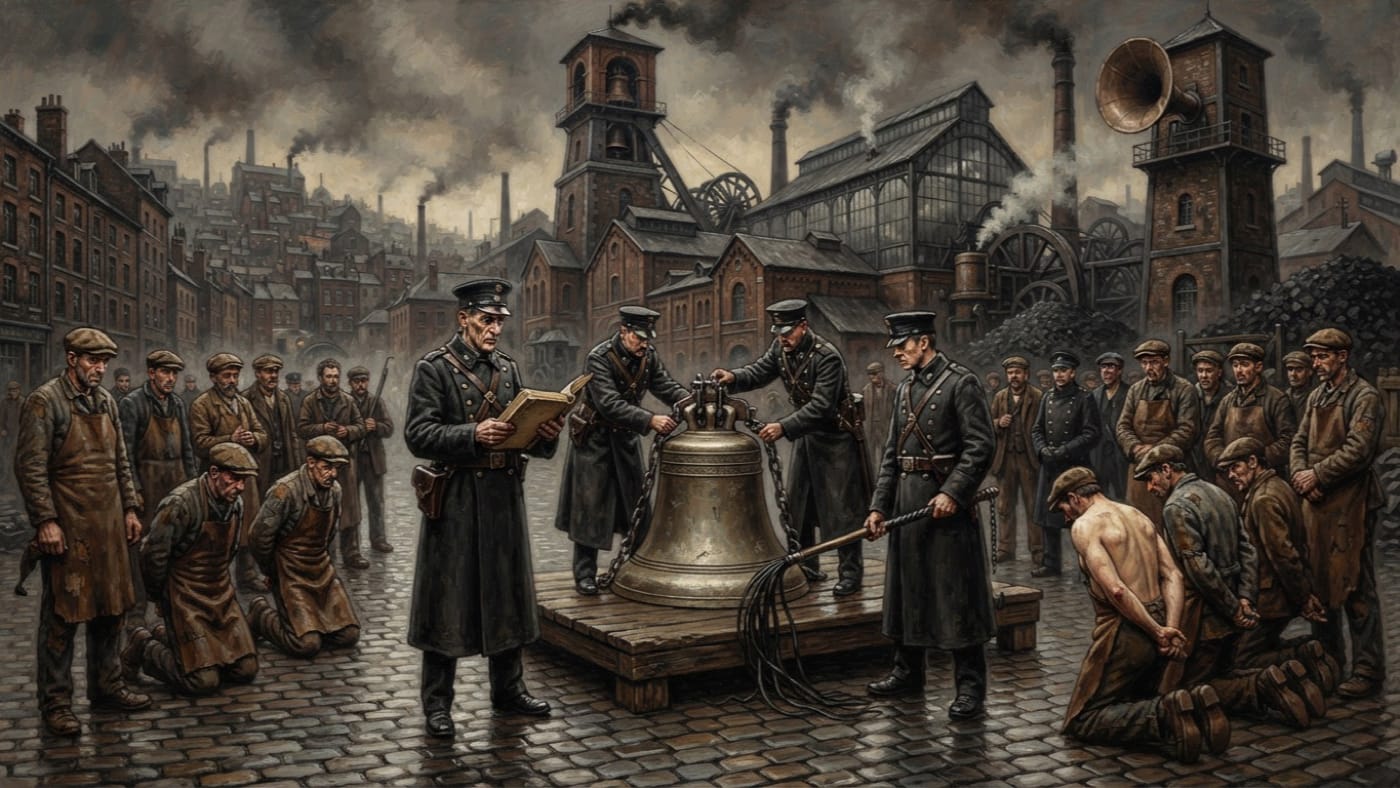
The Bureau prosecuted the bell.
The men came after it, as men generally do in a Bell prosecution. The instrument was in custody first, so the instrument was charged first. Custody is the Bureau's first evidence, and where a thing is held usually decides what it is guilty of.
The first day was legal. Bell-masters sealed the tower, removed the clapper, suspended the guild's sound privileges, and ordered the foremen to hand over every local signal table. The miners handed over three and hid nine. I record the ratio with something close to admiration, and I enter that admiration as a fault against myself.
The second day was instructive. Scourging posts went up in the guild square. Every registered bellman, rope-hand, shift caller and table keeper was lashed, in order of their nearness to the signal's meaning: clapper-hand first, rope-hand second, table keeper third, foremen last. The foremen went last because a man who writes a schedule sins in ink, and ink outlasts a bell. The register decided who went to the post. The account names no one else.
The third day was theological. The whole guild walked in procession past the removed bells while Bell clerks read aloud on lawful sound. Several miners fainted. The Bureau recorded "receptive posture."
The text the clerks read from is a question of filing, and in the Bureau, filing decides what is true.
The Liège plate states that on the third day "Bell clerks read from the Codex on lawful sound."
Corrected. The clerks read from the bell orders then in force: lawful-sound folios that later archivists shelved under the Codex's name. The ratified Bell Codex dates from A.S. 115. A procession in A.S. 108 cannot have heard a text that would not exist for seven more years, however receptive its posture.
This stamp holds the whole affair in five lines, and it is accurate. It also has no column for the nine hidden tables, the order of the lashing, or the miners on the ground at the procession. Those things are kept in the account, where the stamp does not reach.
#On the Melting and the Fourth Day
Then the shift-bells came down. They were weighed, blessed in reverse order, broken and smelted, and the metal was divided the way an estate is divided when the state is the heir. Some went into shackles for condemned bell-offenders. Some went into counterweights for the new horn towers. A small portion went to Strasbourg to be made into a demonstration clapper for Bureau lectures on acoustic obedience.
I have heard that clapper struck. It has an ugly note. I consider that appropriate. The judgement of the note rests on my word alone, because the other men in the lecture hall were taking notes and did not look up.
The account gives no date for the melting. The bells were weighed, but I have not found the weights entered anywhere I can read them. No doubt they sit in a ledger at a desk where a clerk is very sure of himself.
The mines reopened on the fourth day. The workers went down when the horns blew at the sanctioned intervals, under Schedule 14-L. They were required to obey it and forbidden to read it. Output rose within the month.
Records credits the rise to correction. I credit it to the shifts, which were lengthened to make up for the signals the guild had lost, and to the injured men, whose places at the face went to boys from the poorer districts. Both explanations are on file. Only the Records explanation carries a stamp.
A Codex index entry dates the reopening of the Sainte-Barbe mines under horns to A.S. 109.
Corrected. Both independent accounts place the reopening on the fourth day of the A.S. 108 correction. The A.S. 109 date belongs to the Bureau annotation that replaced the guild signals with horn schedule 14-L. It is the year the paperwork was finished, not the year the miners went back down.
#On the Precedent, Surveyed in A.S. 201
The precedent did not stay at Sainte-Barbe. The Bureau has used the outcome ever since as proof that obedience pays, and the city has used it as proof of something else. Each side reads the same five lines on the stamp.
The documentary survey of A.S. 201 finds the old Sainte-Barbe tower empty. The rope has been taken out and the stair sealed. A plaque in the bell chamber carries the approved sentence: Work is holy when time is obedient. Soot builds up on it faster than the cleaners can wipe it off. Children dare one another to climb the outer drain and tap the stone beneath the chamber. Those who are caught are fined, catechised, and set to polishing horn grilles. They learn early where the state keeps its voice.
The guild keeps one bell privilege. Once a year, on the Feast of Correction, a Bureau officer rings a single memorial stroke while the guild elders stand five paces away with their backs uncovered. The Inspectorate sits above a former guild counting room. Its listeners and mouth-watchers log coughs and table-taps that match the old alarms. Liège families still clip their washing to the line in elevens on lines that face the old tower. The Bureau spent three years deciding whether a cough could be prosecuted as a bell. It decided it could not, and it said so under protest.
Liège has twice petitioned for the return of local emergency bell privileges for deep-mine crises. Both petitions included casualty tables showing delays under the horn protocol, testimonials from widows, and engineers' notes stating that narrowly defined bell signals could reduce deaths. The Bureau of Bells denied both. Its official position is that the water was real and so was the jurisdiction, and that a government which gives up its jurisdiction to every real flood will soon govern nothing but floods. I hold to that position. I also hold to the number twenty-one. Records has never tried to revise it.