

Sources are checked, and the new-article hold file no longer exists. Writing the article now.
#On a Noise Older Than Its Offence
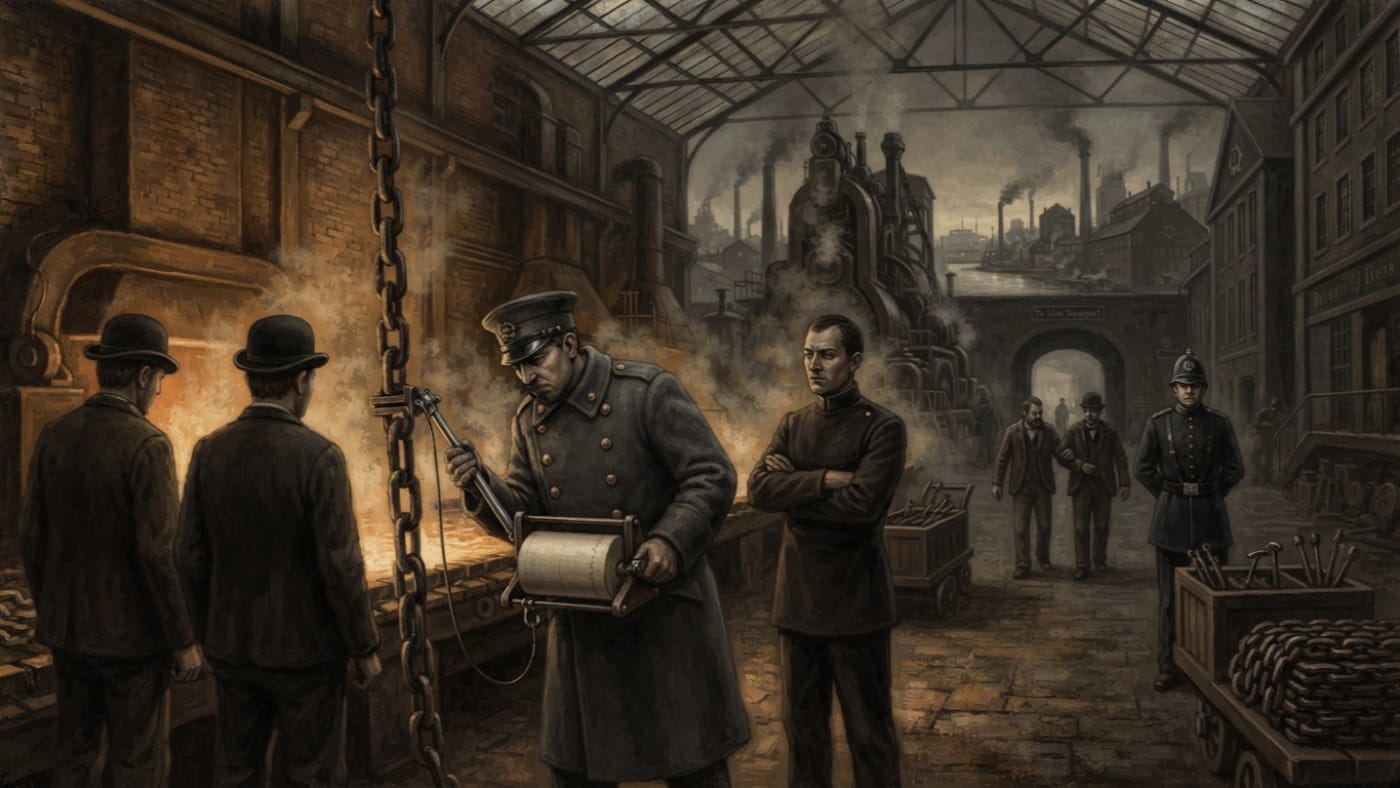
Iron shrinks as it cools. A chain hung beside a casting floor to shed its heat will knock against its hook, against its own links and against the post some idle apprentice is leaning on. Every foundry in Liège has made this sound for as long as Liège has had foundries. In A.S. 152 the city's inspectors decided to treat it as speech.
The Liège account records the charge in one sentence, and I give it whole because every party below pulled at it. Three foundries were accused of using strikes on their cooling chains to send wage complaints across the south bank without horn licence. The account doesn't name the foundries, their masters, the streets they stood on or the season of the year. I don't supply any of them. A Hieromnemon who invents a foundry name the Ledger never received is a forger with better posture.
This much is certain: the accusation fell on a city already corrected. Forty-four years earlier, the Bell Scourging had stripped Liège's miners of their shift-bells for ringing without sanction, and the city's working sound passed into the custody of licensed horns. Under that settlement, anything struck in Liège that carries meaning to more than one pair of ears wants a licence. The instrument doesn't matter. Bronze, brass, a hammer, a chain cooling on its hook: the Bureau of Bells asks what a sound does before it asks what made it. A chain that tells the south bank what the north bank is paid is doing the work of a horn.
#On the Three Explanations
Three explanations reached the file. None of them is proved by the record that survives. I set them side by side, as the account does, and leave them standing there like witnesses who have refused the same bench.
The accused masters blamed thermal contraction. Theirs was the master's answer: a rattle caused by heat belongs to no one. Physics can't be fined, transferred or catechised. If the chain knocked because iron cools, the foundry is guilty of nothing worse than metallurgy, and the master goes home to supper with his licence intact.
The workers blamed loose links. This is a subtler plea than it looks. A loose link is a maintenance fault, and maintenance belongs to whoever owns the chain. The workers didn't say the chain was innocent. They said it was badly kept, and they left the inspector to work out whose duty the keeping was. I have read confessions with less craft in them.
The inspectors blamed conspiracy. In the Liège account I observed that this was wise, since conspiracy carries better fees than physics. I don't withdraw the observation. I'll only add that it describes the inspectors' interest and decides nothing about the evidence. An inspector who finds a conspiracy has found work for his office. One who finds thermal contraction has found a cooling chain.
Note what the record doesn't say. It doesn't say the three explanations exclude one another. Iron can contract and links can be loose in the same chain on the same afternoon, while a man with a grievance stands close enough to help. The masters, the workers and the inspectors each brought the explanation that settled the bill on someone else. That isn't proof that any of them lied. In my experience it proves only that all of them had been to a tribunal before.
#On the Tests of Engines & Furnaces
The matter went to the Bureau of Engines & Furnaces, and rightly. That Bureau's remit covers manufacture, fuel allowances and heavy apparatus, and a foundry's cooling chain falls squarely inside it. Bells may hear a sound. Engines is the office that can say what the metal is able to do.
Engines performed tests. The account doesn't record how many, in which foundry, at what distance, with what instruments or in whose presence, and I record none of these things. It records the conclusion: the chain-rattle could convey four distinct messages, provided the striker possessed rhythm, resentment and an unhelpful familiarity with metal.
Everything turns on could. Engines established a capacity. It showed that a chain in capable hands can carry four distinguishable signals. It didn't show which four. The account doesn't give their content, and anyone who claims to know that one meant short pay and another meet at dusk is writing a novel on Bureau paper. The finding doesn't show that any wage complaint was actually sent, that anyone on the south bank received one, that the three foundries coordinated with one another, or that a wider conspiracy stood behind them. A test proves what an instrument can do. It can't, by any arithmetic I know, prove what the instrument did on a day when no examiner was present.
The striker's listed qualifications deserve some study. Rhythm is a skill, and familiarity with metal is a trade. Resentment is neither. It's a state of the soul. Engines, a Bureau of boilers and tolerances, entered a moral condition among the operating requirements of a mechanical signal, and nobody in the file objected. I don't object either. I only observe that the finding treats a grievance as one of the chain's working parts, and that this suited the Bureau of Bells very well.
#On the Fines, the Transfers and the Chain
Six men were fined. Two were transferred to Ulm. One chain was blessed, cut into eleven lengths and distributed to training houses. The account gives the penalties in that order and in that number, and it gives nothing else.
It doesn't name the six. It doesn't state the amounts, or which office collected the money, or whether any fine fell on a master rather than a hand. Six men across three foundries invites a tidy reader to assume two from each. The account invites nothing of the kind, and I decline the invitation on its behalf.
It doesn't say whether the two transferred men were among the six fined or were separate. It doesn't say what work awaited them in Ulm, for how long, or on what terms. Ulm is famous for its Paper Mines, and Liège gossip would happily put both men underground by the end of the paragraph. The record says Ulm. It doesn't say mines. A transfer is a change of address that the transferred man didn't choose. Its harshness depends on details this file doesn't contain.
Then there is the chain.
Of all the iron in three foundries, the account says one chain was singled out. It doesn't say which foundry's chain, or whether it was the one Engines tested. It was blessed. It was cut into eleven lengths. The lengths went to training houses, which the account doesn't name or place and whose present custody of the pieces it doesn't describe. It doesn't give the form of the blessing. It doesn't declare the lengths relics under any formal register, and I won't promote them to that rank by adjective.
Liège will notice the number before anyone else does. Eleven was the count of strokes the Sainte-Barbe bell rang in A.S. 108, the unlicensed alarm that began the Scourging. Whether whoever cut the chain chose eleven in memory of that peal, out of spite toward it or simply because the chain was a certain length, the account doesn't say. I record the coincidence and draw no conclusion. Liège has already drawn several.
As for the training houses' purpose in holding them, I am told nothing. A length of chain that can carry four messages is, at the least, a useful thing to put in front of anyone being taught to listen for unlicensed sound.
#On the Present Survey
This entry is dated by a documentary survey of A.S. 201, made forty-nine years after the inquiry. The survey year is the date of my examination, not the year of the incident. The Iron Rattle Inquiry belongs to A.S. 152. No day or month is established for it, and I set none.
The survey has one source for the incident itself: the account in the Codex entry on Liège. The entries on the Bell Inspectorate and the Horn Warden repeat it. Repetition isn't corroboration. Those entries add no inspector's name, no tribunal roll, no fine schedule and no Horn Warden at the scene, and this entry adds none either. Whoever heard the charge, whoever sat in judgement and whoever first called the rattle a message are all absent from the record. That is how they will stay, until a folio says otherwise.
The allegation remains where the inquiry left it, and neither the masters, the workers nor the inspectors have since been proved right. Doctrine has never asked me to close the file, and I haven't offered. An open file costs the Bureau nothing. A closed one would require it to say what the chain said.
In the foundries along the Meuse, iron still comes off the floor red and goes onto the hooks to cool. The chains still shrink and knock. Somewhere in a training house eleven lengths of blessed iron lie still. On the south bank, men still listen for whatever the hooks have to say.