

I've checked the hold, which has been lifted, and the sources. Here is the article:
#On the River as Filed in A.S. 201
This survey was put together at my desk in A.S. 201, which is 1911 by the common count. It is not an inspection, I did not ride out to make it, and no earlier edition exists that it replaces. I have taken the files that mention the Meuse and laid them side by side. Then I asked what the river does when the cities on it are kept out of the way.
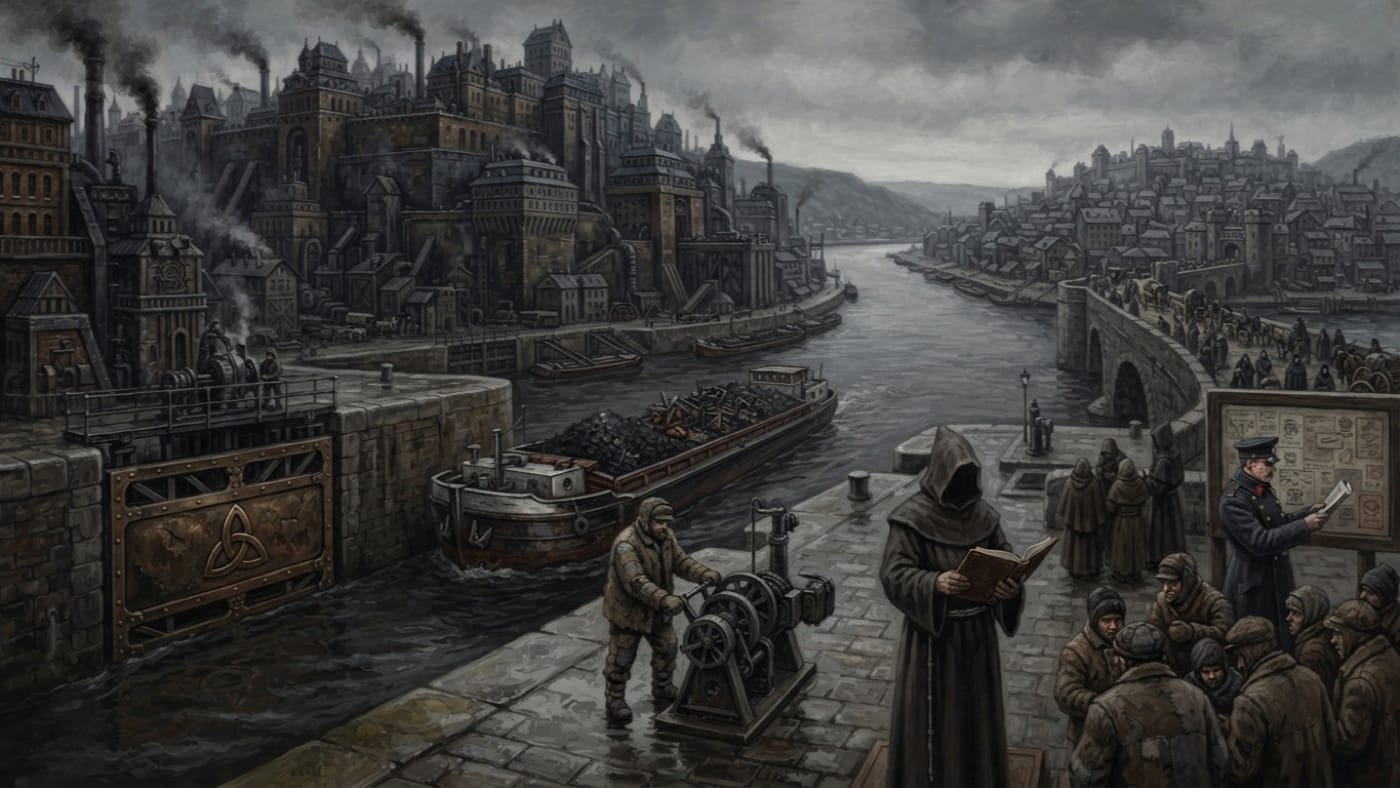
It carries things and it gets in the way of things. That is the whole of it. At Liège a coal barge goes through a lock under a Triune Knot plate and a gatekeeper mumbles bell-law at it. Downstream at Maastricht, a carter waits at a toll board while a clerk reads his writ twice, because that city has learned what a writ can do. The barge is the river being used. The carter is the river being an obstacle. Most of what the Ledger holds about the Meuse lies between those two men.
The Ledger records no length for it, no source, no watershed and no line on a modern survey that it marks. I have been asked for each of these. The files are silent on all of them, and so am I.
#On the River and the Corridor
The Meuse corridor is a separate entry, and readers who mix the two will be made to sit through both. The corridor is a descriptive term for a theatre of war. It takes in the valley through Liège and Maastricht and the roads that run off it toward Aachen, Cologne and the Lowlands. It has no charter, no governor and no boundary stones. The river is a single watercourse, and the corridor is the stretch of country an army had to think about because the river was there.
Aachen shows the difference. It is east of the Meuse at the end of an approach road and is not a river city. A clerk who puts Aachen's gate on the riverbank has drawn himself a better story and a worse map.
Liège is an industrial city on the Meuse in the Western Heartlands. Maastricht is a crossing and road city further downstream. Each has its own plate and its own grudges. Here they appear only where water traffic, road traffic and administration meet.
Maastricht is registered as Synod-held. The status covers the city. It gives the Synod no title to the Netherlands past the city, and anyone who reads otherwise is reading an atlas I have not sealed.
#On Freight, Locks and Toll Boards
The Liège plate lists the city's work as coal, ironwork, bell-metal recovery, mine labour and river transit. The river part of that list is barges. They carry coal, scrap, tools and rumour downstream, faster than any Bell inspector can follow on foot. I record those cargoes because the city's own file saw them. I do not record a shipping network along the whole river, because nobody has shown me one.
The barges were also where the river most embarrassed the Bureau of Bells. Liège lost its shift-bells in the Scourging of A.S. 108 / 1818 CE. That correction belongs to the mines and the city. Afterwards the river workers took up whistle codes, on the argument that a whistle was neither a bell nor a horn under the first wording of the horn schedule. The Bureau closed that gap in A.S. 119. The river workers switched to chain-taps. The file is still open.
The locks at Liège now carry Triune Knot plates on every gate, cut deep enough to hold soot. Before letting traffic through, the gatekeeper recites a short bell-law. The words are rote and the gates move precisely. A lock holds water, lets a boat through on the keeper's terms and turns it away on his whim. It controls movement along the river and has nothing to do with getting across it.
The Ledger's file on the Meuse corridor describes a modern lock as "a crossing that charges for passage, records it and then lets it through."
Corrected. A lock regulates movement along the river. It does not carry a road over the water, and no cart has ever crossed the Meuse by one. The original sentence was mine. The cart's opinion was not sought.
Maastricht handles the other half of the river's business. Its plate lists quays, stores, bridge toll boards and inspected commerce. Its bridges carry pilgrims toward Aachen, coal and metal toward Liège, paper toward Records, grain toward the garrisons, and the odd packet of contraband wrapped in saint cards. A crossing collects carts the way an altar rail collects knees. When everyone has to pass one point, everyone can be counted there, and once counted, everyone can be charged.
In A.S. 187 / 1897 CE, a quarantine writ posted in the Bridge Quarter bloomed with Hungry Ink and became two valid orders. One sealed the east ward and the other reopened traffic. For nine hours the bridge was open for some purposes and shut for others. Nine wagons crossed under release authority while the closure authority held the east chain. This happened at one crossing in one city. It did nothing to the rest of the Meuse. It is filed here because it is the clearest case in the Ledger of paper deciding whether a river can be crossed.
#On the War Record, at Its Proper Size
The Sisters' wartime record is thinner than the songs about it, and the songs are easier to hum.
The Sisters of the Martyrdom are attested from A.S. 15 to 25, and their record is densest from A.S. 15 to 18. Their first confirmed action was at the Pont des Tanneurs in the Montreval approaches in A.S. 15 / 1725 CE. Montreval is not on the Meuse, and its six hours and two lost guns stay where they happened.
For A.S. 16 / 1726 CE, the order's published tract summarises a report from the corridor. Maud of Saint-Riquier asked an unnamed chaplain to bless axle grease. He refused. She used it anyway, and the bridge fell. Afterwards the chaplain sent in a doctrinal query, and it has never been answered. I have this only through the tract's summary. I have not examined the original report and cannot trace how it reached the archive. The report gives no name for the bridge and no site. It also leaves out casualties, the length of the delay, how the grease was applied, the chaplain's reasons, the wording of his query and who received it, and what became of Maud.
The corridor file once called this an act "on this river." The theatre is the corridor. The bridge stood somewhere in it. I will not put it over the main channel, over a tributary or under another crossing's name.
"Of Saint-Riquier" is an index locative. It tells us nothing about where she was born and does not make her a saint. No Bureau existed in A.S. 16 to give the chaplain a ruling. The formal Synod dates from A.S. 90 / 1800 CE, and every present Bureau label on this incident was applied afterwards.
The order's list of crossings has two other entries for this country, "the lower Meuse" and "three unnamed spans outside Liège." Neither has a date or a description. "Outside Liège" puts the spans near the city. It does not put them over the Meuse, because a mining valley has streams and every stream needs a road over it. The list is a list and does not record a campaign. Châlons sits on the same page between Saint-Riquier and the lower Meuse. It is a separate crossing on a river the record leaves unnamed, and being listed near the Meuse does not put it there.
The Liège plate states that three unnamed spans outside the city "burned under their doctrine of transit denial" and "delayed columns long enough for reliquaries and children to escape westward."
Withdrawn to the narrower record. The order's list gives three unnamed spans outside Liège, with no date, no method, no watercourse and no result. The burning, the delay and the escape are not attested. Liège may keep its songs. The Ledger keeps the list.
A.S. 25 / 1735 CE belongs to the roads more than the river. Before the Betrayal of Aachen, faithful commanders depended on Liège's yards and Maastricht's storehouses to supply the routes east. Neither city opened Aachen's gate. Sisters on the western approach to Aachen covered the evacuation and slowed the pursuit until that bridge was demolished. It is a road crossing on the Aachen approach and has no connection to Maud. Afterwards, Maastricht's stores and prayer-cellars came under occupation clerks and Verdane's road seizure. His staff maps are said to have marked the Maastricht crossings in red pencil, which means that, at least once, the river was read by a man who knew what to do with it.
#On Passage at Present
In this compilation year the Meuse is watched at the same points that once mattered to armies, and the watching is done by people with ink rather than oil. Liège keeps its gate plates and its recited bell-law. Maastricht keeps its toll boards, inspection posts and a standing order to audit bridge writs. No document says that any of these came from a particular wartime bridge, and I will not give one a pedigree to make it look respectable. Rivers push traffic onto a few points, and officials collect wherever traffic gathers.
The barges still go down from Liège. The carts still queue at Maastricht. The Ledger has two cities, one corridor, one attributed bridge with no site, and a list of crossings that will not give up its rivers. It has no figures for the river itself and will take none on hearsay.