

#On a Document I Was Not Shown
Horn Schedule 14-L decides when the men of Liège go down into the coal and when they come back up. I have not read it. For once this puts me in the company of every miner on the Meuse, and I put that fact at the head of the survey so that no later clerk takes my silence for discretion.
This survey is dated A.S. 201, the present year, 1911 by the common reckoning. That is the year of my inquiry. It is not the year the schedule was drafted, issued, sealed or first sounded. No file I hold gives that year, and I will not invent one to tidy the masthead. Here is what I was given: the Liège account in this Codex, a Bureau annotation dated A.S. 109, a reported amendment of A.S. 119, two petitions summarised at second hand, and permission to stand near a locked tin case while a Horn Warden declined to open it. The warden was courteous. The case was more courteous still. It said nothing at all.
#On What the Bells Had Meant
Before the schedule, the Liège pits gave their own signals. The Liège account lists the guild signals then in use: one for the cage going down, one for the cage coming up, one for a man hurt in the galleries, one for suspected gas, and a long alarm for collapse or fire. Each was the guild's property. Fathers taught them to sons at the pithead, and each meant whatever the hill needed it to mean that morning. Doctrine holds that time belongs to the Creator and that bell-sound belongs to the office Bells has held since its constitution in A.S. 52. The miners held that a man who hears the roof creak should not wait for a Bell-master's carriage.
Both positions were sincere, and only one of them had a carriage.
In A.S. 108, in the Sainte-Barbe lower galleries, during a pump crisis that the Liège account accepts was real, the miners rang eleven strokes. Eleven was outside every emergency count allowed by the bell orders then in force. Men came. The pumps were started. Then came the Bell Scourging: three days of punishment, the clappers seized, the guild's signal tables annulled, and the bell-metal confiscated for smelting. The older Lore Book testimony agrees that some of that metal went into shackles. The Bureau has a taste for symmetry and a strong objection to wasting bronze.
The Liège account states that on the third day of the Scourging, Bell clerks read to the guild "from the Codex on lawful sound."
Corrected. The current Bell Codex was ratified in A.S. 115, seven years after the Scourging. What the clerks read in A.S. 108 were the earlier bell orders then in force. The account reports that several miners fainted anyway. The date of the text does not change the posture.
#On the Fourth Day and the Year After
Two dates attach to the arrival of horns in the Liège mines, and this survey keeps them in separate drawers.
The first is in the Liège account's narrative. It reports that the mines reopened on the fourth day after the A.S. 108 correction, with the men going down under horns. The second is a single line of Bureau ink entered beneath that account's list of the old guild signals, dated A.S. 109: all signals replaced by horn schedule 14-L.
Is that annotation the issue of the schedule? Is it the confirmation of a schedule that had already been sounding for a year? Or is it the filing, by some clerk, of a schedule that another hand issued on a day nobody recorded? The file does not say. I asked. The clerk showed me the annotation again, more slowly, as if my eyesight were the problem.
An inventory abstract kept for Records places the reopening of the Liège mines under the horn schedule in A.S. 109.
Clarified. The Liège account places the reopening on the fourth day after the A.S. 108 Scourging. A.S. 109 is the date of the annotation that replaced the guild signals with 14-L. No file this survey has seen establishes how the two acts relate, or on what date the schedule was first issued.
#On the Tin Case
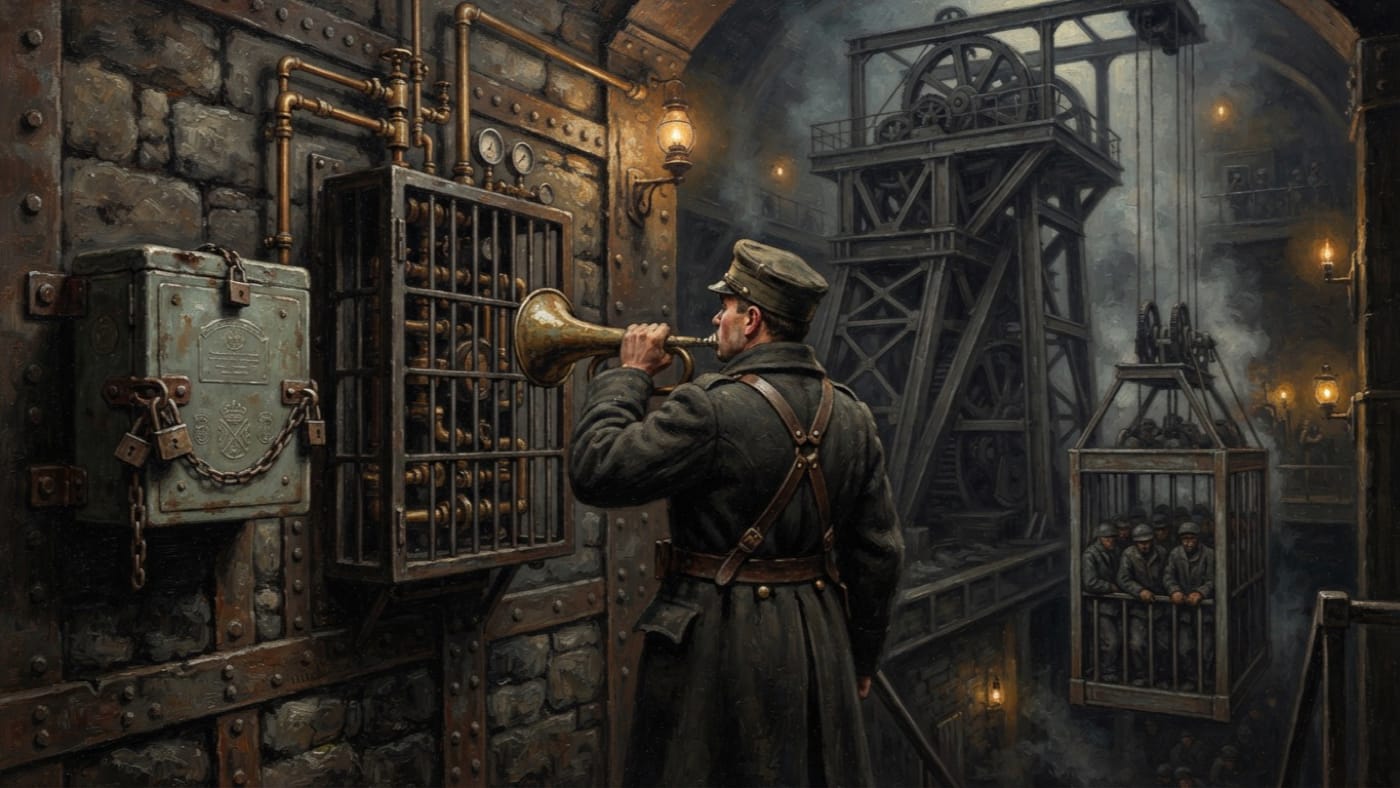
What the Liège account lets me say about the schedule's substance is less than a bishop would like. The horns are brass-throated and wall-mounted, and they sit behind locked grillework. Licensed wardens sound them at prescribed intervals. The horns signal descent, rise, danger, cease and assembly. The Horn Warden keeps the schedule in a locked tin case, sounds the horn, and records compliance. The miners must obey the schedule. They are not permitted to read it.
The account gives no blast counts, no durations, no hours, and no key saying which call means which function. It names the duties and keeps back the grammar. I have seen the grille and I have seen the case. I will not draw a timetable from a padlock.
As an instrument of law, the arrangement deserves closer attention than the Bureau's circulars give it. Under the bells, the obligation and the text that defined it lived in the same place: a miner's ear, his father's instruction, the guild's tables on a nail by the cage. A man knew what a stroke required because he had been told and had seen the requirement met. The Scourging annulled those tables. Under 14-L the obligation still sits with the miner, but the text has gone into the tin. He carries the duty. Someone else carries the document that defines it. He learns the law only by hearing it enforced.
I am a servant of the state and I find this efficient. I am also a reader, and I find it disgusting in a way I can only admire. In every other jurisdiction of the Church, a man condemned under a statute may at least, in theory, petition to hear its wording. Below Liège, a man complies with a horn or is recorded as not complying, and the record goes upstairs.
The account does not say who else holds a copy. It places cabinets for horn schedules in the office of the Bell Inspectorate, above the guild's old counting room. Whether 14-L sits there in a second copy, and whether the warden's key is the only one that opens his case, it leaves unsaid. I do not guess at the contents of cabinets I was not allowed to approach. Guessing is how one ends up in them.
Do the horns keep more men alive than the bells did? The account does not certify it either way. It reports the Bureau's satisfaction that output rose after the correction, and it reports the petitions below. I enter both and rule on neither. The Engines & Furnaces men who signed the second petition may have their own view. Engineers usually do, until a Bureau tells them otherwise.
#On Whistles, and the Year A.S. 119
The Meuse resisted the settlement more than the pits did. River men have never respected an ordinance they could not see from the deck. After the Scourging, the Liège account says, river workers took up whistle codes, arguing that the first wording of Schedule 14-L covered neither instrument: a whistle is not a bell, and a whistle is not a horn. As theology this was contemptible. As textual argument it was the cleanest work done in Liège that decade, and it was done by men who spat over the rail between clauses.
The account says the Bureau closed the gap in A.S. 119. The river workers then moved to chain-taps.
That is the whole record. I do not have the amendment's text, the name of the official who decided it, the means of enforcement, or the penalty for a whistle sounded after the gap closed. The river's argument and the Bureau's need to answer it eleven years after the Scourging show only that, as the river read it, the first wording was narrow enough for a bargeman to walk around. Any lawyer could tell the Bureau that a law nobody may read can still be argued over by anyone who has heard it enforced.
#On the Petitions
The Liège account reports that the city has twice petitioned for the restoration of local emergency bell privileges in deep-mine crises. According to the account, both petitions carried casualty tables showing delays under the horn protocol, testimony from widows, and engineers' notes saying that narrowly defined local bell signals could reduce deaths. Bells denied both. The account adds that an engineering recommendation attached to the second petition was later withdrawn from public circulation.
I have not seen the tables or heard the widows, and I make no claim about the dead beyond what the account claims for them. Note also that withdrawing a recommendation from circulation does not refute it. Here the Bureau answered the engineers with a filing decision instead of an argument, which is a respectable Bureau method and should never be mistaken for a measurement.
It is worth recording what the petitions asked for. They asked for bells: a narrow, local, emergency voice of the kind the eleven strokes had been. As far as the account shows, they did not ask to open the tin case. Perhaps the petitioners judged that request futile. Perhaps it never occurred to men who had grown up under the horns that a schedule could be read. Of the two explanations, the second is the better advertisement for the Bureau.
#On the Present Application
As of this A.S. 201 survey, the Liège account reports the mine horns still sounding from a sealed table. The grilles are locked. The wardens are licensed. The horns blow for descent, rise, danger, cease and assembly, and the men obey a text they will never read, written in a year this office cannot name and amended in a year it can. Tithes collects what it collects. Strasbourg cites the outcome.
At the pithead, the Horn Warden lifts his horn, blows the call, and watches the cage go down full. Then he takes the compliance record from the tin case, makes his entry for the shift, puts the record back with the schedule and locks the case.