
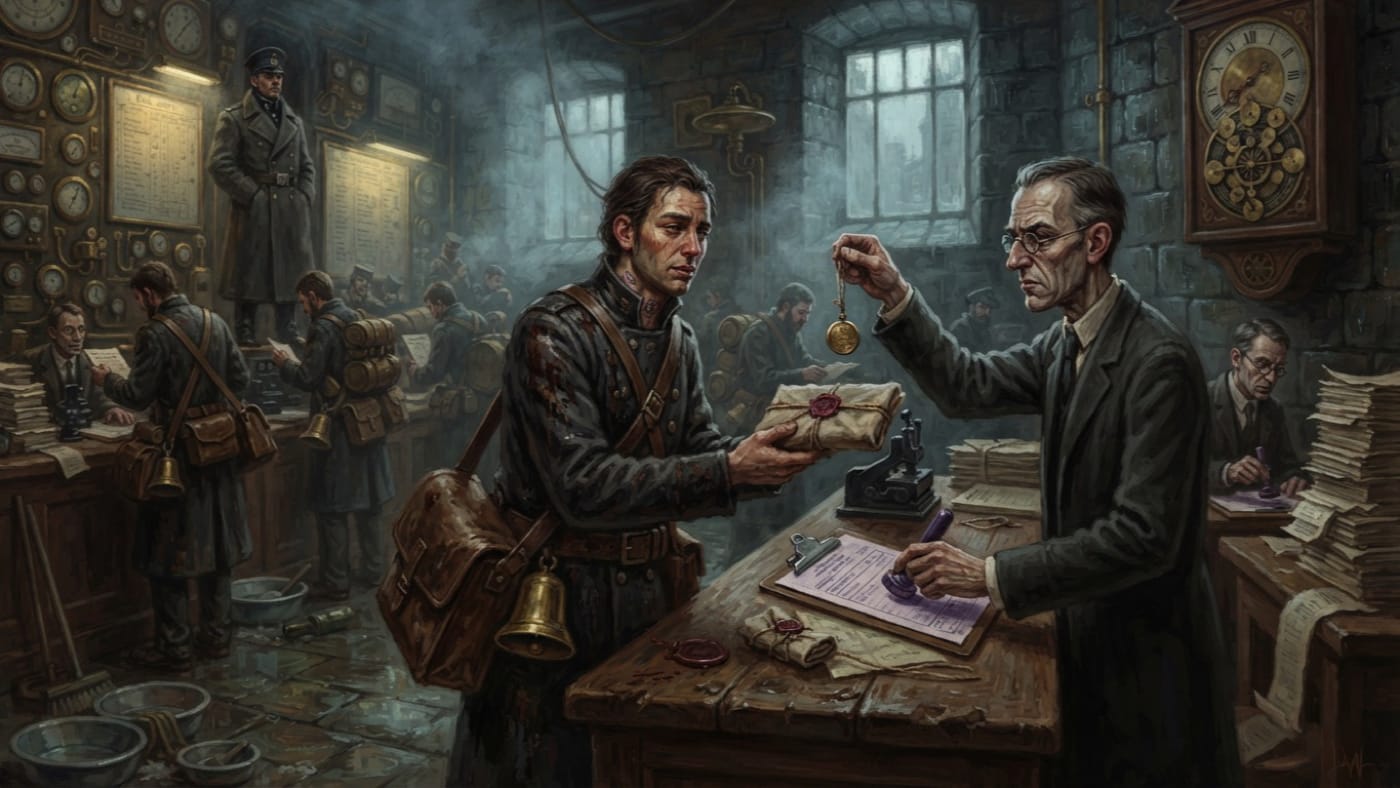
I've finished checking the continuity file, the voice guides and the Runner and Bellwarden lore. Now I'm writing the tract.
#On Judgment and Arrival
A condemnation is complete in Strasbourg the moment the Bureau of Purity seals it against the Index Damnatus. Everywhere else it is a rumour with prospects. Doctrine holds that judgment is immediate and that the courier merely reveals what has already been decided. Doctrine also draws the courier's wages, which suggests a private reservation.
The early decades of the Index taught the lesson at cost. Names condemned at the centre went on buying passage, rations and lodging at the edges, because the local ledger still carried them clean. The Night of Six Names remains the favourite humiliation. The surviving accounts quarrel over ships, offices and checkpoints; they agree on the lateness. In the Purity reforms of A.S. 80, which the later Synod would file under its own name, Procurator della Torre gave the Index legs. The Index Damnatus Runner Corps is the history of those legs.
Legs proved insufficient. A courier who arrives cannot by arriving prove which packet was current, when it left, or whether the clerk did anything once the courier had gone. Bellway Synchronisation answered the first two. Routes were set against bell-hours, and runners began carrying time-locked tokens as proof of current truth. No surviving file records who sealed the reform or in what year. Purity calls the omission modesty. I call it a filing failure with good posture.
#On the Bell-Hour
Take a representative relay-house in Strasbourg before Matins: wet stone, lye smoke, a tin basin, a keeper with a face like an unsigned warrant. Yesterday's strips burn first. The ash goes into the drain with the wax. The keeper stamps the Runner's throat-tag in violet with the day's cipher, and the Runner recites it without looking, taps the satchel clasp three times, and receives the packets: waxed, string-bound, keyed to bell-hours, valid from Matins to Iron Vespers. A night carrier holds the reverse window, Iron Vespers to Matins, and is paid a hazard allotment for the privilege of being hated by darker streets.
The Route Captain chalks the board. Gatehouses take the packet first, then orphanage registries, ferries, shrines and print-quarters, with permit and service desks thereafter. An urgent packet jumps the order and anyone standing in it. The Captain also redraws the board when a ferry fails or a street closes, which happens before breakfast more often than the Bureau's annual returns admit.
The hour itself does not belong to Purity. It belongs to the Bureau of Bells and the Bellwardens who keep its peal charts and calibration logs, open its gates and license its courier corridors. A Runner times each leg by the local tower: one gatehouse by this peal, the ferry by the next, the shrine vestibule before the bell after that. The bellways give every node in a district the same hour to hear, and therefore the same hour it cannot claim to have misheard. When a leg runs long, the Runners say the bell ate the route, and the Captain's chalk comes out again.
The small brass bell an Express Runner carries is a separate instrument. It buys priority through crowds, cordons and ferry chains, and it does nothing for the timetable. The towers keep the hour. The brass bell interrupts it, once, usually over a corpse.
#On Current Truth
The gate clerk inspects four things, which differ from one another and are confused daily by men paid to tell them apart.
The token is cold brass keyed to the route and the bell-hour. It shows the Runner is moving on the hour assigned, and it tattles when the Runner is late. The cipher on the throat shows the Runner belongs to today; a courier without one is a heretic with a satchel. The intact seal shows that nobody opened the packet between Strasbourg and this table. The receipt shows that the node acknowledged what arrived. Those four documents together make a packet current. Whether the name inside deserves what is about to be done to it is for Strasbourg to say, and Strasbourg has already said it.
Then comes application, which is the only part the condemned feel. The clerk crosses the ledger entry. The shrine warden replaces the notice behind the icon screen. The ferry office invalidates the passage token, and a do not serve line reaches the ration desk. The Runner witnesses each act, collects the countersignatures and the stamp, and leaves.
These are three separate events: arrival, acknowledgment and application. A clerk may stamp acknowledged at bell in the morning and cross the ledger after the midday peal. In the space between the stamp and the pen, a family whose passage token is still lawful boards the ferry. The receipt chain returned before expiry will show a perfect delivery, and in law it was one.
The strip burns at dawn regardless. Expiry belongs to the courier's credential. The name stays dead.
#On False Arrival
Synchronisation made arrival legible, and anything legible can be forged.
Receipt Farming buys a node's signatures in advance with favours, soap and boot oil, so that a late delivery reads as punctual. The Shadow Relay hands the packet to an unlicensed sprinter to save a bell-hour and forges the handoff afterwards. The Soft Drop leaves the amendment under a shrine tray for a fee and gives the target a head start measured in peals. The Name-Merchant skips the ledger altogether and sells tomorrow's condemnation to tonight's buyer, who is usually the condemned, sometimes a creditor, and occasionally a rival with a ferry to catch.
The False Packet Panic of A.S. 134 showed the larger danger. Forged bundles moved through three Rhineland cities under counterfeit Purity wax. Gate guards saw proper seals. Registrars accepted convincing ciphers. Four hundred people were arrested on names Strasbourg had never condemned. Every credential that Synchronisation teaches a clerk to trust testified to currency, and none of them testified to truth. A good seal made the false packet faster. The arrests produced riots, the riots produced genuine condemnations, and the genuine condemnations went out in properly timed packets.
Triple-witness handoffs followed, along with tamper-evident seals and daily cipher rotation. These are post-Panic integrity measures. Whatever Synchronisation first required, it did not require these, and the Bureau's habit of reciting them as if they were original provisions should be watched closely. The rotated ciphers have since been cracked twice. Purity discusses the first breach.
Initial Purity circulars classified the False Packet Panic as "minor wax irregularity."
Withdrawn. The wax was the most regular thing in it. Tokens ran on the hour, ciphers were accepted and receipts were stamped at the proper bell. What was irregular was the names, and no bell certifies a name.
#On Present Application
The A.S. 201 survey of the Corps places standard carriage across Zones 1–5, with counter-signature required in Zones 4–7 where War or Settlement interferes. That is permission and does not promise safe roads. Synchronisation works where towers ring on their charts, where ferries run, and where clerks are sober and frightened in roughly equal measure. A cut ferry rope, a riot street, demon fog in a corridor or a Runner simply too tired to climb the last stair will each defeat a lawful schedule. The Corps calls the outcome late truth and audits the boots.
Runners keep the hour in their bodies. They count steps between peals and flinch at hot wax. They wake in relay bunks at a bell that has not rung.
The ledger's lateness falls hardest on the people the packet names. In a town whose register is a day stale, a condemned family still holds a passage window that closes when a clerk's pen arrives. A registry refuses bread to a child whose surname changed at the last bell and was lawful at the one before. A whole block that served a name before its ledger learned to hate it is punished collectively for complicity by delay, and that punishment comes with a properly countersigned receipt.