
#On the Function of Speed
"Late is the same as false." — Runner Corps maxim, ratified without amendment since the Founding.
The Index Damnatus is the Synod's catalogue of annihilation. I have written of it elsewhere — its five Registers, its chained lectern in the Vault of Silences, its rolling compendium that grows fatter with each condemned name and forbidden syllable. What I did not write, because the subject merited its own entry, is the apparatus that makes the Index real. A catalogue locked beneath Strasbourg is theology. A catalogue sprinting through curfew streets with sealed packets in a grey coat — that is governance.
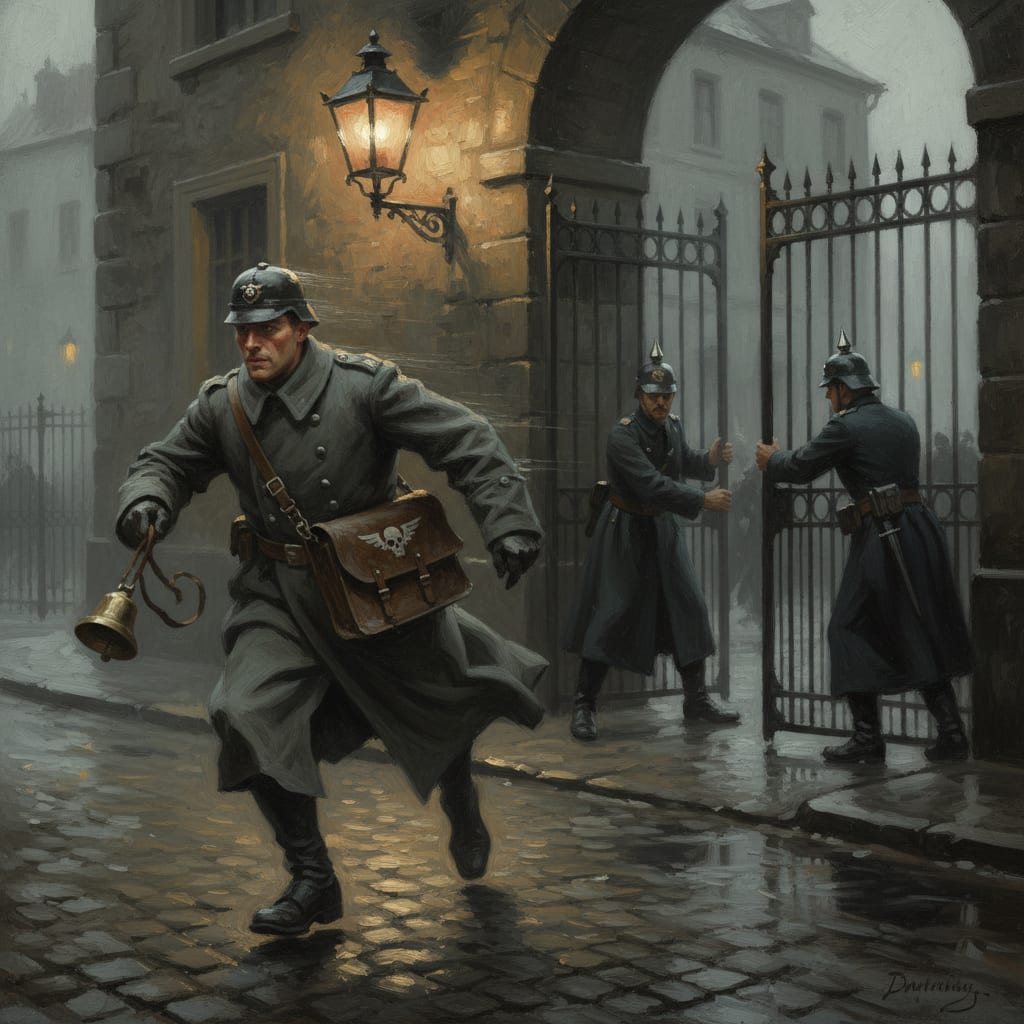
The Index Damnatus Runners are the Synod's circulatory system for erasure. They are couriers — young men and women of exceptional stamina and, as Procurator della Torre preferred, limited curiosity — whose function is to deliver damnation before the damned can flee. Some carry scars that soldiers would envy. Every packet they bear has been sealed with wax that was blessed before it was melted. A name condemned in Strasbourg at dawn must reach the last ferryman on the Rhine by vespers. A proscribed lineage flagged at the Bureau of Purity's desk must be in the hands of every orphanage registrar, every gatehouse notary, every ferry checkpoint before the children of the damned can cross a bridge, collect a ration, or marry into a clean ledger.
The mathematics are della Torre's. He calculated transit times from Strasbourg to every major node on the Sagittal Line — gatehouses, permit-yards, ferry crossings, shrine vestibules, the narrow rooms behind print-shops where the presses listen — and found them satisfactory. That was A.S. 80, when the Index had perhaps three hundred entries and the condemned could be counted on the fingers of a moderately zealous Procurator. The Index now runs to Volume XLVII. The condemned cannot be counted at all, because counting them would require acknowledging a number the Bureau finds unseemly.
#On the Origin and Founding
The Runner Corps did not spring from doctrine. It grew from failure.
In the early decades, the Index operated on a quarterly update cycle: provincial copies of the banned registers were dispatched to bastions and cathedral cities in sealed crates, carried by ordinary Bureau couriers at ordinary Bureau speed. The system functioned adequately until a condemned official named Veyrel — a name the Bureau has since struck from even its own internal histories, which tells you something about the severity of the embarrassment — crossed three ferries, changed his documentation twice, married his daughter into a clean family in Cologne, and was seated at a Procurator's dinner table before the quarterly Index update naming him arrived at the city gates. The ferryman who waved him through had been operating on information four months stale. By the time the sealed crate reached Cologne, Veyrel had been a citizen in good standing for eleven weeks.
The Night of Six Names followed — six condemned persons, in six separate cities, crossing six separate checkpoints on papers the checkpoints had no reason to doubt. Each was fleeing a ban that existed in Strasbourg but did not yet exist at the gate through which they passed. The Bureau of Purity's internal memorandum, which I have read and which I am told does not exist, described the situation with uncharacteristic candour: "The Index is faster than the damned only when it moves faster than the damned."
The Runner Corps was funded the next morning. Della Torre did not request the budget. He announced it as a fait accompli, presented the transit calculations, and informed the Bureau that the alternative was a proscription system that existed on paper and nowhere else. The budget was approved. Della Torre, characteristically, had already hired the first twelve Runners.
#On the Mechanism of Delivery
A Runner's day begins at a relay-house — one of eight hundred cramped, lye-smelling, perpetually damp stations positioned along the major transit arteries of Zones 1 through 5. The relay-house keeper stamps the Runner's throat-tag with the day's date and cipher, issues the sealed packets and route tokens, and burns yesterday's strips in a tin basin. The burning is not optional. An expired strip is heresy in paper form — truth that was true yesterday and is a lie today, and the Synod does not tolerate lies that wear the Bureau's seal.
The packets are wax-sealed, cipher-keyed, and time-locked to bell-hours. A packet stamped at Matins is valid until Iron Vespers. A packet stamped at Iron Vespers is valid until the next Matins. Beyond that window, the packet's contents are no longer truth — they are obsolete, and obsolescence is a category of sin the Bureau of Doctrine has never bothered to classify because it has never needed to. Everyone understands that stale paper kills.

The route is fixed by bell-cadence: gatehouse drops first, because gates control movement; orphanage registries second, because the children of the damned must be flagged before they can be adopted into innocence; ferry crossings third, because water is the oldest escape; shrine vestibules fourth, because a condemned man may still seek sanctuary if the shrine-warden has not received the update; print-quarters last, because the presses must know which names can no longer be set in type. At each node, the Runner delivers the packet, obtains a countersigned receipt stamped with the bell-hour of delivery, confirms the purge — old signage burned, ledger margins crossed, tokens invalidated — and moves to the next.
The receipts matter more than the delivery. A Runner who delivers without receipts has accomplished nothing, because unreceipted delivery is indistinguishable from non-delivery, and non-delivery is indistinguishable from treason. The chain of custody is the proof that the Index lives. Break the chain and the ban reverts to theology — words in Strasbourg, meaningless at the gate.
#On the Corps and Its Hierarchy
The Runner Corps is not large. Della Torre kept it lean by design — twelve at founding, perhaps eleven hundred active across the eight zones by A.S. 201 — because a lean corps is a controllable corps, and controllability is the only virtue the Bureau of Purity prizes above zeal. The hierarchy is simple and brutal:
Strip-Runners work local districts. A Strip-Runner's route is three gatehouses, two orphanage registries, and whatever shrines fall within a half-bell's sprint. They carry single-day validity strips and earn rations, a relay-house bunk, and the privilege of being ignored by Inquisitors who have larger quarry.
Relay Couriers run multi-node routes — ferries, river crossings, the Carpathian corridor passes where a single missed update can leave a condemned family free to cross into Zone 4 and vanish among the levy-villages. Their packets are thicker, their ciphers more complex, their boots more worn.
Route Captains do not run. They assign, coordinate, and override. When a new name falls — a sudden condemnation, a freshly discovered lineage, a Bureau of Purity raid that produces six heretics before noon — the Route Captain redistributes the Corps, cancels scheduled routes, and dispatches emergency couriers carrying hot-sealed packets whose wax is still soft when they reach the first gate.
Damnatus Express is the designation no Runner wants and every Runner covets. High-value bans — senior clergy, military officers, persons whose condemnation will produce political consequences if they flee — require a dedicated courier who will deliver the packet to every relevant node before dusk. No excuses. No delays. No ferries missed. The Express Runner carries a brass bell that he does not ring unless he is dying, because the bell's sound grants him absolute priority over every checkpoint, ferry queue, and curfew patrol in his path.
#On the Corruption and the Counterfeit
A system built on speed breeds a particular species of rot.
The simplest corruption is the Soft Drop — a Runner who, for a price, leaves the update under a shrine tray instead of delivering it to the shrine-warden's hand. The condemned gains a few hours. The Runner gains a coin or a favour. The shrine-warden finds the packet at evensong, files the update, and records the delivery time as "received." No receipt is falsified. The delay is invisible unless an auditor checks the bell-hour stamps against the transit calculations, which auditors do, because auditors exist to check bell-hour stamps against transit calculations, and della Torre built the audit system with the same obsessive rigour he applied to everything else.
The Shadow Relay is more dangerous: a Runner hands the packet to an unlicensed sprinter — a street boy, a debtor, a member of the Black Ledger with fast legs and flexible principles — to shave a bell-hour off the route. The Runner then forges the receipt and files it as his own. If the shadow relay delivers correctly, no one knows. If the shadow relay opens the packet, sells the names, or simply loses the satchel in a gutter, the Runner is immured and the shadow relay is never found.
The False Packet Panic of A.S. 134 exposed the system's deepest vulnerability. Counterfeit blacklist bundles — sealed with forged Bureau wax, carrying invented names — circulated through three Rhineland cities in a single week. Gatehouse guards, unable to distinguish the forgeries from genuine Index amendments, arrested four hundred citizens on the strength of names that had never been condemned. The wrongful arrests produced riots. The riots produced genuine condemnations. The genuine condemnations produced real packets. By the time the Bureau sorted the counterfeit from the authentic, the distinction had ceased to matter — the damage was the same, and the damned were equally dead.
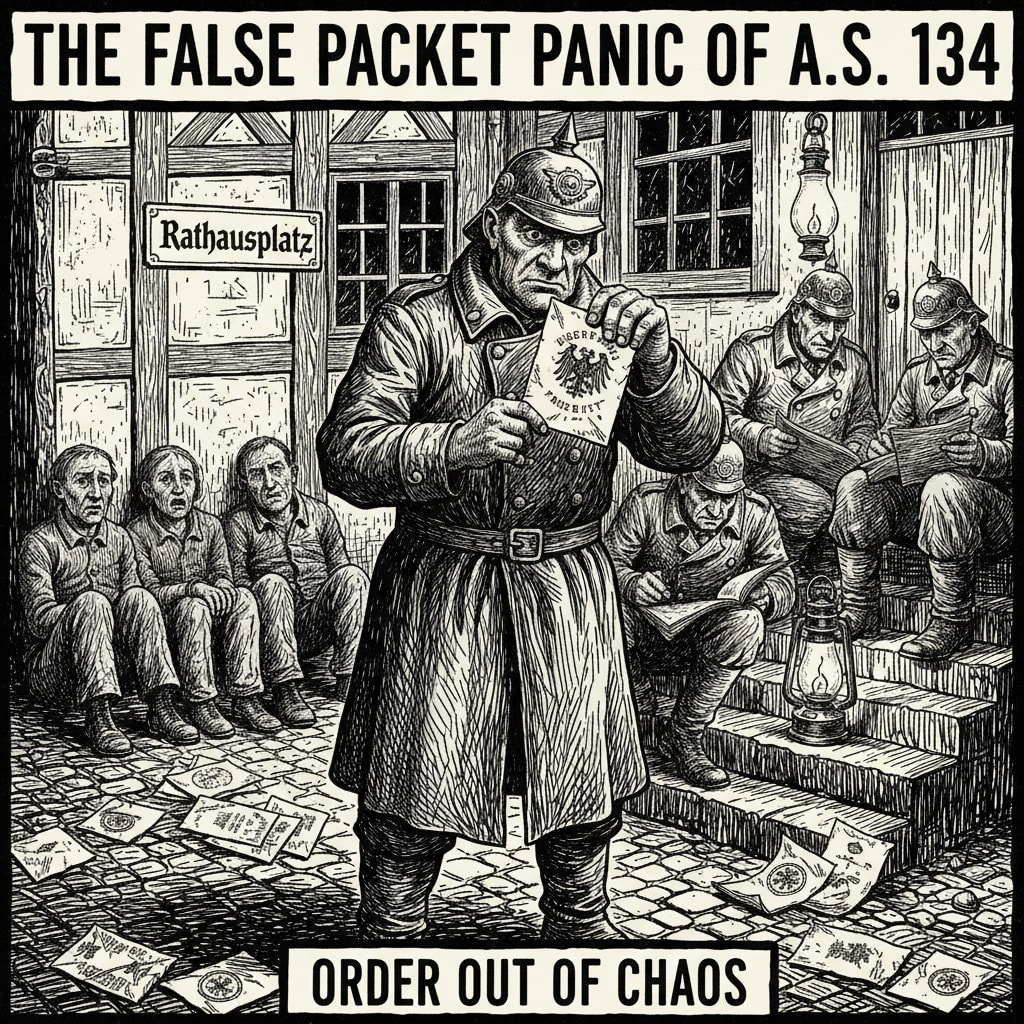
The Corps responded with stricter seals, chain-of-custody rituals involving three witnesses at each relay handoff, and a cipher system that changes daily. The ciphers have been cracked twice. The Bureau of Purity does not discuss the second time.
#On the Cost to the Carrier
The profession file for an Index Damnatus Runner lists the standard hazards: exhaustion, frostbite, street violence, infection from crowded relay bunks, bell-stress delirium. These are the hazards of any courier. What the profession file does not list, because the Bureau of Purity does not recognise psychological categories it cannot stamp, is what the Runners call index echo — the condition of hearing condemned names in random speech.
A Runner who has delivered three hundred packets begins to hear the names in market chatter. The baker calls out "Veyrel" and the Runner flinches, because Veyrel was last Tuesday's Register of Names, third strip, second entry. A child shouts "Maren" in a game and the Runner's hand goes to his satchel, because Maren was a lineage flag from last month's express. The names adhere. They accumulate. After a year, the Runner carries a private Index in his skull — a catalogue of the dead-on-paper that no burning ritual can purge.
The burnout endpoint is known to every Runner and spoken of by none. You become a relay — a thing that carries, delivers, and returns, with no interior life beyond the route and the receipt. Your friends are nodes. Your home is a bunk with a satchel strap around your wrist. Your loyalty is to the seal, because the seal is the only thing that never changes its mind about you.
Or you become a Name-Merchant — selling tomorrow's damned to tonight's highest bidder. The Black Ledger pays well for advance knowledge of condemnation. A family warned twelve hours before the packet arrives can cross a ferry, change their documentation, and vanish into the Warrens where forty thousand souls live unregistered and the Bureau of Settlement has spent a decade pretending otherwise. The Name-Merchant is the Runner's mirror, the corruption that proves the system's power: if the Index were not worth obeying, it would not be worth betraying.
Earlier entries described Index Damnatus Runners as operating exclusively under the Bureau of Purity's command.
Operational command remains with the Bureau of Purity. However, route authorisation in Zones 4–7 requires counter-signature from the Bureau of Settlement's Transit Writ office, and emergency dispatches during garrison alerts fall under the Bureau of War's temporary jurisdiction. I am advised that the phrase "exclusively under" is a luxury the Synod's administrative geography no longer affords.
#On the Present Condition
The Corps operates. Eleven hundred Runners in eight zones, carrying sealed packets along routes calculated a century ago by a man who slept with a quill in his hand. The transit times are faster now — Bellway Synchronisation has keyed every relay to the bell-cadence, so a packet sealed at Matins in Strasbourg reaches Bastion-Brest by High Angelus and Bastion-Przemyśl by Iron Vespers. The ciphers change daily. The seals are tamper-evident. The auditors audit.
And the damned still flee. They change names at ferry crossings. They marry into clean ledgers. They bribe gatehouse clerks whose salaries have not kept pace with their hunger. They slip through the cracks that exist between one bell-hour and the next, because the Synod's power, for all its precision, is still the power of paper delivered by human legs across distances that do not shrink when the Bureau wills it.
The Runners know this. They run anyway. Late is the same as false, and a name that reaches the gate alive is a name that the Index has failed to kill. So they run — through curfew fog, through riot streets, through demon weather that scrambles ciphers and turns bell-tones into frequencies the Bureau of Bells has classified but not explained — and they deliver the dead. One packet at a time. One name at a time. One seal at a time.