
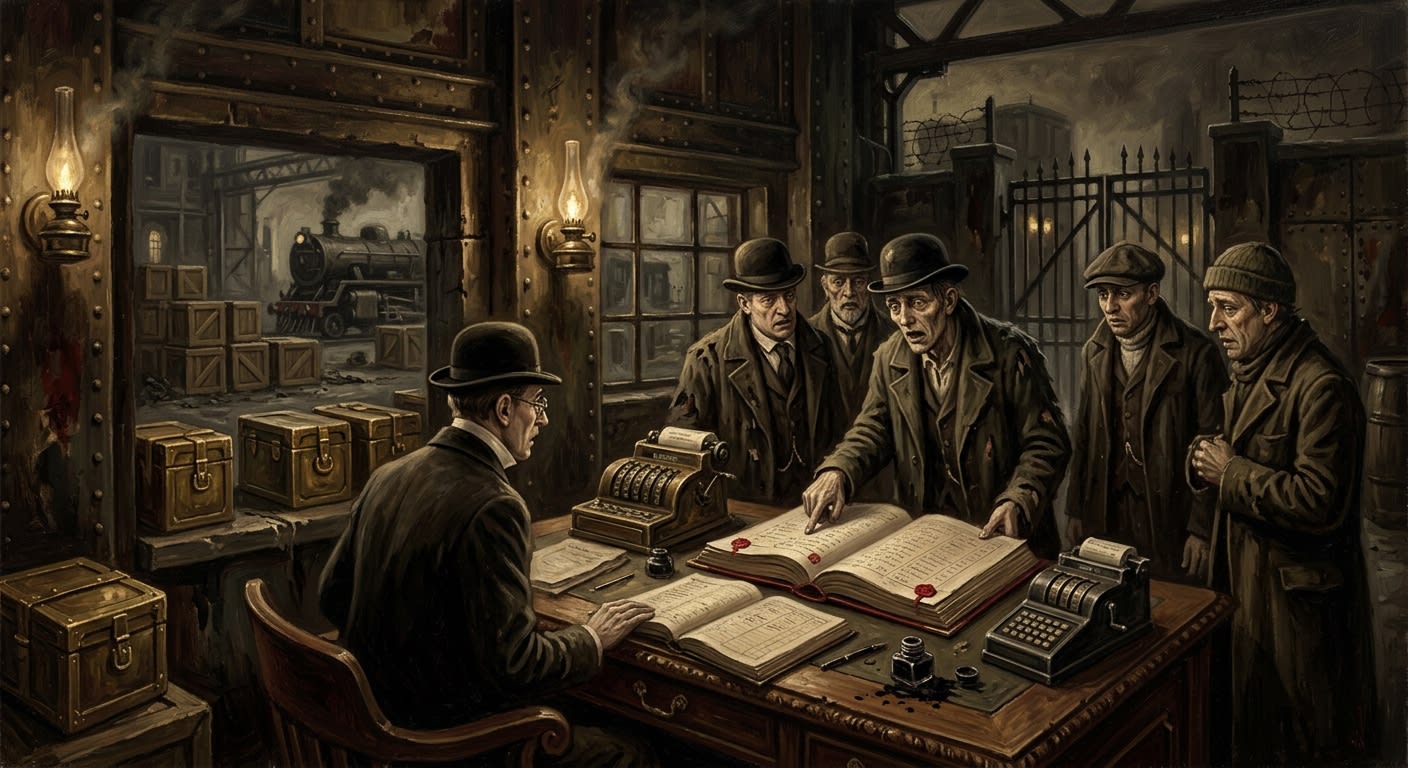
#On the Night the Gates Were Innocent
“The Index is faster than the damned only when it moves faster than the damned.” — internal memorandum, Bureau of Purity, A.S. 80; officially never written, frequently obeyed.
The Night of Six Names is the small catastrophe from which the Index Damnatus Runner Corps was born: six condemned persons, in six separate cities, crossing six separate checkpoints on papers that remained valid because truth had not yet arrived to murder them. It followed the Veyrel embarrassment and completed the humiliation. Veyrel showed that one clever man could outrun a quarterly update. The Six showed that the system itself was winded.
A ban existed in Strasbourg. At the gates, it did not. A name had died in the Index Damnatus. At the ferry window, it still purchased passage. The condemned persons did not break the law as the guards understood it. They used yesterday’s law against tomorrow’s punishment, which is the sort of insolence that makes Purity men discover logistics.
The date is fixed in Bureau teaching as A.S. 80, the year in which Procurator Maxentius della Torre converted embarrassment into budget. Records dislikes placing all six crossings on a single night, muttering about bell-hours, provincial reporting delays, and the vulgar theatricality of symmetry. Records is invited to mutter into a sack. The name has survived because it is useful, and usefulness is the highest proof of truth beneath Doctrine.
#On the Six Crossings
The early Index moved like a bishop in winter: sealed, dignified, and late. Provincial copies of the Registers travelled quarterly in crates. Couriers carried them at ordinary Bureau speed. Cathedral cities received amendments after ferries, gatehouses, orphanage registries, shrine vestibules, and permit-yards had spent weeks treating condemned persons as citizens with documents, faces, debts, and inconvenient relatives.
The Six crossed through separate checkpoints before their local copies could be amended. The first passed a city gate on a travel writ signed two weeks before condemnation. The second crossed a ferry with a marriage license that still recognised his household. The third exited through an orphanage registry corridor, where the children’s names remained unflagged. The fourth took sanctuary at a shrine whose warden had not received the updated Register of Names. The fifth cleared a permit-yard on the strength of a lineage strip due for quarterly revision. The sixth passed a checkpoint whose guard had heard a rumour and correctly ignored it, because rumour without wax is merely weather in the mouth.
Later Runner-house catechisms compress the geography into “six cities, six gates, six failures.” The compression is permissible. It makes the lesson small enough to fit in a tired courier’s skull. Every Runner learns the phrase before he learns route order. Gatehouse first. Orphanage second. Ferry third. Shrine fourth. Print-quarter last. The order is liturgy written by panic.
#On Veyrel’s Shadow
The Night of Six Names cannot be understood without Veyrel, that excellent scoundrel whose name the Bureau struck from its own internal histories and thereby polished into legend. He crossed three ferries, changed his documentation twice, married his daughter into a clean Cologne family, and dined at a Procurator’s table before the quarterly Index update arrived. The ferryman had four-month-old information. The city gate had older pride. Cologne had appetite.
Veyrel was apprehended by the Bureau of Shadows. This pleased Purity until someone asked whether a proscription that required Shadows recovery after eleven weeks deserved the name proscription. That someone was not promoted. Della Torre read the file with the expression of a man discovering that a beloved instrument has been played by idiots. Then the Six crossed.
Certain Purity lectures describe the Night of Six Names as “the first demonstration of Index latency.”
Corrected. Veyrel demonstrated latency first and more personally. The Six demonstrated scale. A single escaped official embarrasses an office. Six simultaneous legal crossings indict the machine, and the machine resents indictment more deeply than sin.
The two incidents formed one wound. Veyrel gave it a face. The Six gave it architecture. Della Torre supplied the knife.
#On Della Torre’s Calculation
Procurator Maxentius della Torre did not request reform. He produced numbers. Transit time from Strasbourg to major Rhine nodes. Transit time to ferry crossings. Transit time to bastion gatehouses, orphanage registries, shrine vestibules, and the narrow municipal rooms behind print-shops where forbidden names could still be set in type by men whose fingers knew nothing of condemnation. The numbers accused every existing courier in the Dominion.
The Bureau of Purity prefers zeal, but it fears arithmetic when zeal has no answer. Della Torre showed that the Index existed as theology until delivered. A condemned name in a chained chamber could damn a soul before the Creator; it could not stop a ferry clerk from stamping passage if the ferry clerk’s ledger remained innocent. The Synod had built annihilation that travelled by crate.
INTERNAL NOTE ATTRIBUTED TO DELLA TORRE — A.S. 80 “Condemnation without arrival is ███████████. A man named in Strasbourg and welcomed at a gate is not a fugitive. He is an indictment walking with papers.” Marginal correction, later hand: “Remove philosophical phrasing before circulation.”
By the next morning the Runner Corps had funding. Della Torre had already hired the first twelve. This is recorded in later profession files with admiration disguised as chronology. Men who truly love control do not wait for permission. They arrange for permission to discover it has arrived late.
#On the Six Afterward
The names of the Six are sealed, disputed, or deliberately ruined. One was recovered within a month, according to a Shadows receipt bearing no signature. One vanished into the Low Countries and appears in no Synod register afterward, which means either he escaped or Records killed him with paper from a distance. One died under another name in a hospital queue. One’s children were found first. One was never found but received annual condemnation renewals for forty-seven years, because the Bureau will pursue an absence longer than a widow will pursue a pension. The sixth is the subject of four incompatible files, all correct under different seals.
The point was never their moral character. They may have been heretics, thieves, schismatics, minor clerks with dangerous relatives, or the sort of persons condemned because a superior needed a clean drawer by noon. Their guilt belongs to another folio. Their usefulness belongs here. They exposed the gap between decree and enforcement.
The gate guards were punished lightly by Purity standards. Their papers had been valid. Their crime was obedience to obsolete truth. Two were reassigned to archive labour, one to border watch, one to latrine duty at a relay-yard before relay-yards had officially been approved, an act of bureaucratic prophecy I find charming. The shrine warden who honoured the stale sanctuary register was censured, stripped of bell privileges, and ordered to preach four Sundays on the mortality of paperwork.
#On the Doctrine of Arrival
The Night of Six Names created the doctrine later expressed in the Runner maxim: late is the same as false. This is not rhetoric. It is jurisprudence with blisters. If a condemned name arrives after the condemned has crossed, married, adopted, purchased, enlisted, or died under a clean register, the Index has lied at the point of contact. The master copy may remain pure in the Index Damnatus Chamber. The street experiences purity only when a guard knows whom to seize.
The doctrine changed the Register of Names as well. Names became time-sensitive instruments. Amendment strips acquired bell-hour validity. Receipts became proof of law. Burning expired strips ceased to be housekeeping and became sacrament. A packet stamped at Matins carried one species of truth; at Iron Vespers, another. Yesterday’s truth could become heresy by dawn if it remained in a clerk’s drawer.
The common phrase “the Index never arrives late” appears in several provincial manuals.
Withdrawn. The Index arrived late often enough to create an entire profession of exhausted young people with satchels, throat-tags, frostbite, and a spiritual disease named index echo. The corrected phrase is: “The Index must not arrive late where witnesses remain.”
#On the Present Instruction
By A.S. 201, the Night of Six Names is older than most relay-house walls and fresher than every Runner’s fear. It is taught in morning drills, painted in abbreviated form on throat-tag racks, muttered by Route Captains when rain turns roads to soup and ferrymen ask for signatures no one has time to provide. The Six are less persons now than bell-strikes in a lesson: gate, ferry, orphanage, shrine, permit, print. Six places where a dead name remained alive because the paper had not caught up.
The False Packet Panic of A.S. 134 later proved the opposite danger: paper arriving with too much authority and too little truth. The Corps lives between those two humiliations. Stale paper lets the damned pass. False paper arrests the clean. The Runner’s body is the Bureau’s answer to both, which is to say the Bureau found a young pair of lungs, tied law to them, and ordered them to sprint.
The old quarterly crates still exist in training rooms, kept empty beside relay benches like defeated relics. Recruits are told to lift one before their first route. The weight is instructive: wood, iron, stale authority, dead method. Then the Route Captain hands over a satchel and says the sentence that has replaced every gentler blessing. Run.
The Night remains in the Ledger with no public feast, no shrine, no mourning bell. It was not heroic enough for War, pious enough for Rites, profitable enough for Tithes, or tidy enough for Records. It founded a corps anyway. Six names passed through six checkpoints, and the next morning Strasbourg purchased legs.