
#On the Week the Packets Lied
“Late is the same as false.” — Runner Corps maxim, amended in taverns after A.S. 134 to add: “early is worse.”
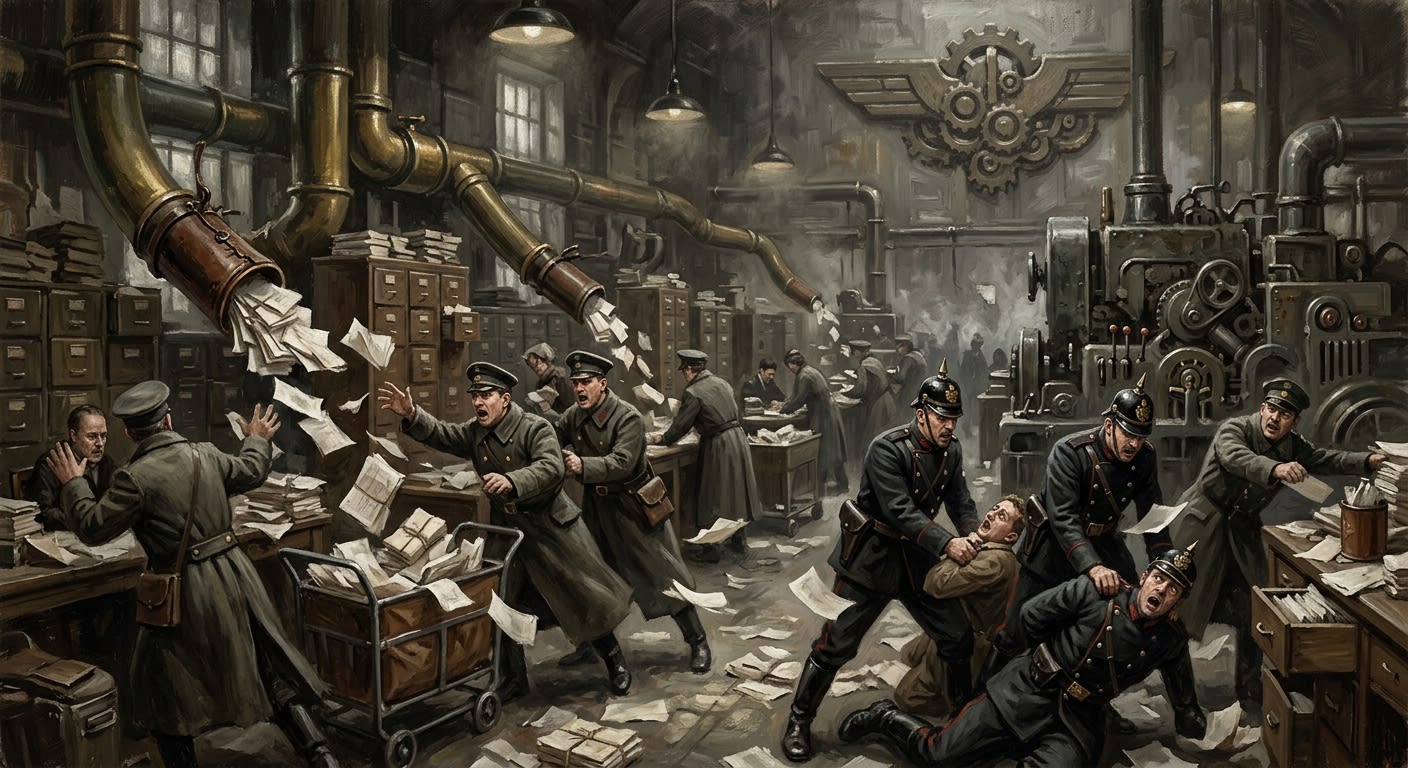
The False Packet Panic of A.S. 134 began with counterfeit blacklist bundles moving through three Rhineland cities in a single week, each bundle sealed with forged Bureau wax, each carrying invented names, each convincing enough to make a gatehouse guard choose violence over thought. Four hundred citizens were arrested on the strength of names that had never entered the Index Damnatus. Some were shopkeepers. Some were widows. Some were merely standing near doors when the packet opened. Proximity has ruined better men.
The Bureau of Purity describes the event as a document irregularity. I describe it as paper learning to bite.
The Index was already feared by A.S. 134. Its Runner Corps, founded after the shame of Veyrel and the Night of Six Names, had made condemnation mobile: a name struck in Strasbourg could reach ferries, orphanages, shrine vestibules, and gatehouse notaries before the condemned had finished sweating through his first lie. The packet was the Index’s hand extended into the street. Men obeyed it because delay was treason, doubt was sympathy, and sympathy in Purity work is a confession waiting for ink.
#On the Three Rhineland Cities
The surviving files refuse to agree on which three Rhineland cities first received the counterfeit bundles. This is not mystery. It is shame with a filing cabinet. Each city had gatehouses trained to receive daily amendment strips from the Runner Corps; each maintained local copies of the Register of Names; each had guards taught that a fresh packet superseded yesterday’s truth. The counterfeiters understood the chain. They did not need to beat the system. They wore its cassock.
The bundles carried invented names in proper order, with plausible lineage flags, sufficient charge categories, and seals impressed from forged Bureau of Purity wax. The wax was the genius. Citizens trust ink only when wax stands over it with a red fist. A guard at the first gatehouse opened the packet, read the names aloud, and ordered the arrests. The second city followed before the first could send warning. The third received both rumour and packet together and chose the packet, because rumour has no seal.
Gatehouse guards arrested citizens whose only crime was legibility. Families produced marriage slips, baptismal cards, ration tags, and letters from sons at the Line. None of these prevailed against a blacklist packet with warm wax. A woman named Marta Brenn — clean parish, clean tithes, two dead brothers at Bastion-Brest — was taken because the packet listed “M. Brenn, widow-line, suspicious correspondence.” Her correspondence was a bakery account. The account was later found genuine. Her cell had been reassigned by then.
WITNESS DEPOSITION — RHINELAND GATEHOUSE TWO Question: “Did the guard compare the packet against the local Register?” Answer: “He said the packet was newer than the Register.” Question: “What happened when the first arrested man denied the name?” Answer: ███████████████████████████████████████ Marginal note: screams from outer yard made continuation impractical.
#On Riots Becoming Evidence
Wrongful arrest is a delicate phrase, like calling a guillotine an abrupt correction. The citizens resisted. Wives shouted names the packet had condemned into silence. Sons threw stones. Apprentices overturned a Purity wagon in the second city and discovered, inside, three authentic packets addressed elsewhere. By dusk the false arrests had produced real riots. By midnight the riots had produced genuine condemnations. By Matins the genuine condemnations required true packets.
The counterfeit and the authentic entered the same streets. Guards who had arrested clean citizens in error now arrested rioters in law. Families who had protested innocence were charged with obstruction. Men detained under invented names acquired real charges by resisting the invented charge. The distinction between false and true rotted in the yard before the bodies cooled.
The Bureau of Purity could not sort the forged packets from the genuine before the damage became equal. A counterfeit name had led to an arrest; the arrest had led to a riot; the riot had created a real name for the Index. What should the clerk strike out? The false beginning? The lawful ending? The blood between them? Records prefers a clean line through one item. History, that filthy junior clerk, spills across the page.
Early district summaries described the arrests as “pre-emptive detentions of persons later associated with riotous conduct.”
Corrected. Many persons were detained before any riot occurred. Their detention helped manufacture the riot that later justified detention. The Bureau thanks chronology for its service and reminds it to keep quiet.
#On the Runner Corps Response
The Runner Corps emerged from the panic angrier, faster, and less innocent, though innocence in a damnation courier is a decorative defect. Triple-witness relay handoffs became mandatory. A packet leaving a relay-house required keeper, Runner, and witnessing clerk. A packet received at a gatehouse required guard, notary, and receiving officer. Tamper-evident seals replaced ordinary wax on priority amendments. Receipt chains acquired bell-hour notations in a hand separate from the Runner’s. Every strip burned at day’s end had to be witnessed twice.
The reforms worked, which is the cruelest thing one can say about them. They reduced forgery, slowed delivery, increased audit work, and produced a new market in witnesses willing to remember a handoff for money. Daily cipher rotation followed. The first new cipher held for nine months. The second cracked sooner. The Bureau admits the first breach and does not discuss the second.
Shadow Relays became a harsher offence after the panic. A Runner who handed a packet to unlicensed legs was no longer guilty merely of outsourcing without authorisation, that splendidly bloodless phrase. He was guilty of opening the route to false paper. Name-Merchants also grew richer. If a false packet could ruin four hundred citizens, an early warning of a true packet could save a condemned household for the price of a conscience. The Black Ledger learned quickly. Criminals often do. It is their only administrative virtue.
#On the Chamber’s Silence
The master Index in the Index Damnatus Chamber remained chained, open, cold, and technically innocent. No false name had been entered there. The forgeries lived outside the chained book, in packets and copies and gatehouse authority, which made the matter worse. A corrupt master text is heresy. A clean master text with dirty limbs is governance.
Purity’s official conclusion held that the Index remained inviolate. This was true in the narrow sense, which is the sense most useful to a Bureau escaping blame. The Index had not lied. The packet system had been impersonated. Gatehouse obedience had been exploited. Runner speed had magnified the injury. The citizens, by being arrested wrongly and then reacting poorly, had created administrative consequences requiring firm response.
The chamber’s custodians took comfort from their chains. The book had not moved. The lectern had not been breached. The page-turning gloves remained bleached, counted, folded, and blessed. This comfort was idiotic in a technically defensible way, which is the finest grade of institutional comfort.
#On the Present Use of the Panic
By A.S. 201, the False Packet Panic is taught in Runner houses as a seal lesson, in Purity barracks as a caution against hesitation, and in black-market alleys as proof that the Bureau’s face can be copied if one finds the right wax and the wrong clerk. The official teaching is procedural: inspect the seal, confirm the cipher, witness the handoff, burn the expired strip, distrust any bundle whose urgency exceeds its paperwork. The unofficial teaching is simpler. Paper does not need truth if men have been trained to fear delay.
Four hundred wrongful arrests remain the clean number. The files do not agree on how many died in custody, how many were later condemned for resisting false charges, how many vanished into the Paper Mines of Ulm, and how many were released into lives permanently annotated by a mistake no office will own. The Bureau dislikes numbers that do not improve its posture. It calls them unresolved.
Public catechism notes once praised the A.S. 134 reforms as “the restoration of trust in the Index packet chain.”
Withdrawn from instructional use. Trust was not restored. Obedience was reinforced. Trust is for husbands, dogs, and provincial saints with no budget authority.
The packet remains sacred. The seal remains feared. The Runner still enters the gatehouse with breath in his throat and death in his satchel. The guard still opens the bundle. The citizen still waits to learn whether the name inside has always belonged to him.