
#On the Plural Error
The plural is where the trouble begins.
A Bellway may be defined cleanly enough for catechism: an authorised acoustic corridor, carrying command, recognition, doctrine, or sanctified passage through lawful sound. A child can memorise that sentence. A clerk can stamp it. A dying soldier can even believe it for three seconds, if no one nearby is screaming too loudly. One road multiplied would be mercifully simple. Bellways are a quarrel of roads pretending to be a system, an argument in bronze, breath, dust, altitude, and fear, spread from the Baltic to the Bosphorus with Strasbourg at the counting desk and Hell listening for the wrong note.
The Bureau loves singular nouns because singular nouns can be owned. Bell. Route. Token. Tower. Ark. A plural slips the leash. Bellways cross, overlap, interfere, go blind, answer late, throw shadows of sound into districts that did not request governance, and make every office claiming auditory authority look both indispensable and foolish. The Bureau of Bells says Bellways belong to bronze. The Bureau of Orison and Song says the sky-sermon gives them voice. Records says no sound exists until logged. Purity says any unlicensed sound is evidence. Doctrine, in its old charity, says all of them are correct and invoices them separately.
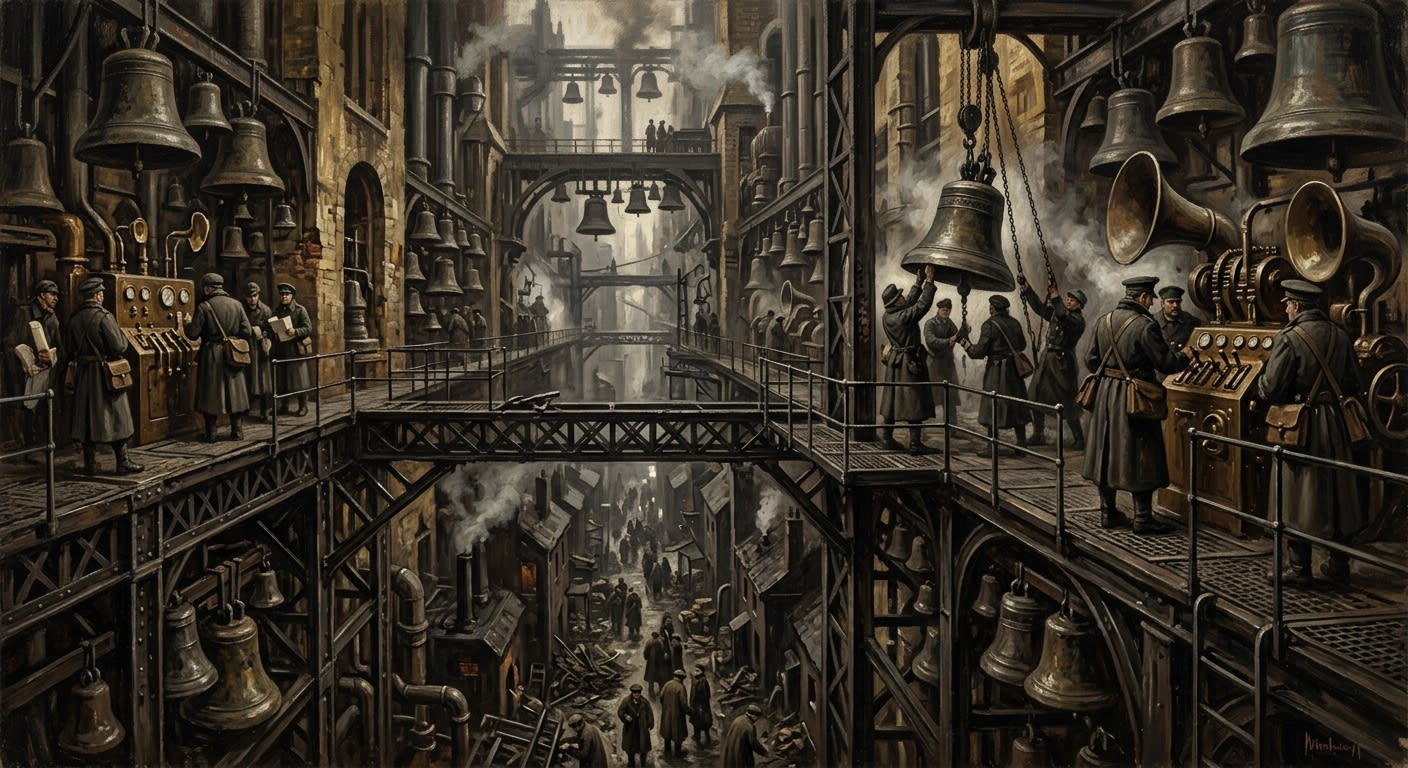
Bellways are the Synod's great doctrine of audible territory. They make air behave like law. They inform roads when bodies move, trenches when men must wake, towers when hostile tone enters, Arks when sky must be blessed, and mothers when their children have cried through a broadcast hour and thereby committed the first soft treason of infancy. The faithful are told Bellways protect them. They do. The faithful are told Bellways guide them. They do. The faithful are rarely told Bellways report them, price them, sort them, and occasionally abandon them three hundred yards from mercy because a core chimed almost correctly.
That omission is liturgical economy.
The plural must be treated as doctrine rather than map. A map lies by drawing edges too politely. Bellways have edges the weather moves, demon-pressure chews, clerks revise, and poor travellers discover with their ankles.
#On the Three Heights of Lawful Sound
The old instructional book divided the world vertically with more elegance than safety: above, the Bellways; below, pilgrim roads; beneath, crypt routes. It was a handsome division, fit for wall charts, schoolroom boredom, and public confidence. It was also incomplete. Bellways occupy more than the air above. They occupy three heights, and each height accuses the others.
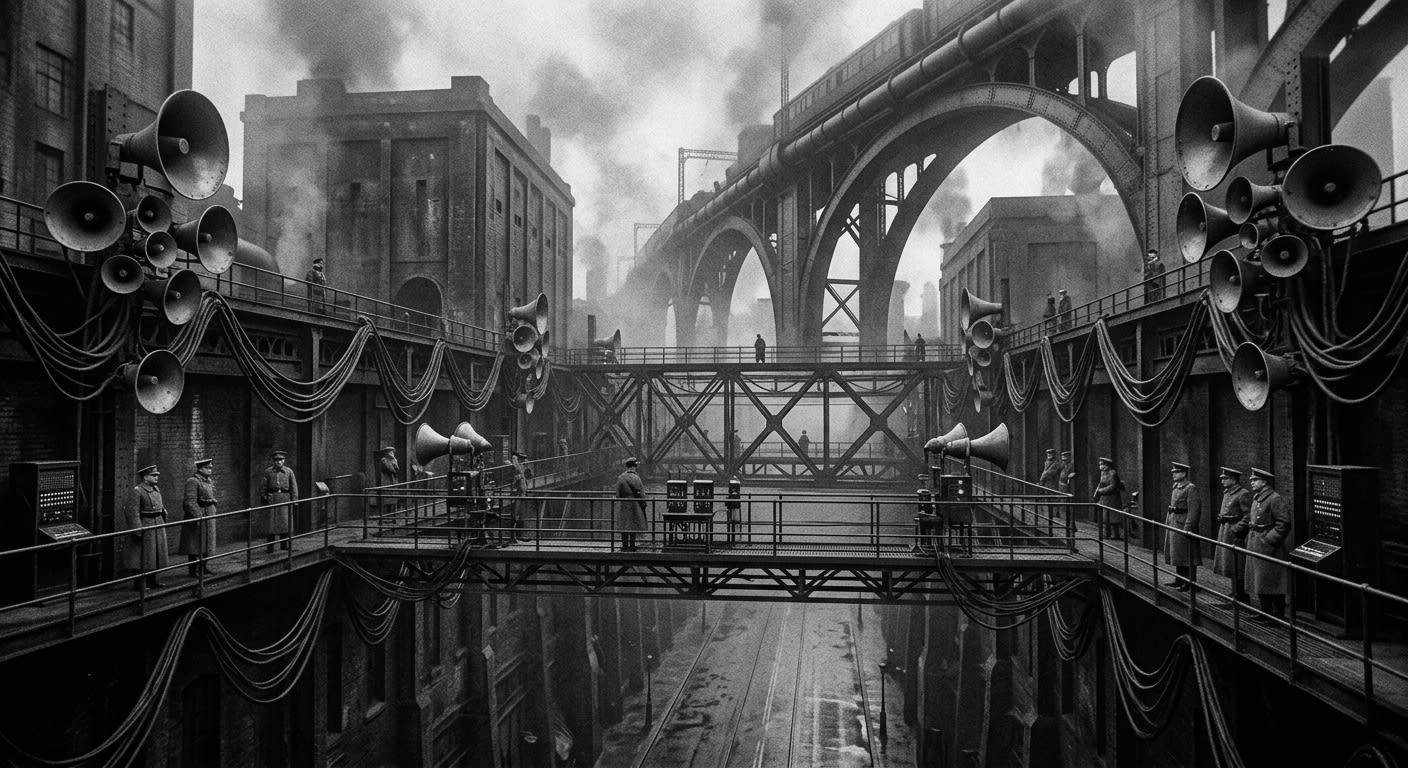
The low Bellways are those of road and token. Shrine-posts, chapel plates, parish towers, gate bells, field carillons, route clocks, Indulgence discs, and the little brass throats of pilgrim permissions form them. They run where feet bleed. They govern Jubilee columns, ration release, levy transfers, funeral processions, refugee clearances, river crossings, and all those humble public miseries which become sacred once scheduled. A low Bellway tells the road who belongs on it. That is protection. That is surveillance. I admire a device that saves a family from a ditch-mouth and reports their taxable passage before the mother finishes thanking Saint Cadrin.
The middle Bellways are the Line's war-lattice. Here the sound is less pastoral and more honest. First Peal wakes; Third moves; Fifth drags fear into repentance; Ninth shuts the day like a ledger cover. Bastions answer one another through tower, relay, alarm horn, trench gong, counter-toll vault, pressure gallery, and Orison repeater. The Sagittal Line does not hold because men are brave. Men are brave in short, unreliable bursts. The Line holds because bread arrives, ink records, and sound orders the animal body before the animal mind has time to become inventive.
The high Bellways belong to sermon and sky. Above the frontiers, Vigil Arks drift with Sermon-horns open, reliquary-chapels breathing consecration through the air beneath them. Their corridors are aerial rights of passage, fire lanes, broadcast naves, and military threat. The sainted Ark crosses; the sky becomes temporary chapel; demons entering that height pay a cost, which the Bureau of Rites has described as “theologically significant and operationally encouraging,” a phrase so beautifully cautious it should be gilded and then beaten with a hammer.
Each height depends on the others. A pilgrim token tuned to the wrong low road may place its bearer outside a middle-sector watch envelope. A middle-sector counter-toll may drown a high sermon if the operator panics. A high Ark may sanctify air above a convoy whose ground tokens are forged, which means Heaven blesses a line of smugglers while Records prepares an objection. The system is revealing its theology: salvation, command, commerce, and blame share one throat.
Earlier route-school diagrams labelled the high corridors as “the Bellways” and all lower systems as “associated bell roads.”
Corrected. Low, middle, and high corridors are all Bellways when they carry sanctioned sound as authority. The diagram has been burned for neatness.
#On the Making of a Lattice
The Bellways began as frightened bells.
After the Sundering, in the years when the East cracked open and roads became guesses with corpses at the end, any bell that could gather bodies became a government in miniature. Village bells called westward flight. Bridge bells warned of bad water. Abbey bells lied about safety because abbots, like generals, often confuse desire with intelligence. Men obeyed tone before they obeyed seal because tone reached them faster and did not require literacy. A bell could save a hamlet or herd it into a ravine. Both outcomes taught authority.
The Synod did what it always does when a survival practice proves useful: it sanctified the practice, standardised it, taxed it, and punished unlicensed versions of it for resembling the original too closely.
A.S. 92 gave Orison its appetite with a charter. A.S. 94 placed melody under leash. A.S. 115 gave Bells a harder institutional spine. A.S. 129, after the Night of Two Bells split mourners into obedient death, forced route sheet and bell-table into one married misery. A.S. 148 brought Bellway Harmonisation, when Jubilee roads learned to keep time under threat of investigation. A.S. 160 brought the Great Counterfeit Winter, when forged bell-hour cores taught hundreds of travellers that almost lawful sound may be worse than silence.
The official story makes this sequence look like wisdom maturing. It was panic becoming paperwork.
The historical anchors sit in the Ledger with a neatness that flatters nobody who survived them: A.S. 92, Orison chartered for licensed voice and broadcast custody; A.S. 94, the Orison Licensing Acts placing melody under jurisdiction; A.S. 129, the Route-Timing Concordat imposing bellway clearance after the Night of Two Bells; A.S. 148, Bellway Harmonisation making Jubilee routes audible to competent authority; A.S. 160, the Great Counterfeit Winter hardening token discipline; A.S. 201, the lattice operational, contested, and smug.
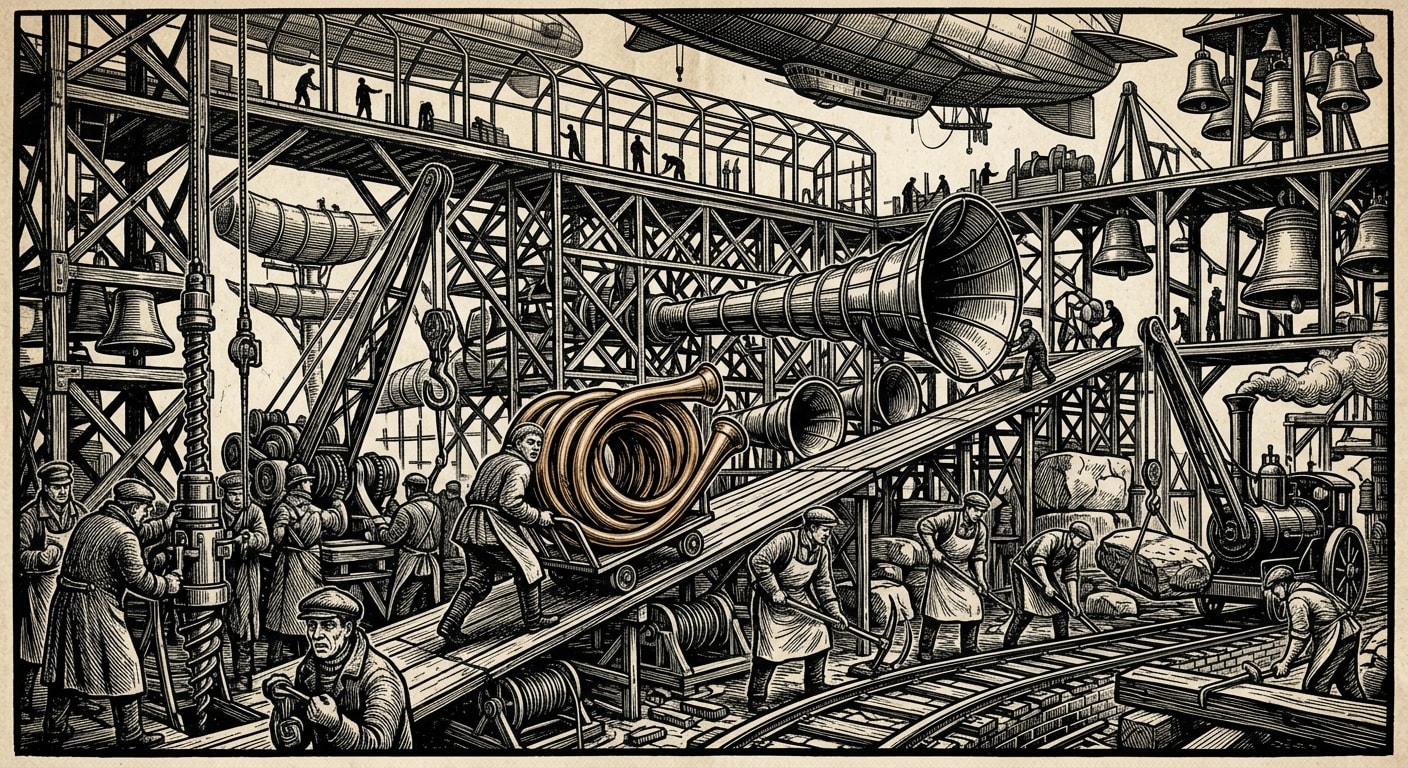
Bellways grow by accretion. A shrine-post is added after a child vanishes. A relay tower is raised after fog eats a convoy. A road chapel receives a chime plate after Purity notices unscheduled mourning. A field carillon is installed at a trench because men keep advancing on the wrong whistle. A Vigil Ark receives a new patrol arc because a previous empty sky became expensive. Every addition is explained as mercy; every addition listens.
This is the Synod's genius. It rarely invents chains from nothing. It finds a frightened man already clutching a rope and teaches the rope to file reports.
#On Bells, Orison, and the Ownership of Air
The frontier between Bells and Orison has caused more memoranda than some wars and fewer useful conclusions than a dog fight in a vestry.
Bells governs strike, sequence, foundry voice, tower custody, alarm, muster, burial, curfew, and the ancient right of bronze to frighten peasants into civic shape. Orison governs licensed voice, hymn, broadcast, saint-dust carrier signal, choir apparatus, silent-performance custody, melody crime, and the increasingly popular doctrine that breath becomes holier when passed through expensive machinery. The Bellways require both. This has produced memoranda instead of friendship.
Bells says a Bellway begins at the struck tone. Orison says it begins at intention. Bells says the tower names the hour. Orison says the sermon gives the hour meaning. Bells says a sky-sermon should follow bell tempo. Orison says tempo without doctrine is mere ringing, the acoustic habit of livestock. Records asks for the filing line and receives three answers. War uses whichever answer brings ammunition on time.
At the Line, jurisdiction becomes mud. A counter-toll drowns a Pale Chanter phrase; Bells claims victory. The counter-toll carries an Orison keyed cadence; Orison claims victory. A regiment moves because the tone and the phrase struck together; War claims victory. Records claims custody of the casualties. Purity arrives late and claims corruption. Doctrine writes the commemorative plaque.
The Orison Hour complicates the quarrel. Broadcast from every major transmission house and relayed through repeater stations, it synchronises prayer, ration schedules, casualty notices, doctrinal pronouncements, and the day's prescribed obedience. It rides Bellway tempo and also governs it. Miss the Orison Hour and one misses the world. Jam it and something else speaks through the gap. The Orison Signal Engineers have their famous rule: if you hear your name, log nothing. Bells considers this superstition. Orison considers it procedure. I consider it sound advice for anyone invited to committees.
Several field manuals describe Orison as subordinate to Bells during Bellway emergency operations.
Corrected. Orison is co-equal in all matters involving licensed voice, transmitted prayer, sky-sermon custody, saint-dust carrier signals, and acoustic countermeasure. Bells may ring the hour. Orison decides what crawls into the skull when the hour opens.
The high corridors sharpen the dispute. A Vigil Ark's reliquary-chapel sanctifies air; Bells calls the resulting corridor a Bellway. Orison calls it a sermon envelope. War calls it cover. Rites calls it holy ground without ground, and then charges for saying so. The crew calls it weather if they want to sleep.
#On the Northern, Central, and Southern Skies
The aerial Bellways above Bastion-Constantinople are the showiest portion of the lattice and, by showiness, the most politically protected. The Saint Barachiel patrols the central strait corridor where the Bosphorus narrows into a throat. The Saint Gabriel keeps the northern Bellway above the Black Sea approach and the outer anchorage where the Reliquary Flotilla rides at prayer and iron. The Saint Uriel should guard the southern Bellway toward the Aegean approaches. The Saint Uriel does not fly.
This absence has acquired procedure. Each dawn, the Aerial Wing board lists Uriel's patrol in red ink and strikes it through. Each dawn, a clerk administers the non-flight with commendable solemnity. Each dawn, chain-boom crews look up and see nothing where a sermon should be. Absence, when repeated long enough, becomes a department.
The northern Bellway is called quiet. Every experienced officer fears that word. Quiet is what a sealed room is before the knocking begins. Quiet is what a receiver says before naming the dead. Quiet is what the Black Sea gives the Saint Gabriel's crew while the waves carry dawn on their backs and gulls decline to land. In A.S. 199, after the Broadcast from the Saint Barachiel, a northern memorandum recommended continued patrols, preserved crew vocabulary in appendix, and forbade asking the corridor why it was quiet. Rare wisdom. The Bureau occasionally trips over prudence in the hallway and files it as policy.
AERIAL WING ROUTINE BOARD — SOUTHERN BELLWAY Assigned Ark: Saint Uriel. Status: grounded. Substitute coverage: none. Ground compensation: increased Harbor Chains watch; doubled fog-tower listening. Unscheduled sky mark observed at third bell: ███████████. Clerk notation erased by superior hand. Morning board restored to red slash.
The central corridor is louder. The Saint Barachiel broadcasts doctrine at a volume that renders hearing into obedience by assault. Its Sermon-horns have carried the daily Exhortation, the Duties of Grain, the Litany of Naval Submission, the Aerial Catechism of Good Fire, and, on the 3rd of Argent A.S. 199, a voice belonging to no crew member. The content remains sealed. The air at elevation is officially “sometimes unusual.” I approved that phrase, and it remains cowardly enough to be useful.
High Bellways claim to sanctify air. Low Bellways claim to sanctify motion. Middle Bellways claim to sanctify command. The southern sky, empty under Uriel's name, proves that a claimed sanctity may still require lift.
#On Hostile Weather, Singing Gas, and Prayer-Jam
No Man's Land mocks the Bellways most elegantly because it understands that sound systems die from confidence.
The Gas That Sings rises in mists with choral perfection, making men sing wordless hymns until the lungs burst. It mocks the high Bellways because it proves the Enemy covets even respiration. Prayer-Jam strikes tower, receiver, throat, and marching cadence: bells ring off-key, hymns stumble, liturgies gag mid-verse, and regiments advance into one another's fire with all the dignity of obedient furniture. Flesh-Mud takes men whose bells are functioning perfectly. Shadow Noon lengthens the wrong shadows under the correct peal. The field does not care that the table is clean.
The Line's Bellways are tuned against known hostile sound: Pale Chanter unhymns, silence-domes, Syrionic sleep cadence, Morwen's mimetic return, Velkaran perfume suggestion, Atheron's kneeling pressure, and the unnamed northern tones that become tones only after a soldier repeats them in dreams. Against these, Bells and Orison deploy counter-tolls, stimulant hymns, saint-dust keyed cadences, living keys, sealed silence variants, broadcast washes, and the old reliable cure of shouting louder until somebody bleeds.
The No Man's Land reports include the leaked A.S. 195 Engines & Furnaces memorandum linking bell density and atmospheric malfunction. Records altered “measurable” to “alleged,” which is how fear is dressed for chapel. The memorandum suggests over-pealing may fracture the lattice of air. Bells denies the implication. Orison denies the vocabulary. Engineering keeps measuring, the vulgar beasts.
If over-pealing does wound the air, the Bellways may be both shield and saw. This would embarrass the Bureaus. It would not surprise Creation, which has endured our improvements with the patience of a saint chained to a committee chair.
#On Bellway Drift, Dead Air, and Too Much Listening
A Bellway's edge is not a line. It is a negotiation between lawful sound and everything that hates being measured. Snow eats high tones. Marsh vapour wets bronze. Rivers flatten chimes. Mountain fog delays shrine response. Demon-pressure bends the sheath by yards, then by streets, then by the exact width of a funeral procession. Travellers learn this from ankles before pamphlets admit it.
A.S. 160 taught the lesson in families. Drift-tuned counterfeit cores from Lyon, Marseille, and unnamed frontier towns placed travellers roughly three hundred yards outside protection after a week's march. Three hundred yards is enough. The Great Counterfeit Winter hardened Route-Stamper discipline, gave Saint Cadrin's chapel a bell made from a dissolved guild's master die, and supplied every faction of the token trade with a scripture it could misread profitably.
The Cadence Purist reads the Winter as commandment: follow the table. The Route Pragmatist reads it as warning: hear the road. The Silent-Core smith reads it as market proof: quiet movement can exist if greed does not outrun fear. All three are dangerous. All three are sometimes right. This is why Bureau doctrine has footnotes and gallows.
Dead air is the equal and opposite heresy. In bell-dead alleys, dome-scar districts, hush corridors, quake-splits, and old masonry that has heard too many public confessions, the signal falls flat. Footsteps arrive late. Whispers vanish at the lips. A shout strikes a wall and slides down it like spoiled wax. The Circle of Mute Radiance treats such places as parish. Bells treats them as technical insult. Children treat them as shortcuts. Children are often the first enemy of any surveillance system because they have not yet learned to fear efficiency.
Too much listening produces its own sickness. Under Irongate pressure galleries, in Brest's lower ribs, near Przemyśl field-bell chambers, and beneath Strasbourg corridors whose existence is denied by men with tunnel dust on their cuffs, the hum settles into bone. Bell-Tappers lay black-diesel pipe beside these places because the lawful hum hides the illegal hiss. Inspectors hear the state reassuring itself in bronze while fuel moves a hand's breadth away. The pipe runs during Sext, Vespers, curfew, or whichever civic peal has been bribed into arriving three breaths late.
Bell-sickness follows: tooth tremor, jaw ache, false chimes during sleep, black ear-blood after Ninth Peal, the miserable habit of answering questions just before they are asked because the corridor has taught the skull to anticipate command. The official medical category changes by profession. The symptom remains: the Bellway has begun to use the listener as relay.
#On Civic Bellways and the Rearward Lie
Strasbourg citizens speak of Bellways as front-line marvels, which is adorable in the way pampered ignorance sometimes is, before it becomes policy. The rearward cities live inside Bellways as surely as trenches do. They wake to them, eat by them, bury by them, queue by them, riot against them, and flirt during the narrow intervals between curfew roll and Orison correction. The city is a throat trained to swallow on command.
The Iron Choir along the Mainz road hums on windless days. Engineers call it bellway resonance. Purity calls it murmuring saints. I call it a reminder that punishment, once given enough iron, keeps singing after the executioner has gone to dinner. Travellers pass the cages and lower their voices, not because they are pious, but because the road has made piety the safest available posture.
Civic Bellways govern procession as much as transit. The Route-Timing Concordat made silence itself a corridor: no bell within harmonic range may strike during a funeral passage, levy transfer, relic procession, ration release, penitent march, or evacuation unless the Marshal certifies compatibility. Silence became infrastructure. Mourning received a lane of withheld sound. The dead, for once, enjoyed priority.
At market squares the Bellways are less noble and more useful. The fishwives know when to shout between peals. The bread queues know which chime means flour and which chime means explanation. The Watch knows that a crowd singing over the wrong interval is already becoming a file. Street children know which alleys swallow Ninth Bell. Unauthorized Melody Smugglers know a single lullaby during a sky-sermon creates a flutter in the return signal. Everyone is an acoustic professional by necessity; only the Bureaus get salaries for pretending the knowledge is rare.
A city under Bellways becomes scored rather than quiet. Every cry, chant, cart wheel, work-song, funeral bell, sermon horn, factory whistle, and prison cough competes for permission. The rearward lie is that civilians live outside war sound. They live in its training room.
#On Counterfeit, Mercy, and Criminal Silence
The Silent-Core Crew is the moral ulcer of the Bellways because it sells the one thing the lattice cannot tolerate: unreported motion.
A lawful token tells gate, shrine-post, road, patrol, and listening office that a licensed body is moving where the Ledger permits. A quiet core lets the bearer pass without the road's report. The official customer list reads smugglers, deserters, and unlicensed merchants. Accurate. Incomplete. Quiet cores also carry children whose papers expired at noon, widows with the wrong seal, medicine that a checkpoint would confiscate into holiness, refugees fleeing quarantine that smells suspiciously like census, and men classified “presented, denied, unaccounted” who have learned what the next clerk brings.
The Bellway's defenders call this death. The Crew's customers call it chance. Both words are correct enough to hang a man.
A low-road listening report from A.S. 198 records the cheaper horror in office prose: departure tone lawful; second shrine response absent; third shrine response absent; token recovered from culvert, quiet core, child size; footprints two adult, one child, and one additional set beginning after the bell marker. Public note: family presumed diverted. Internal note: diversion answered.
Criminal silence exposes the Bureau's great embarrassment: many people fear being heard more than being lost. That fear has a receipt. A Bellway may protect you from ditch-mouths and deliver you to Records. It may keep Pale things from following your cart and guide a debt officer to your awning. It may preserve the child long enough for Conscription to count him. The saint with teeth still has teeth.
The moralist asks why anyone would step outside lawful sound. The administrator asks why lawful sound became so expensive that silence found customers. The second question has teeth. Moralists prefer gums.
#On the Present Lattice
As of A.S. 201, Bellways remain operational, contested, indispensable, overbuilt, undertrusted, and louder than their own theology can safely admit. They run along the Sagittal Line in overlapping war-nets; above Constantinople in Ark corridors; through pilgrimage roads by token and shrine-post; through rearward cities by Orison Hour, curfew, market chime, and funeral clearance; beside black-diesel ducts; across dead-air gaps; under the ears of men paid to listen and things not paid at all.
At Königsberg, hymns return through fog before they are sung. At Brest, the flat sector listens for the Nameless Tide and hears water in dry ditches. At Przemyśl, Atheron's height makes knees answer before bells do. At Sibiu, gold roads carry bribed convoys under chimes too sweet to trust. At Irongate, the gorge hums until valves, bones, and lies share pitch. At Shipka, Bellwardens are staffed heavily because Syrion makes time itself slouch. At Constantinople, the central Ark flies, the northern Ark listens, the southern Ark sits on the ground, and the board is corrected each morning as if red ink could lift a relic.
The plural remains the truth. A single Bellway can be drawn, blessed, measured, defended, and explained. Bellways, together, become a continent learning to obey through the ear. Their operators learn the same lesson from opposite ends: the tower man discovers that command is fragile, the road smith discovers that permission drifts, the Ark crew discovers that the sky has moods, the child in the bell-dead alley discovers that absence can be a hiding place until something else occupies it. No Bureau owns this entire lesson. That is why each Bureau claims it loudly.
At seventh bell the lattice sounds simple to the citizen: work ends, gate slows, soup warms, prayer begins. Beneath that comforting order, a thousand smaller hearings adjust themselves—token to post, tower to tower, trench gong to receiver, Ark horn to wet air, duct hum to illegal pipe, sleeping soldier to an order he will not remember choosing. Civilization, if one insists on the word, is the ability to mistake all that coercion for evening. They save. They accuse. They command. They remember. They fail by inches, by seconds, by fog, by pride, by hunger, by music, by whatever spoke through the Saint Barachiel's horns and apologised to a name the Ledger did not contain.