
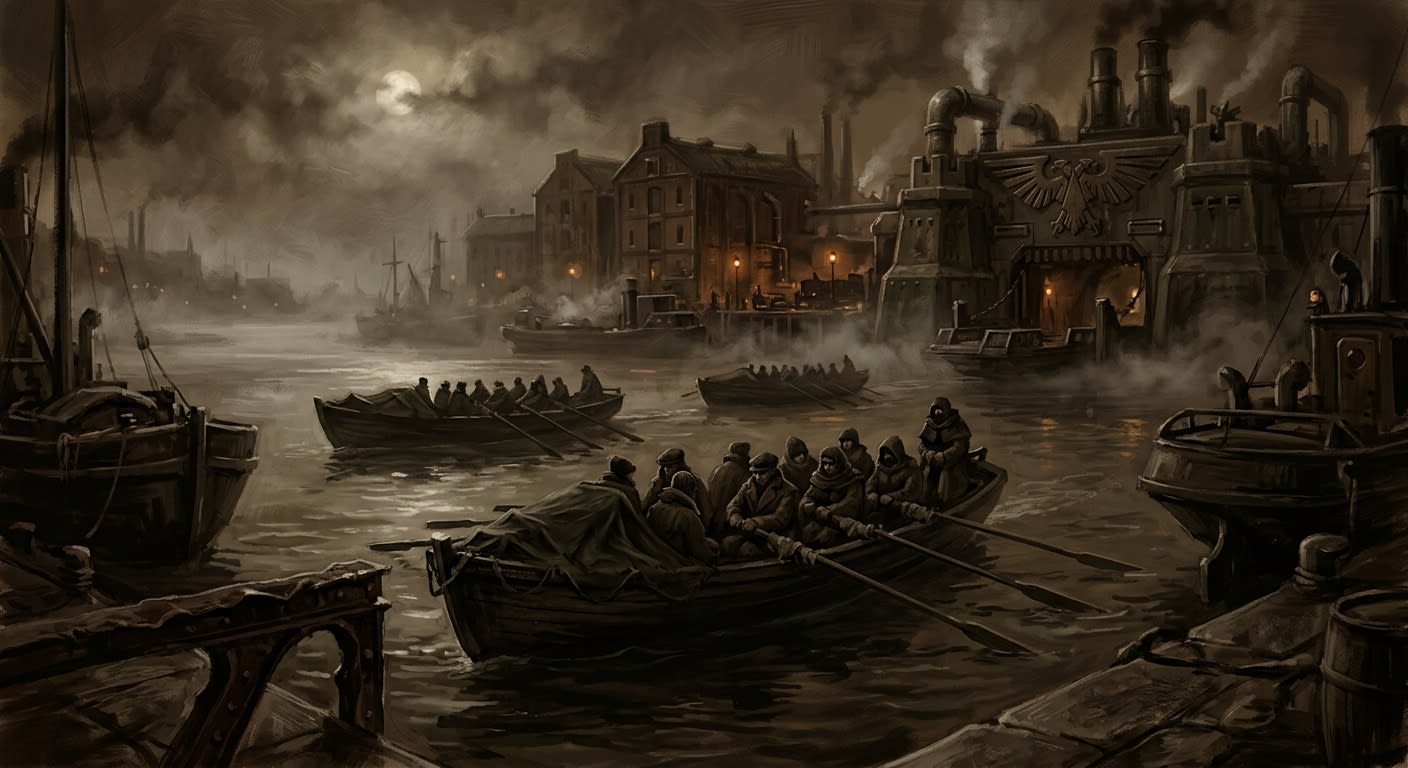
#On the Boats Without Names
Black Oars are the night-crossing faction of the Ferry Chokepoint Broker trade: unlisted, unstamped, unlanterned, and conducted in a silence so strict that coughing becomes a doctrine case. Their boats carry no painted names. Their pilots answer to nicknames, scars, debts, and the occasional saint-name borrowed from a drowned man. Their passengers are those whom daylight has refused: deserters, the erased, smugglers with cargo too dangerous for manifest inspection, fugitives from the Bureau of Purity whose confessions are already filed, and widows whose papers are correct only in parishes that no longer exist.
The Bureau of Records denies them. The Bureau of War hunts them. The provosts purchase their services whenever an officer's nephew must be moved after curfew with no questions asked and a very small trunk.
A Black Oars crossing is cheaper than lawful passage, dearer than starvation, and priced in three currencies: coin before boarding, obedience during water, and deniability after arrival. The coin may be waived. The other two are collected in full.
#On Their Descent from Refusal
The Black Oars were born from the same flood-mud that produced the Clean Slips, but they took the older lesson. Clean Slips learned that a clerk may be softened. Black Oars learned that a clerk may be avoided. After the Silt Week, when washed bridge records turned thousands into unverifiable mouths, certain ferry crews began moving the people no queue would accept. At first they did it for pity, because men are occasionally stupid in beautiful ways. Then they did it for bread. Bread proved more durable.
Their habit hardened after Nominalist's Gate taught the crossings that a consonant could deny three hundred souls before dusk. Daylight became a courtroom. Night became a loophole with reeds.
The Rope-Ferry Chain already kept a shadow economy of black runs, under-plank berths, and struck schedule lines. Black Oars merely gave the underworld a stricter rule: no name on the hull, no speech on the water, no record on either bank. A client who asks the pilot's true name is put ashore before the rope is cast. A client who gives his own true name aloud is charged double, because stupidity increases risk.
Transit Office memoranda describe Black Oars as a late corruption of the Rope-Ferry Chain.
Corrected. The Chain's curfew lie existed first. Black Oars are the hands that learned to row inside it.
#On Their Method of Silence
A Black Oars operation begins away from the public bank, usually in reedbeds, under a broken bridge pier, behind a tar shed, or beside a chapel wall where the saint has seen worse and kept quiet. The client is searched for bells, glass, devotional charms that click, children old enough to panic-sing, and documents that mention names too loudly. Papers are wrapped, mouths are instructed, coins are counted. Then the pilot decides whether the river is listening.
The first rule is silence. Prayer is silence. Weeping is silence. Vomiting is silence if done into the rag provided. The Bureau of Bells may layer sanctified call-and-response over lawful ferries; Black Oars carry a different theology, learned after the Bellwater Breach and improved by every death since: anything that answers from the water has already heard too much.
The boats are small, flat, and blackened with tar mixed with stove soot. Oarlocks are wrapped in cloth. Chains are forbidden. Lanterns are hooded amber or absent. Some crews use hand-lines through reed channels between Chain nodes. Some pole through flood ditches. The finest pilots cross by memory, current, and the pressure of fog on the cheek. The worst cross by confidence. Confidence drowns more passengers than demons.
Payment is separated into portions so that no seized purse proves the whole crime. One coin for the bank watcher. One for the pilot. One for the far-side boy who whistles if provosts wait under the alder posts. One blank confession slip, if the route touches Rope-Ferry jurisdiction. I have seen priests object to this last fee. They object less once reminded that confession, too, is a transport document.
#On the Bellwater Lesson
The Bellwater Breach is their terror and their boast. At a minor crossing south of the Rope-Ferry Chain's seventh node, a water-demon learned the ferrymen's call-and-response and spoke in the pilot's voice. Seventeen died. A season's grain cargo vanished. Lawful crossings answered with harmonic protocols, blessed challenge phrases, and paperwork fat enough to float.
Black Oars answered with silence.
They do not trust perfect phrases. Perfect phrases are bait. They do not trust voices that arrive from the wrong side of the hull. They do not trust a passenger who hears his mother's voice from the reeds and turns his head. The pilot carries a short baton for that passenger. Mercy has many shapes. Some are wooden.
BLACK OARS INCIDENT SCRAP — NODE UNKNOWN Passenger heard: “Come back, little Aron.” Passenger answered: “Mother?” Pilot action: ███████████████ Bodies recovered: 0 Cargo recovered: 3 sacks grain, wet but saleable
Certain crews tap the gunwale three times before departure, following the cult of Mother Vellum-of-the-Reed: one for the paid name, one for the true name, one for the name the water keeps. Clean Slips call this superstition with wet knuckles. Black Oars call Clean Slips men who ask permission from clerks to breathe.
Bureau of Purity lecture sheets state that Black Oars reject all liturgical practice.
Amended. They reject official liturgy. Their own rites are older, uglier, and less likely to alert a patrol.
#On Their Clients and Their Cruelties
Black Oars serve whoever daylight rejects and whoever can pay enough to become temporarily invisible. Deserters come with shaved heads and regimental ghosts. The erased come with no names and excellent posture. Contraband smugglers arrive with sealed bundles that hum, sweat, or whisper under oilcloth. Purity fugitives bring the worst cargo: certainty that someone official already expects their body.
No faction that deals in the desperate remains clean. Black Oars sell people twice when the river is hungry and the buyer patient. They abandon cargo to save the boat, passengers to save the crew, and crew to save the route. A pilot may refuse a child who cannot keep quiet. A runner may redirect a condemned man into a provost net to protect twenty later crossings. The faction's defenders call this arithmetic. Arithmetic has always been the grammar of Hell with better columns.
Their quarrel with Clean Slips is a family quarrel conducted with knives under the table. Clean Slips provide guard rotations, password scraps, and clerk gossip. Black Oars provide exit when daylight fraud catches fire. Each despises the other's method. Each survives by the other's failure.
#On the Present Water
As of A.S. 201, Black Oars run wherever curfew creates profit and law creates stranded bodies: Rope-Ferry side channels, Rhine tributary crossings, quarantine piers, broken bridge shadows, and the downstream dark beneath Nominalist's Gate. They are fewer than rumour claims and more numerous than reports admit. Every crackdown catches three crews, misses nine, and teaches the tenth to row without splashing.
The Bureau will not eradicate them while crossings remain slower than hunger and rules sharper than mercy. A man refused at dusk will seek the reeds by night. A woman whose child has no baptism copy will kneel in mud beside a nameless boat. A soldier with his confession already filed will pay anything to cross before his body is collected for administrative symmetry.
The pilot will take the coin, touch the oar, and raise one finger to his lips.