
#On the Week the River Ate the Files
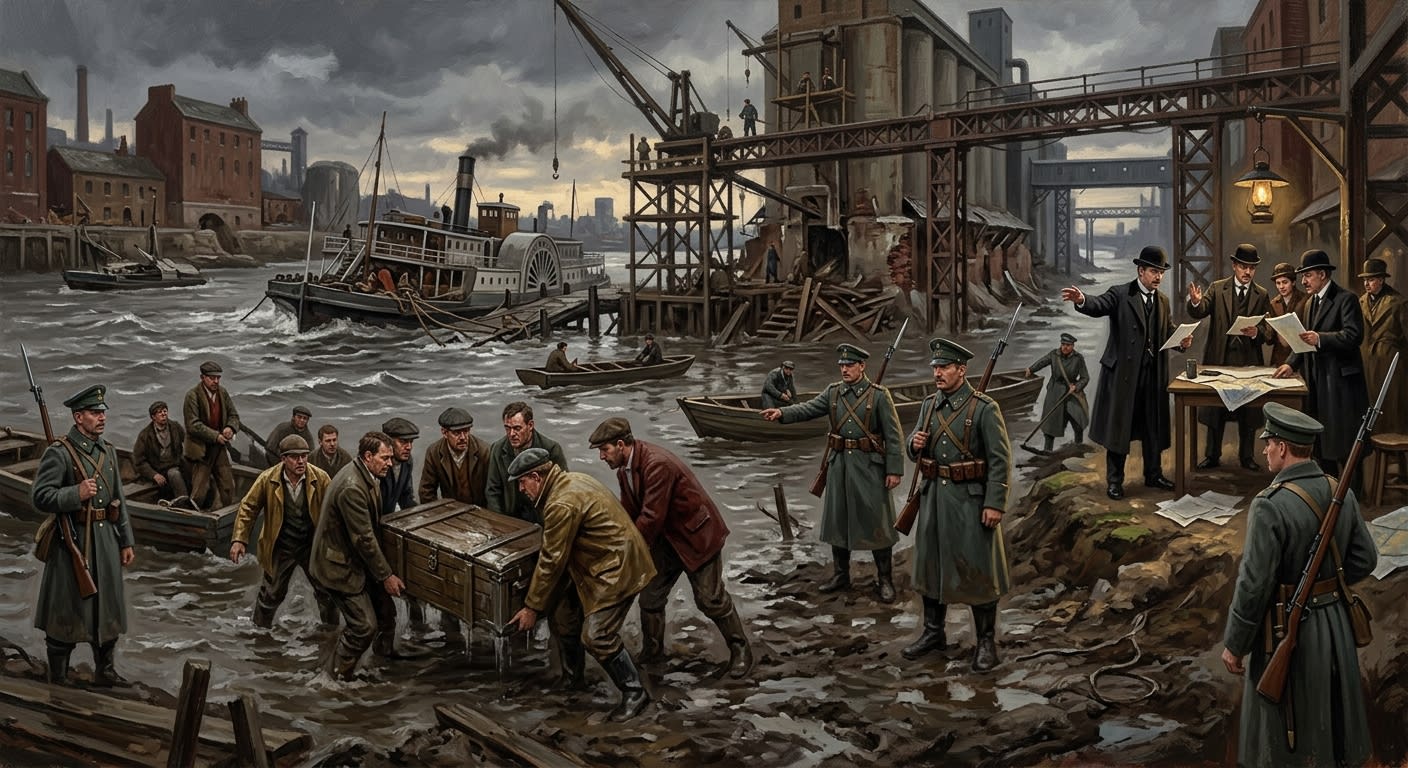
Silt Week was a spring flood along three Rhine tributary crossing nodes in the late post-bridge years, fixed by Records teaching copies to A.S. 78 because the Bureau prefers a date with hinges. The flood itself was not spectacular. No cathedral floated away. No bishop was found in a tree. The water rose, browned, dragged bridge planks from their pins, swallowed two lockhouse basements, and made pulp of the transit ledgers that Records had stored, with sublime clerical confidence, below the high-water mark.
By dawn of the second day, thousands of travellers became unverifiable.
They still had faces, boots, hunger, children, carts, oxen, debts, fevers, warrants, accusations, and the moral ugliness common to human life under rain. What they lacked was surviving paper. In the Synod's arithmetic, this made them less than missing and more than dead: present without proof.
The three affected nodes are named differently in every surviving list. One was certainly downstream of Nominalist's Gate. One served a Rope-Ferry feeder road. One has since been folded into a quarantine district whose current clerk denies any ancestral wetness. This is typical. Disasters that expose bad storage become vague in the archives with astonishing speed.
#On the Halted Crossings
The ferries stopped before the bells could agree on the hour. Guards refused to accept soaked slips. Clerks refused to stamp replacement slips without prior slips. Families produced witnesses whose own names had vanished in the same water. Merchants carried cargo manifests listing crates whose labels had dissolved into saint-brown paste. Pilgrims arrived with relic packets that could no longer prove they had ever been permitted to leave the parish, much less cross a river under wartime transit discipline.
Then came the audit teams.
The audit teams required crossing to reach the affected nodes. The affected nodes could not process the audit teams because the records proving the audit teams' right of passage were among the records the audit teams had been dispatched to reconstruct. The senior auditor at the middle node reportedly demanded a temporary clearance from his junior clerk, whose ink had washed away, whose authority derived from a roster underwater, and whose patience ended at knife point.
The queues thickened into bodies. The banks became camps. Camps became markets, latrines, prayer circles, extortion stalls, fever tents, and those little tribunals of exhausted people who begin by deciding bread distribution and end by hanging someone for owning dry boots. Ferry crews armed themselves. Lockhouse guards barred the porches. The river carried pages downstream like small pale fish.
An early Records circular calls Silt Week a weather interruption.
Corrected. Weather wets paper. Administration turns wet paper into civil death.
#On the First Brokers
Before Silt Week, bankside touts existed as all vermin exist: close to food, close to fear, useful when ignored. They sold queue places, carried messages, introduced merchants to pliable oarsmen, and produced the occasional forged pass for a widow whose village priest had died with the baptism book under his pillow. The flood promoted them.
They knew names by hearing. They knew who had crossed before, who owed the left-bank tavern, who had a brother on the far side, which guard drank, which ferryman lied, which child belonged to which cart when the mother had fainted from hunger. This knowledge, previously vulgar, became infrastructure by the third day. The first Ferry Chokepoint Brokers did not invent authority. They performed it before authority could find dry socks.
The solvent crossed first. That is always how emergency mercy begins: with a price list. Merchants paid for reconstructed clearances. Convoy captains paid for priority. A bridegroom paid in silver candlesticks to be recorded as married before the water could carry off his witnesses. The insolvent waited, cursed, prayed, broke fences for firewood, and learned that bureaucracy may be suspended during catastrophe only for persons carrying coin.
By the fifth day, the practice had split into its future shapes. Daylight forgeries, modest corrections, clerk-softening, and witness pairing would become the Clean Slips. Reed-channel evasions, nameless boats, curfew crossings, and spoken names held behind the teeth would become the Black Oars. Silt Week did not create the river trade. It gave the trade a ledger, which is the Synodal way of baptising sin.
#On the Militia Interval
The Bureau restored nothing quickly. Strasbourg sent orders. The orders arrived late, damp, duplicated, and mutually hostile. Records demanded all crossings halt until identity could be reconstructed. War demanded movement of grain, powder, and bodies. Purity demanded inspection of anyone whose papers had softened, on the principle that water damage resembles intentional concealment when viewed by a sufficiently sour official.
The ferry militias filled the gap.
Dock gangs seized the planks, rope stores, tar sheds, and toll counters. Some were ferrymen protecting their trade. Some were smugglers promoted by opportunity. Some were hungry men holding oars in a way that made law reconsider its schedule. They marked queue lanes with poles, sold guard positions, beat thieves, hired thieves, and established the first rule of wet government: whoever controls the plank controls the citizen.
MIDDLE NODE WITNESS SCRAP — RECOVERED FROM LIME PACKET Statement: “They made the clerk stand on the table and recite names until he forgot one.” Question: “What happened when he forgot?” Response: █████████████████████████ Disposition: witness accepted as temporary ledger source, later untraceable
The militias lasted six weeks in some places, six hours in others, depending on whether the Bureau of War arrived before the local gang learned to invoice. When the official ledgers were rebuilt, the militias were condemned, absorbed, praised, denied, and taxed in that order. Several officers received commendations for restoring control to crossings that the militias had already made functional. This is called command.
Public catechism editions state that Bureau intervention ended the Silt Week disorder.
Clarified. Bureau intervention ended the unauthorised portion of the order.
#On the Pedagogical River
Records later issued its most beautiful lie: Silt Week proved the importance of record-keeping because record-keeping had failed. The Bureau thanked the river for its pedagogical contribution. I have read the circular. The phrasing bears three signatures and no shame.
The circular did more than polish embarrassment. It gave doctrine to the crossings. Replacement rules followed: raised ledger shelves, duplicate bridge books, oilskin queue rolls, flood hooks, clerk evacuation priorities, and the sainted stupidity of stamping paper WATER-SAFE in ink that ran blue at the first cough of rain. The reforms helped. The next flood destroyed fewer books and more people.
Silt Week also taught the underworld its holiest lesson. A name written once can drown. A name carried in ten mouths can be sold. From that lesson came the Clean Slips with their pale ribbons, the Black Oars with their nameless hulls, the Broker's Split Prayer, the reed-knot bracelet, and Mother Vellum speaking through folios that keep one blank line for the river.
#On the Present Use of the Disaster
As of A.S. 201, Silt Week is taught in three registers. Records teaches it to junior clerks as proof that ledgers must be copied, raised, sealed, indexed, dried, and defended from weather, vermin, children, wine, mildew, heresy, and superior officers. Ferry brokers teach it to runners as the week their profession climbed out of the mud with wet shoes and a price schedule. Mothers in crossing towns teach it to children as a warning against letting strangers write your name too easily.
The river still rises each spring along the Rope-Ferry Chain and its lesser tributary nodes. The shelves are higher now. The fear is higher with them.