
#On the Gentle Forgery of Daylight
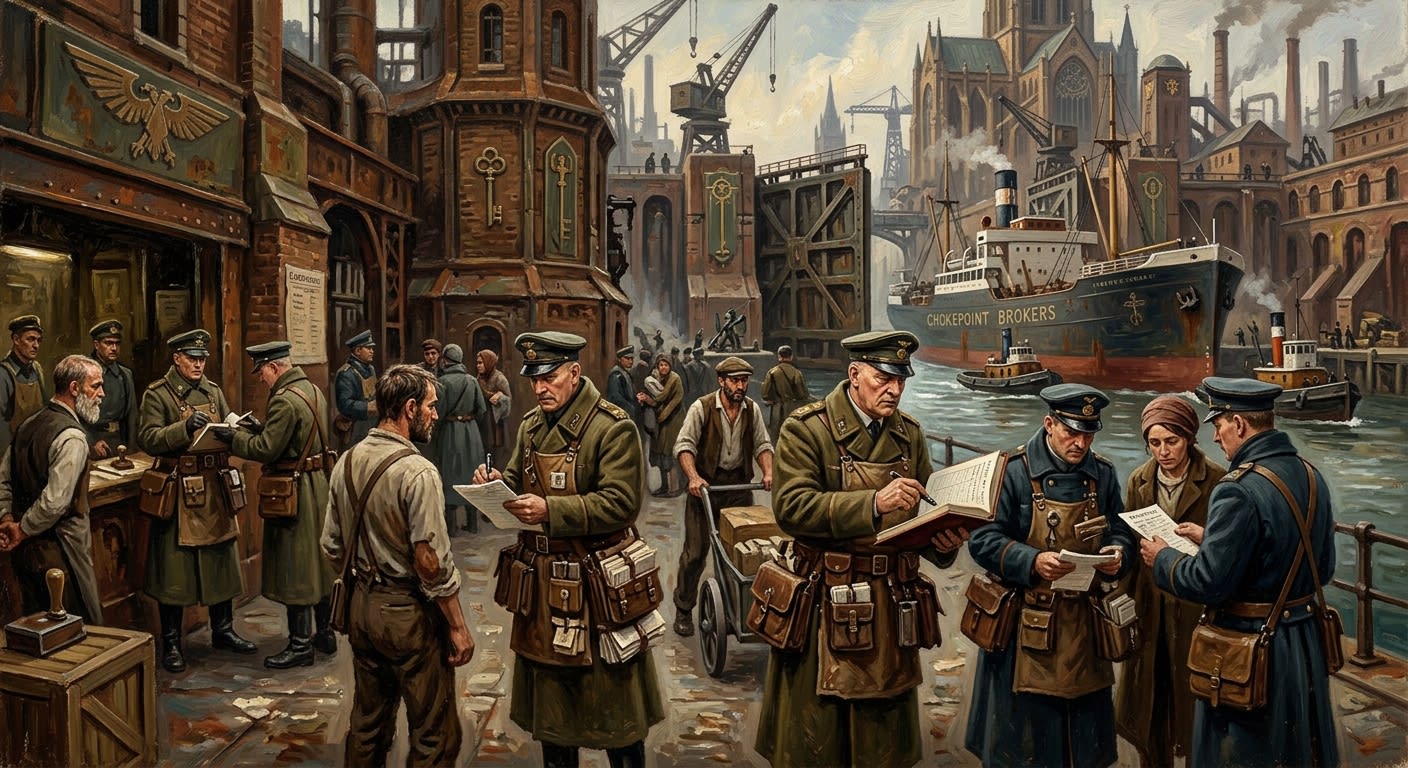
Clean Slips are the respectable hand of the Ferry Chokepoint Broker trade, which is to say they commit their crimes in legible ink, before supper, within sight of the lockhouse window. They prefer tolerated paperwork: pass slips, witnessed identity affidavits, donation receipts, pronunciation cards, queue corrections, and those small amendments by which a living body is moved from the category of “problem” into the category of “processed.”
The Bureau of Records does not license them. The Bureau of Purity does not approve them. The guards at the crossings accept their slips because the guards also prefer a queue that moves, a bribe that arrives wrapped as a chapel gift, and a fraud modest enough to be mistaken for mercy by anyone tired, wet, and underpaid.
Their emblem, when they dare use one, is a pale ribbon tucked into the folio seam, clean at dawn and filthy by second bell. Their clients call them paper saints. Their rivals call them auditors' pets. Both descriptions have teeth.
#On the Origin of the Faction
The faction emerged after the Silt Week, when spring floodwater stripped three Rhine tributary crossings of their bridge records and made thousands unverifiable before breakfast. The first brokers saved the solvent by memory and bluff; the insolvent rioted; ferry militias learned how easily a drowned archive becomes a market. From that mud came two instincts. One instinct rowed at night with no name on the hull. The other found a clerk, paid him exactly the bribe he expected, and wrote the receipt as devotional maintenance.
That second instinct became the Clean Slips.
They gained coherence at Nominalist's Gate, after the Mass Denial turned three hundred valid travellers into a lesson about one consonant. Brokers carrying phonetic prayer cards discovered that a guard who would reject a forged pass might accept a corrected mouth. Soon they were selling pronunciation as paperwork: half lesson, half clearance, entirely billable.
The name came from the strips themselves: clean slips, oilproof, narrow enough to hide in a cuff, broad enough to carry a temporary correction, a witness mark, or a saint-phrase rendered phonetically for the terrified. Clean meant unbloodied. Clean meant legible. Clean meant an auditor could overlook it without feeling his immortal soul scrape against procedure.
Earlier Purity memoranda classify Clean Slips as a charitable adjunct to ferry management.
Revised. Charity does not maintain lockhouse contacts, calculate bribe rhythms, and charge extra for dry ink.
#On Their Method of Passage
A Clean Slip operation begins with inspection of the client's official deficiency. The deficiency may be real, invented, anticipatory, or scheduled to become real at sundown. A seal expires in two bells. A convoy manifest lists nine crates and arrives with seven because two were eaten by mud. A child has no baptism copy. A widow's husband is dead in one parish and alive in the next. A deserter has made the mistake of keeping his own name.
The Clean Slip does not solve the life. He trims the paperwork until the life fits through the hatch.
The faction's power lies in expectation. They pay expected bribes at expected rates, to expected persons, through expected devotional covers. A lockhouse clerk will forgive many things if the offence arrives in familiar shape. Surprise offends him. Surprise requires thought. Thought produces reports.
Their forgeries stay modest. A Clean Slip does not turn a condemned man into an archbishop. He turns a condemned man into a brother-in-law with damp papers, a plausible cough, and a witness willing to squint. The best Clean Slip documents look weary rather than false. A tired stamp is safer than a perfect one.
They keep ledger shadows: duplicate lists that omit the true crime while preserving enough mundane detail to bore an auditor. Oarsman paid. Candle donation entered. Queue position corrected. Pronunciation card surrendered. If a sting arrives, the Clean Slip produces a chain of petty errors so dull that the inspector begins to long for treason.
#On Their Bargain with Authority
The Clean Slips survive by humiliating everyone gently. They let the Synod believe it governs movement. They let guards believe they enforce doctrine. They let clients believe mercy has touched them. In return, bodies cross, rations move, bastion parcels arrive before rot, and the official numbers remain just clean enough to praise.
The arrangement is neither secret nor acknowledged. Bureau of Records advisories deny unauthorised passage intermediaries while noting lower transit irregularity rates. Bureau of Purity inspectors confiscate phonetic cards during sweeps and purchase them during emergency crossings. The Bureau of Tithes taxes donations that no one admits are bribes. Such is Order: every Bureau blind in one eye and invoicing through the other.
The phrase “minor transit corruption” appears in a Records digest of A.S. 199.
Clarified. The corruption is not minor. It is properly sized.
At Mother Vellum's blank-folio shrine — which is no shrine, naturally, because Hagiography remains non-cognisant — Clean Slips leave dry ribbons and bottom margins cut from rejected permits. They claim Vellum proves that paperwork carries souls through danger. The Black Oars call this daylight cowardice. Clean Slips answer by pointing to their survival statistics, which are both better and more expensive.
LOCKHOUSE AUDIT FRAGMENT — ZONE 2–3 Clean Slip packet recovered: 47 Clients crossed: 46 Uncrossed client: ███████████████ Cause of failure: witness recognised himself on condemned list Resolution: packet refiled as devotional arithmetic error
#On Their Quarrel with the Black Oars
The quarrel with the Black Oars is theological, professional, and personal in the manner of all profitable hatreds. Clean Slips believe daylight can be bent. Black Oars believe daylight is a trap with better lanterns. Clean Slips pay clerks. Black Oars avoid clerks. Clean Slips teach a client how to speak to authority. Black Oars teach silence and carry a knife for anyone who forgets.
Both factions need each other. Clean Slips provide guard rotations, password schedules, and the little rumours that collect on counters like dust: who drinks, who listens, who has a sick child, who has just been warned by Purity and is too frightened to be bribed this week. Black Oars provide escape when a Clean Slip sting goes sour, when an auditor arrives early, when a client turns out to be worth more dead than processed.
The feud flares whenever a daylight passage fails and a night crew must retrieve the damage. Clean Slips accuse Black Oars of theatrical criminality. Black Oars accuse Clean Slips of polishing chains. Mother Vellum receives prayers from both and, being dead, missing, or river-filed, offers no arbitration.
#On the Present Use
As of A.S. 201, Clean Slips work most visibly at Nominalist's Gate and the Rope-Ferry Chain nodes, though any river bank with a queue, a lockhouse, and a clerk who has learned the smell of money will produce them by natural generation. They sell pronunciation coaching, witness pairing, correction slips, dry-ink stamps, and the confidence with which a terrified person must say a saint's name to a bored guard.
They remain tolerated because they keep disorder tidy. They remain hunted because tidiness outside Bureau control is an insult. Their trade is the Bureau's own logic reflected back in cheaper wax: if a man may be condemned by a form, he may also be rescued by one.
A Clean Slip ends the day by burning failed drafts, rinsing the thumb-wax, and copying tomorrow's password list from a clerk who swears he has never taken payment. The clerk lies. The Broker nods. The river waits with its mouth open.