
#On the Voice Beneath the Hull
The Bellwater Breach occurred at a minor crossing south of the seventh node of the Rope-Ferry Chain, during the ugly years when the Chain had already learned extortion and had not yet learned fear. The date is filed under A.S. 78 in the instructional bundles, close enough to Silt Week and the Nominalist's Gate consonant disgrace that the clerks may shelve all three disasters together and call the arrangement pedagogy. Shelving is the Bureau's sacrament of cowardice.
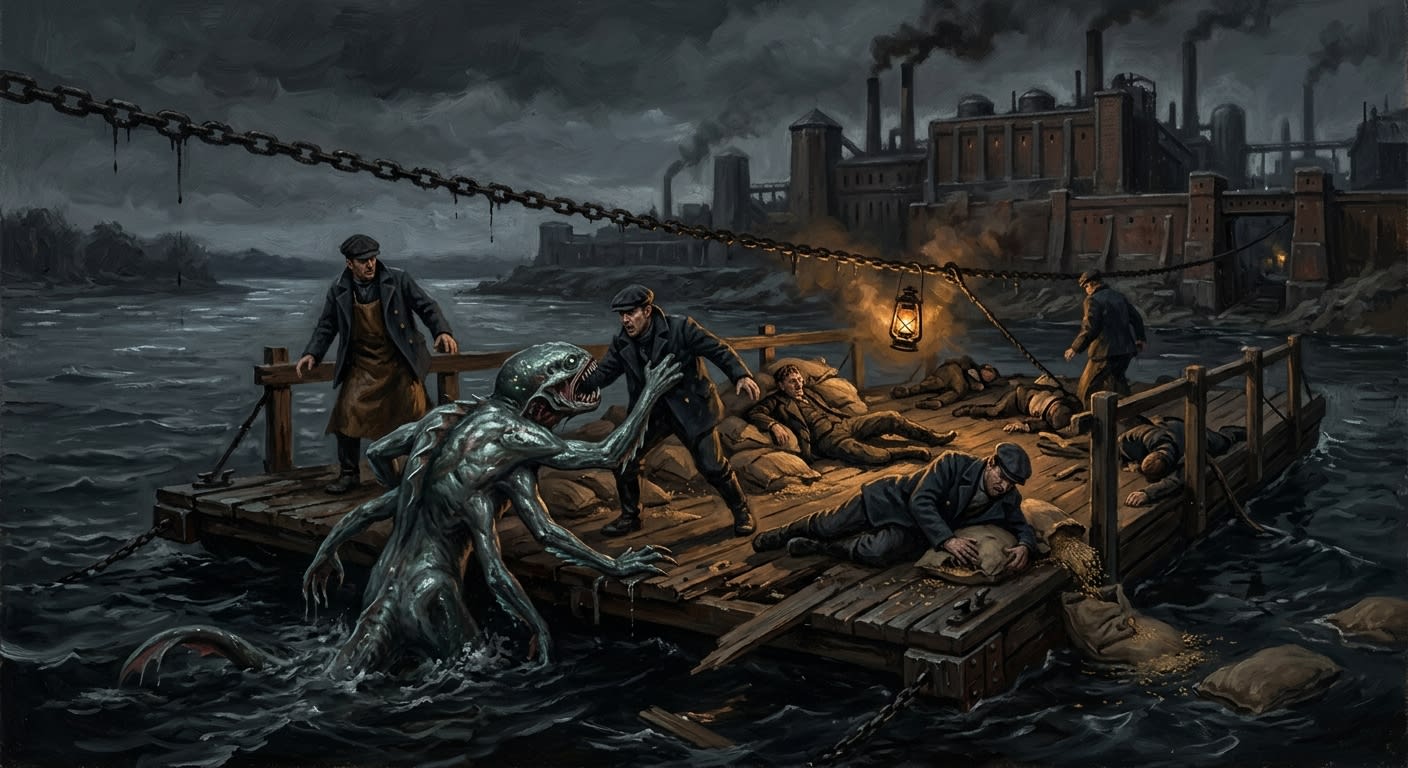
At Bellwater, a water-demon learned the ferrymen's call-and-response.
That sentence is brief because terror is brief at first. A ferry crew hears the pilot call from the forward plank. The bank answers. The barge-hands haul. The rope tightens. The hull noses into current. Every motion belongs to habit, and habit is the little god workers trust when the larger the Creator appears busy elsewhere. Then the same voice comes from below the boards, perfect in tone, perfect in timing, repeating the correct phrase with the pilot's breath and the pilot's cracked left vowel.
Seventeen died. A season's grain cargo vanished. The official account says the barge was pulled into an ambush. The ferrymen say the river opened its mouth.
#On the Crossing Before the Breach
Bellwater had no grandeur. It was a side crossing: reed flats, two alder posts, a tar shed with one leaning wall, a chapel niche whose saint had lost his face to damp, and a ferry so flat it looked less built than persuaded to float. The crossing served grain barges, small convoys rejected by busier nodes, pilgrims too poor for priority lanes, and the furtive traffic that accumulates wherever law creates a queue.
The lawful procedure was simple enough for catastrophe. The pilot stood forward and called the day's phrase. The shore guard gave the response. The cable crew repeated the closing word while hauling, because the Chain had already discovered that men pull better when ordered by rhythm. The Bureau of Bells had blessed the schedule, Records had filed the phrases, and the Transit Office had certified the whole apparatus as secure, by which it meant that no clerk could imagine the river studying.
Transit Office memoranda describe Bellwater as an unforeseeable supernatural incursion.
Corrected. Bellwater was unforeseeable only to officials who mistook repetition for safety and water for scenery.
The grain convoy was ordinary. Sixteen sacks of rye in the forward hold, eleven sacks of millet aft, three sealed tithe crates, two guards, one clerk, four barge-hands, the pilot, and passengers whose names became useful only after death. The phrase for the evening was a clipped invocation of Saint Edras. The pilot called it. The bank answered. The barge moved.
Halfway across, the pilot called again.
He had not opened his mouth.
#On the Answering Water
The first repetition came from under the forward planks. The second came from beside the hull. The third came from the stern, where no man stood. Witness scraps disagree about whether the voice sounded wet. Such disagreement is natural. Persons about to die become poor acousticians.
The barge-hands did what training had installed inside their muscles. They answered the cadence. One man hauled on the cable. Another loosened the aft brake. The shore guard, hearing the correct response at the wrong distance, shouted the confirmation. The ferry obeyed the language before anyone understood that language had changed sides.
The current took the bow toward the ruined pier.
That pier does not appear on later maps. The Bureau calls it removed. Divers call it fed. I have read two salvage reports, both sealed for doctrinal agitation, describing iron rings fixed to stones below the waterline, fresh rope burns on old masonry, and finger marks on the underside of planks where no living passenger could have reached during the roll.
SALVAGE DIVER STATEMENT — BELLWATER SUPPLEMENT Question: “What was attached beneath the hull?” Answer: “A mouth made of rope.” Second question: “Repeat for clarity.” Answer: ███████████████████████████ Disposition: diver paid, cleansed, forbidden from river work, later found at Ink Dock counting teeth in his sleep
The grain disappeared with insulting neatness. Bodies drift. Barrels split. Cloth fouls reeds. Grain, when sunk, swells, clouds, rots, and leaves a smell even sainted paperwork cannot deodorise. Bellwater's grain was gone. The tithe crates were found empty, seals unbroken, stacked on the far bank in a row so straight that one investigator accused the surviving guards of theatre. Accusation is the refuge of a man who prefers crime to miracle.
#On the Seventeen
The dead are counted as seventeen because seventeen names were paid against the loss column. The number may be wrong. Bellwater was a minor crossing, and minor crossings keep minor books, which is to say books damp enough to excuse arithmetic. One passenger travelling under a borrowed name may have died twice in the records. One child may have been folded into her mother's entry. One guard may have survived long enough to be reassigned into silence.
The six recovered bodies were lodged beneath the alder roots below the crossing. Their mouths were packed with river silt. Their tongues showed rope burns. Purity first attributed the marks to post-mortem abrasion, then to panic-biting, then to hostile acoustic contact. The third phrasing survived because it sounds like a diagnosis and accuses no one important.
No chapel bell rang during the recovery. This matters. Bellwater's little niche bell had been cracked since a winter frost and was considered devotional furniture rather than instrument. After the Breach, Bells made much of this absence, as though a cracked hand-bell had invited the demon by neglecting etiquette. The Transit Office accepted the blame eagerly, since blaming a bell costs less than rebuilding a crossing system.
Earlier homiletic sheets claim the seventeen died because no bell answered the demon.
Withdrawn for excess poetry. The seventeen died because men obeyed a correct phrase spoken by an incorrect mouth.
#On the Harmonic Remedy
Strasbourg's answer came in layers: blessed challenge phrases, response phrases calibrated to bell-harmonic signatures, clerk-issued cadence cards, new rope watches, inspection prayers, whistle bans, and a schedule of punishments for any ferryman who abbreviated the exchange. The Synod adores adding steps to a process that failed because its earlier steps were trusted too much.
The new protocol required the pilot to speak the challenge, the bank guard to answer, the cable crew to hum the undernote, and the bell-card to be struck once against the rail. Bells certified that no demon had yet replicated the authorised harmonic interval. Records certified that each response could be logged. Purity certified that deviation from the new rite would be treated as suspicious. War certified nothing and demanded the grain move faster.
The Ferry Chokepoint Brokers counterfeited the overlay within a month. Of course they did. A client who cannot produce a sanctified response does not cross; a client who does not cross does not pay. Brokers acquired bell-cards, copied cadence marks, bribed lockhouse clerks for next week's challenge, and learned to coach terrified mouths through the difference between piety and passage.
Clean Slips treated Bellwater as a paperwork problem with teeth. Black Oars treated it as revelation. Lawful crossings added more sound. Night crossings stripped sound away.
#On the Black Oars' Doctrine
Black Oars still call Bellwater their terror and their boast. Their pilots teach the lesson without sermon: no name on the hull, no speech on the water, no answer to any voice arriving from the wrong side of the boards. Prayer is silence. Weeping is silence. Vomiting is silence if done into the rag provided. A passenger who hears his mother's voice from the reeds receives the pilot's baton before he receives comfort. Mercy has many shapes. Some are wooden.
The rites of Mother Vellum-of-the-Reed entered sharper practice after Bellwater: three taps on the gunwale, one for the paid name, one for the true name, one for the name the water keeps. Pilots rinse their oar hands in ash-water. Runners are searched for clicking charms. Children old enough to panic-sing cost double. Priests object to these prices until reminded that sermons travel poorly underwater.
Bellwater made silence professional. Before it, night crossings were criminal convenience. After it, silence became a countermeasure, a theology, a tariff.
#On the Present Water
As of A.S. 201, the Bellwater protocols remain in force at lawful ferries along the Rope-Ferry Chain and its lesser tributary nodes. The cards have changed. The phrases rotate. The official diagrams display clean arrows showing voice, response, undernote, witness strike, and clerk entry. Clean diagrams are a narcotic. They show everything except fear.
At certain crossings, ferrymen still pause when the pilot's voice comes back too quickly from fog. At Node Seven, crews tar the underside of the planks before flood season and refuse to explain why. At Bellwater itself, the alder posts are gone, the tar shed has collapsed, and the chapel niche contains a bell without a clapper.
The water below it answers anyway.