
#On the Crossing Where Grammar Became Weather
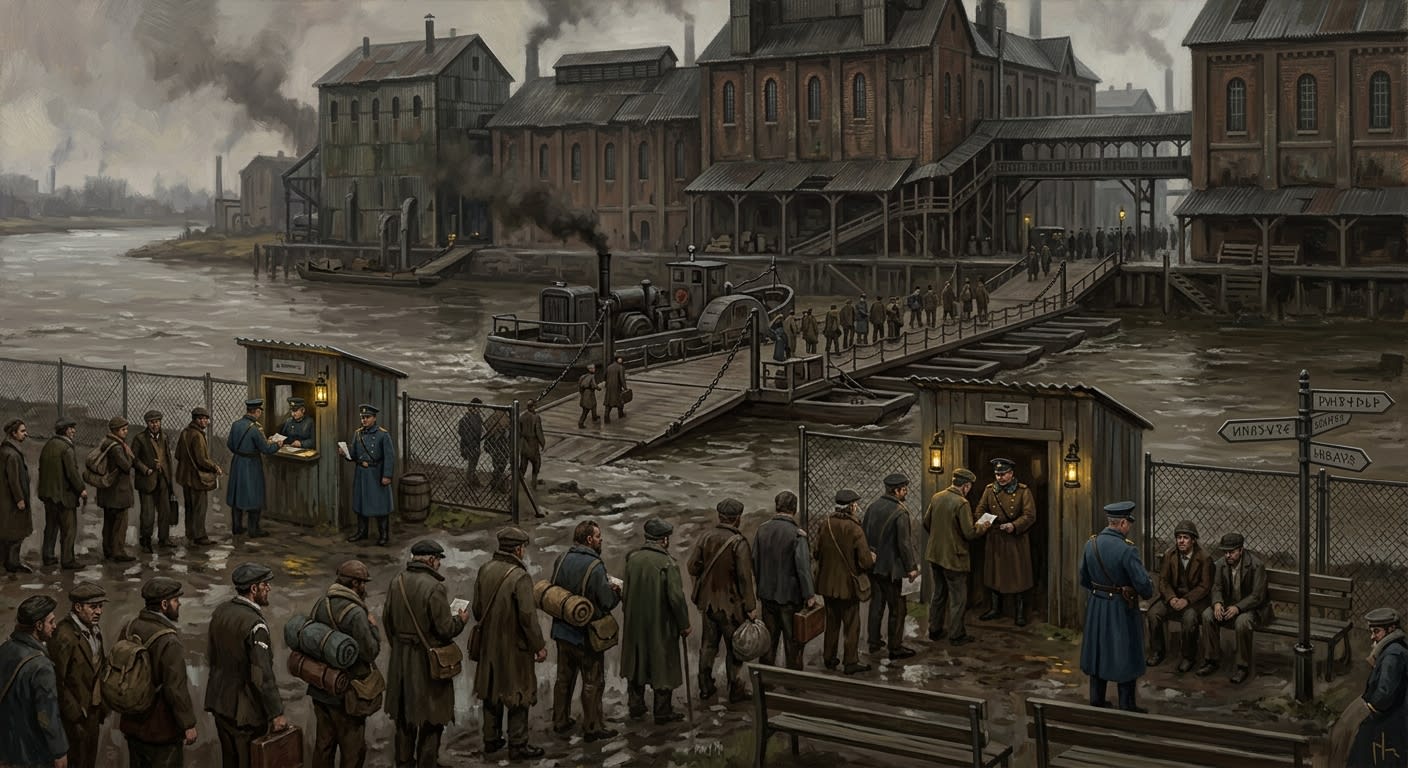
Nominalist's Gate is a river crossing, a ferry office, a tribunal porch, a mud-bank, a password school, a mortuary queue, and a warning to every poor fool who thinks a valid permit is sufficient protection against language. It stands among the Zone 2–3 river nodes that feed the Rope-Ferry Chain, where the Rhine tributaries become narrow enough for ferrymen and wide enough for theology.
The maps mark it as a crossing. The Bureau of Records marks it as a transit verification node. The people who have slept in its queue call it the Gate because a gate may be shut, and this one is shut more often than charity permits.
Its fame rests on three related brutalities. Ferries capsize under the weight of ledgers. The mud kills alphabetically. The guards hear one wrong consonant and convert a crowd into a procedural lesson.
#On the Founding of the Gate
The crossing hardened into its present form after the bridge destructions of A.S. 48–65, when the Bureau of War discovered that ruins make excellent policy if one installs a tollhouse beside them. Earlier ferrymen had worked there in the old fashion: rope, barge, payment, insult. After the first bridge piles were cut and the river made official, passage required name, paper, seal, password, and the patience of a saint who has never missed a ration window.
By A.S. 78, when flood years and ferry-chain expansion had taught the Synod to fear every uncontrolled bank, the crossing had gained its lockhouse, archive shed, and first mud court. The Synod called this improvement. The ferrymen called it heavier cargo, because every traveller now carried enough paper to drown by regulation.
The name came later, from a doctrinal quarrel about whether a man incorrectly named at a crossing was the same man who had been correctly named on the opposite bank. A theologian answered yes, a Records officer answered only if the spelling matched, and a guard answered by refusing both until dusk. The guard's answer became practice. The theologian's answer became a footnote. The Records officer's answer became law, which proves again that the worst sentence in any room is the one with a stamp under it.
Earlier route manuals glossed the name “Nominalist's Gate” as scholarly humour.
Corrected. Scholarly humour is absent. It is the local doctrine of identity, with mud.
#On the Architecture of Refusal
Nominalist's Gate is built in layers because the Synod distrusts any cruelty that cannot be repeated. At the lower bank sits the Mud Court, a churned black apron where queues form by first letter during ordinary traffic and by alleged guilt during alerts. Above it stands the Ferry Rail, a roofed plankway where passengers recite password phrases to guards who hear with the selectivity of men whose supper depends on refusal. Behind the rail rises the Archive Porch, narrow, damp, and lined with cabinets whose drawers swell shut in rain.
The ferry itself is flat, broad, and miserable. Its deck boards are scored with tally cuts from pilots counting passengers when clerks fail to. The ledgers travel in oilskin chests, stacked amidships. Pilgrims joke that the books are given the driest place and the souls the wettest. Pilgrims make this joke once.
The Return Pen is the crossing's most honest structure. It receives those whose papers are valid in one office and defective in another, whose names contain old district marks, whose accents offend the password, whose witnesses died between application and arrival, or whose misfortune consists of resembling someone the Bureau of Purity expected elsewhere. Men enter it as travellers and leave as cases.
#On the Mass Denial
The Ferry Chokepoint Brokers place the Mass Denial among their founding incidents, and for once their professional vanity is justified. One morning, at the lead barge, a traveller pronounced Adras where the password required Edras. The guard refused him. The second guard, hearing confusion and discovering authority in it, refused the next twelve supplicants on principle.
By afternoon, three hundred souls stood on the trench-bank with valid papers, valid seals, valid transit writs, and one shared deficiency: a consonant.
The queue began peacefully, which is the most dangerous state a queue can occupy. Peace gives clerks time to invent categories. First came pronunciation deficiency. Then collective verbal contamination. Then temporary oral quarantine. By the ninth bell, the crowd had been divided into those who had heard the correct phrase, those who had heard the incorrect phrase, those who had repeated either while asking for clarification, and those too frightened to open their mouths. The silent were marked suspicious.
MASS DENIAL WITNESS NOTE Subject: woman with infant, papers valid, husband across water Statement: “If I say nothing, am I still wrong?” Guard response: ███████████████ Infant status after night exposure: sealed under Mercy request
The Brokers arrived with oilskin cards showing phonetic spellings of the current prayer phrase, annotated by local accent and guard temperament. They coached mouths one by one. They sold confidence in syllables. By midnight, the first corrected group crossed. By dawn, phonetic prayer cards had become contraband, necessity, and trade emblem.
A Bureau of Purity circular later described phonetic prayer cards as “tools of password corruption.”
Amended by use. The cards preserve passwords from the mouths of the desperate and the ears of the stupid.
#On the Orthography Siege
The Gate's second famous lesson came in c. A.S. 138, when an entire regiment halted at the crossing because its colonel's name appeared in three spellings across orders, commission papers, and regimental manifest. The Manifest Litigants on duty could not clear one document without condemning another. Proper channels opened. Men waited.
The soldiers starved on the trench-bank while the case climbed the archive ladder. Wrath's raiders found them at dawn.
The Orthography Siege fixed Nominalist's Gate in military profanity. Officers cursed it in dispatches. Clerks cited it in training. Litigants quoted it in murmurs and never in court. The Bureau audited the Gate afterward and found no procedural breach. This is true. The procedure performed exactly as designed. That is the accusation.
#On the Shroud Near the Water
Nominalist's Gate also holds, or held, the first chapter house of the Order of the Shroud, placed near the old mortuary road beside a shuttered Rationalist printery. Some pedants complain that this makes the Gate both crossing and district, river office and urban threshold. Pedants should be tied to a ferry rope and improved by current.
The same name applies because the same doctrine applies. At the water, the Gate decides whether a living name may cross. In the Shroud house, black folios decide whether a living name may remain. Between ferry ledger and extraction folio lies only a difference of ink density.
Prior Sebald Voss (Unregistered) once showed a black folio there, its vellum dyed grey-black and ruled in white ink, with neat windows cut through names like a surgeon's apology. That such an Order chose Nominalist's Gate should surprise no one. The place had already taught Europe that a person can be stopped, thinned, or removed by administrative attention.
#On the Present Condition
As of A.S. 201, Nominalist's Gate remains open by schedule and closed by temperament. The ferries run when the cable holds, the passwords match, the mud has not swallowed the lower stakes, and the archive clerks have not discovered a feast day, audit day, ink shortage, consonant dispute, or moral concern. Transit throughput is described as adequate. Adequacy, at Nominalist's Gate, means the bodies stack slowly enough to count.
Clean Slips work its daylight queues with practiced humility, selling pronunciation coaching, witness pairing, and the kind of small paper correction that lets an auditor overlook mercy without risking his stamp. Black Oars wait downstream in silence for those whom daylight has rejected. Between them pass deserters, widows, convoy clerks, minor pilgrims, relic couriers, condemned men with unfinished business, and the erased who have learned to answer to whatever name the guard is willing to hear.
The mud still kills alphabetically. This is no metaphor. During thaw, the queue lanes closest to the lower bank soften first, and the old ordering posts sort petitioners by initial letter against the sinking edge. Families with unfortunate surnames pay brokers to be renamed for an afternoon. The Bureau condemns the practice as fraudulent identity manipulation. The Bureau also collects the corrected filing fee.
Nominalist's Gate has no patience for intention. It respects only utterance. Say the word correctly, in the right mouth, under the right seal, before the right guard, while the right clerk remains willing to hear it, and the barge may move.
Miss one consonant and become doctrine.