
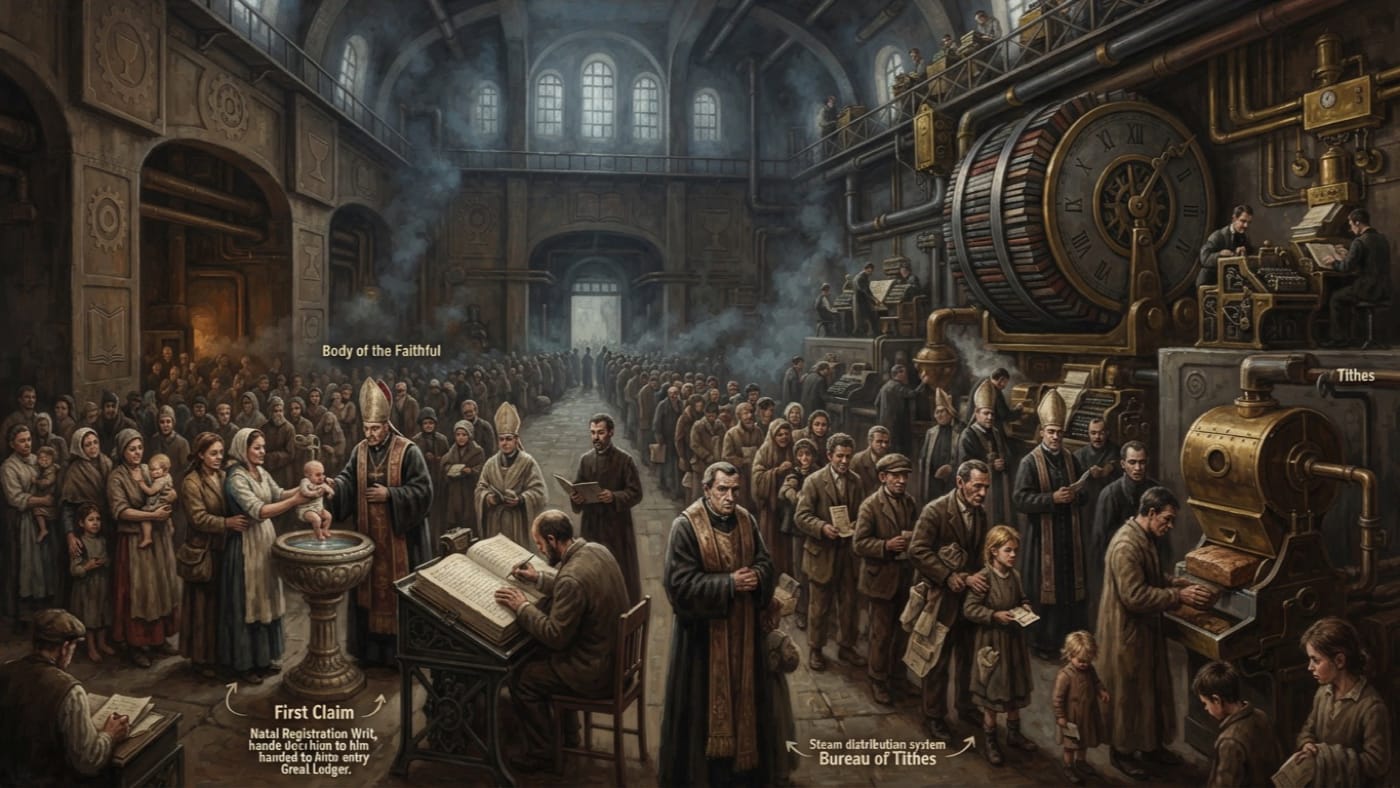
#On the Body and Its Members
The Body of the Faithful is the Church's name for its people taken together: every household kneeling in a diocese of the Dominion, every parish answering its bell, every guild, circle and sworn brotherhood that does sanctioned work inside the Covenant. It has no charter of its own. It keeps no hall, elects no board and sends no delegate to Strasbourg. Bishops shepherd it, Bureaus administer claims upon it, and confessors listen to it at close range. A clerk who mistakes the Body for any office that counts it should be reassigned to a smaller desk with a worse chair.
The Synod claims the Body's allegiance through two hands, the ecclesiastical and the civil. The catechism of the Bureau of Doctrine teaches that the Synod governs the flesh while the Hierarchy shepherds the soul. It is a fine sentence for a homily. I have watched both hands fill in the same form.
A soul may belong in two ways. The first is devotion: the widow at the shrine rail, the levy-boy mumbling the Creed before muster, the Penitents' Guild bleeding in procession for the edification of the street. The second is recognition, which is an administrative condition and so more dependable. Devotion can be feigned. Recognition has to be filed.
#On the Recorded Soul
Archon Benedict Veyrault did not invent the faithful. He invented a test for them. His doctrine of recorded existence holds that a soul passes into the Synod's keeping when it passes into the Great Ledger of Souls, and that an unentered soul drifts beyond the reach of ordered grace. "Nothing is forgotten" is Records' motto and its public face. The private corollary is that nobody is obliged to mourn the unremembered.
The Bureau of Records did not spring from Veyrault's skull fully bound. Parish rolls, ration lists and baptismal books came before it. The transformation of A.S. 78 gathered those scattered memories into an apparatus that could outlast a siege, and later a bishop. Each Bureau then took its portion of the flock. Doctrine defines what the Body may believe. Records keeps the names by which the administration recognises it. Tithes reckons what it owes. Purity investigates what it hides. Mercy receives the children it fails to keep. That makes five offices for one flock, and an archive of quarrels over jurisdiction that I am forbidden to index.
By A.S. 150 the Ledger held four million names. That is a historical count, taken in a year of strain. Any preacher who quotes it as the present size of the Body should copy it out by hand until he can tell a census from a congregation.
#On the First Claim
Veyrault died in A.S. 118. Forty years later Hierarch-Procurator Marius of Cologne ratified the Natal Registration Act of A.S. 158, Records countersigned, and the recorded soul acquired a deadline.
The Act retired the quarterly birth rolls that parish priests used to submit, or failed to submit, or submitted with mice in them. In their place the attending midwife files the Natal Registration Writ, Form 7-NR, within forty-eight hours of first breath. The parish receives the writ. Records transcribes it. Tithes takes the projected obligations it carries and prices the child by a formula the Bureau keeps classified. I will not describe that formula. Obedience forbids it, and so does the fact that I have never been allowed to see it.
A midwife who files late owes a fine equal to the child's projected lifetime tithe. A midwife who never files owes double, under the Administrative Inconvenience Premium. The first fine punishes tardiness. The second punishes a conscience that arrived at the wrong hour.
The same Act constituted the Womb Registrar corps, the Records deputies who handle pregnancy notices, issue approved names, check midwife compliance and reconcile every blank writ against its serial number. A missing blank is a missing child, or a forger's opportunity. The corps treats both the same until told otherwise.
Doctrine let the clerks work for four years before it consecrated their work. In A.S. 162 it ruled that entry in the Great Ledger constitutes "a preliminary claim upon the soul's allegiance to the Body of the Faithful."
Every word of that sentence was weighed in a locked room. Preliminary concedes that a child two days old has assented to nothing, infants being reticent in matters of fealty. It confers no sacrament and certifies no salvation, which remains the Creator's affair and Doctrine's commentary. Claim is a creditor's word. Allegiance is something owed, which is different from something given, and the gap between the two can last a lifetime.
The writ comes first and the font afterward. At baptism the child enters the Book of Promise. Later still the vocations come down: levy, choir, ledger. The writ, the claim, the font and the vocation are four instruments used on four occasions, and all four move the child in one direction. Anyone who calls the writ a baptism will be corrected, kindly the first time.
The memorial tablet to Marius of Cologne records that he "secured every child's place within the Body of the Faithful."
Corrected. Marius secured every child's filing obligation. The child's place is settled by Doctrine, the font and the Creator, in ascending order of jurisdiction. The tablet was carved at so much per letter, and the mason chose to be generous.
#On Service and Protection
The recorded soul receives as well as owes. This has to be said plainly, because the Pale Kin say the contrary with great feeling and little arithmetic.
A Ledger entry underwrites the ration chit, the residence permit, the work assignment and the pilgrim's passage. An estate passes only with ledgers stamped in Strasbourg. A burial with proper rites requires a name the ossuary clerk can find. When a scribe certifies a birth, duplicates go down the line to the ration register and the tithe roll, so the child who eats in the Body's kitchen also appears in the Body's accounts. Every service is also a sightline. The household that draws bread is a household that can be inspected, assessed and forecast for the levy.
The Mothers of Plenty show the bargain at its most domestic. They are a loyal association, not a Records corps, though several of their Matrons style themselves Womb Registrars, and the corps of that name tolerates the confusion because it saves on introductions. A pregnant woman who gives notice receives a prenatal allotment. Flour requires notice. Notice requires inspection. Inspection produces a record, and the record outlives the flour.
#On the Unentered and the Removed
The Body is troubled by two kinds of absence, and Records keeps them in separate cabinets.
The first kind is the child who was never entered. Concealment is older than the Act; the Nursery Levy decrees produced their own cellars. The Act did make concealment a crime with a clock on it. The Pale Kin hide births, plant false stillbirth entries, pass infants through family shelter and give them names that appear on no approved list. Purity calls this theft. Many of the thieves pray every night. Their offence is that they love a particular child more than they trust the claim upon it, and Doctrine has never fully explained why that should make the prayer void. Under Standing Order 34-PK, Purity and Records act together. Recovered children go into Orphanarium custody, receive a saint's name from the approved list and are processed under Administrative Recovery, a phrase that sounds like an accounting adjustment and is meant to.
The second kind is the person who was entered and then struck. An Erasure Notary's black seal voids the ration claim, the right of passage, the property, the marriage, the kinship roll and the burial right. Some scribes say a struck name thins the flesh that once answered to it. Doctrine has not ruled on that question, and I decline to rule ahead of Doctrine.
The unentered child and the struck man are both outside the record. The child is still owed to the Body. The man has been written out of it. The Body claims everyone, and its clerks decide who stays on the books.
#On the Present Claim
In A.S. 201 the Natal Registration Act remains in force. Form 7-NR stands in its revision of A.S. 188. The ruling of A.S. 162 is affirmed every time a midwife's ink dries within the window. Approved names are issued by district, blanks are reconciled monthly, and projected obligations travel to Tithes in sealed satchels that nobody below the rank of assessor may open.
The rhetoric of the Body is universal. Its administration is not. Britain and the Netherlands keep their own rolls and their own midwives, and the Church prays for both nations with great sincerity. It does not file them.