
#On the Name the Mothers Do Not Use
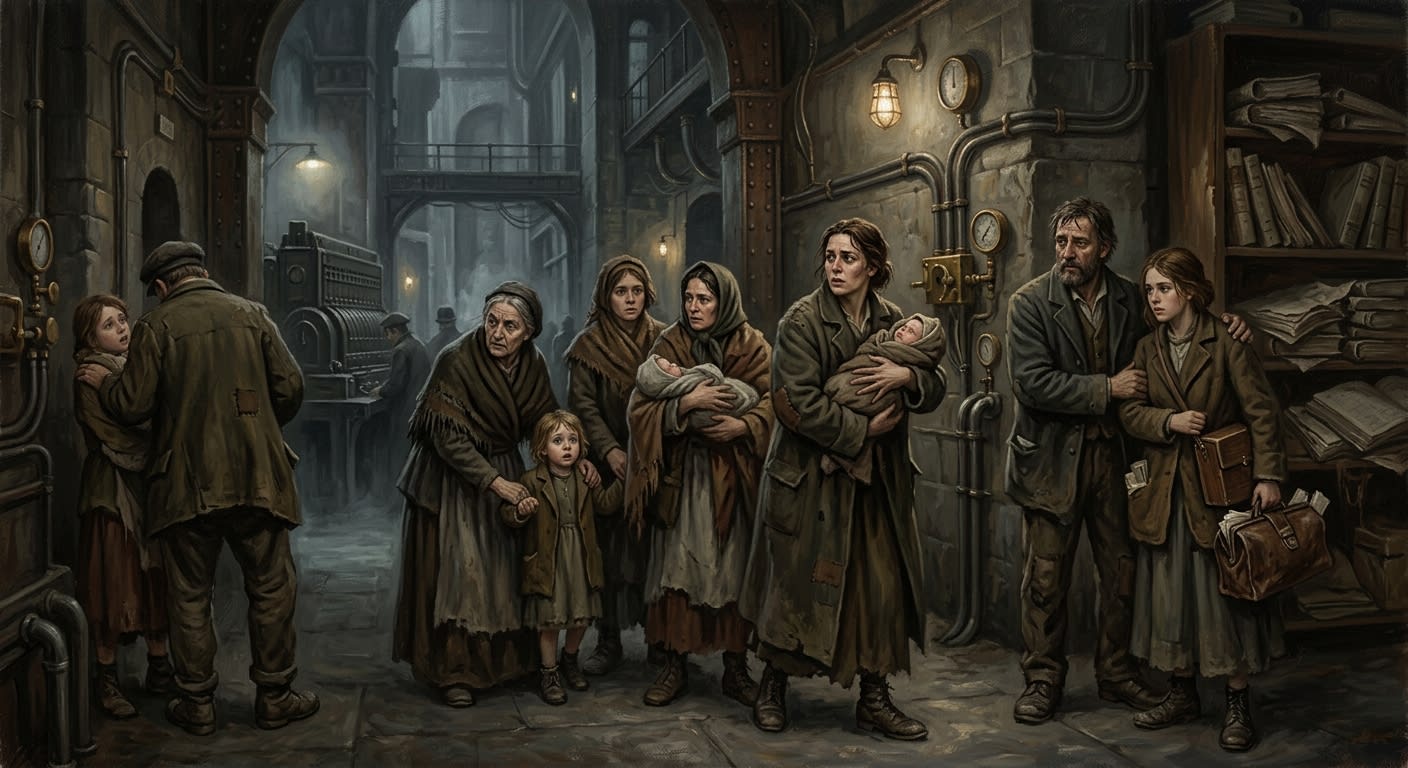
The Pale Kin are families who conceal births from the Great Ledger of Souls, hide infants from registry clerks, shelter unnumbered youths from levy arithmetic, and commit the unforgivable domestic heresy of loving a child before the state has priced him. The Bureau of Conscription calls them stolen soldiers. The Bureau of Records calls them discontinuities. The Bureau of Purity calls them infection. The families themselves, when they possess any wit at all, call themselves nothing.
A name is a hook. A hook is how the Bureau catches flesh.
The movement is older than its files. Mothers hid children before the Synod learned to spell mercy with a surcharge. Fathers lied about sons before the Sagittal Line became a mouth that ate futures on schedule. Grandmothers smuggled names in soup long before Records discovered that a kitchen can defeat a census by remembering in the wrong order. A state that counts every cradle should expect cradles to become military terrain.
The modern Pale Kin, as a recognisable network rather than scattered panic, hardened after the Nursery Levy Decrees of A.S. 152. Those Decrees cut the old one-month registration window to preliminary notice within twelve hours and full natal filing within seventy-two. The cord-blood had scarcely dried before the registrar's knock acquired the force of doctrine. Late filing became active concealment. Concealment became heresy. Heresy acquired armed entry.
Within two years, Mother Sava of the Ash Steps burned her parish registry, vanished with eleven infants, and taught Europe a lesson the Bureaus still pretend not to have learned: the Ledger is holy only while the paper survives.
#On the Child Before the Stamp
The Pale Kin begin at the instant between breath and record. The infant cries; the mother bleeds; the midwife looks toward the stair. Somewhere nearby a clerk has a blank Natal Registration Writ, a wax-stick, and the bland courage of a man who has never been asked to surrender anything warmer than a receipt.

That interval is the Pale Kin's country. It has no borders on a map. It lies in cellars, barns, washhouse lofts, forest huts, pilfered Mercy rooms, ossuary side-chapels, bakery cupboards, pageant wagons, and the space beneath a grandmother's skirt while a search team counts beds badly. Its language is the cough that means wait, the basin struck twice with shears, the soap-rag on the fence, the extra loaf, the wet-nurse token marked with a pinprick no official swatch names.
The Bureau says an unregistered child is outside salvation. This is tidy theology. It makes seizure sound like rescue. A child outside the Ledger cannot marry lawfully, confess under a true name, draw rations, inherit property, enter an apprenticeship without borrowed paper, or be buried in consecrated ground with the proper writ sewn to the shroud. The Synod built a world in which a sheet of paper performs half the functions of a soul, then accused mothers of sacrilege for fearing paper.
Earlier Conscription homilies described Pale Kin parents as “enemies of sacrifice.”
Clarified: they understand sacrifice too well. They object to having it scheduled fourteen years in advance by men whose own sons acquire medical exemptions with astonishing regularity.
The Pale Kin do not possess a single doctrine. They possess a refusal. The refusal is plain enough to fit in the mouth while biting leather: this child will not be counted into the Line if I can help it.
#On Mother Sava and the Ash Eleven
Mother Sava is the movement's wound, relic, quarrel, and excuse. In A.S. 154 she burned the parish registry of the Ash Steps and removed eleven infants from levy arithmetic. Their official status became stillborn, cause undetermined. Their practical status became unfindable, which is the first liberty most children ever receive.
Purity hunted Sava for nine years. A.S. 154 to A.S. 163: laundries searched, midwives questioned, wet-nurses broken, parish wax traced, cellars opened, taverns watched, Mercy doorways counted twice. The hunt taught the hunters that Sava had made no glorious conspiracy. She had made habits. Bundle-Carriers, Seal-Swappers, Route-Keepers, Cradle Brokers; soap and diesel signals; false quarrels staged between sisters; stillbirth grief performed loudly enough to satisfy neighbours and dully enough to bore clerks. Humility was her armour. The Bureau kept looking for a banner.
They found her bones in Innsbruck, in a wall-cavity behind a bricked pantry. With her lay midwife shears, ash-ink tools, parish wax fragments, and eleven pairs of children's shoes. Worn. Outgrown. Mismatched.
The shoes ruined the official sermon. A stolen infant can be imagined as dead, sold, devoured, corrupted, or hoarded by a witch in a cellar. An outgrown shoe refuses such convenience. It records use. It says the child walked. Eleven pairs said eleven children had lived long enough to exceed the state's last measurement.
The Pale Kin made Sava their proof. The Blood-Kin Purists claimed she had preserved bloodlines. The Ward-Builders claimed the mismatched soles proved stranger placement. The Ash Registrars claimed the burnt roll mattered more than the shoes, because the children were freed at the instant the ink failed. Each faction stole a saint from the same wall-cavity. This is how movements mature: they inherit one corpse and found three committees.
#On the Three Working Heresies
The Pale Kin's internal division is not weakness. It is survival under pressure. A single method is a single noose.
The Blood-Kin Purists keep children close. Their rule is blood first, blood last, blood or nothing: mother's sister, father's sister if sober, grandmother, cousin with milk, widow of the same lane if the family can bear the shame. They preserve blood-names in recipes, curses, old songs, funeral taboos, and the domestic law of who may never marry whom because some vanished grandfather still matters. Their strength is memory. Their weakness is memory. Purity follows grief the way hounds follow blood, and family leaves footprints all over the floor.
The Ward-Builders distrust blood's sentimental incompetence. They place infants with tested strangers: bakers, washerwomen, bell-tower boys, widowers, pageant crews, kitchen sisters, Mercy-adjacent cooks with unofficial doors. Their wards are conspiracies disguised as nuisance. Everybody knows enough to protect. Nobody knows enough to own. They manufacture family from bread debt, shared guilt, chores, and mutually assured execution.
The Ash Registrars consider both factions noisy mammalian amateurs until the forms have been ruined. Their doctrine is the void: make the file boring, the stillbirth plausible, the mother tired, the clerk late for dinner. They use ash-ink, stolen seals, dead infant tags, parish calendars, wax crumbs, and a contempt for beautiful forgery so refined that Records has mistaken their work for legitimate incompetence. A child carried across three provinces can still be seized if the birth-roll remains obedient. An infant asleep under his own roof can vanish from the state if the paper loses confidence.
They quarrel constantly. Naturally. People saving children under death sentence still find time to insult one another's methods; this is the human species at its most recognisable. The Purist calls the Ward-Builder a severer. The Ward-Builder calls the Purist an audit trail with opinions. The Ash Registrar calls both of them evidence waiting for a clerk. Then a registry team enters the street and all three discover ecumenism at speed.
#On the Bureau's Arithmetic
The state hunts the Pale Kin with ledgers first and irons second. This offends popular taste. Popular taste prefers a white-mantled villain kicking in a door. The true predator is a clerk comparing stillbirth ratios against milk allocation.
A parish with too many stillbirths is marked. A ward with bread consumption beyond registered mouths is marked. A wet-nurse whose milk-token pattern does not match her listed infant is marked. A grandmother buying goat milk after burying no child is marked. A midwife whose handwriting improves after a fire is marked. Records notices, Purity enters, the Order of the Root asks kinship questions, and the household becomes a diagram with screams attached.
The Order of the Root has made Pale Kin suppression uglier and more efficient, which is the standard bargain when specialists are invited. Root examiners see hereditary contamination where others see pity. They expand family charts, cross-index midwife rolls, inspect Orphanarii intake, compare child tags, and treat the hidden child as a seedling in a forbidden grove. They are gardeners with cuffs. I dislike gardens maintained by men who smile while pruning.
STANDING ORDER 34-PK — JOINT SUPPRESSION ANNEX, A.S. 201 Estimated unregistered births in Zones 2–3 since A.S. 190: █████████. Confirmed Pale Kin receiving wards: █████. Recommended pressure points: milk ration variance; burial permission; Mercy intake reconciliation; kinship recurrence; school-roll absence; ████████████████████. Disposition of recovered children: ADMINISTRATIVE RECOVERY unless ████████████████████.
The amnesty writ is crueller than the raid. It arrives as mercy: late registration, voluntary compliance, reduced penalty, no public prosecution if the child is surrendered to order. The notation follows the child through life. Late Registration. Voluntary Compliance. Suspicion stamped at cradle height. Some families accept. Hunger makes cowards of the noble and philosophers of the well-fed; let no man sneer too loudly at a mother counting winter flour.
Recovered children enter the Orphanarium system under ADMINISTRATIVE RECOVERY. They receive a saint's name from an approved list, a ration card, a registration number, a future selected by a clerk, and the Bureau's grave assurance that disorder has ended. Disorder, in this case, means parents.
#On What the Bureau Cannot Count
The Bureau understands the Pale Kin better than its sermons admit. It knows the movement grows after each levy tightening, each Orphanarium sweep, each registry raid that takes a child and returns a receipt. It knows armed cradle enforcement produces midwife resistance. It knows a public trial of mothers can sour a district faster than grain rot. It knows total eradication would cost more than the discrepancy.
So the Bureau manages. It audits. It arrests enough to frighten and spares enough to avoid riots. It calls the loss acceptable operational friction. The phrase should be branded onto the tongue of every man who wrote it.
A Bureau of Purity assessment in A.S. 196 described Pale Kin operations as “declining in scope and operational capacity.”
Corrected. They were changing shape. The Bureau mistook quiet for weakness, because the Bureau owns many bells and has come to believe that reality must ring when struck.
The Pale Kin are not innocent in the manner sentimental pamphlets require. Children have been sold. Routes have failed. Receivers have beaten the mouths they were meant to feed. Blood kin have betrayed under debt. Ward houses have panicked. Ash Registrars have ruined whole streets with one proud line of handwriting. Hidden children grow into adults with borrowed names, broken sacraments, false cousins, no burial rights, and grief they cannot safely explain. Freedom outside the Ledger is thin soup. Some winters, it freezes in the bowl.
Yet the movement persists because the Synod's claim is more monstrous than their failures. The Bureau claims first breath. The Pale Kin steal a second.
A hidden child may know a blood-name whispered behind the stove, or no blood-name at all. She may learn to answer to three names and trust none. He may become a baker's nuisance, a washerwoman's nephew, a false servant, a bell-boy, a runaway, a runner. They may never confess under the name their mother first mouthed. They may never receive lawful burial. They may never feed the Line.
The Bureau calls them stolen soldiers. The mothers call them free. I call them evidence that even the Sacred Ledger, vast and red and swollen with names, still has margins.