
#On the Instrument Itself
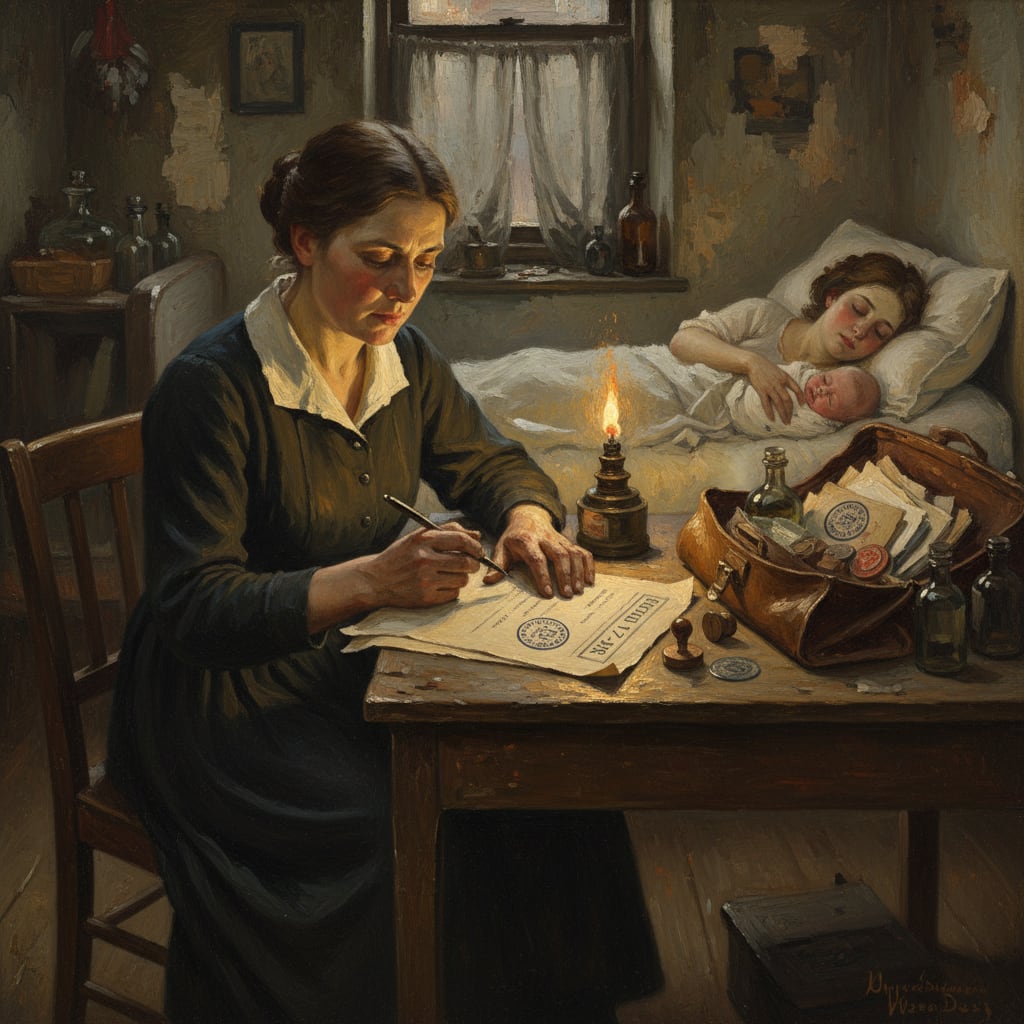
The Natal Registration Writ — Form 7-NR, Bureau of Records, Revised A.S. 188, Third Impression — is a single sheet of rag-bond paper, eleven inches by fourteen, bearing the watermark of the Bureau of Records in its upper-left corner and the watermark of the Bureau of Tithes in its lower-right. Between these two watermarks lies the whole apparatus of a life not yet lived: name, parish, date of delivery, hour of delivery, sex, weight (estimated), condition (assessed), mother's registration number, father's registration number (or, in the case of bastardy, the standard notation Patris Incerti followed by whatever the midwife thinks she heard through the wall), and a blank field at the bottom labeled PROJECTED OBLIGATIONS, which the Bureau of Tithes fills in later with a figure that represents the approximate fiscal value of the child's existence to the Synod from cradle to coffin.
The form must be completed and filed within forty-eight hours of delivery. This is not a guideline. This is law — the Natal Registration Act of A.S. 158, ratified by Hierarch-Procurator Marius of Cologne, countersigned by the Bureau of Records, and enforced by every midwife, parish clerk, and Womb Registrar between the Atlantic and the Sagittal Line.
Failure to file is punishable by a fine equivalent to the child's projected lifetime tithe.
I will allow that sentence to settle before proceeding, because it contains two implications that the casual reader may have failed to absorb. First: the Bureau of Tithes has devised a formula that calculates, at the moment of birth, the total fiscal yield a human being will produce across an average span of years — tithe contributions, labour tokens, conscription value, sacramental fees, burial costs, the lot. Second: the fine for failing to register that human being is equal to the full amount. Which is to say that a midwife who neglects the paperwork owes the Synod the price of an entire life. Not her life. The child's.
#On the Necessity That Produced It
The Great Ledger of Souls was, by A.S. 150, the largest single document in the Church's lands. Four million names. Each one cataloged by parish, diocese, and sacramental status. Each one maintained by the four hundred and twelve scribes of the Lower Vaults beneath the The Basilica of the Ledgered Saints in Strasbourg, who scratched their quills across red calf from Lauds to Compline and woke at Matins to begin again.
The problem was arithmetic. Births outpaced the scribes. Parish rolls arrived late, incomplete, illegible, water-damaged, forged, or — in one memorandum I have read — "written in what appears to be turnip ink on the back of a gambling receipt." The Bureau of Records was losing names. In a system where a lost name is a lost soul, and a lost soul is a failure of governance, and a failure of governance is heresy, the situation was intolerable.
Archon Veyrault had anticipated the problem. His original charter for the Bureau included a provision requiring parish priests to submit birth records quarterly. The provision assumed that parish priests could write, that they would write honestly, and that the postal system between a mountain village in the Tyrol and the Lower Vaults of Strasbourg would function with the regularity of a pendulum clock. All three assumptions were wrong. The priests were drunk. The roads were rutted. The postal riders were eaten by wolves, or by demons, or — in the recorded case of Courier-Designate Wenders of Ulm — by both, sequentially, with a twelve-hour interval between predations that the Bureau of Records classifies as "administratively distinct."
An earlier edition of this entry attributed the Natal Registration Act to Archon Veyrault himself.
Veyrault died in A.S. 134. The Act was ratified in A.S. 158 by Hierarch-Procurator Marius of Cologne, twenty-four years after Veyrault's last breath. The Bureau of Records considers Veyrault's vision "foundational" and Marius's contribution "implementational." Marius's ghost, if it objects, may file the relevant form.
The Act solved the postal problem by eliminating the post. It placed the obligation to register directly upon the attending midwife — not the priest, not the parish clerk, not the father — on the grounds that midwives are already present at the relevant moment and are less likely to be drunk. The forty-eight-hour window was calculated from the child's first breath, not the mother's last push, because the Bureau required a fixed and observable starting point and because the Bureau of Doctrine had ruled that ensoulment occurs at the first independent inhalation, a ruling that the Bureau of Records found theologically acceptable and administratively convenient.
#On the Midwife's Burden
The midwife carries the blank Writs in a leather satchel issued by the Mothers of Plenty — or, in the bastions, by the Bureau of Mercy's field office. She carries ink. She carries a seal-stamp bearing her registration number. She carries a measuring cord for the infant's length. She carries a set of reference tables, published annually by the Bureau of Records, which list approved given names by diocese and the corresponding saint's-day associations. Names not on the list require a supplementary form. Names in languages other than the Synod's approved liturgical tongues require two supplementary forms and a letter from the local Bureau of Doctrine representative explaining why the parents believe their linguistic preference outweighs the administrative convenience of standardized nomenclature.
The midwife fills in the Writ at the bedside. She records the time. She records the weight, estimated by hand. She records the condition — "vital," "weak," "monstrous" (a category the Bureau insists is purely morphological and carries no doctrinal implication, a claim that no one in the Bureau believes and no one outside the Bureau is willing to test). She takes the mother's thumbprint on the left margin and the father's on the right. In households where the father is absent, dead, deployed, dissolved, imprisoned, or otherwise indisposed, the midwife stamps the right margin with a Bureau seal reading Absens Per Causam and moves on, because the Bureau does not wait for fathers and neither does the child.
The completed Writ is then carried — by the midwife herself, not by proxy, not by post, not by the helpful neighbour who offers and must be refused — to the nearest Bureau of Records parish office, where a Receiving Clerk logs it, stamps it, and forwards it to the regional archive for transcription into the Great Ledger. The regional archive forwards a confirmation stub to the Mothers of Plenty, who update the household's ration allocation to include the new mouth. The ration adjustment triggers a notification to the Bureau of Tithes, who calculate the household's revised tithe obligation. The tithe revision triggers a notation in the Bureau of Conscription's forward projections, if the child is male.
A single sheet of paper. Eleven inches by fourteen. And by the time it has passed through the apparatus, the child is named, counted, tithed, fed, and — if a boy — already penciled into a column marked FUTURE LEVY YIELD on a desk in Strasbourg that the child will never see and the mother was never told about.
#On the Penalties and Their Application
The fine for late filing is the projected lifetime tithe. The fine for non-filing is the projected lifetime tithe plus a surcharge the Bureau calls the "Administrative Inconvenience Premium," which is calculated as a percentage of the fine and is, in practice, approximately equal to it. A midwife who fails to file owes the Synod twice the value of a human life. She will not pay it. She cannot pay it. The fine is not designed to be paid. It is designed to ensure that every midwife in the Church's lands reaches for the satchel before she reaches for the swaddling.
Late filing — defined as any submission after forty-eight hours and before thirty days — carries a reduced fine: one-tenth of the projected lifetime tithe, which remains ruinous for a midwife earning three Crowns per delivery. The practical result is that midwives file immediately, often before the cord is cut, often before the child has been cleaned, and in documented cases before the child has been fully delivered, the head being sufficient for the Bureau's purposes and the name having been agreed upon in advance.
██████████████ has documented ████████████████ cases in which midwives filed Natal Registration Writs for infants who were ████████████████ at the time of filing, on the grounds that ████████████████ and the Bureau's forty-eight-hour clock "begins at first breath, not first warmth." The ████████████████ of these writs remains ████████████████ under standing order.
#On Those Who Refuse
They are called the Pale Kin. They hide their infants from the census. They give birth in cellars, in barns, in the deep forest, in the warrens beneath the cities where the Bureau of Purity's inspectors lose their nerve and their lanterns. They do not call a midwife. They call no one. They bite down on a strip of leather and deliver in silence, because sound carries, and a crying infant is a registered infant, and a registered infant belongs to the Synod from its first breath to its last.
The Pale Kin call their unregistered children "free." The Bureau calls them "stolen soldiers." The Mothers of Plenty call them "unsung cradles" — infants who exist outside the ration system, who eat food that was allocated to no one, who grow into adults with no name in the Ledger and therefore no sacramental existence. They cannot marry in a licensed chapel. They cannot confess to a registered confessor. They cannot be buried in consecrated ground. They are ghosts produced by the refusal of a single sheet of paper.
The Bureau of Purity hunts them. The Bureau of Records hunts them. The Order of the Root hunts them, because an unregistered child is an un-catechized child, and an un-catechized child is a theological vacancy the Order finds intolerable. Joint suppression teams patrol the warrens with lanterns and registration satchels, offering amnesty writs that promise retroactive filing with "no penalty beyond the standard surcharge," which is, as noted above, the price of a life.
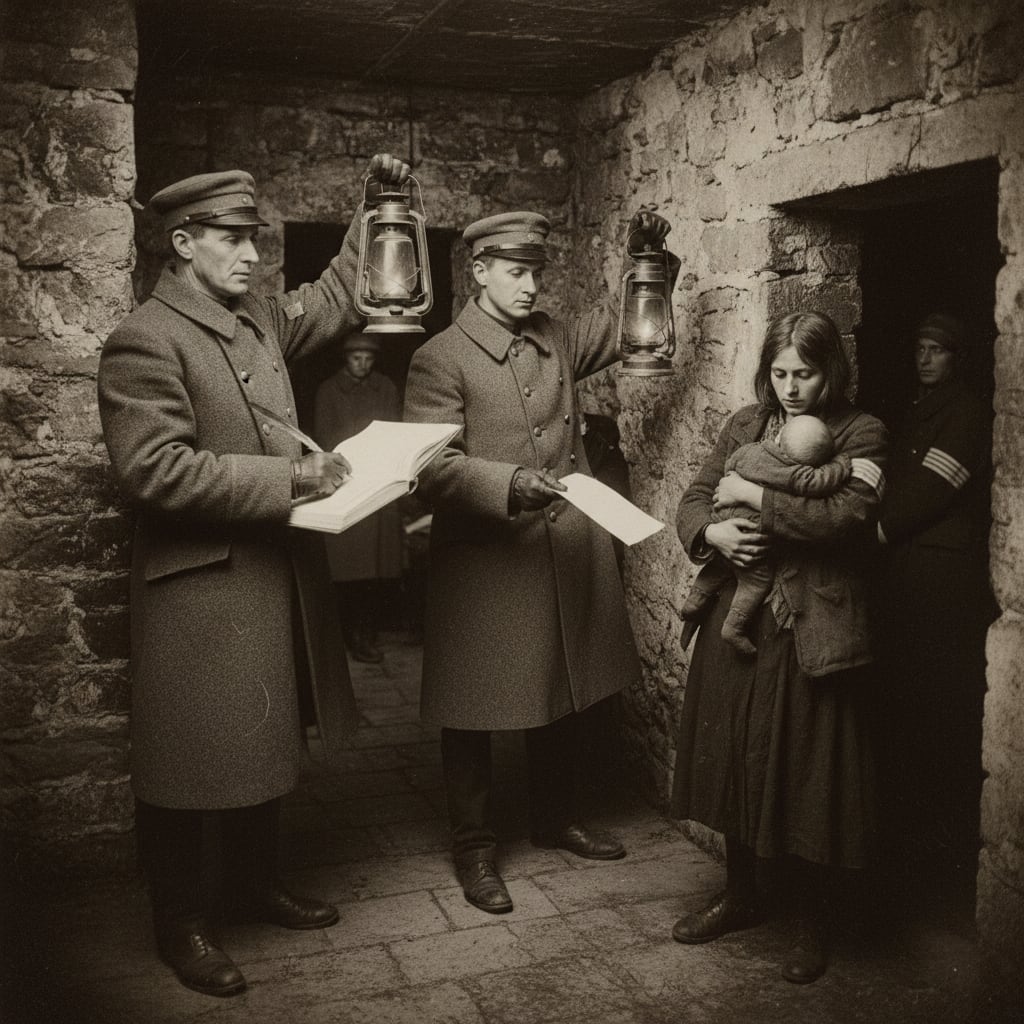
The Pale Kin who refuse the amnesty are charged under the Natal Registration Act with "obstruction of the Ledger's continuity" — a crime that carries a penalty the Bureau of Records describes as "proportionate" and that I, having read the sentencing guidelines, describe as ecclesiastical fury dressed in filing-cabinet prose. The parents are separated. The mother is placed in a Plenty House for "reintegration." The father, if identifiable, is conscripted or dissolved. The child is taken to an Orphanarium, washed, named by a clerk, and entered into the Ledger under a new natal registration writ stamped ADMINISTRATIVE RECOVERY.
The child receives a name the parents did not choose. A saint's name from the approved list. A registration number. A ration card. A future.
#On the Writ's Theology
A previous edition suggested the Natal Registration Writ serves a purely administrative function.
This was my error, and I correct it with the reluctance of a man who preferred the simpler version. The Writ is not administrative. It is sacramental — or rather, it occupies the gray territory between administration and sacrament that the Synod has cultivated with the patience of a gardener growing thorns. The Bureau of Doctrine ruled in A.S. 162 that a name entered in the Great Ledger of Souls is "a species of baptismal registry" and that the act of filing constitutes "a preliminary claim upon the soul's allegiance to the Body of the Faithful." The ruling stopped short of declaring the Writ a sacrament. It did not stop short of declaring that failure to file is "a wound to the Body's integrity."
The implication is stark. An unfiled child is an unclaimed soul. An unclaimed soul is, in the Bureau of Doctrine's careful language, "in a state of administrative limbo" — which is distinct from theological limbo only in that administrative limbo has a filing deadline and theological limbo, by definition, does not.
The midwife is therefore more than a scribe. She is — whether she knows it, whether she consents, whether she has read the Bureau of Doctrine's ruling or merely felt its weight in the satchel on her shoulder — the first official to lay claim to a soul on the Synod's behalf. Before the priest. Before the baptismal font. Before the godparents and the candle and the oil. The midwife's pen touches the form, and the child becomes the Synod's.
This is the genius of the Natal Registration Writ. It transformed the most intimate act in human life — birth, blood, the first cry — into a filing event. It placed the Synod's hand upon the infant before the mother's milk had dried. And it did so with a single sheet of paper, eleven inches by fourteen, bearing two watermarks and a blank field for projected obligations that will follow the child from its first breath to the grave the The Bureau of Records has already assigned it a plot number for.
Archon Veyrault would have wept.
I suspect he would have wept with satisfaction.