
#On the Fourteen
In A.S. 104, which the Strasbourg calendar renders as 1814 CE, the furnace of a bastion powerhouse failed and fourteen stokers burned.
That is the whole of the certified record. No source this office may cite names the bastion. The day, the month, the season and the duration of what followed were never entered. Later copyists have nominated a valve, a seam and a firebox in turn as the mechanism. Each did so with the confidence of a man who was not present and had read nothing. I nominate none of them. The Ledger records a failure, and the Ledger does not guess at boilers.
The men are easier to describe than the machine. A stoker of the period worked a gallery of soot-black iron with a shovel, a rag at his throat and a gauge above his head whose meaning belonged to other men. Ash lived in the creases of his knuckles. He learned the furnace by ear, by colour and by the smell of a draught gone wrong. He learned it without vocabulary, because vocabulary was issued elsewhere. Fourteen such men went into the shift, and the shift ended without them.
The title is plural, and the plural belongs to the clerks who filed it. The record supports one powerhouse, one catastrophe and one body of survivors. I decline to multiply any of them for the sake of a heading.
#On the Demand for Truth Lessons
The survivors asked for what they called truth lessons. The phrase is the only fragment of their speech that reached the Ledger, and it is precise. They wanted the failure explained in engineering terms to the men who would stand at the same grate on the next shift, so that they might hear the next failure coming.
I enter this against the interest of my own Bureau: it was a sensible request. A man who has watched fourteen of his fellows burn wants to know which sound came first, which needle moved, and how far it moved, and what he ought to have done with his hands. The record preserves no other demand from the crowd. They wanted a lesson they could use to stay alive.
The difficulty was jurisdiction, and jurisdiction is the only difficulty the Synod has ever taken seriously. The Bureau of Engineering held technical competence and kept its explanations among its own sworn men. The Bureau of Doctrine held the permitted language of cause. The Lore Book frames their quarrel as a question: did the furnace roar because of fuel, or because Heaven commanded it? Both Bureaus had built careers on the question staying open. A truth lesson in a stoker's hands would have closed it at shovel height. Engineering would have lost the how and Doctrine the why in a single afternoon, to men with ash in their knuckles.
#On the Six Preachers
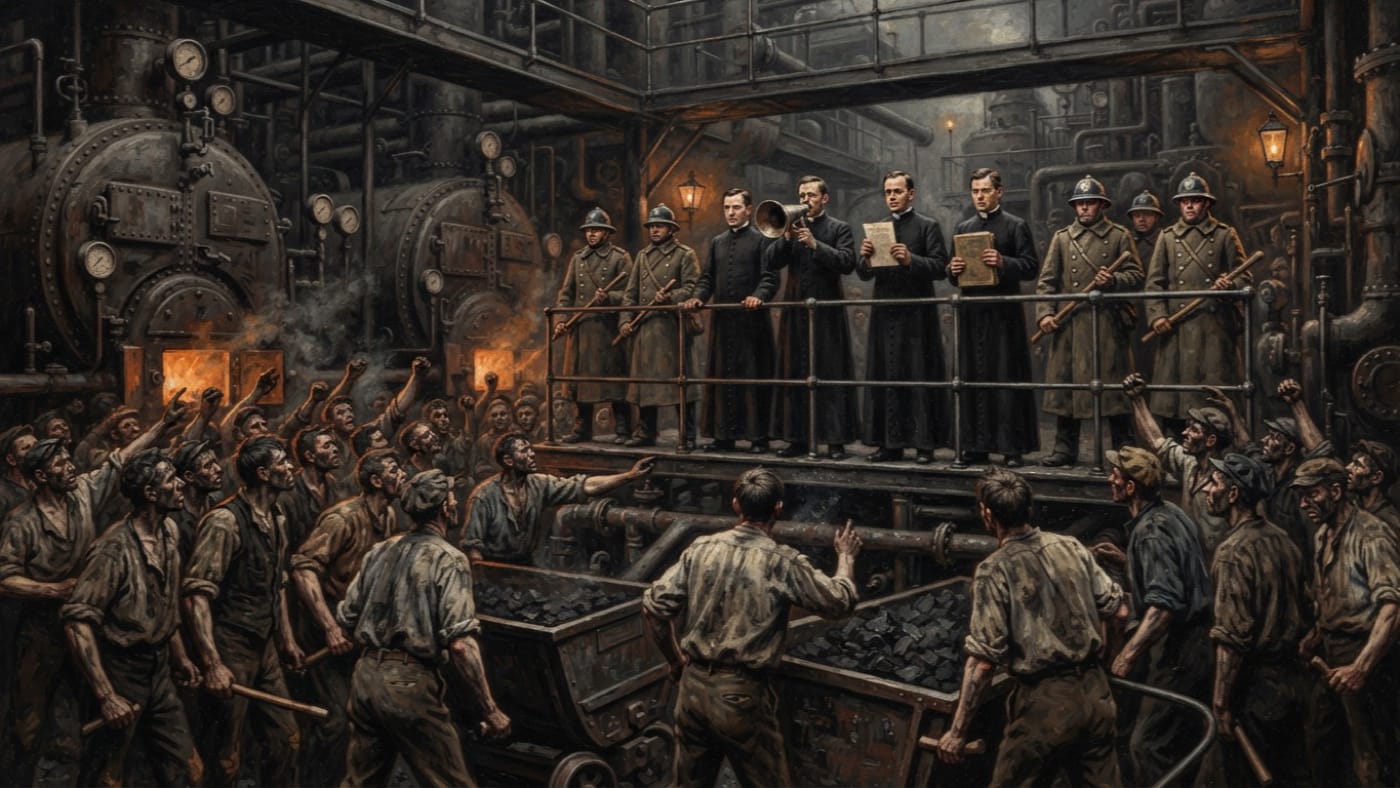
Doctrine sent six men.
They came in heat-resistant cassocks, so someone in the Bureau knew exactly what kind of room they were walking into. They carried doctrine cards so that six mouths would give one answer, and portable loudhailers so that the answer would be louder than the question. Wardens walked with them carrying cudgels. The common people call the Wardens Shepherds of the Rod, and on that day the common people were the flock. The accounts give no names for the six, no ranks and no leader. They do not record who spoke first or how many Wardens came. The record keeps the sermon and lets the speakers go.
The sermon ran as follows. The furnace had failed because obedience had failed. Somewhere in the chain of command a prayer had been misarticulated, a confession skipped, a catechism recited without conviction, and the fire had found the fault. The failure was spiritual, and so was the remedy.
That was Doctrine's finding, and the Codex attributes it to Doctrine. The sources I may cite establish no verified cause of this catastrophe, mechanical or spiritual. A careless reader may take this page for a Rationalist pamphlet, so I add the following. I have stood in galleries along the Sagittal Line where a wrong hymn cost a furnace its fire and the right one brought it back. Liturgy bears load on the Line. Nobody has shown whether it bore the load in that powerhouse in A.S. 104.
The record says the riots ended. What ended them has three answers, and each belongs in its own drawer.
The first answer is official. Doctrine stamped the operation doctrinal intervention, Category One, successful, and by the only measure Doctrine applied, the stamp was accurate, because the disturbance stopped. The second is what could be observed. Men facing cudgels go back to work, and the survivors went back to work. The third is belief, which no stamp records. By the account the Codex already carries, some of the stokers took the sermon to heart. I understand them better than I would like. A broken valve leaves a man in an indifferent world. A broken prayer leaves him in a world that is at least watching him, and that can be mended by kneeling, which is cheaper than an apprenticeship.
#On the Office Constituted
"Explaining is stealing." — saying of the Furnace Catechists
The six were sent to end a riot, and the posts they occupied were never closed. The Furnace Catechist office was constituted in A.S. 104 by deployment, without a written mandate. The Synod's more useful offices usually begin this way, in service first and on paper afterward, if they reach paper at all. Whether any of the original six served a further term I cannot say. The institution persisted, and no record of individual postings has reached this office.
What persisted was a function. In the powerhouses a Doctrine man stood between the workforce and the why. He gave instruction at the change of shift. He supplied approved words for heat, pressure and failure and corrected the unapproved ones. After an incident he heard it confessed and entered it in doctrinal terms. Above all, he decided who was permitted to explain a machine, and the answer was nearly always someone else.
The Catechist's trade differs from the Litany-Engineer's, and both trades resent being confused. The Litany-Engineer runs the machine by calibration and cant, with his hand on the valve and his mouth on the chant. The Catechist runs nothing. He polices what may be said about the running.
Mature practice came later and should not be read back onto the first six. That practice includes the eleven-minute recitation of the Chain of Cause and the forbidden lexicon of Standing Order 14-P, revised in A.S. 199. Both belong to the office in its age. Whatever the cards of 104 carried, it was less. Saint Veyra of the Mouth, with her brazier and her sealed book, became the profession's patron. Her iconography suits the work so exactly that a cynic might suspect it was chosen for the purpose. I am paid to suspect nothing.
Earlier chronological tables enter the office as "formally chartered A.S. 104."
ERRATUM (Office of the Sacred Ledger): The office was constituted operationally in A.S. 104, by deployment and without written mandate. This office holds no charter text, ratifying act or sealing day for that year. The particulars of any written charter remain unestablished. The earlier wording is withdrawn.
#On the Precedent
"Cause is a chain; chains have owners." — saying of the Furnace Catechists
The survivors of 104 asked for their lessons aloud. Thirty years later, other men stopped asking. The Causality Purge of A.S. 134 pursued the clandestine manuals called Fuel Is Chemistry through bastion powerhouses. The manuals explained combustion in plain mechanical terms, with diagrams. The truth lessons had found their own way down the gallery, with no licence and no preacher. The office born in 104 answered them with immurements at Bastion-Przemyśl.
Fifty-four years after the riots, in A.S. 158, generators at Bastion-Shipka faltered under what the Bureau of Bells classified as foreign harmonics. The Trench Sermon Mandate then placed Furnace Catechists at every power installation on the Line. At Shipka the pipes held a real enemy. A preacher who governed what men said when the pipes answered back could keep a shift alive. I set this beside A.S. 104 deliberately. In 158 Doctrine had an adversary to name, while in 104 it named obedience. The Mandate gave the office the whole Line, but the office already had the habit of answering with a sermon.
Eighty-three years after the riots, in A.S. 187, came the Ash-School Scandal at Essen-of-Hymnsteel. A Catechist taught unauthorized thermodynamics to an apprentice. The Bureau responded with its full apparatus: the Catechist was immured, the plant reassigned and the apprentice sent away. One of the office's own men had finally given a truth lesson, the thing the survivors of 104 had asked for, and the office answered him as it had been built to answer.
The fourteen remain fourteen. On Doctrine's word, their furnace's failure remains entered under obedience.