
#On the Accusation
“Bread has witnesses.” — ration-hall saying
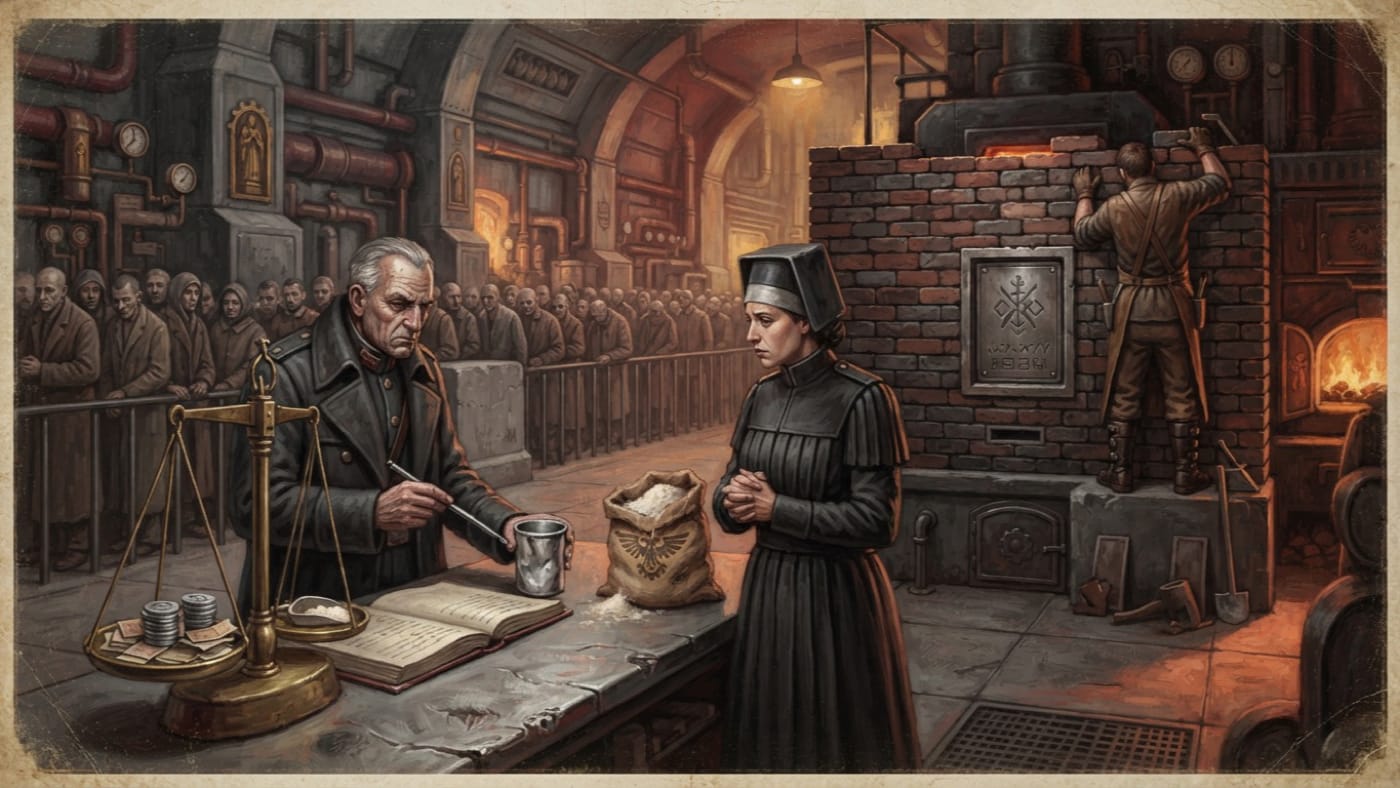
The case begins with a cup: a tin measure, dented at the lip, set on an audit table beside a scale and an open ledger. An inspector from the provision office fills it from the same sack the Matron used at dawn. The cup comes up short by a thumb's breadth, sometimes less. A hundred households stood in the queue that morning, and a hundred thumbs' breadths make a loaf that nobody can account for.
That missing loaf is where larceny becomes heresy.
Bread heresy has no founder and no council of origin, and I cannot produce a decree for it from the vaults. I have looked, with the diligence the Bureau pays me for and some diligence it does not. It is an accusation. The Mothers of Plenty attach the name to flour skimming, counterfeit flour chits, the doctoring of spoiled lots, and bribes paid at the ration rope or the pregnancy desk. Provincial clerks stretch it further, because provincial clerks stretch everything. The charge reaches any food that has moved without the Church's permission.
The soft-handed reader asks why this should be called heresy when it is plainly theft. The halls give a short answer: those caught hoarding grain are punished as heretics and not as thieves. The longer answer is my own. I offer it as Warden of the Ledger, and I do not claim it comes from any recovered enactment. A portion is a sentence the Church passes on a body, fixing how much of that body will continue. Whoever alters the portion has issued a second sentence and made himself a second authority over hunger. In a bastion city, the authority over hunger is the only one that keeps a crowd standing in a queue.
#On the Portion and the Paper
Before a portion can be stolen, someone has to define it, and the definition is made of paper.
A household is entered, classified and weighed against its compliance. The Mothers measure the incoming supply and set each allotment by category: full, half, child, widow, soldier's household, noncompliant. A declared pregnancy changes the entitlement. A certified birth creates a record, and the record feeds a forecast that travels to the Bureau of Conscription long before the infant can hold a spoon.
Each office keeps one hand on the loaf. The Bureau of Tithes collects and accounts for grain, issues seizure orders, and hears denunciations of hidden stores. The Bureau of Records holds the names, and a name missing from its rolls carries no entitlement at all. A duplicate entry draws a double portion until somebody notices. The Bureau of Mercy supplies the ward and the orphanage. The Mothers stand at the rope with the ladle and pour.
The instruments vary by city. In one ward a household holds paper chits that go soft with sweat. In another it holds bone tokens, and in a third a slice is weighed against ash credits and stamped in wax. I have heard the reformer's claim that a single chit governs the whole continent. He has never left his office.
The rule underneath does not vary. Food reaches a mouth through a name, a category and a signature. Remove any one of the three and the mouth is legally empty.
#On the Missing Flour
The documented offences are dull, and they are everywhere. A cup is shaved at the measure bin. A sack is dampened so it weighs heavier on the manifest. A spoiled lot is entered as usable after someone receives a suitable gift of soap. A place nearer the front of the queue is bought from the guard, and a Matron sells access to the reserve bin while wearing the face she wears at the cradle blessing.
Some of this is plain greed. Some of it is the quieter vice of favour, which feeds a cousin, a patron or a captain who might be useful in a bad winter. A third kind sits inside the ration hall itself: the portion shaved to build a reserve, so that when the convoy fails to arrive there is something in the bin besides weevils.
The fourth kind keeps auditors awake at night. The profession's own taboos forbid giving extra to an unregistered household, and Matrons do it anyway. They pay out Ladle Debt, an extra pour of broth today recorded against some future service that may never be called. They practise Womb-Smoothing, lowering a pregnancy risk score so that a woman stays on the allotment and out of a dormitory. Each of these is a fraud by any honest ledger, and each of them keeps a person breathing.
Then there are the Grain Keepers, fifth of the eight named heretical movements. They hide sacks from quota, falsify spoilage reports, swap chits, and send food out through back doors and "charity" parcels. A Grain Keeper can be charged with bread heresy, but the two words do not mean the same thing. A Ladle Sister who skims a cup has never met a Keeper, and a Keeper's cellar may hold no flour that passed through a Mother's hands. The Keepers also differ among themselves. The Mercy Keepers feed children first and ask nothing. The Quota Men keep the system running and skim modestly. The Hunger Brokers use grain the way a magistrate uses a writ, to recruit, bind and blackmail. The charge is the same for all of them, and so is the wall.
#On the Inspection
The audit begins with the cup.
The inspector checks the measure cups first, then the reserve bins. After that, sample households are visited and asked what their chits bought and when. Where the stores belong to a granary and not a ration hall, the routine changes its objects but keeps its method. Bins are weighed, grain is tested, chits are matched to signatures, seals are examined for a second knife, and queue captains are questioned about what they saw and what they were paid to forget.
That last line is the one a Matron learns before she learns pity. Any shortfall needs a name attached. Experienced hands keep a scapegoat ready before the inspector arrives, and the trade has its usual choices: a Ladle Sister caught skimming, a midwife whose numbers will not reconcile, a "noncompliant" mother whose household has complained once too often.
Patronage does the rest. A parish canon or trench commissary officer who wants quiet in his ward can slow an audit, lose a report, or ask whether a reserve that fed four streets through the last bad winter really counts as hoarding. He cannot grant an exemption, because no exemption exists. He can only arrange for nobody to look.
Once the Bureau of Doctrine has named a thing a sin, the Bureau of Purity is entitled to take an interest. Its inspectors have been known to find documentary proof exactly where a superior needed it found. I record this without comment. Comment would require a second ledger.
#On the Sentence
Sentences vary by office and circuit, and I will not invent a ladder of penalties to make the subject look tidier than it is. No minimum quantity of stolen flour, mandatory term or right of appeal is fixed for bread heresy as such.
The milder sentences are public shame and reassignment to the plague kitchens, or to a trench depot where the food goes to men who will be dead before it spoils. Some are made to confess in front of the same queue they fed short. Erasure belongs to a different charge, unauthorized births and ledger fraud, and a careful clerk keeps it separate even when the same Matron stands accused of both.
For bread heresy itself, the sentence the Mothers' own practice names is immurement.
The Immurement Mason receives a writ and a body in cuffs. He checks the name and charge against a plaque slip, cuts the niche if none has been prepared, and lays the courses. Then he sets the plaque bearing name, charge and seal, closes the gap, and logs the completion with the time, the grade of mortar and his own stamp. Some circuits leave an air slit. Others do not, and the mason does not choose. In the bastion cities, grain hoarders have been sealed into bakery walls, so the oven heats the brick on one side while the mourners are kept from the other.
A thumb's breadth of flour ends as a course of brick, a plaque and a line in the completion log. The whole procedure needs a cup, a sack, an inspector, a mason and a wall, and nobody involved has to raise his voice.
#On the Necessary Offence
Ration catechisms state that bread heresy "springs always from private appetite" and that "the charge falls equally in every ward."
Corrected: Grain Keepers are publicly condemned and privately tolerated during crises. Concealed stores have fed children through winters in which the official bins were empty. Enforcement follows patronage, audit pressure and the need for a scapegoat as closely as it follows the flour.
This is the trouble with the accusation, and I set it down because I am paid to be accurate before I am paid to be comfortable. The cup that gets shaved to build a reserve is the same cup that gets shaved for profit, and the same falsified spoilage report hides a cellar of mercy or a broker's warehouse. Measured with the instruments the Church provides, the woman who fed an unregistered child and the woman who sold the reserve bin come up short by the same thumb's breadth.
The Church has always known this. Ever since the hard decades after the Sundering taught every ward what an empty storehouse does to a crowd, the people who keep order have relied on stores that the order forbids. When the convoys fail, the provision offices go looking for the hidden sacks, and they take them first and file the charges later, if they file any.
I defend the charge all the same. A ration system that pardons every merciful theft loses its count within a season, and a city that has lost its count goes back to whoever holds a key, a cudgel and a cousin in uniform. My objection is to the pretence that the wall separates the faithful from the thieves. It separates the people the ward needed this winter from the people it could spare.