
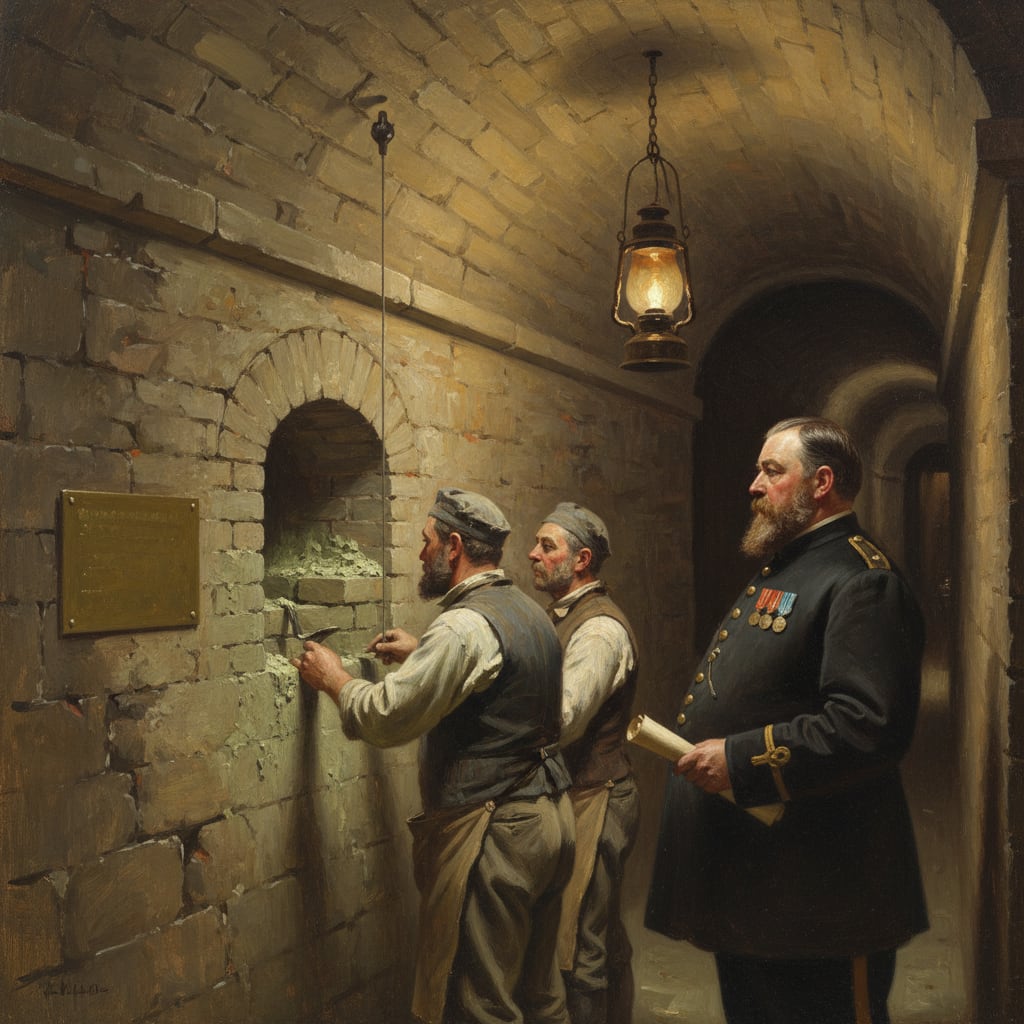
#On the Craft and Its Necessity
"Sin seeks escape. Stone is faithful." — attributed to Saint Karron the Trowel-Hand, date of attribution classified
The Synod does not lack methods of killing. It commands firing squads and hanging trees. It licenses the Lictors of Purity, whose instruments require a separate inventory. It maintains the Ossuary Draft, which converts a man into a walking relic in the space of one charge. None of these, the Bureau maintains, is sufficient.
Execution ends a man. Immurement files him.
The distinction is theological, practical, and — in my estimation — aesthetically superior. A bullet creates a corpse, which requires disposal, which generates paperwork, which burdens the Bureau of Records with a casualty entry that contributes nothing to morale or infrastructure. A hanging produces a spectacle, which generates crowds, which generates the risk of sympathy, which generates the risk of martyrdom, which generates the risk of insurrection — and the Bureau has learned, at the cost of several unpleasant centuries, that spectacle is a blade with no safe end.
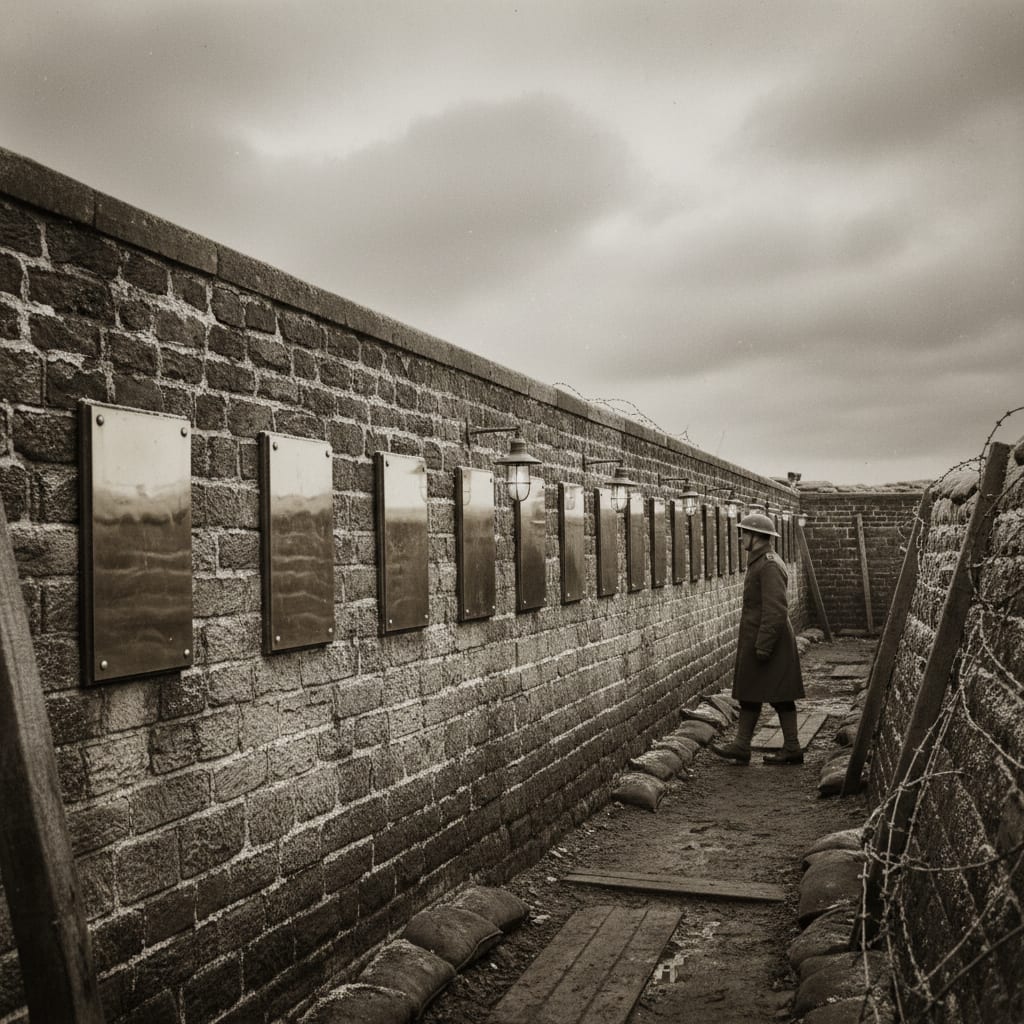
Immurement produces a wall. A wall that holds weight, bears a plaque, teaches a lesson, and — if the mortar is mixed correctly — does not require maintenance for decades. The condemned ceases to be a problem and becomes a structural element. The Bureau of Engineering approves. The Bureau of Doctrine approves. The condemned's opinion was not solicited.
#On the Origin of the Practice
The practice predates the Synod's formalisation, which is to say it predates the paperwork that makes it legal. During the Great Retreat of A.S. 48–65, when the Sagittal Line was being scratched into the earth of a continent that had ceased to understand the word "safety," discipline was a commodity more scarce than bread. Prisons were impossible — every structure was needed for defence, supply, or worship, and the Synod could not spare the men to guard those it had condemned. Executions created martyrs: three firing-squad victims at the Moselle ford in A.S. 53 were venerated as saints within the month, their names chanted by the same soldiers the executions were meant to terrify.
Immurement solved both problems. The condemned occupied no cell. He required no guard. He produced no martyr's corpse to be wept over or smuggled into a reliquary. He simply became part of the trench, and the trench — the soldiers understood — held firm.
The Ration Plunder Winter of A.S. 97 standardised the practice. Famine drove theft to epidemic proportions; ration convoys between the Queue Road staging posts were arriving lighter than they departed, and the Bureau of Tithes calculated losses exceeding nine per cent of total caloric throughput. Hanging was tried. Hanging was insufficient. A Judge in the Rhineland — name sealed, as Judges' names are — ordered the first formal sentence of immurement by writ: a supply clerk convicted of diverting three barrels of flour to the black market. The niche was cut into the supply depot's east wall, at eye level, so that every clerk who entered would pass the plaque. Theft in that depot fell to zero within the week. The Bureau took note.
#On the Masons Themselves
The Masonry Corps — formally the Punitive Construction Auxiliary, though no one calls it that except the Bureau of Records, which calls everything by its least humane title — numbers approximately two thousand four hundred licensed operatives across Zones 1 through 5. They are drawn from the building trades: bricklayers, stonemasons, mortar-mixers, men whose hands know lime and plumb line and the particular resistance of wet stone. They are not executioners. The Bureau is emphatic on this point. Executioners kill. Masons build. That the building happens to contain a living person is, doctrinally, a secondary consideration.
Saint Karron the Trowel-Hand is their patron — a mason of the early Line years who, per the Bureau's hagiography, sealed a heretic whose screams were attracting demonic attention. Karron's binding mix — lime, ash, relic dust, and a compound the Bureau of Engineering classifies as "doctrinally sufficient calcium silicate" — became the standard formula. The heretic's screams stopped. The demons withdrew. Karron was canonised. The binding mix was entered into the Masonry Code, Appendix VII, and has been revised four times since, each revision prompted by an incident the Bureau prefers not to specify.
The hierarchy is legible from a mason's hands. A Lime Boy carries and mixes — his fingers are white with caustic, his knuckles split, his nails eroded to thin crescents. A Wallwright (Unregistered) cuts niches and lays courses — his palms are callused into leather, his wrists thick from hammer-work, his eyes permanently narrowed against dust. A Master Sealer supervises and stamps — his hands may be cleaner, but they shake at night, and he washes them more than the others, and he does not discuss why.
The work is triggered by rulings. A trench-court verdict, a Judge's bailiff bearing the writ, a custody transfer at the wall. Some weeks produce nothing. Some — after a raid, a famine surge, a failed offensive that sends desertion rates climbing — produce a queue. The masons work in pairs, minimum. Solitary sealing is forbidden after the incident at Bastion-Irongate in A.S. 163, when a mason working alone was found the following morning sealed into his own niche, his trowel still in his hand, the plaque bearing his name in handwriting that was not his own. The Bureau classified the event as "administrative error." The Bureau declined to elaborate.
#On the Method
The process is codified. The writ arrives bearing a seal imprint that matches the Judge's stamp. The niche is cut or, if pre-cut, inspected for structural soundness — a niche that compromises the trench wall is worse than useless; it is sabotage, and sabotage is grounds for the mason himself to occupy the next available vacancy. Standard dimensions are regulated by crime class: theft earns a standing niche, sixty-eight inches by twenty by sixteen; desertion earns a kneeling niche, shorter and tighter; heresy earns what the masons call "the box," a seated niche with no standing room, the body folded into a posture the Bureau of Doctrine has declared "penitential."
The condemned arrives in cuffs. The mason confirms name and charge against the plaque slip. Mouth protocols vary: some circuits require gagging, some require that the condemned be permitted to speak the Creed one final time, some require silence from both mason and condemned throughout. The three locking bricks are laid first — bottom, left, right — under strict measurement. The plaque is set after the second course. The closing bricks follow, with lime wash applied to each seam, inspection marks chalked on the exterior. Completion is logged: time, mix grade, mason's stamp.
The air slit is the controversy.
#On the Factions Within
Every profession under the Synod's hand divides into those who serve the letter and those who serve their own estimation of the spirit, and the Masons are no exception. Two factions persist, undeclared but understood:
The Pure Sealers hold that a sentence is a sentence, a wall is a wall, and mortar does not negotiate. No mercy vents. No concealed straws. No "breath-threads" — the illegal pipe or tube routed through a crack in the masonry to provide extended air to the condemned. A Pure Sealer will tell you that the writ is holy, the wall is structural, and mercy is a theological question above his station. He will tell you this with steady hands and a plumb line that does not waver, and you will believe him, and you will not ask what he hears at night.
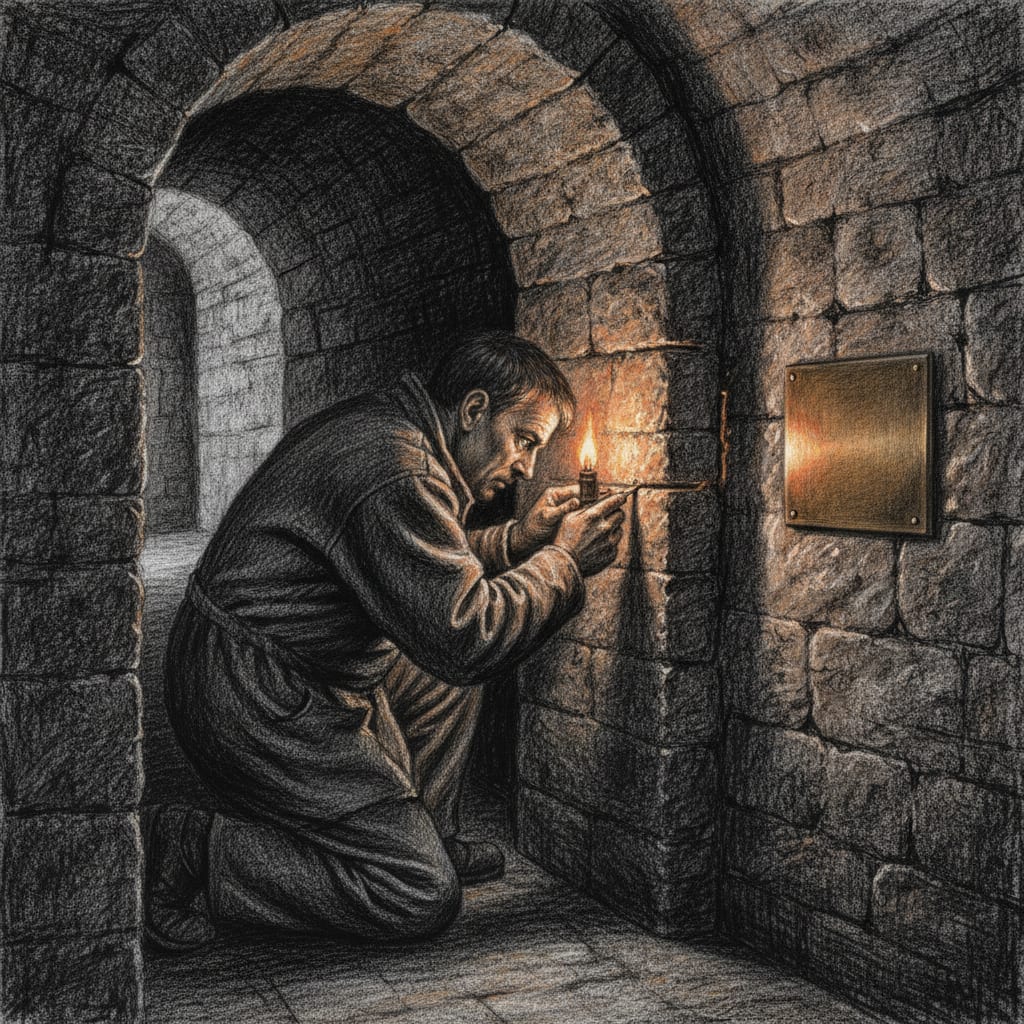
The Breath-Givers hold that the wall teaches nothing if the condemned dies too quickly for the lesson to circulate. A man who suffocates in three hours is a rumour. A man who moans for three days is a curriculum. The Breath-Givers cut mercy vents — thin, angled, invisible from the exterior, routed through the masonry with a skill that the Bureau of Engineering would admire if the Bureau of Engineering were permitted to acknowledge their existence. The cost of a breath-thread is considerable: salt, fuel chits, morphine, or — in the forward bastions — a forged "mercy clause" addendum to the writ, which requires the collaboration of a Trench-Court Clerk and a seal that costs more than a month's rations.
The Bureau does not officially acknowledge either faction. The Bureau officially acknowledges that all masons follow the Code, that all niches meet specification, and that deviation is punishable by — the Bureau pauses here, savouring the symmetry — immurement.
#On the Walls That Answer
The Demon-Listening Incidents of A.S. 158 changed the profession.
Prior to that year, immurement was understood as a one-directional sentence: the living entered the wall, and the wall remained silent. In the autumn of A.S. 158, three niches along the southern curtain of Bastion-Przemyśl began tapping. The rhythm matched the trench bell cadence — First Peal, Third Peal, Fifth Peal — with a precision that the Bureau of Bells confirmed was "metrically exact." The niches had been sealed between six and fourteen months prior. The condemned, by any medical standard, should have been silent for five and a half of those months at minimum.
The Bureau of Doctrine dispatched an assessor. The assessor's report is sealed. What is known: the binding-mix formula was revised within the month, adding compounds that the Bureau of Engineering classifies as "doctrinally specified mineral additives" and that the masons call "hush-powder." The tapping ceased. The niches were re-mortared. The assessor was reassigned to the Paper Mines of Ulm, which is where the Bureau sends people whose reports contain facts the Bureau has decided not to have learned.
A prior memorandum from this office stated that the Demon-Listening Incidents of A.S. 158 "involved auditory hallucination among front-line personnel, subsequently attributed to shell-concussion." This characterisation is withdrawn. The tapping was metrically exact. Hallucinations are not metrically exact. The revised binding-mix formula is classified under Seal Obsidian. This correction is noted without comment.
The Silence of Târgu (Unregistered) is older and worse. During a trench lull in A.S. 128, a Judge found an entire platoon guilty of "collective hesitation" — the crime of failing to advance when ordered, an offence the Bureau classifies as contagious cowardice. The Judge spoke one word. The platoon — thirty-one men — was immured into a single wall. The masons worked for nine hours. The wall is still standing. It is still known as the Murmur Line, because the muffled sounds lasted until the next bombardment, and because soldiers stationed nearby reported that the sounds were words, and because the words were the Creed, spoken in unison, and because unison prayer from inside a wall is, the Bureau has determined, a Category Two Spiritual Anomaly requiring quarterly inspection but no further action.
#On the Present Condition
The Masonry Corps is, by the Bureau's assessment, "operationally adequate." This phrase, as readers of the Bureau's correspondence will know, translates to a condition somewhere between functional and desperate. Lime shortages in the Carpathian corridor have forced masons in Zones 4 and 5 to substitute inferior compounds — mud-calcium blends that crack within months, producing niches that weep in wet weather and generate rumours that the condemned are crying. The rumours are, the Bureau insists, unfounded. The weeping is chemical. The mason's opinion — muttered over brine-washed hands, between shifts, where no clerk can hear — is that everything in a trench weeps eventually, and distinguishing the chemistry from the theology is a task he leaves to men with cleaner fingernails than his.
Immurement persists because nothing else combines deterrence, infrastructure, and doctrine into a single act. A niche is cheaper than a cell, more permanent than a hanging, more useful than a bullet hole. The wall holds the condemned. The condemned holds the wall. The plaque teaches the lesson. The lesson teaches the district. And somewhere in the masonry, behind the lime and the ash and the bone-dust and the hush-powder, something that was once a man contributes, at last, to the structural integrity of the Synod.
The mason washes his hands. The mason checks his plumb line. The mason recites his mix ratios like a prayer, because they are a prayer, because everything in this Theocracy is a prayer, because the alternative to prayer is silence, and silence — as the Murmur Line will attest — belongs to the walls.